I've probably planted what I'm going to now in the growing area this year. I've decided to leave the 'roots' bed fallow and have heavily mulched it with hay cut from the treefield pathways. I'll try and dig out the dock and nettles if they manage to grow through it this summer. The peas and beans are sprouting - rather small as yet. Again I'm going to leave the other half of the bed fallow now. Question is whether to chop and drop and mulch it so save the weeds getting too great a hold on it....
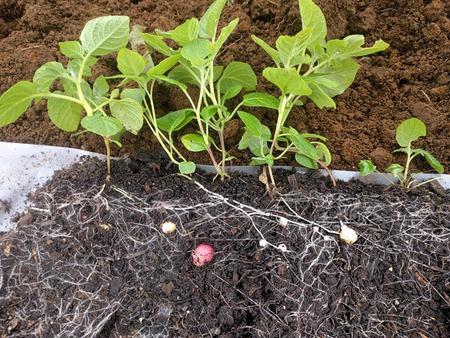
The poor little TPS seedlings have now been planted too. Most of them now had little tubers forming - both red, white and bicolour as far as I can tell. I did lose a few tubers as I removed them from the seed snail. I definitely think they could have been transplanted and planted out earlier, but "I'll be more organised next year".....maybe!
TPS seedlings ready to plant out
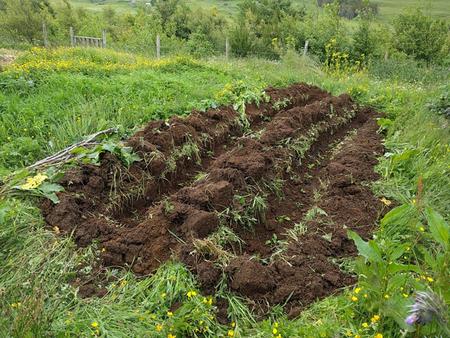
I did the same as last year and dug a very deep trench and put all my saved dog bones in it, then back filled a little and planted the seedlings in the trench. The rain came the following day, so I never watered them in. I rejected a few seedlings as being rather strange in growth habit, or with extremely long stolons. I'm wondering if I'll regret making the trenches so deep on this occasion. It will make earthing up awkward if I chose to do so as the plants are so tiny. However the main reason for earthing up (as I understand it) is to stop the tubers greening. As I won't be eating them this year, just selecting promising ones to grow on for next year, if they do go a bit green it won't matter. The trenches will protect the little plants from the wind a bit I hope which will help.
TPS in trenches
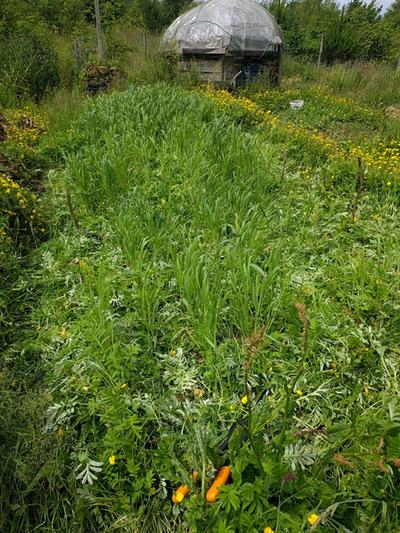
I did a little assessment of the growth of my barley for the trials people. It looks like the control variety may be a good variety for this area. It is shorter, greener and is tillering more. Of course the proof will be in the harvest and there are as yet no ears forming. The silverweed is growing rather enthusiatically in this bed, so I did a bit of chop and drop on half the bed so as to try and give the barley a bit of room. It will be interesting to see if it makes any difference to the growth and yield. My suspicion is that it won't - the silverweed leaves supports the barley stems, so I think by cutting them back (as well as getting some casualties!) I may get some more lodging where the stems fall over.
barley bed progress - chop and drop in foreground half
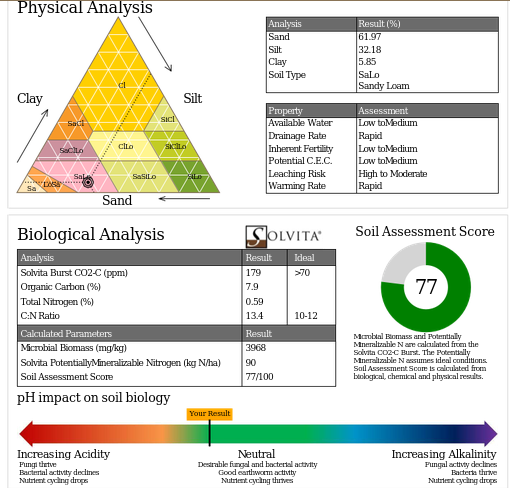
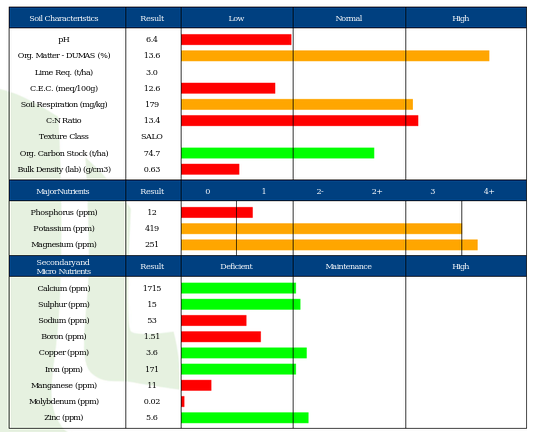
I reaped one result from the barley project already - they sent my soil results to me! Nice and comprehensive results and not quite what I was expecting. What I'm taking away from it at the moment is that my soil came back more sand and less silty than I expected, less acidic than I expected, higher in carbon, and OK in most nutrients except Phosphorus and some micronutrients. The biological activity level found was also gratifying (considering I still feel I've got way to go) I'll try and have another look with the microscope this summer.
physical and biological activity summary
nutrient analysis summary
These charts are the summaries from the report, which goes into a bit more detail. It sort of implies that the field hasn't been quite as defiled as I'd thought, or maybe that the soil was so peaty that there is still some organic residue left, or that I've managed to improve the soil more than I'd thought. I'm thinking that what I am doing - bringing in seaweed (for micronutrients) and bulky organic materials and charcoal (for CEC boosting) is still the right actions. It definitely looks more alive to me - the above ground animals appear more numerous, and the worms are more various and lively than the ones that were there before. So overall I'm quite pleased. I'm thinking it's a pity I don't have a 'before' test to reference against and wondering how expensive it would be to get a couple more samples tested in the same way - one from an undug area of the treefield which has just been allowed to recover by itself, and one from next door, which is still (appears to me) overgrazed by sheep.
All very exciting. What dear little potato plants. And, yes, a 'before' test would be interesting.
--
"Whitewashed Hope: A Message from 10+ Indigenous Leaders and Organizations"
https://www.culturalsurvival.org/news/whitewashed-hope-message-10-indigenous-leaders-and-organizations
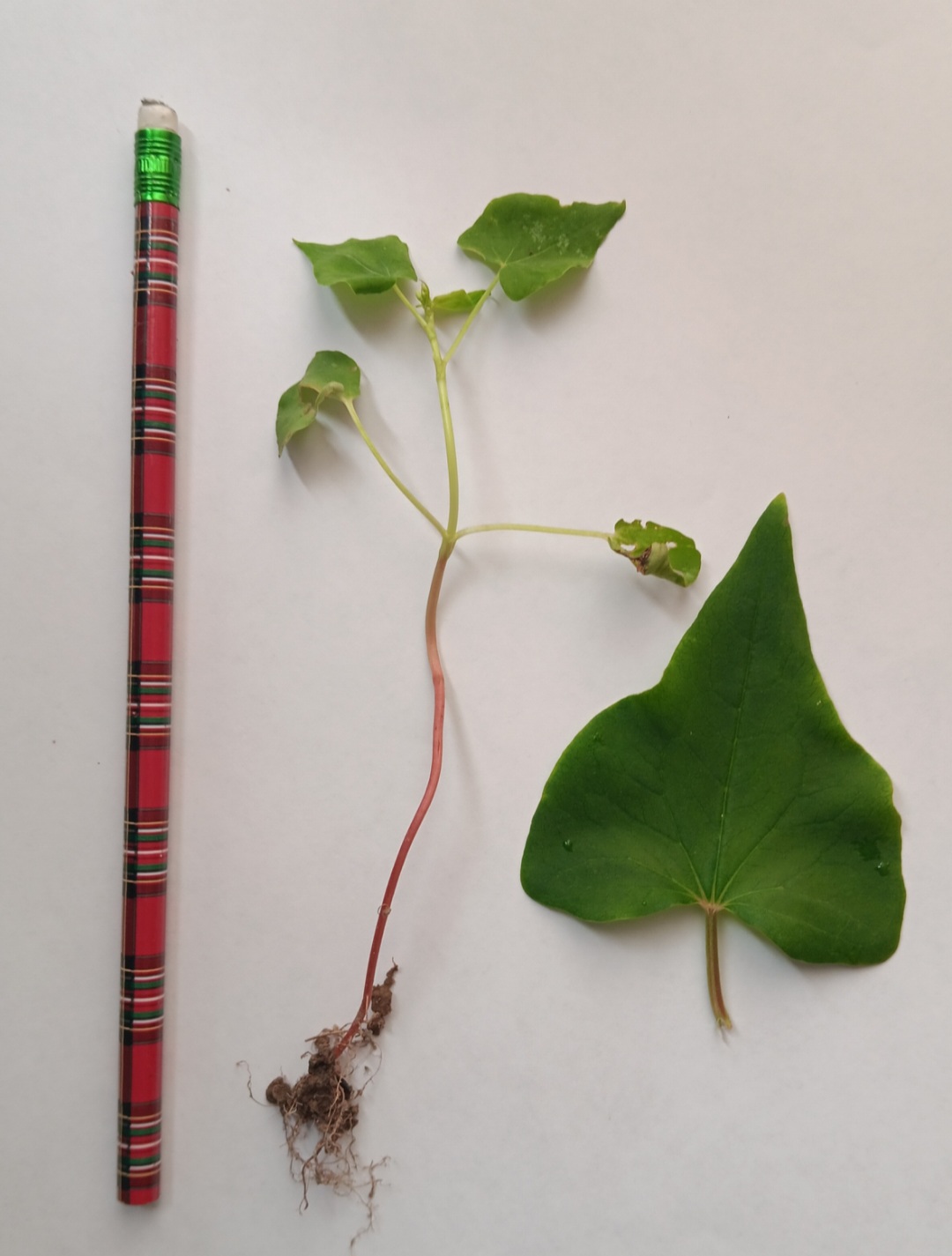
Nancy, it's interesting you get reading o molybdenum in the soil test. Here in US, molybdenum is usually not included since the level would be near the equipment detection limit. Midwest lab, Cornell, or multiple University extensions don't have the option. A few universities have offer tissue test with Mo as add-on. I feel it is something overlooked, maybe because of the survivor's bias, soils good enoughto support agriculture have sufficient molybdenumto begin with, and the removal is restored from treated seeds. My soil order is ultisol and your is histosol and they're both acid with low fertility. I probably went on organic gardening for 2 years and had to switch to regenerative mode with outside mineral input. As you see the Mo-deficient buckwheat is weak with small pale leaves and goes to flowering early. Other sensitive plant families from my experience included: legume, brassicas, mint and umbel. Sensitive plants can have reduced yield, low quality seeds or even die. Less sensitive plants also show lower stress resistance. If your soil Mo is so limiting as the test shows, harvesting lots of organic matter especially the seeds without returning humanure can deplete it quickly. Since you have access to sheep manure and seaweed, maybe you would be able to address the imbalance organically.
20260812.jpg
Mo deficient buckwheat setting terminal flower buds with 4 leaves vs healthy leaf
Zone 6, 45 inches precipitation, hard clay soil
Nancy Reading
steward and tree herder
Posts: 14676
Location: Isle of Skye, Scotland. Nearly 70 inches rain a year
It was a lovely soil test - quite expensive (£110 inc. VAT). You can get more basic ones, I'm not sure how often Molybdenum is included. Although I didn't pay for this one, I've splashed out and treated myself to the same again - once for the tree field adjacent to the growing area, and once for my new zone one kitchen garden which has been disappointing in survival and growth. The tree field one is as close as I can get to a starting reference (short of doing some digging in next door's field which is still sheep wrecked). The only changes I have made to it, is to let the grass grow and self mulch.
Yes, I'm hopeful that seaweed and bone char will help raise the element levels that I am short in. I don't know whether going higher in Potassium and magnesium is likely to be a problem?
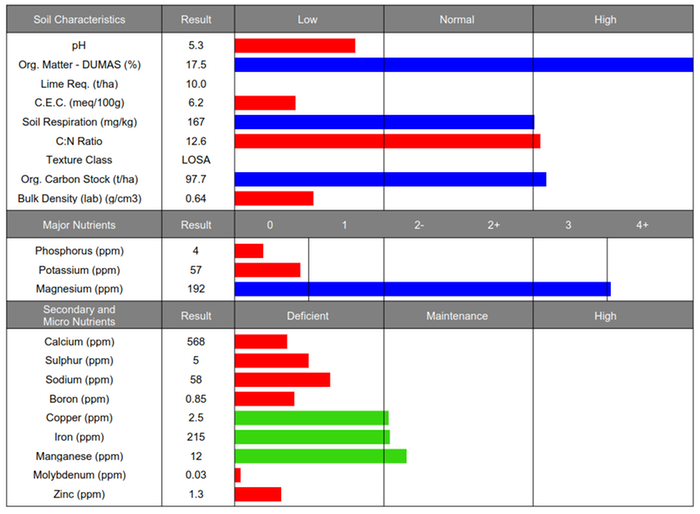
I've got the results from the extra soil analysis I had done:
So this is soil from an unimproved area of turf - amalgamated from several samples taken from outside the growing area, under the turf about 4 - 6 inches down.
I'm pretty pleased with myself overall. The amounts of many of the nutrients are much improved or even into the OK range. The pH, CEC are also much improved and the soil respiration (measure of soil micro-life) is also a bit better.
The samples aren't exactly like for like, as the sub soil was dug into my growing beds as I turned the soil over to get the greatest depth and relieve compaction. That probably has affected more than just the soil texture (increase in clay and silt) but without going back in time and doing an analysis at the start I can't prove how much my efforts have contributed. Some of the elements have reduced too - Iron, manganese molybdenum and sodium, although the iron is still in the acceptable range the others are low.
Still, I'm happy that I'm heading in the right direction and maybe will do another test in 5 years time....
More grass and bracken mulch, more seaweed, more wood ash, more bone char....
Those are interesting results. I always thought our areas seemed sort of similar in some way and think it’s by reason of the soil. I live in an inland hilly-mountain forested region and you are on some bare hills by the edge of the sea, many climate zones up from me, but we have a lot of the same weeds nevertheless. I did hear someone say that our parts of the world may have come from the same rock when the continents split.
Except here, we had an inland sea and even earlier things going on and significant amounts of calcareous rock, but this isn’t evenly distributed.
One can never be too kind to oneself or others.
Never our fault, always our responsibility
Nancy Reading
steward and tree herder
Posts: 14676
Location: Isle of Skye, Scotland. Nearly 70 inches rain a year
M Ljin wrote:I did hear someone say that our parts of the world may have come from the same rock when the continents split.
Except here, we had an inland sea and even earlier things going on and significant amounts of calcareous rock, but this isn’t evenly distributed.
Well I guess if you go down deep enough (and back far enough)! in my part of Skye the surface rock is igneous volcanic rock (basalt), but in other parts of Skye that is metamorphic or eroded away to the sandstone underneath (with fossils) or sedimentary rock from under the sea - including limestone - a fair variation in a smallish distance! I think since the volcano we have had a tropical climate, although we're a long way from having that now!
The soil tests have given me a greater appreciation of the history of the soil though and the damage probably caused by ploughing this soil. I believe the soil up in my zone one growing area was not ploughed to the same extent and the soil organic matter is 26.2% (see here) compared to 17.5% in the tree field - that's still fairly high, due to my cooler climate making degradation of organic material slower I suppose. It would probably have a tendency to form peat left to it's own devices! All very low in plant nutrients though, partly due to the compaction (low aeration for soil organisms) and partly due to the rain leaching soluble nutrients away.
That's an amazing difference in soil organic matter. My recollection is that each added 1% in soil organic matter - especially below a few inches soil depth, where evaporation is low - can increase water retention by the equivalent of up to an inch of rain.
That's less of an issue in your part of the world than mine at the moment, as I don't get anything like the rain & springs you get.
But it's an eye-opening exercise in how important good soil management techniques are!
--
"Whitewashed Hope: A Message from 10+ Indigenous Leaders and Organizations"
https://www.culturalsurvival.org/news/whitewashed-hope-message-10-indigenous-leaders-and-organizations
Always look on the bright side of life. At least this ad is really tiny:
a new overhaul of the freeheat page - need feedbacks for world domination






 9
9