gift
Rocket Mass Heater podcast gob
will be released to subscribers in: soon!
  • Post Reply Bookmark Topic Watch Topic
  • New Topic
permaculture forums growies critters building homesteading energy monies kitchen purity ungarbage community wilderness fiber arts art permaculture artisans regional education skip experiences global resources cider press projects digital market permies.com pie forums private forums all forums
this forum made possible by our volunteer staff, including ...
master stewards:
  • Carla Burke
  • John F Dean
  • Nancy Reading
  • r ransom
  • Jay Angler
  • Timothy Norton
stewards:
  • paul wheaton
  • Pearl Sutton
  • Anne Miller
master gardeners:
  • Christopher Weeks
  • M Ljin
gardeners:
  • Jim Garlits
  • thomas rubino
  • William Bronson

Tips for planting hardy kiwi Issai (Actinidia arguta)

 
pollinator
Posts: 405
Location: Central Texas
106
5
wheelbarrows and trailers foraging rocket stoves homestead ungarbage
  • Likes 6
  • Mark post as helpful
  • send pies
    Number of slices to send:
    Optional 'thank-you' note:
  • Quote
  • Report post to moderator
I'm in USDA zone 8b and am planning on transplanting kiwi Issai (Actinidia arguta)

These are very prolific berry sized kiwis and I'm wondering how sturdy of a trellis do I need to support these plants?

How long until they are hardy enough to survive the cold, 8b is probably pushing it a little.

I don't think my soil is very acidic, what amendments would you suggest for this plant?
 
pollinator
Posts: 241
65
  • Likes 5
  • Mark post as helpful
  • send pies
    Number of slices to send:
    Optional 'thank-you' note:
  • Quote
  • Report post to moderator
 8b is fine for cold hardy kiwi. A freeze after bud break in spring can cause a little damage, not too bad.   You will need a stout trellis.  I used cattle panels. these put on a LOT of foliage.
Do not fertilize the plants much, just a little compost is good for massive crops. I would test your soil PH.   Mine is slightly acidic, kiwi just don't like alkaline soil.
prune them back every winter to a few buds on each spur like you do with muscadine grapes.
 
steward
Posts: 2890
Location: Zone 7b/8a Southeast US
1129
4
forest garden fish trees foraging earthworks food preservation cooking bee woodworking homestead ungarbage
  • Mark post as helpful
  • send pies
    Number of slices to send:
    Optional 'thank-you' note:
  • Quote
  • Report post to moderator
My hardy kiwis have seemed to really like well draining soil, and didn't care for soil that stayed too wet for very long.

I haven't grown the variety Issai, but I've heard that it is a little more less vigorous/dwarf than most other hardy kiwis.

I'm experimenting with growing them up trees as a trellis, still in the early phases of experimentation.
 
master steward
Posts: 15865
Location: Pacific Wet Coast
10304
duck books chicken cooking food preservation ungarbage
  • Likes 3
  • Mark post as helpful
  • send pies
    Number of slices to send:
    Optional 'thank-you' note:
  • Quote
  • Report post to moderator

Steve Thorn wrote:My hardy kiwis have seemed to really like well draining soil, and didn't care for soil that stayed too wet for very long.


Does anyone know of people growing them in the Pacific Northwest where it's wet all winter?

Suggestions for that ecosystem?

How much/ how often will it need water in the summer drought?
 
pollinator
Posts: 318
Location: Oregon Coast Range Zone 8A
91
art purity forest garden fungi foraging trees books cooking bee medical herbs seed
  • Likes 5
  • Mark post as helpful
  • send pies
    Number of slices to send:
    Optional 'thank-you' note:
  • Quote
  • Report post to moderator
I live in the Coast Range where it's wet all winter (usually) and bone dry all summer (usually). I've grown Issai hardy kiwi for many years in 20 gallon pots in high quality potting soil. I usually water them once a day in the summer, but during nasty heat waves I water them twice a day. Plants in the ground will probably need watered every two days in the summer. I fertilize the plants several times a year with a little tiny bit of side dressing, usually bone meal or chicken manure. I propagate them using the layering method in pots.

They should do great in your area, just add compost to the soil before planting or grow them in big pots in high quality potting soil.

The main thing I've noticed for hardy kiwis is that they do NOT like hot sunny weather (like me) and will require shade during the afternoon during the summer. If transplanted into full  sun, their leaves can get fried during a sudden heat wave. Also, they need a trellis- I use an old swing set with wire fence pieces hooked over the top, also t-posts with wire. Cattle panels or concrete wire will work well, too. Fuzzy kiwis require bigger trellises, but can take more sun. Another thing- wait till fall or late winter/early spring to transplant your kiwis. Good luck!

 
Jay Angler
master steward
Posts: 15865
Location: Pacific Wet Coast
10304
duck books chicken cooking food preservation ungarbage
  • Likes 3
  • Mark post as helpful
  • send pies
    Number of slices to send:
    Optional 'thank-you' note:
  • Quote
  • Report post to moderator
Any idea if they would tolerate being under the drip line of cedar? Hard to get away from cedar on my land, if I want afternoon shade.
 
M.K. Dorje Sr.
pollinator
Posts: 318
Location: Oregon Coast Range Zone 8A
91
art purity forest garden fungi foraging trees books cooking bee medical herbs seed
  • Likes 2
  • Mark post as helpful
  • send pies
    Number of slices to send:
    Optional 'thank-you' note:
  • Quote
  • Report post to moderator
My experience with cedars (Incense and Western red cedar) is that many plants don't like being planted in the root zones of these trees because of the chemical compounds in their roots inhibit the growth of many other plants, sort of like black walnut trees. (Western red cedars are also an alternate host for cedar apple rust, but that's a different story.)

I'm not sure, but my gut feeling would be that the kiwis would not like being transplanted into the established root zone of a cedar, so I would transplant your Issai kiwi into a big pot with premium organic potting soil- 10- 20 gallon size. Issai is especially well adapted to being grown in big pots. An added bonus is that you can move the plant around if it needs more light or more shade. My kiwis are under a crab apple and old swing set. Observe the kiwi  carefully during heat waves for signs of stress. Mulch with compost and/or chicken poop. Hand pollinate the flowers with a paint brush the first few years, because our local bees are unfamiliar with the flowers and it takes a while for them to figure them out.

By the way, the fruit on Issai kiwis is incredibly delicious and is one of my all time favorites- well worth growing.
 
  • Likes 5
  • Mark post as helpful
  • send pies
    Number of slices to send:
    Optional 'thank-you' note:
  • Quote
  • Report post to moderator
I doubt that the cold will be a problem as such. (Though what might be a problem is if you have alternating warm and cold periods in the spring.) Actinidia arguta, including the Issai cultivar, survive just fine in Southern Finland (though the growing season tends to be too short so that many years the fruit does not ripen before the frosts). I had one in my garden when I was living in Helsinki (I guess in USDA zone classification that would be something like 5b, though of course that only considers the coldest temperatures, many plants that originate from continental climates with cold winters but also long, warm summers won't do well here or fail to bear fruit because the low growing degree days sum). If there is any problem with Actinidia arguta, though, you can switch to Actinidia kolomikta that also makes mini-kiwis and that survives cold temperatures (and shorter summers) much better. I have several growing even here in Lapua, Finland, where they survive just barely, but they do survive (not all cultivars, though). (The location is roughly 200 km north compared to Anchorage, Alaska, but thanks to Gulf Stream the mean temperature every month throughout the year is about one degree centigrade warmer than Anchorage.)
 
Jay Angler
master steward
Posts: 15865
Location: Pacific Wet Coast
10304
duck books chicken cooking food preservation ungarbage
  • Likes 4
  • Mark post as helpful
  • send pies
    Number of slices to send:
    Optional 'thank-you' note:
  • Quote
  • Report post to moderator
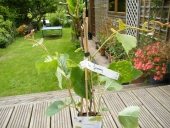
A friend of mine sent me a divided piece of his Hardy Kiwi. Due to "reasons" (deer being a big one) I had to plant it in a large tree pot.

I put a few bean seeds around it for nitrogen fixing and company, and they are doing OK.

However, Kiwi isn't happy.


I think I'm giving it enough water. I hope I'm not letting it stay too wet.

I'm wondering if it's getting too much afternoon sun, although I was told by its donor that it liked sun. I was hoping the beans leaves would shade it a little, but maybe not enough?

If you look at the picture carefully, it has fruit forming. It bloomed profusely earlier.

Ideas anyone?
 
pollinator
Posts: 322
Location: UK
106
kids urban seed
  • Likes 7
  • Mark post as helpful
  • send pies
    Number of slices to send:
    Optional 'thank-you' note:
  • Quote
  • Report post to moderator
Jay, mine struggled in a pot the first summer too. They really resent being root-bound and the foliage gives up before the roots do. If you can, pot it up into something bigger with good drainage and give it morning sun only for a couple of weeks. Afternoon heat on a small container just cooks the roots. Once it settles in they're surprisingly tough plants but that first season in a pot is always rough.
 
Jay Angler
master steward
Posts: 15865
Location: Pacific Wet Coast
10304
duck books chicken cooking food preservation ungarbage
  • Likes 5
  • Mark post as helpful
  • send pies
    Number of slices to send:
    Optional 'thank-you' note:
  • Quote
  • Report post to moderator

Joao Winckler wrote:... They really resent being root-bound and the foliage gives up before the roots do. If you can, pot it up into something bigger with good drainage and give it morning sun only for a couple of weeks.


It's in a tree pot, and the only thing bigger I've got would be a half barrel. Changing pots during our drought season could make it worse, so I will see what I can do to get it to hang on until the fall.

Joao Winckler wrote: Afternoon heat on a small container just cooks the roots.


The pot is shaded by other pots, but maybe I can find a way to give the pot even more shade.

It is very hard in my ecosystem to hit the balance between "enough water" and "dead".  If it needs to dry out better between watering, I may be able to improve that and not have it die.

Ultimately, it needs a forever home, but that will be late fall at the earliest, due to our weather patterns.
 
Rusticator
Posts: 9879
Location: Missouri Ozarks
5462
7
personal care gear foraging hunting rabbit chicken cooking food preservation fiber arts medical herbs homestead
  • Likes 5
  • Mark post as helpful
  • send pies
    Number of slices to send:
    Optional 'thank-you' note:
  • Quote
  • Report post to moderator
I just got 4 tiny hardy kiwi berry bare-root plants in today's mail. I'm debating where to put them. It's hot out. It's going to get hotter... should I put them into bigger-ish pots, and keep them in the shade for now, to plant in a sunny spot, in autumn, after it cools down? I have no means of temporarily shading them, once they're in the ground, permanently they need sun, for growth & fruiting, right?
 
Posts: 45
22
  • Likes 8
  • Mark post as helpful
  • send pies
    Number of slices to send:
    Optional 'thank-you' note:
  • Quote
  • Report post to moderator
I tried and failed with hardy kiwis a couple of times before winning this year (so far).

My mistakes:

1) Too much sun for young plants - scorched 'em. They're kinda like pawpaws, where you want them in the shade for the first year, and shade on their roots pretty much always, but they like lots of sun afterwards.

2) Sandy soil - Yes, they hate getting waterlogged, but I planted some in an area of my yarden that started as almost entirely sand. It dried too quickly, and the roots didn't like being dry in July, savvy?

3) Heavily alkaline soils - they don't like alkalinity, and had chlorosis and were way more susceptible to herbivorous insects.

My solutions:

1) I have a trellis (chainlink fence+add-ons) running along the back of my property that has the root zone + up to 4' of shade through most of the day in the 1/3 of the trellis area that I planted my specimens in. This gives them some good sun, enough to grow, but protects them from scalding and wilting while they're getting established.

2) I planted them in some of my best soil. It's rich, full of organic matter, and is tilthy and worm-rich. It keeps consistent moisture but doesn't get waterlogged.

3) The improved soil they're planted in helps, because it's neutral pH, but I also planted with elemental sulphur, and I add a little elemental sulphur to my system each year where I've got fruit that prefers something slightly acidic. I've avoided acid lovers (like blueberries, for now, though I'll container those buddies) because you can't shift pH very much in my soils due to a massive bicarbonate reserve, but the sulphur feeds the microbes which create acidic conditions locally, and roots only care about the pH of the soil they're touching. Additionally, the byproduct of sulphur consumption by the microbes is gypsum, water and oxygen. The gypsum helps with soil structure.

Anyway, tangents aside, you might need to figure out what works locally with a couple sacrifices. Hopefully not, but it's worth considering that hardy kiwis are persnickety while they're getting established, and you probably need to over plant to compensate for losses and then thin in the second or third year (or later, if you want to see which ones fruit better).
 
gardener
Posts: 3823
Location: Western Slope Colorado.
957
5
goat dog food preservation medical herbs solar greening the desert
  • Likes 5
  • Mark post as helpful
  • send pies
    Number of slices to send:
    Optional 'thank-you' note:
  • Quote
  • Report post to moderator
Is your climate pretty similar to Olympia Washington?  There are too many details to explain how I was in the situation, but I once had lunch in Olympia.  It included locally grown (in someone’s back yard) hardy kiwi, a gift to the hostess from a friend.
 
Jay Angler
master steward
Posts: 15865
Location: Pacific Wet Coast
10304
duck books chicken cooking food preservation ungarbage
  • Likes 4
  • Mark post as helpful
  • send pies
    Number of slices to send:
    Optional 'thank-you' note:
  • Quote
  • Report post to moderator

Chance Lunceford wrote: 3) Heavily alkaline soils - they don't like alkalinity, and had chlorosis and were way more susceptible to herbivorous insects.


We tend to run on the acid soil, but the only way I can water is with our deep, calcium rich well water. I think that's what did in my blueberries when I tried growing them. I'm thinking I will try putting some Fir needles on top as mulch, but maybe even more, put some Fir needles in a bucket, fill with well water, and let it sit a couple of days and then be watering from that bucket?

The plant looks to be a good colour and I haven't noticed an insect problem, so I'm thinking it's a sun problem mostly. I had already started some beans around it, and I'm trying to make sure they shade it, but our UV index has been in the "high" range regularly, and there's only so much I can do quickly.

The "well draining" is always an issue - we go from too wet to too dry with very little time in between. I am thinking that before the winter storms come I will need to have it covered somehow. I recall that the fellow who sent the plant to me sounds like he had it partly protected by the overhang of his house, so that also may be a factor I have to consider.

Thanks, Chance, for describing your experience with the plant so well. It gives me some directions I could experiment with.
 
Chance Lunceford
Posts: 45
22
  • Likes 3
  • Mark post as helpful
  • send pies
    Number of slices to send:
    Optional 'thank-you' note:
  • Quote
  • Report post to moderator

Jay Angler wrote:

Chance Lunceford wrote: 3) Heavily alkaline soils - they don't like alkalinity, and had chlorosis and were way more susceptible to herbivorous insects.


We tend to run on the acid soil, but the only way I can water is with our deep, calcium rich well water. I think that's what did in my blueberries when I tried growing them. I'm thinking I will try putting some Fir needles on top as mulch, but maybe even more, put some Fir needles in a bucket, fill with well water, and let it sit a couple of days and then be watering from that bucket?

The plant looks to be a good colour and I haven't noticed an insect problem, so I'm thinking it's a sun problem mostly. I had already started some beans around it, and I'm trying to make sure they shade it, but our UV index has been in the "high" range regularly, and there's only so much I can do quickly.

The "well draining" is always an issue - we go from too wet to too dry with very little time in between. I am thinking that before the winter storms come I will need to have it covered somehow. I recall that the fellow who sent the plant to me sounds like he had it partly protected by the overhang of his house, so that also may be a factor I have to consider.

Thanks, Chance, for describing your experience with the plant so well. It gives me some directions I could experiment with.


For what it's worth, I have found the addition of char and clinoptilolite have greatly improved the water retention in my soil without allowing it to waterlogged.
 
Carla Burke
Rusticator
Posts: 9879
Location: Missouri Ozarks
5462
7
personal care gear foraging hunting rabbit chicken cooking food preservation fiber arts medical herbs homestead
  • Likes 5
  • Mark post as helpful
  • send pies
    Number of slices to send:
    Optional 'thank-you' note:
  • Quote
  • Report post to moderator
Thank you, all. I put them in a pot, in indirect sun, on Thursday. It was a busy weekend for me, and I  still haven't had a chance to go out and check on them. I hope they've survived the unintentional neglect. The timing of their shipment wasn't mine...
 
Posts: 778
Location: Iqaluit, Nunavut zone 0 / Mont Sainte-Marie, QC zone 4a
154
3
  • Likes 2
  • Mark post as helpful
  • send pies
    Number of slices to send:
    Optional 'thank-you' note:
  • Quote
  • Report post to moderator

Carla Burke wrote:I just got 4 tiny hardy kiwi berry bare-root plants in today's mail. I'm debating where to put them. It's hot out. It's going to get hotter... should I put them into bigger-ish pots, and keep them in the shade for now, to plant in a sunny spot, in autumn, after it cools down? I have no means of temporarily shading them, once they're in the ground, permanently they need sun, for growth & fruiting, right?


I've had some success with these requirements by planting behind on the north side of a crescent shaped compost hill of 18" high on contour around the drip line of my red pine. By tucking them into the bottom on the north side, they get some protection while young, but benefit from all the moisture and nutrients in the compost hill. I've done this with swiss chard and bare rose prunings and then abandoned them to the drought a couple of summers ago while I went up north and everything survived with no watering.

As for providing some shade, I have used roadside parasols that have seen better days to protect transplanted wild leeks and they all survive this way, ditto for hydrangea transplants onto little more than gravel.

Edit: I guess I should mention the idea of planting along the drip line is because that area gets more rainwater.

I hope this helps
 
Carla Burke
Rusticator
Posts: 9879
Location: Missouri Ozarks
5462
7
personal care gear foraging hunting rabbit chicken cooking food preservation fiber arts medical herbs homestead
  • Likes 1
  • Mark post as helpful
  • send pies
    Number of slices to send:
    Optional 'thank-you' note:
  • Quote
  • Report post to moderator
Thank you, RA. I'll have to mull that over and see if I can find a way to do that, here. Our land is pretty much all steeply downhill from north to south, so everything north of anything also means uphill from it.... It will require some careful thought, but since they're in pots now, that buys me a bit more time.
 
Ra Kenworth
Posts: 778
Location: Iqaluit, Nunavut zone 0 / Mont Sainte-Marie, QC zone 4a
154
3
  • Likes 3
  • Mark post as helpful
  • send pies
    Number of slices to send:
    Optional 'thank-you' note:
  • Quote
  • Report post to moderator
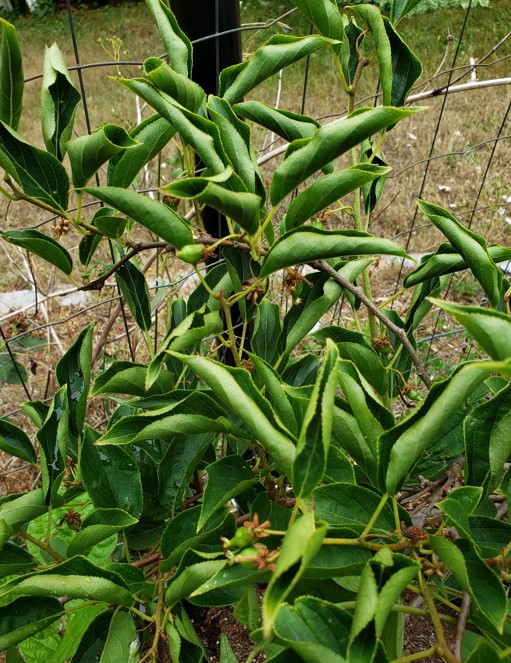
Yes I saw that Clara that you had potted, but if any of them look desperate, and look like those poor curled leaf kiwis, you could try a crescent shaped hill and give it a go! In fact if your land is all that way, I imagine little crescents all over your property around the south sides of your drip lines !

Quick and dirty way of cover cropping those hills to hold down the dirt is transplanting not so obnoxious weeds -- in my case I was given a large quantity of expired turnip seeds so I am eating turnip sprouts and holding up hills with them! Radish, carrots, parsley, and wild carrots are candidates for this approach.
 
pollinator
Posts: 217
78
  • Likes 3
  • Mark post as helpful
  • send pies
    Number of slices to send:
    Optional 'thank-you' note:
  • Quote
  • Report post to moderator

Jay Angler wrote:  the only way I can water is with our deep, calcium rich well water. I think that's what did in my blueberries when I tried growing them. I'm thinking I will try putting some Fir needles on top as mulch, but maybe even more, put some Fir needles in a bucket, fill with well water, and let it sit a couple of days and then be watering from that bucket?


Hi Jay
FYI
We have the same issue as you, with acidic soil, and calcium-rich deep well water. Our water is even pH 7, due to minerals like manganese, but it STILL is a problem for plants that don’t like alkalinity.

Same as you wondered about:
we tried pine and fir needle mulches around blueberries and huckleberries. We even added acetic acid (compounds produced by fermentation anyway) to our watering of these plants and tested the water pH so it was Exactly 6.0-6.5. And it still didn’t work.
We concluded Acidic plants just plain ol’ need acidic conditions. We found the watering water to be really significant.
 
Thekla McDaniels
gardener
Posts: 3823
Location: Western Slope Colorado.
957
5
goat dog food preservation medical herbs solar greening the desert
  • Likes 4
  • Mark post as helpful
  • send pies
    Number of slices to send:
    Optional 'thank-you' note:
  • Quote
  • Report post to moderator
Any chance you could store rainwater just for watering your acid loving kiwis (and blueberries if you try them again)?

I used to live in a region with calcium and other minerals in the deep well water… and there was no other water.   When we boiled water to make tea, a lot of minerals precipitated out.  There was sediment on the bottom and deposits on the inside of the stainless steel pan.  I never checked the pH after boiling the water, so I don’t know if it changed.

I don’t know how much water your kiwis will need, maybe more than you can boil cool and filter… but it might get you by in a pinch!
 
If you send it by car it's a shipment, but if by ship it's cargo. This tiny ad told me:
Gardening and natural building at a delightful pace
https://wheaton-labs.com/bootcamp
reply
    Bookmark Topic Watch Topic
  • New Topic