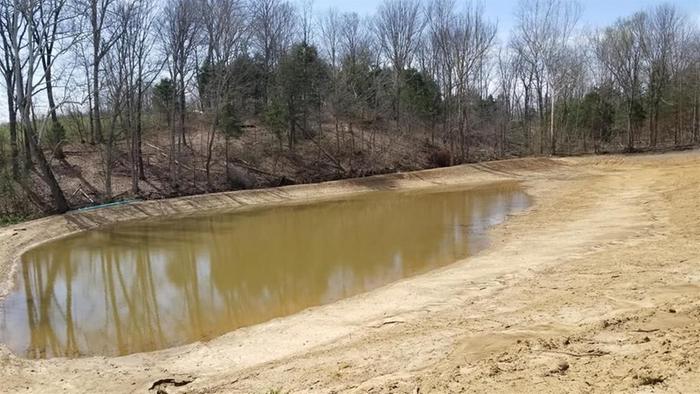
We just bought a property that looks like someone dug a big ol hole in our (lots of) clay lot, alongside our tiny spring creek, in an area with lots of rocks and sandy clay, and things don't seem to want to grow there.
Now, honestly, I have no flippin idea when they dug it, or how long it's been there, but it's there and it's one of the most unnatural things I've ever seen.
I'm happy to have it. Don't get me wrong...
I just have no idea where to start with it. It needs shade somewhere, for starters, right?
PS: if anyone can give me any pointers on how to search engine this info without having to wade through pages of plastic koi pond advice, I would greatly appreciate it!
It looks like its been built to actually hold water that may run off the bare clay.
If it was a catchment dam I believe it would be deeper.
Could it have been a clay pit?
I agree with John. Depending on how long it's been there, it may have filled somewhat with silt. Regarding depth, I just watch Geoff Lawton's PDC video on landscape water catchment, and picked up that a 2-metre depth is perfect for aquaculture. Not sure how helpful that tidbit is, but I had to mention it because I just learned it!
If you let animals into that depression it will be filled in by the action of the stock and their feet.
Its important to keep stock away from dams, ponds etc.
Fencing is needed, with a separate water supply made availBLE.
John C Daley wrote:
If it was a catchment dam I believe it would be deeper.
Could it have been a clay pit?
There's a point at the far end of this photo where I believe it was meant to connect with the spring/creek, and be fed by it, but then that little gulley didn't win out for which direction the spring wanted to go. I think maybe in heavy rain, the pond is fed by this spring. When it's heavy enough, the spring jumps its banks, and feeds the pond.
Anne Miller wrote:I agree with John as I can see its purpose. To me, this is a great example of a "swale".
I understand that this looks unnatural because nothing is growing there. Unfortunately, it will take some work to make it better.
All along the edge built up as that swale is the spring creek. It's weird, and I don't understand it. They did not want water running off into the creek?
As for work, I am so excited to get started! I'm so grateful for all of you all and the links you're dropping
John C Daley wrote:If you let animals into that depression it will be filled in by the action of the stock and their feet.
Its important to keep stock away from dams, ponds etc.
I'm imagining how that could happen, while knowing that the pond is on one side of the dam, but along that side, there runs a spring fed creek. I could probably water them.in that, further up the creek just fine.
Really, I think I wanted this pond more for fish and ducks one day.
But that's a useful warning
Thanks!
Jennie Sue Dean wrote:Is it beneficial to be filled with silt?
In the video, Geoff mentions installing silt traps where water enters the pond. He didn't explain how to make them, however. Someone with more experience can probably answer your question better, but I think the problem with silt is that, eventually, it will re-fill and obliterate the pond.
Highly recommend you come up with an alternate way to water any livestock. There were cattle run on our land prior to us acquiring it, and the dam on our big pond is rutted and heavily eroded because of the cattle. The rocks stick up so high that they scrape the underside of our side by side when we drive over. It can't be mowed and the only way to keep the grass down is either weedwack it or introduce sheep or something to eat it (which will theoretically make the issue even worse) til we have some heavy equipment come in and move some additional fill on top of the dam to even it off.
I think it's beautiful. I would leave it alone. Native plants will grow in on their own if you leave it alone and it will end up with loads of small creatures living there.
I don't know where you are but in our area you have to get a permit to build a dam to make a pond, that permit will tell you who built the pond, what their intentions were for building it, and how they wanted to operate it. You can go from there.
If no permits are required in your area then do whatever you think makes sense. Your picture shows what appears to be a muddy puddle with the potential to be a useful good sized pond.
Post by:autobot
We're being followed by intergalactic spies! Quick! Take this tiny ad!
100th Issue of Permaculture Magazine - now FREE for a while