|

|

|

|

|

|
|
|
|
|
|
|
|

|

|

|

|

|
 7
7


 4
4
![[Thumbnail for NewBattonPump.jpg]](/t/274663/a/295373/NewBattonPump.jpg "Filename: NewBattonPump.jpg
Description:")
“The most important decision we make is whether we believe we live in a friendly or hostile universe.”― Albert Einstein
5
5
![[Thumbnail for 1000015522.jpg]](/t/274663/a/298405/1000015522.jpg "Filename: 1000015522.jpg
Description:")
![[Thumbnail for 1000015524.jpg]](/t/274663/a/298406/1000015524.jpg "Filename: 1000015524.jpg
Description:") 7
6
7
7
6
7
M Pearson wrote:They sell these chargers that go from your vehicle battery through the firewall (or underneath if you have a truck and are going to the bed). Mine charges up to 500W but that's also limited by the controller in my power station. It's pretty sweet because 2h of driving will charge 1kWh. They now sell ones with higher capacity too, I'm not sure what the maximum draw on a car battery would be.
If you take this thing on road trips a lot, I'd recommend it. $200 on Amazon or so I think.
Do you have a thread or video on how you built the battery box? That sounds interesting.
![[Thumbnail for 1000015519.jpg]](/t/274663/a/298444/1000015519.jpg "Filename: 1000015519.jpg
Description:") 6
6
“The most important decision we make is whether we believe we live in a friendly or hostile universe.”― Albert Einstein
6
5
Allen Jackson wrote:....
At least for a 12 Vdc LiFePO4 system, the stock alternator output voltage is high enough to charge the batteries, so as long as the BMS is configured for such, it will charge without blowing a fuse or tripping a breaker.
“The most important decision we make is whether we believe we live in a friendly or hostile universe.”― Albert Einstein
6
6
![[Thumbnail for signal-2026-10-15-22-00-32-890.jpg]](/t/274663/a/298494/signal-2026-10-15-22-00-32-890.jpg "Filename: signal-2026-10-15-22-00-32-890.jpg
Description:")
![[Thumbnail for signal-2026-10-15-22-00-32-890-1.jpg]](/t/274663/a/298495/signal-2026-10-15-22-00-32-890-1.jpg "Filename: signal-2026-10-15-22-00-32-890-1.jpg
Description:")
![[Thumbnail for signal-2026-10-15-22-00-32-890-3.jpg]](/t/274663/a/298496/signal-2026-10-15-22-00-32-890-3.jpg "Filename: signal-2026-10-15-22-00-32-890-3.jpg
Description:") 6
6
“The most important decision we make is whether we believe we live in a friendly or hostile universe.”― Albert Einstein
4
M Pearson wrote:Do you have a thread or video on how you built the battery box? That sounds interesting.
John Weiland wrote:Although it's rather the wrong time of year for the following suggestion, are you using the roof rack of your minivan while traveling? In a pinch, would strapping down two of your solar panels on that roof supplement in any significant way the trickle charging from your vehicle alternator....during mid-summer of course with the longer days? I realize this could cause too much drag on the car, but perhaps with some sort of roof spoiler to reduce friction? So nice to see the utility of even these small battery set-ups, the recharging diversity that one can implement, and the utility of the bluetooth monitoring of it all.
Edit for additional tangential question: Will sodium ion battery cells require a BMS purchase specific for that chemistry or will the same BMS's sold for LiFePO4 be usable for sodium ion? I could see where it might just be a matter of tweaking the parameters controlled by the BMS to allow its use with that chemistry, due to the different discharge curve and perhaps other idiosyncracies of those cells but don't know for sure. Just looking ahead to potential future builds..... Thanks!
5
![[Thumbnail for signal-2026-10-18-09-35-08-712.jpg]](/t/274663/a/298769/signal-2026-10-18-09-35-08-712.jpg "Filename: signal-2026-10-18-09-35-08-712.jpg
Description:")
![[Thumbnail for 20261018_093128.jpg]](/t/274663/a/298770/20261018_093128.jpg "Filename: 20261018_093128.jpg
Description:") 5
6
5
6
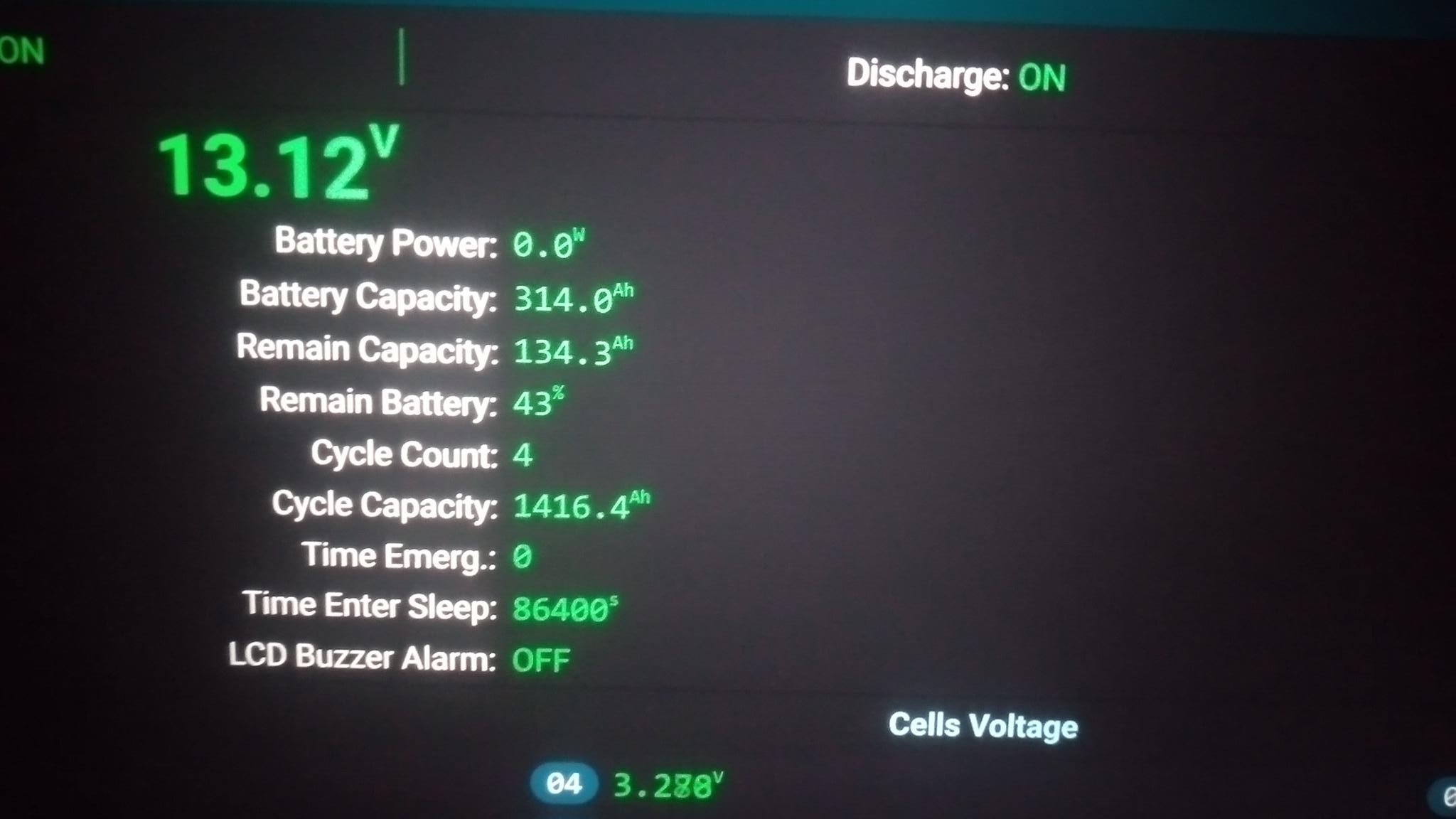
Allen Jackson wrote:We made it home safely and there's 55% capacity left in the battery. We won't even unload the van tonight, and just let it run until morning
“The most important decision we make is whether we believe we live in a friendly or hostile universe.”― Albert Einstein
4
3

|
You've gotta fight it! Don't give in! Read this tiny ad:
grow your own garden and build your own home in the gardening gardeners program
https://wheaton-labs.com/bootcamp
|