• Post Reply Bookmark Topic Watch Topic
  • New Topic
permaculture forums growies critters building homesteading energy monies kitchen purity ungarbage community wilderness fiber arts art permaculture artisans regional education skip experiences global resources cider press projects digital market permies.com pie forums private forums all forums
this forum made possible by our volunteer staff, including ...
master stewards:
  • Carla Burke
  • Nancy Reading
  • r ransom
  • John F Dean
  • paul wheaton
  • Jay Angler
stewards:
  • Timothy Norton
  • Pearl Sutton
  • Tereza Okava
master gardeners:
  • Christopher Weeks
  • M Ljin
gardeners:
  • Jeremy VanGelder
  • Matt McSpadden
  • thomas rubino

Favorite Elderberry Cultivars?

 
Steward of piddlers
Posts: 7377
Location: Upstate New York, Zone 5b, 43 inch Avg. Rainfall
4028
monies home care dog fungi trees chicken food preservation cooking building composting homestead
  • Likes 9
  • Mark post as helpful
  • send pies
    Number of slices to send:
    Optional 'thank-you' note:
  • Quote
  • Report post to moderator
I have recently made the decision to get some elderberry shrubs for my property and have realized that an elderberry is not just an elderberry.

There seems to be a variety of cultivars that have been in production for many years out there. I have recently got my hands on an 'Adams' American Elderberry and have been looking for another type to help with pollination.

I have seen 'Adams', 'Bob Gordon', 'Whyldewood', 'Nova', 'Scotia', 'Johns', 'York', 'Ranch', 'Kent' and many many more. That is just for American Elderberry!

My question is, what are your favorite elderberry cultivars? Why?
 
gardener
Posts: 3138
Location: Central Maine (Zone 5a)
1685
homeschooling kids trees chicken food preservation building woodworking homestead
  • Likes 10
  • Mark post as helpful
  • send pies
    Number of slices to send:
    Optional 'thank-you' note:
  • Quote
  • Report post to moderator
I don't have a favorite, as I have only ever grown an unknown variety. But I am very interested in the answer. I did read about one variety that was supposed to stay more upright like a hedge, rather than round like a bush. And it was used in larger operations in rows and could be mowed down at the end of the year, and it would grow and produce berries the next. I can't remember the name though.

I did find this article which has some good info on varieties. https://shop.farmoncentral.com/blogs/around-the-farm/which-elderberry-should-i-grow
 
Timothy Norton
Steward of piddlers
Posts: 7377
Location: Upstate New York, Zone 5b, 43 inch Avg. Rainfall
4028
monies home care dog fungi trees chicken food preservation cooking building composting homestead
  • Likes 3
  • Mark post as helpful
  • send pies
    Number of slices to send:
    Optional 'thank-you' note:
  • Quote
  • Report post to moderator
Overview on the "Adams" Elderberry

The "Adams" cultivar is a well known variety that produces sizeable berries and tolerates the cold quite well. It is stated that the cultivar is the result of a 1920s breeding project that happened in New York State.

Height: 6'-12'
Width: 6'-10'
USDA Zone: 3-9
Light Needs: Full to partial shade


pollinator
Posts: 468
Location: zone 5-5
163
  • Likes 6
  • Mark post as helpful
  • send pies
    Number of slices to send:
    Optional 'thank-you' note:
  • Quote
  • Report post to moderator
My Adams and York both get dark along the edges and die.
I got some mystery cuttings from a guy last year and they are doing well.

Got some Bob Gordons this spring and they seem to be doing well.
The farmer that I got Bobs from said they were his favorite.
Kinda scowled at the Yorks and Adams, which have been doing a good job of dying at my place.
 
Timothy Norton
Steward of piddlers
Posts: 7377
Location: Upstate New York, Zone 5b, 43 inch Avg. Rainfall
4028
monies home care dog fungi trees chicken food preservation cooking building composting homestead
  • Likes 3
  • Mark post as helpful
  • send pies
    Number of slices to send:
    Optional 'thank-you' note:
  • Quote
  • Report post to moderator
An overview of the "Johns" Elderberry. (1954)

The "Johns" cultivar known for growing large clusters of dark berries. This type is regarded to be a vigorous grower and low maintenance. This type of elderberry is considered to be an early bearing variety.

 
Timothy Norton
Steward of piddlers
Posts: 7377
Location: Upstate New York, Zone 5b, 43 inch Avg. Rainfall
4028
monies home care dog fungi trees chicken food preservation cooking building composting homestead
  • Likes 2
  • Mark post as helpful
  • send pies
    Number of slices to send:
    Optional 'thank-you' note:
  • Quote
  • Report post to moderator


This video reviews four varieties. - Adams, Bob Gordan, Pocahontas, and Arthur's Point Select
 
Timothy Norton
Steward of piddlers
Posts: 7377
Location: Upstate New York, Zone 5b, 43 inch Avg. Rainfall
4028
monies home care dog fungi trees chicken food preservation cooking building composting homestead
  • Likes 6
  • Mark post as helpful
  • send pies
    Number of slices to send:
    Optional 'thank-you' note:
  • Quote
  • Report post to moderator
Edible Acres has a video out on the different varieties of elderberries.


Timothy Norton
Steward of piddlers
Posts: 7377
Location: Upstate New York, Zone 5b, 43 inch Avg. Rainfall
4028
monies home care dog fungi trees chicken food preservation cooking building composting homestead
  • Likes 2
  • Mark post as helpful
  • send pies
    Number of slices to send:
    Optional 'thank-you' note:
  • Quote
  • Report post to moderator
The University at Missouri Extension Office has a 19 minute video out on Elderberry cultivars. It is a trove of information.

Specific information is discussed for the following varieties. - Ranch, Bob Gordon, Wyldewood, Pocahontas, and Marge.

 
gardener
Posts: 1690
Location: Zone 9A, 45S 168E, 329m Queenstown, NZ
896
dog fungi foraging chicken food preservation cooking fiber arts
  • Likes 8
  • Mark post as helpful
  • send pies
    Number of slices to send:
    Optional 'thank-you' note:
  • Quote
  • Report post to moderator
It's elderberry season in the southern hemisphere and picked some berries to make syrup.

The trees at the community garden are un named European cultivars that grew from seeds that the birds have deposited.

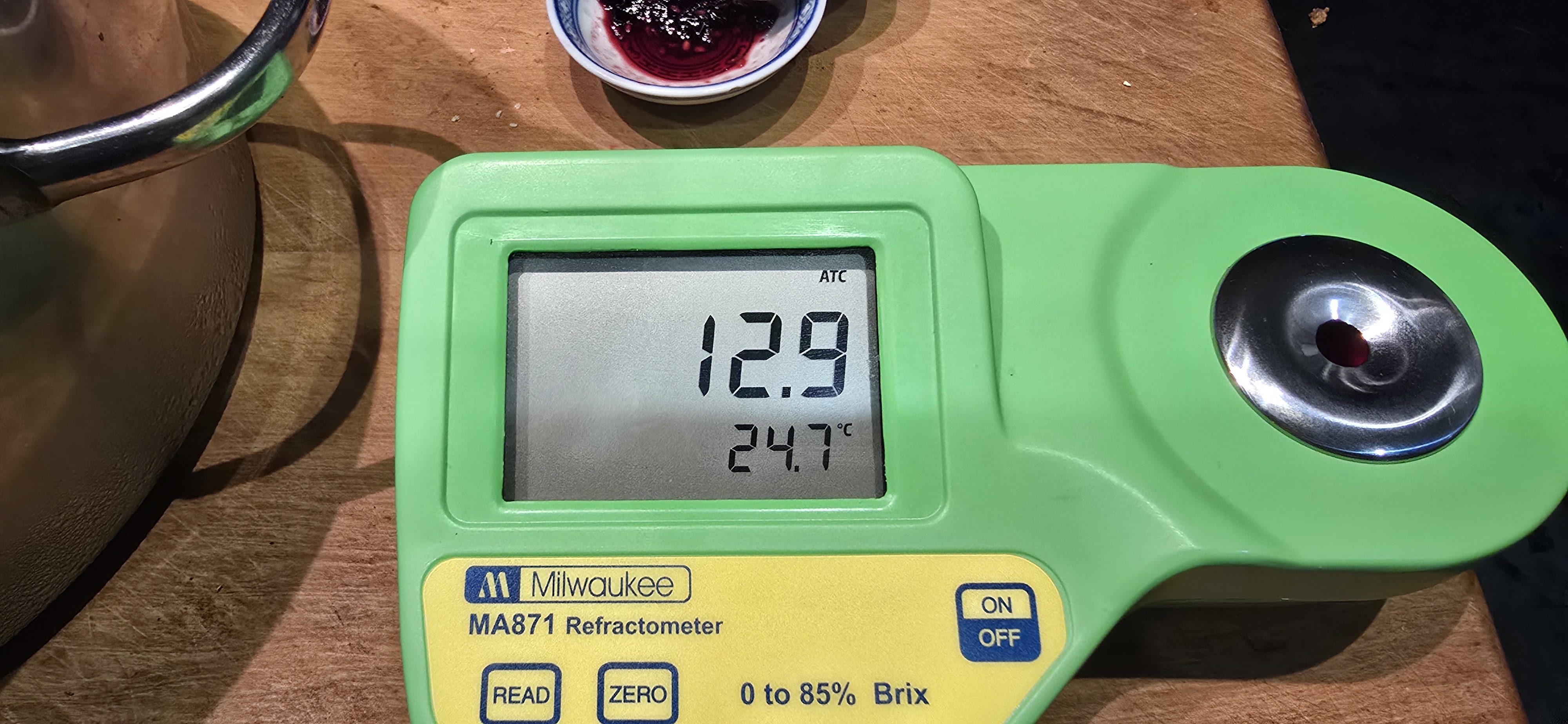
The University of Missouri extension office video prompted me to dig out my refractometer and was pleasantly surprised that the juice was 12.9 Brix.

The berry and umbel sizes vary on each of the trees as does the flavour - sampled a few raw and they're mildly sweet.

The berries were frozen overnight to make them easier to strip off the umbels.

Am simmering them with some ginger and a cinnamon quill and will make the syrup up tomorrow.
20260224_195542.jpg
Frozen elderberries
Frozen elderberries
20260224_210133.jpg
Elderberry juice brix reading
 
steward and tree herder
Posts: 12618
Location: Isle of Skye, Scotland. Nearly 70 inches rain a year
6541
6
transportation dog forest garden foraging trees books food preservation woodworking wood heat rocket stoves ungarbage
  • Likes 4
  • Mark post as helpful
  • send pies
    Number of slices to send:
    Optional 'thank-you' note:
  • Quote
  • Report post to moderator

Megan Palmer wrote:The berries were frozen overnight to make them easier to strip off the umbels.


That's a good trick!

Most of my elder bushes come from a tree that flowered and fruited well near my allotment in Solihull. Just a random bush as far as I know. Unfortunately, although it flowers well, it doesn't seem to set fruit much....I also have a variety that is supposed to be a good fruiter from Denmark, and some taken from local trees. None of them fruit very well as yet, I'm hoping that one year the weather and the insects and the bushes all will align for a good crop. In the meantime, I enjoy elderflower cordial, and dry the flowers for tea and for adding to jams and jellies.
 
Posts: 12
  • Likes 5
  • Mark post as helpful
  • send pies
    Number of slices to send:
    Optional 'thank-you' note:
  • Quote
  • Report post to moderator
I’ve found that mixing early- and late-blooming cultivars improves pollination and yields, so planting two vigorous, disease-resistant varieties that flower at slightly different times is a smart way to ensure reliable harvests.
 
I agree. Here's the link: http://stoves2.com
reply
    Bookmark Topic Watch Topic
  • New Topic