• Post Reply Bookmark Topic Watch Topic
  • New Topic
permaculture forums growies critters building homesteading energy monies kitchen purity ungarbage community wilderness fiber arts art permaculture artisans regional education skip experiences global resources cider press projects digital market permies.com pie forums private forums all forums
this forum made possible by our volunteer staff, including ...
master stewards:
  • Nancy Reading
  • Carla Burke
  • John F Dean
  • Timothy Norton
  • r ransom
  • Jay Angler
  • Pearl Sutton
stewards:
  • Devaka Cooray
  • Leigh Tate
  • paul wheaton
master gardeners:
  • Christopher Weeks
gardeners:
  • M Ljin
  • thomas rubino
  • Megan Palmer

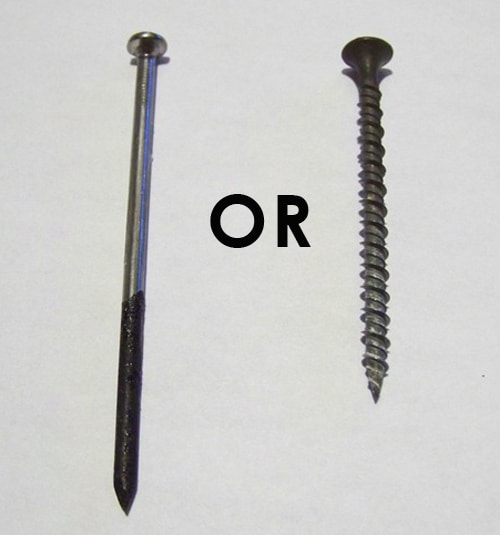
Screw vs Nail: Which one when?

 
Steward of piddlers
Posts: 7185
Location: Upstate New York, Zone 5b, 43 inch Avg. Rainfall
3825
monies home care dog fungi trees chicken food preservation cooking building composting homestead
  • Likes 9
  • Mark post as helpful
  • send pies
    Number of slices to send:
    Optional 'thank-you' note:
  • Quote
  • Report post to moderator
Nail or Screw?


I generally use two types of fasteners when I build which happen to be screws and nails.

Is there a basic thought process one can use when considering which to use in a project? How much consideration should they really put into it? Any laymen explanation that can be given to someone new to building stuff?

Thank you in advance for your advice.

 
Timothy Norton
Steward of piddlers
Posts: 7185
Location: Upstate New York, Zone 5b, 43 inch Avg. Rainfall
3825
monies home care dog fungi trees chicken food preservation cooking building composting homestead
  • Likes 7
  • Mark post as helpful
  • send pies
    Number of slices to send:
    Optional 'thank-you' note:
  • Quote
  • Report post to moderator
Don't even get me started on bolts...

Chart of Bolts
 
master rocket scientist
Posts: 6994
Location: latitude 47 N.W. montana zone 6A
4028
cat pig rocket stoves
  • Likes 17
  • Mark post as helpful
  • send pies
    Number of slices to send:
    Optional 'thank-you' note:
  • Quote
  • Report post to moderator
Nails bend but rarely break, but they can unnail themselves over time.
Screws break but do not back out

Bottom line
Nails are stronger and resist shearing
Screws never come loose but can shear suddenly.

 
Posts: 214
Location: KY
75
wheelbarrows and trailers hugelkultur forest garden gear trees earthworks
  • Likes 12
  • Mark post as helpful
  • send pies
    Number of slices to send:
    Optional 'thank-you' note:
  • Quote
  • Report post to moderator
I like to think screws are better because things can be taken back apart easier for repair/change of plans etc...but you are really "screwed" if they strip or break!

On the downside it takes a battery powered driver, or else it's a hard and loooong time to turn in/out by hand.

It's typically easier to pull wood where you want it, and get tighter fits with screws tho, if seeking perfection.

Ohhh what about a nailgun?? Super fast!

Something satisfying about smacking nails with a hammer as well - for certain less important projects.

Maybe I'll just be nice and go with they are equally good depending on circumstance and mood ;)


Posts: 136
39
  • Likes 14
  • Mark post as helpful
  • send pies
    Number of slices to send:
    Optional 'thank-you' note:
  • Quote
  • Report post to moderator
Predrill a pilot hole and use screws for things that need to stay tight and may one day need to be replaced or if the timber is seasoned, tough or likely to split using a nail. Wherever possible when using screws for building projects I use those with square or hex drive heads. Slot and Philips head are fine for joinery and stuff. Make sure to use gal or otherwise weather proof fixings for outdoors. If you use nails for framing and stuff, drive them at slightly opposing angles into the timber, not straight in- that way they hold way better and can't pull straight out.
 
pollinator
Posts: 1147
Location: Greybull WY north central WY zone 4 bordering on 3
349
hugelkultur trees solar woodworking composting homestead
  • Likes 10
  • Mark post as helpful
  • send pies
    Number of slices to send:
    Optional 'thank-you' note:
  • Quote
  • Report post to moderator
There is so much missing in this discussion it isn't even funny.

1.  corrosion inhibitors and cement coatings to prevent backing out.
2.  structural screws:  screws that bend rather than breaking.  They can be used in places where nails are normally required
3.  screws that are designed to be driven by nail guns.  2 types  One drives flush right off.  Second drives most of the way and is then screwed the rest of the way home
4. types of screws

The screw in the picture basically should never be used anywhere but its intended purpose.  It is a drywall screw.  They are brittle, weak and corrode off at the drop of a hat.

For most stuff I prefer outdoor rated screw with Torx drive.  Bigger screws I want impact type drivers rather than screw guns  Self drilling with the reverse twist section to prevent them from backing out.  Now if you are in hard woods you will find you often need to predrill to prevent splitting.  Some of the time you can prevent the need for this by running the screw in reverse till it gets hot while it makes a bit of a pilot hole.  Then if reverse so you screw it home while the tip is still hot it doesn't split.

Unless you are getting structural rated screws all framing and load bearing projects should be nailed.  Personally for framing my preferred answer is 2 20 box nails with a screw in them too.  Strutural rated screws are pricey costing 3X to 10X more than normal screws.

Here is a good beginning course on nails.

Nails

Now the price differential is coming down but nails are still cheaper and nearly everyone has a hammer.
 
Posts: 749
170
  • Likes 9
  • Mark post as helpful
  • send pies
    Number of slices to send:
    Optional 'thank-you' note:
  • Quote
  • Report post to moderator
Generally for building I use nails, and limit my screws to building case work like cabinets or holding up a picture or something. The ratio is probably around 90% nails, and 10% screws.

But using the right nail is everything. I seldom hand pound nails because I have a litany of cordless nailers by Milwaukee. This makes a huge difference because auto framing nailers don't have nails that back out. With the whole construction industry using them, getting a nail gun that takes full round headed nails helps, but so too does the glue they put on these nails. When the nail is driven, the heat is activated and melts the glue, then when the nail cools, that glue bonds the nail to the wood so there is adhesive, and the friction of the compressed wood fibers. Add a full round headed nail with some ring shanks and it is considered adequate for even hurricane building zones.

But I also use a Cordless Finish nailer, and while it does not have the same integrity as a framing nail, I tend to use more nails because they are easy to drive, so it holds things together well.

I have some other auto-nailers, but for the most part, these two cordless nailers do about everything I need to do most of the time. Since they are battery powered this saves me from having an air compressor and hose to lug around.

(No one asked, but as a side note, when taking things apart where modern auto-nailers were used, a reciprocating saw is your best friend. It is far easier to cut the boards apart then to try and pry out the nails)
 
pollinator
Posts: 5916
Location: Bendigo , Australia
536
plumbing earthworks bee building homestead greening the desert
  • Likes 14
  • Mark post as helpful
  • send pies
    Number of slices to send:
    Optional 'thank-you' note:
  • Quote
  • Report post to moderator
Interesting comments all around.
Things are different from when I started using nails!
Today I apply these rules;
- use galvanised nails only
  you never have to throw them away if they get wet.
  They grip better
  They are easy to reuse
- Modern screws are great and dont work loose like some nails can.
But the real issue is these bolts I have collected below, they can take hours to get into place.
misshapenned-bolts.jpeg
[Thumbnail for misshapenned-bolts.jpeg]
 
Steve Zoma
Posts: 749
170
  • Likes 5
  • Mark post as helpful
  • send pies
    Number of slices to send:
    Optional 'thank-you' note:
  • Quote
  • Report post to moderator

John C Daley wrote:Interesting comments all around.
Things are different from when I started using nails!
Today I apply these rules;
- use galvanised nails only
  you never have to throw them away if they get wet.
  They grip better
  They are easy to reuse
- Modern screws are great and dont work loose like some nails can.
But the real issue is these bolts I have collected below, they can take hours to get into place.


Too funny! :-)

My favorite bolt by far are "sex bolts". No joke, they are a REAL thing.

I actually used to turn them on a lathe back when as a hobby I made woodworking tools like hand planes and dovetails saws and such. Sex bolts are the special bolts used to bolt the saw handles onto the steel blades. I also use them in my bookbinding hobby sometimes to bolt the bindings of leatherbound medieval books.
 
pollinator
Posts: 5560
Location: Canadian Prairies - Zone 3b
1553
  • Likes 6
  • Mark post as helpful
  • send pies
    Number of slices to send:
    Optional 'thank-you' note:
  • Quote
  • Report post to moderator

Steve Zoma wrote:... auto framing nailers don't have nails that back out. With the whole construction industry using them, getting a nail gun that takes full round headed nails helps, but so too does the glue they put on these nails. When the nail is driven, the heat is activated and melts the glue, then when the nail cools, that glue bonds the nail to the wood so there is adhesive, and the friction of the compressed wood fibers.

... (No one asked, but as a side note, when taking things apart where modern auto-nailers were used, a reciprocating saw is your best friend. It is far easier to cut the boards apart then to try and pry out the nails)


Hm! I wonder if that's why wood pallets are so damn hard to pull apart.
 
Steve Zoma
Posts: 749
170
  • Likes 6
  • Mark post as helpful
  • send pies
    Number of slices to send:
    Optional 'thank-you' note:
  • Quote
  • Report post to moderator

Douglas Alpenstock wrote:

Steve Zoma wrote:... auto framing nailers don't have nails that back out. With the whole construction industry using them, getting a nail gun that takes full round headed nails helps, but so too does the glue they put on these nails. When the nail is driven, the heat is activated and melts the glue, then when the nail cools, that glue bonds the nail to the wood so there is adhesive, and the friction of the compressed wood fibers.

... (No one asked, but as a side note, when taking things apart where modern auto-nailers were used, a reciprocating saw is your best friend. It is far easier to cut the boards apart then to try and pry out the nails)


Hm! I wonder if that's why wood pallets are so damn hard to pull apart.


Yes, they use full ring shanked, adhesive, and full headed nails. They also drive them into hardwood that makes up the pallet.

What wood you are connecting makes a huge difference too. Drive a regular smooth shanked, hand-hammered nail into Eastern Hemlock and the wood will be destroyed before you can pull the nail. Eastern Hemlock, once dried contracts around the nail incredibly hard.
 
master steward
Posts: 8226
Location: southern Illinois, USA
3153
goat cat dog chicken composting toilet food preservation pig solar wood heat homestead composting
  • Likes 7
  • Mark post as helpful
  • send pies
    Number of slices to send:
    Optional 'thank-you' note:
  • Quote
  • Report post to moderator
To add, if you should nail yourself and have to go to the ER, make 100% certain the Dr. knows and appreciates what kind of nail your shot into yourself ….especially if it hit bone.
 
gardener
Posts: 461
Location: The Old Northwest, South of Superior
256
books building wood heat
  • Likes 9
  • Mark post as helpful
  • send pies
    Number of slices to send:
    Optional 'thank-you' note:
  • Quote
  • Report post to moderator
I would only add the following:

Duplex headed nails can still be had.  They are great temporary purposes like site-built scaffolding or staging, or for form work.  The double head allows them to be driven tight while still being easily removed with a framing hammer's claw at a later time.  Beware the protruding heads in tight quarters.

Though, to be frank, rightly or wrongly, for the last forms I built, I used pocket jig screw (Kreg brand, but it doesn't really matter) - but the forms were only a single 1X6 high, to pour pads for low piers (two dry laid cinder blocks, side by side).  When I stripped the forms, the screws backed out just fine, but I was careful to not slop concrete everywhere (sack-crete, mixed one sack at a time in a plastic mortar pan with a hoe, with water which was hauled in 6-gallon Reliance jugs, so I wasn't interested in being wasteful).

As was mentioned in passing up thread, but I'll reiterate, ring shank nails grip tenaciously.

Re pulling nails: a slide handle nail puller can sometimes be useful when a cat's paw wouldn't work.  Spread the jaws wide enough to swallow the head, with jaws oriented so that there is room to swing the handle, hammer the jaws in with the slide handle, then extend the slide handle and pull the nail.  I've had good success using my ancient Crescent-branded nail puller when disassembling pallets (but that is a relative thing - sometimes cutting the nails, or the boards, is the only solution).  These will bite (the slide hammer handle), so if you use one, be careful.

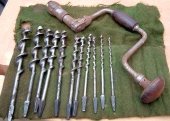
Screws don't require an electric drive, though that is definitely quicker.  In my current project, I have driven hundreds of screws (almost 10 pounds now of 1-1/4" screws, and 4 or 5 pounds to date of 2-1/2" to 3" structural screws), a mix of Robertson/square drive and Torx.  All but a couple of dozen (18 for sure, maybe a few I'm forgetting) of these have been driven by hand, using a Yankee screw driver, a brace (I think it's a 10" sweep ratcheting Stanley, but I'd need to measure to be certain), a Millers Falls ratcheting drive 3-jaw chuck breast drill, and - in very tight quarters - a stubby 1/4" square drive ratchet with a 1/4" 6-point socket to turn the driver bit; this is non-magnetic, so I need to be careful to not lose the driver bit.  I have a quick change 1/4" hex driver adapter for the Yankee screw driver, and an adapter from the brace's two-jaw square drive chuck to 1/4" hex, which make it easy to use modern interchangeable driver bits.  The adapters were all Christmas presents from my wife, purchased from Lee Valley (I also have a 3/8" square drive adapter, so that I can drive in hex head lag screws with a socket, same source and provenance),.  For the 1-1/4" screws, I can drive them in until the heads touch (and sometimes until they pull tight) with the Yankee's spiral drive.  This is into "white wood" construction lumber.  Sometimes (more than half the time) I have to lock the spiral drive and finish with wrist power.  For the longer screws, I can usually get them run in most of the way with the Yankee, then switch to the brace, or lock the Yankee, depending on access.  For high torque fasteners with good access, I have a Stanley-manufactured John S. Fray and Co. wimble brace, with both handles eccentric to the axis of rotation (rather than a single handle offset, with a pad on axis).  Josh from the Mr. Chickadee YT channel turned me on to these, as a more easily packable substitute for a full-on boring machine (Millers Falls, Swan, Double Eagle, etc.) when timber framing on site, out in the woods, as opposed to cutting a frame in a shop.  I found one on Ebay, and have found it to be a useful addition to my panoply of drills, braces and drivers, though I haven't used it for timber framing per se, yet; but I did auger 90 1" diameter holes for this current project, using the wimble brace and an Irwin auger.  It made the task trivial, compared to using the aforementioned Stanley 10" brace, if a bit time consuming.

Don't be afraid to use screws "off grid".
 
pollinator
Posts: 642
Location: Zone 8A
133
homeschooling kids rabbit tiny house books chicken composting toilet medical herbs composting homestead
  • Likes 10
  • Mark post as helpful
  • send pies
    Number of slices to send:
    Optional 'thank-you' note:
  • Quote
  • Report post to moderator

thomas rubino wrote:Nails bend but rarely break, but they can unnail themselves over time.
Screws break but do not back out

Bottom line
Nails are stronger and resist shearing
Screws never come loose but can shear suddenly.


Yes, this.

Shear
A force that causes a material to deform by slipping along a plane or planes parallel to the stress. Shear forces act in opposite directions at the top and bottom of a plane, causing shearing deformation. Shear is the most common stress at transform plate boundaries.

Tension
A directed stress that pulls a material apart in opposite directions. Tension is the major type of stress at divergent plate boundaries.

A visual;

Deck boards on top of a deck are in tension. Screws are best. This is also why a subfloor nailed off instead of screwed off will squeak. Nails are less resistant to tension.

Deck joist, fastened to the deck band, will experience vertical slip forces. Nails are best.

Look at something, put your hands together and imagine these components failing. If failure would most likely happen if you'd be sliding one hand up the other (shear use nails) or pulling you hands apart (tension use screws).

This is a little oversimplified but a good principle to follow as a diy'er.
 
Timothy Norton
Steward of piddlers
Posts: 7185
Location: Upstate New York, Zone 5b, 43 inch Avg. Rainfall
3825
monies home care dog fungi trees chicken food preservation cooking building composting homestead
  • Likes 7
  • Mark post as helpful
  • send pies
    Number of slices to send:
    Optional 'thank-you' note:
  • Quote
  • Report post to moderator
I found this video to be rather topical to this thread.

 
pollinator
Posts: 226
Location: Nebraska zone 5
88
hunting chicken building
  • Likes 6
  • Mark post as helpful
  • send pies
    Number of slices to send:
    Optional 'thank-you' note:
  • Quote
  • Report post to moderator
For me, it's always screws, if at all possible. For whatever reason, I can't drive a nail straight. I tend to end up smashing them over. It drives me nuts.
 
steward
Posts: 18357
Location: USDA Zone 8a
4659
dog hunting food preservation cooking bee greening the desert
  • Likes 3
  • Mark post as helpful
  • send pies
    Number of slices to send:
    Optional 'thank-you' note:
  • Quote
  • Report post to moderator
When we were building our house we used screws because screws use less energy.

A machine called a drill usually battery power screws into wood in seconds ...
 
Timothy Norton
Steward of piddlers
Posts: 7185
Location: Upstate New York, Zone 5b, 43 inch Avg. Rainfall
3825
monies home care dog fungi trees chicken food preservation cooking building composting homestead
  • Likes 5
  • Mark post as helpful
  • send pies
    Number of slices to send:
    Optional 'thank-you' note:
  • Quote
  • Report post to moderator
I'm still learning all I can about fasteners. I found another video, this one on screws, and how different properties can be useful for different builds.

 
Steve Zoma
Posts: 749
170
  • Likes 8
  • Mark post as helpful
  • send pies
    Number of slices to send:
    Optional 'thank-you' note:
  • Quote
  • Report post to moderator
The strongest connection there is is actually the clenched nail. That is where you nail a too-long nail through two boards then peen the end of the nail over... a clenched nail. This is super strong because a nail can bend and not be hardened and break like screws. Yet it holds the two boards together mechanically making it both strong in tension and shear.

It is just gawd-awful ugly. And there are places where you blind nail and cannot bend over the other end of the nail. But it you can, it will be a bear to ever pull those two boards apart.

Another nail that is surprisingly strong is the cut nail. They are the old-fashioned square nails and still used in flooring because they do not pull out. Because of how they are blunt and not pointed, they shear the fibers of the wood off when pounded in and do not wedge the fibers apart. This causes a very sound connection because it uses the same physics to stay tight as a split lock washer on a bolt. I recently bought some to use on my softwood floor. I specifically used Rosemont Headed cut nails as they have a bigger head to them and hold my wide pine flooring boards better.

In this 1890 house there are numerous original cut nails and it is better for me to drive them in, or cut them off, because there is no way to pull them out of the wood if they need to be removed.
 
Steward and Man of Many Mushrooms
Posts: 6030
Location: Southern Illinois
1851
transportation cat dog fungi trees building writing rocket stoves woodworking
  • Likes 4
  • Mark post as helpful
  • send pies
    Number of slices to send:
    Optional 'thank-you' note:
  • Quote
  • Report post to moderator
Never had a nail loosen up of me.

OTOH

I have never had a screw fitting loosen.  The cheapest screw beats the best nail.


Eric


John F Dean
master steward
Posts: 8226
Location: southern Illinois, USA
3153
goat cat dog chicken composting toilet food preservation pig solar wood heat homestead composting
  • Likes 1
  • Mark post as helpful
  • send pies
    Number of slices to send:
    Optional 'thank-you' note:
  • Quote
  • Report post to moderator
Hi Eric,

My experience has been different. At my homestead, I use screws just about 100%.  But I have been in industrial settings with experienced people using nail guns. Pallets were assembled in seconds. It sounded like machine guns were in use. Removing a ring shank nail that has been shot in with a nail gun is not an easy task.

The nails were less expensive, went in faster, and held tight.
 
Steve Zoma
Posts: 749
170
  • Likes 2
  • Mark post as helpful
  • send pies
    Number of slices to send:
    Optional 'thank-you' note:
  • Quote
  • Report post to moderator
Having cordless rechargeable nail guns have been a real game-changer for me.

Before there was a sense of mobility as I just grabbed my cordless drill-driver and put in a screw or lag bolt over that of driving in a spike by hand, or getting my compressor, airline, and pneumatic nail gun to drive some spikes or nails. Now with a cordless framing nailer, finish nailer, or brad nailer, I literally just grab them and go.

A great example is something that happened last week while putting up new kitchen cabinets. I nailed a cleat in the wrong place. So in less time then I could screw in three screws, realize it was in the wrong spot, back out the screws, reset the cleat and rescrew the cleat, instead... I slammed in three nails, realized it was in the wrong spot, grabbed my sawzall saw, cut the nails, repositioned it and "bang, bang, bang" the cleat was in the right place again. It literally took as much time to do in real time as it did for you to read how I did it.

Some of that is having the tools... the cordless framing nailer in this case, but so too was experience. There was no attempt made to pry the nails out. I knew to fruitlessness of that, I just cut the nails and slammed in three new ones. In this situation I think screws and nails are on the same level; neither one better in this situation or the other. They each have plenty of holding strength, both can be redone if needed, and they both countersink so applying filler and covering the holes makes them impossible to see.

Grab some screws and a driver, or grab one of my cordless nail guns? For me I am as likely to grab one as the other now.
 
John C Daley
pollinator
Posts: 5916
Location: Bendigo , Australia
536
plumbing earthworks bee building homestead greening the desert
  • Likes 1
  • Mark post as helpful
  • send pies
    Number of slices to send:
    Optional 'thank-you' note:
  • Quote
  • Report post to moderator
I finally got around to finding those 'sex bolts' !
sex-bolt.jpeg
[Thumbnail for sex-bolt.jpeg]
 
gardener
Posts: 621
Location: Boudamasa, Chad
236
2
forest garden
  • Likes 2
  • Mark post as helpful
  • send pies
    Number of slices to send:
    Optional 'thank-you' note:
  • Quote
  • Report post to moderator
Screws. With glue.

But for furniture: neither. Just tenons.
 
I agree. Here's the link: http://stoves2.com
reply
    Bookmark Topic Watch Topic
  • New Topic