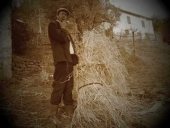
Fagopyrin is a toxin in Buckwheat greens(Known as Buckwheat Lettuce) that causes sever skin issues in man and beast.
I have been trying to find out if cooking the greens renders this toxin harmless.
So far my searches have come to naught.
Any input would be appreciated.
Sheesh, yet another delicious and abundant weed is declared to have something toxic in it!?!?
Here buckwheat leaves are cooked and eaten and they are delicious and don't appear to cause any problems.
In lower (warmer) parts of Ladakh buckwheat is sometimes grown as a field crop and people collect and eat some of the leaves. It's also a field and garden weed in all parts of Ladakh and people definitely save it when weeding.
Those who have a lot dry it for the winter and even sell it. As a dried green, it tastes more delicious and luxurious than dried domestic greens like chard, etc. It thus is sold for a higher price.
I've had a bag of it all this past winter and have been throwing a handful into my pasta while cooking almost every day. It's also extra delicious as a cooked green, you know just fried up with onions and garlic and the spices of your choice.
I don't know about the toxin you've heard of, but my feeling about oxalates is SHEESH! Just eat a good variety of things, and don't worry! Especially if they are foods traditionally eaten somewhere and the population is thriving.
My impression after reading that article is not that I should start avoiding buckwheat greens, but that I must continue to avoid food fads. Four glasses of green juice every day? Of the same four specific vegetables?! No, just eat more whole foods not juice, and don't eat any one ingredient to excess every single day!
As I said, I've eaten a handful of cooked dried buckwheat greens probably four times a week or more for the past 3 months, for lack of very much variety in winter here, but I'm not noticing any photo or other sensitivity. And occasionally we've cooked a big batch as cooked greens, and fifty of us eat it along with other foods, and I've never heard a peep.
Well, I'll keep an eye out for symptoms, and next winter I'll make sure I have more different greens in stock, but really buckwheat greens are too yummy to quit entirely. And so easy to cook.
Great input from everyone, thank you all for taking the time.
I was wondering how to use buckwheat in my designs, it seems likely that moderation is key. I had read the Townsend Letter, and he seemed to think it was not a traditional green. Facts on the ground in India seem to say other wise.
Moderation in my own consumption then, and certainly I won't make it a fodder crop on its own.
I know there are several species know as "buckwheat" are we sure everyone here is on the same page?
Carol Deppie talked about a perrenial buckwheat species with edible greens, and I'm sure I've heard of at least one other "buckwheat", besides the species commonly used as a grain or cover crop in the USA.
Any updates on this? Just happened on the thread tonight while thumbs-upping a post in the Happy Accidents thread, and got all excited. Buckwheat is one of the few things that takes easily in our less than ideal and quite muddy clay "fields"...would love to know if we could enjoy some in our mixed steamed greens
Hmm.I put this in my signature in order to bring more scrutiny. At this point my own conclusion is I need to find the seeds from the Himalayan variety. I myself have not tried the leaves. Fortunately I have a lot of forage radishes with excellent greens that also self-seed.
William Bronson wrote: Hmm.I put this in my signature in order to bring more scrutiny.
Yep - that's how I found it Doing a little poking about now myself to see if I can help in any way.
William Bronson wrote:At this point my own conclusion is I need to find the seeds from the Himalayan variety.
From what I'm finding, it looks like both the common buckwheat(s) (Fagopyrum esculentum spp.) and tartary buckwheat (Fagopyrum tataricum) contain high-ish levels of the phagopyrin compound, mostly in their leaves but also in the stems and flowers. There's not much in the seed which we use as grain.
Though I'm not finding much understandable info on this, fagopyrin is mentioned in a few places as anticarcinogenic. This appears to be due to the photosensitivity that it causes inducing apoptosis (programmed cell death). That same study that mentions a possible mechanism for the anticarcinogenic properties also mentions that low nitrogen levels cause higher production of fagopyrin (and the closely related hypericin in St. Johns Wort). In fact, they closely compare fagopyrin to the more well known hypericin and use it as an analogue. We can do that as well for educated guesses as to how much would cause toxic reactions (somewhere in the vicinity of 10.5 mg/kg body weight can cause toxicity in hereford cattle, around 32mg/kg body weight is the LD50 for chickens), how quickly it leaves the system (up to 2 weeks), etc.
There's the one study from 2011 showing that age didn't matter - 14 day old sprouts had the same fagopyrin content as mature plants - and at least 40 grams of plant matter (fresh green) was considered "safe". Another study showed that while flowers of common buckwheat (F. esculentum) had higher levels of phenolic compounds, including salicylic acid suprisingly (anyone have a headache?), the whole plant is very rich in flavanols overall at 16-18% by dry weight. Even more surprisingly, the lower levels of phenolic compounds in the tartary buckwheat were correlated to a higher level of antioxidant activity.
According to this, tartary buckwheat is more bitter than common buckwheat as well, and if Rebecca enjoys it so much, I definitely want to give it a try
So overall, it doesn't look to be very "dangerous" in low quantities (a small handful - 1/4 to 1/2 cup fresh greens...that 40 grams number is probably a good upper limit to use). It's medicinal, if anything, at that dose. If you did happen to eat too much buckwheat foliage, your symptoms would include a reddening and strong, painful burning sensation of the skin when exposed to sunlight. Hot and cold water, friction, etc will become painful, and this sometimes lasts for days. You might even get a numb/fuzzy feeling in the hands, get dizzy or nauseous, etc. It will eventually go away, at which point you can decide for yourself if you really want to chance the experience again in the future.
Like William said - moderation appears to be the key....and if you suffer from an allergy to it, have liver problems that would cause you to not handle the compound well, or are more prone to the fagopyrism deal, you'll know it pretty quick and can just avoid eating it. Probably wouldn't include it as an ingredient in potluck dishes or otherwise serve it to people that don't have experience with it, just to be on the safe side.
I'm gonna give it a try though - small bits added here and there. We can all use more anticarcinogens in our diets
Brother, you are amazing!
People like you are why I love Permies!
Thank you for taking an interest, taking the time and sharing your research.
Time to buy a new bag to add to the polyculture mix.
William Bronson wrote: Brother, you are amazing!
People like you are why I love Permies!
Thank you for taking an interest, taking the time and sharing your research.
Time to buy a new bag to add to the polyculture mix.
No problem - I honestly just didn't want to get my behind moving. The black flies and deer flies are so bad out there right now that sitting here on the computer for a bit was a lot more enjoyable than being sucked dry just trying to get some clearing and thinning done out there Thankfully, the info I was able to find gives me some confidence that eating small amounts should be safe enough. Like with everything else, lots of variety in the diet can only be a good thing and it should make a nice addition to the mixed greens and salads where we already include small amounts of plantain, yellow dock, wood sorrel, dandelion, etc. Buckwheat is one of those permaculture magic bullets (soil building/nutrient mining, insectary, food crop, weed smother, etc) - the idea of eating the greens as well is exciting!
I’m in Northern California in a coastal zone just north of San Francisco. Does anyone know why my Himalayan buckwheat never goes to seed? We do freeze and it dies all the way back in the winter and then gets pretty darn hot in the summer. Perhaps it has to do with latitude? Any thoughts? Thanks!
Tiffany
Tiffany Dawson wrote:I’m in Northern California in a coastal zone just north of San Francisco. Does anyone know why my Himalayan buckwheat never goes to seed? We do freeze and it dies all the way back in the winter and then gets pretty darn hot in the summer. Perhaps it has to do with latitude? Any thoughts? Thanks!
Tiffany
I have the first, in Hamburg, so much farther north and more extreme weather, and it flowers prettily every year but I haven't seen seed, which matches PFAF's experience. I haven't looked for seed as it's doing a fine job taking over its bed.
I'm not sure which Rebecca is harvesting there in the Himalayas.
Wow, it's been 7 years since my post above where I said I was eating it frequently that winter. That was dried buckwheat greens that I'd bought from the local food sellers sitting in the main market in town here in Ladakh in the Indian Himalaya. I haven't seen it for sale for a few years now, and I feel people are collecting less wild foods nowadays. The dried greens for sale now are mostly cultivated ones. Dried buckwheat greens have an attractive dark green with silver speckles that I used to be able to spot from a distance (the sellers don't use any labels).
The leaves that are dried and later cooked are the buckwheat that pops up as a garden weed here. I haven't heard of people harvesting greens from the buckwheat they grow in fields as a grain. I think they might be different species of Fagopyrum.
In the intervening years I've occasionally tried to find out which species these are. In the part of Ladakh where I live, buckwheat is not grown, and in the gardens I've worked in, there are no wild buckwheat weeds, so I haven't personally compared them in detail.
At some point I found a paper on the ethnobotany of buckwheat and copied the following from it, that indicates that two species are cultivated in Ladakh and one is wild. I guess the buckwheat greens we eat are the wild F. dibotrys species. I haven't run into the puffed buckwheat grains mentioned, only ground flour.
Munshi paper on ethnobotany of buckwheat: "In Kashmir Himalaya the genus is represented by four cultivated species, Fagopyrum sagittataum, F. tataricum, F. esculentum, F. kashmirianum and wild species F. dibotrys" ... "In Ladakh and its adjacent area the whole grains of buckwheat (F. tartaricum, F. sagittatum) when popped and softened are highly palatable and are as good as those prepared from the corn or other millets ... Also leaves and young shoots are boiled and eaten as spinach (F. dibotrys) in lower areas of the region." [Actually buckwheat is cultivated only in the lower areas of Ladakh but the weedy greens appear and are eaten in various parts of both lower and upper Ladakh.]
I will continue to eat flowery buckwheat tops in moderation in my sandwiches and strip the leaves from the stalks and add them to stews which I have been doing for years. In winter, I use buckwheat for sprouts. 2 days under peat moss and it's time for the scissors
Reading this thread in 2024 as someone who was interested in buckwheat and a beginner in permaculture made me join this site! Thank you for the interesting read
Welcome to permies Jacqueline, and thank you for 'bumping' this interesting thread. I think my fagopyron dibotrys died, but I have another plant that looks very similar and I'm trying to decide whether it is the same thing, or some other perennial buckwheat look alike that I decided to try growing.

Nancy Reading wrote:Welcome to permies Jacqueline, and thank you for 'bumping' this interesting thread. I think my fagopyron dibotrys died, but I have another plant that looks very similar and I'm trying to decide whether it is the same thing, or some other perennial buckwheat look alike that I decided to try growing.
Thank you Nancy! I love your project posts, so interesting to read as someone who is just garden planning my dream garden!
Post by:autobot
Don't touch me. And don't touch this tiny ad:
100th Issue of Permaculture Magazine - now FREE for a while