
• Post Reply Bookmark Topic Watch Topic
  • New Topic
permaculture forums growies critters building homesteading energy monies kitchen purity ungarbage community wilderness fiber arts art permaculture artisans regional education skip experiences global resources cider press projects digital market permies.com pie forums private forums all forums
this forum made possible by our volunteer staff, including ...
master stewards:
  • Carla Burke
  • John F Dean
  • r ransom
  • Nancy Reading
  • Timothy Norton
  • Jay Angler
stewards:
  • paul wheaton
  • Pearl Sutton
  • Eric Hanson
master gardeners:
  • Christopher Weeks
  • M Ljin
gardeners:
  • thomas rubino
  • Megan Palmer
  • Benjamin Dinkel

Designing zone 1 - the kitchen garden

 
steward and tree herder
Posts: 11895
Location: Isle of Skye, Scotland. Nearly 70 inches rain a year
6011
5
transportation dog forest garden foraging trees books food preservation woodworking wood heat rocket stoves ungarbage
  • Likes 12
  • Mark post as helpful
  • send pies
    Number of slices to send:
    Optional 'thank-you' note:
  • Quote
  • Report post to moderator
Up to now I've been a bit lacking in zone one - most of my productive gardening has been done in a zone 3ish growing area - my 'simple farming' area further down the hill. This is now getting quite established and I'm happy with the way it is progressing. Formerly, and in the future, my zone one was/will be my polytunnel. I'm hoping to supplement that next year with another growing area next to it for vegetables that don't need the protection of the tunnel, but are the sort of thing that I will want to harvest today for dinner, rather than all at once like my maincrop vegetables and grains. There is enough flat space with pretty good soil between my polytunnel site and the escarpment downhill from it to make quite a nice sized vegetable patch/garden.
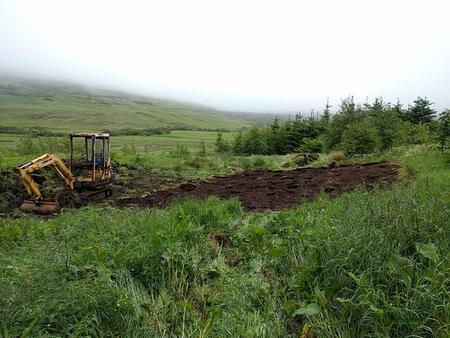
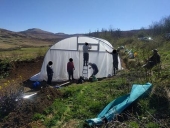
This picture shows the area as we were clearing the space for the polytunnel on the right. At the moment the area to the left where the digger is parked is covered in the soil that will be returned to the polytunnel for growing beds, so some at least will be clear earth to make easy planting next year

small digger with turf cleared area misty hills and trees in background
zone one potential


I had quite a bit of success growing leaf beet for the first time this year, but the plants are so far down the hill that I only managed to pick it a couple of times for dinner, despite the potential. Early potatoes again are better harvested as you need them, rather than all at once and stored, like maincrop potatoes. Runner beans also are good picked for today's dinner, and indeed if you don't pick them regularly they can turn into tough monster pods, not so nice!

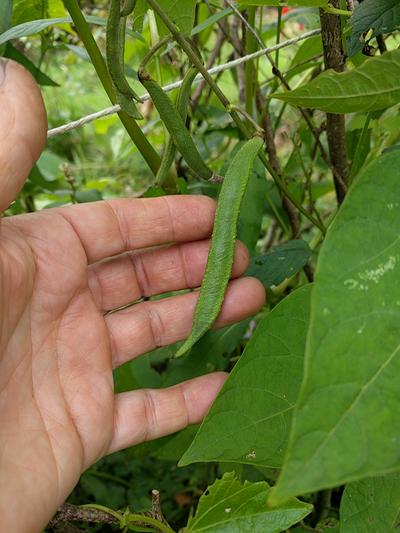
tiny runner bean pod in the hand
this one a bit small yet!


What other vegetables do you think would be most useful in a zone one area, rather than an area visited less often? What other aspects should I consider to make life easier?
 
pollinator
Posts: 1583
Location: NW California, 1500-1800ft,
487
2
hugelkultur dog forest garden solar wood heat homestead
  • Likes 10
  • Mark post as helpful
  • send pies
    Number of slices to send:
    Optional 'thank-you' note:
  • Quote
  • Report post to moderator
Looks like a lovely spot. Near my kitchen door, I like to grow herbs, greens and fruits with a long harvest seasons and which I use most often. Thyme and other mediterranean herbs, garlic chives, walking onion for its greens and shallot like bulbs, tree collards as a primary green, strawberries and raspberries that fruit over multiple or long seasons have become perennial or self replicating in my zone 1 garden. Other things I’d like to grow don’t necessarily thrive in my very challenging native soil, but those plants above are a good, hearty base for me where I have built hugel terraces and provided ample compost (4-12”).
 
pioneer
Posts: 340
81
cat trees urban
  • Likes 10
  • Mark post as helpful
  • send pies
    Number of slices to send:
    Optional 'thank-you' note:
  • Quote
  • Report post to moderator
Leaf beet, early potatoes, runner beans, good ideas.

Making life easier: perennial or self-seeding hardy vegetables which are eaten young, I guess?

Broad beans & hardy peas for eating young & green too?

How would other leafy greens such as
chickweed do, as an edible ground cover in that case?

Exciting!
 
Nancy Reading
steward and tree herder
Posts: 11895
Location: Isle of Skye, Scotland. Nearly 70 inches rain a year
6011
5
transportation dog forest garden foraging trees books food preservation woodworking wood heat rocket stoves ungarbage
  • Likes 4
  • Mark post as helpful
  • send pies
    Number of slices to send:
    Optional 'thank-you' note:
  • Quote
  • Report post to moderator

Ben Zumeta wrote:Near my kitchen door, I like to grow herbs, greens and fruits with a long harvest seasons and which I use most often.


Hmm, I'll probably put some perennial kale round as a sort of windbreak. I can't think of any fruit that will have a very long season for me here (better in the polytunnel for cultivated strawberries). Maybe some alpine strawberries though - I do like those, you can't have too many, and they make good path edging.
 
Nancy Reading
steward and tree herder
Posts: 11895
Location: Isle of Skye, Scotland. Nearly 70 inches rain a year
6011
5
transportation dog forest garden foraging trees books food preservation woodworking wood heat rocket stoves ungarbage
  • Likes 2
  • Mark post as helpful
  • send pies
    Number of slices to send:
    Optional 'thank-you' note:
  • Quote
  • Report post to moderator

Ac Baker wrote:Making life easier: perennial or self-seeding hardy vegetables which are eaten young, I guess?


I'll have to think on this - I do like scorzonera as a green vegetable. Babbington leek - or preferably the non-garlicky perennial leek I have heard rumours of

Broad beans & hardy peas for eating young & green too?


Oh I'd forgotten them! I've already separated out my field beans for eating dry and broad beans for eating fresh. I'll need to work out how to manage the seed saving. At the moment I'm just drying and keeping everything and eating very little, but as I want to continue to save seed I need to decide how to grow and select the seed (as opposed to eat it).
[quoteHow would other leafy greens such as chickweed do, as an edible ground cover in that case?[/qiuote]
Good idea! I used to have quite a nice polyculture in my polytunnel of leafy salad veg like claytonia and chickweed, ragged kale, baby beet...It would be useful to have something similar outside.
 
master gardener
Posts: 1526
Location: Zone 5
799
ancestral skills forest garden foraging composting toilet fiber arts bike medical herbs seed writing ungarbage
  • Likes 8
  • Mark post as helpful
  • send pies
    Number of slices to send:
    Optional 'thank-you' note:
  • Quote
  • Report post to moderator
I have done this with perennials that are both ornamental and edible. A new one is cup plant, a lovely bitter green; mallows, dock, and lamb’s quarters like it near the doorstep. Pokeweed—I haven’t quite figured out their cooking but there they are. Nettles like it too and they look nicer when harvested often.

It’s also good to keep some good ornamental medicinals close to the house in case of need. I planted comfrey and while they are medicinal and love the position they don’t agree with me that much as an herb, external or internal. Nettle does, however, and they are happy to grow. Lungwort and motherwort get to be very pretty, so does burdock, lemon balm, morning glory, etc. Cup plant (digestive bitters, edible leaves and flower buds), nettle (nutritive, wound-healing and the rest); hopefully pachysandra will get established; lobelia is a good one that likes it next to houses, wild geranium, an astringent, etc.

Rhubarb?

Daylily is a traditional one beside houses here, and makes an excellent basketry plant and some good food too. Camassia too. Mint. Elecampane? Buttercup likes it too but is most useful by being pretty. These are just the plants that work here—some of the suggestions I know won’t be useful for you. Some of the local houses have lovely perennial varieties of sunflower and evening primrose, hardy native plants here that have made a home with human gardeners.

Maybe also look to what people traditionally planted around their houses in your region? Often these have useful medicinal or edible uses that people in former times were quite aware of, in addition to being lovely flowers.

I notice that Zone 1 is an area where fertility tends to be concentrated and plants typically grow gigantic: thus the grandeur of my lambs quarters, curly dock, jewel weed, sochan, cup plant, poke, burdock, etc. (Burdock isn’t my first choice for Zone 1 for reasons not obscure.) Rainwater from the roof carries celestial nitrogen to the earth and concentrates it, providing some more fertility. And also, if you throw food scraps, floor sweepings, acorn husks, char and ash, etc. around the house or anywhere in Zone 1, the growth becomes even more lush in a terra-preta-esque fashion.
 
Nancy Reading
steward and tree herder
Posts: 11895
Location: Isle of Skye, Scotland. Nearly 70 inches rain a year
6011
5
transportation dog forest garden foraging trees books food preservation woodworking wood heat rocket stoves ungarbage
  • Likes 4
  • Mark post as helpful
  • send pies
    Number of slices to send:
    Optional 'thank-you' note:
  • Quote
  • Report post to moderator
Thank you M ljin for the suggestions - I do have many of the plants you mention in various places. This area, despite being a potential zone 1, is not adjacent to the house but just inside the tree field. The polytunnel will probably need attention everyday though - probably twice a day for ventilation - so this area lends itself to getting more attention too.
I'll definitely have comfrey! That grows so well for me and is useful for acting as a barrier against weeds and for cutting as a mulch. I haven't explored it's potential medicinal uses yet. I'm not sure which variant I have so am a bit reluctant to try eating it - I gather some varieties of comfrey have less of the liver affecting chemicals than others.
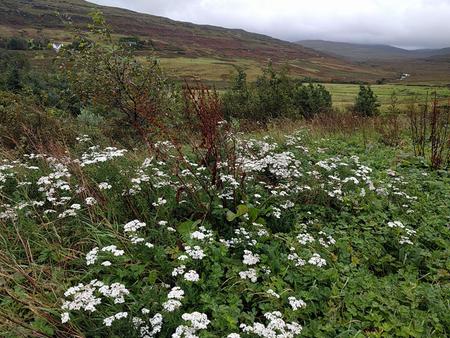
I think some herbs and flowers will definitely be wanted. I'll probably end up with silverweed and yarrow at the very least as both of those have established populations in the area.

yarrow blooming on a Scottish hillside
Yarrow at edge of potential zone


Mostly I'm looking for vegetable that you pick and use straight away. Day lillies are a good suggestion, thank you, as those tend to produce little and often! I do have some, but am yet to experiment much with eating them. Mine are a bit small (possibly due to being on poorer soil) so don't have very long leaves for craft work.
At the moment I'm thinking of unedged raised beds to give deeper soil and better drainage. This area is below where the animal barns were, and the soil is pretty good and dark with organic material. So I'm excited to start to grow food there!
 
Nancy Reading
steward and tree herder
Posts: 11895
Location: Isle of Skye, Scotland. Nearly 70 inches rain a year
6011
5
transportation dog forest garden foraging trees books food preservation woodworking wood heat rocket stoves ungarbage
  • Mark post as helpful
  • send pies
    Number of slices to send:
    Optional 'thank-you' note:
  • Quote
  • Report post to moderator
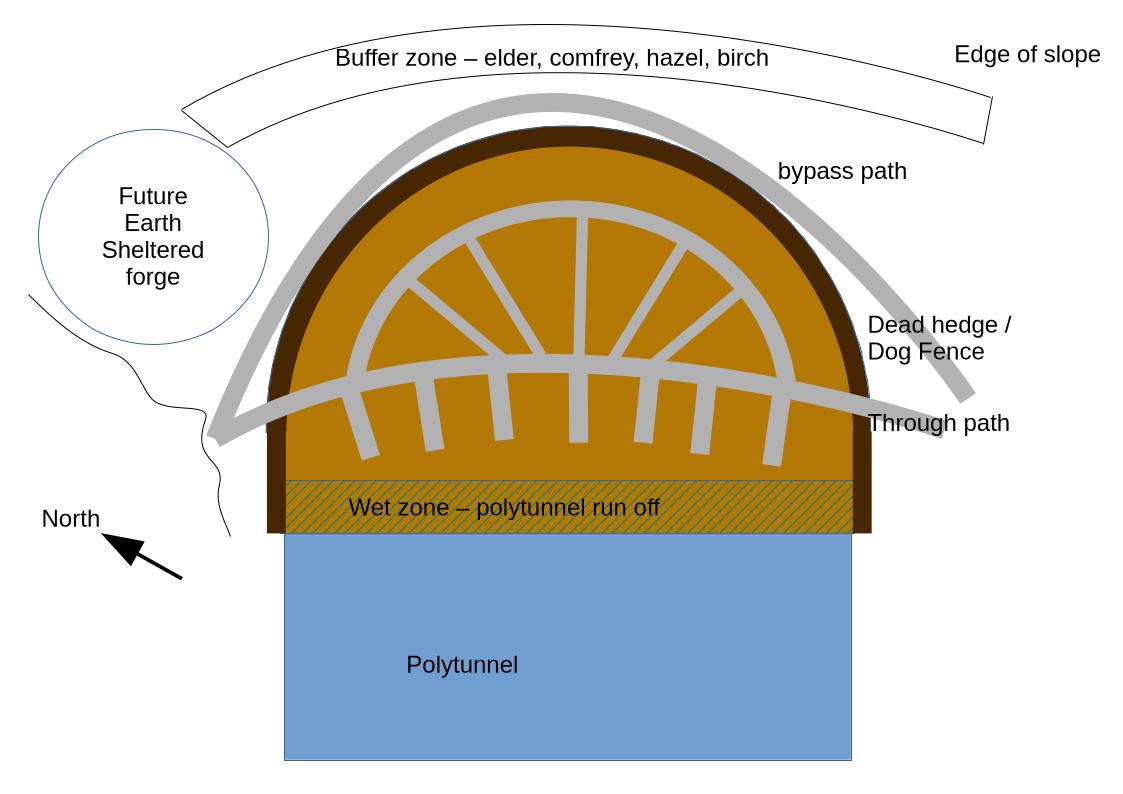
Inspired by Christopher's mention of Toby Hemenway's designs of recurring keyhole designs here I have come up with a concept for consideration. I'll need to walk through what I'm now calling the kitchen garden, so it will have a path running roughly parallel to the polytunnel, which will lead down the hill and to the far end of the tunnel. I could actually walk through the polytunnel and back through the garden (or vice versa) in a hunt for the day's dinner.
One of my limiting factors is wind, the chill effect on the plants is more significant than getting sun through the day. I'm therefore contemplating a series of keyhole gardens off the central spine path with raised growing areas surrounded by much taller perennial plants and shrubs to give shelter. These beds might be planted in a random polyculture, or with a different crop in each. Having keyhole lobes like this will encourage lingering when I want to work in a particular bed. I would make the actual bed area only an arm's width from the centre standing area to the outer edge. So they will individually be quite small. I'll have to measure out the actual area - maybe there will be room for a third row of keyholes and a second path.
I haven't decided what to do with the band along the polytunnel, which is likely to be rather damp as the rainwater from the East half of the tunnel will collect there. Likely to be standing water after rain, which will then gradually dry out. Opportunities for plants like wasabi, water cress, skirret... so I may want some gaps between the keyhole beds for access occasionally, as the damp soil will not be conducive to a second path there.
keyhole_garden_design-1.jpg
concept keyhole kitchen garden
 
gardener
Posts: 392
Location: Southern Ontario, 6b
276
cat forest garden food preservation cooking writing ungarbage
  • Likes 2
  • Mark post as helpful
  • send pies
    Number of slices to send:
    Optional 'thank-you' note:
  • Quote
  • Report post to moderator
The stuff I really like having close are what I use often. It can be overwhelming, but lovage is one I grab a leaf or 2 from very frequently. Stocks, soups, chopped salads, egg and potato salads, omlets or quiche. All can use a bit. ( you can do celery instead, but the lovage is much easier)
Carrots, parsely, nasturtiums, lemongrass, garlic, sage, purslane. Even the bronze leaf fennels are handy to have close. I don't like having to go far once a meal making process is underway.
I also agree on the beans, peas and any other alliums and greens you can get to take there.
 
Ac Baker
pioneer
Posts: 340
81
cat trees urban
  • Likes 2
  • Mark post as helpful
  • send pies
    Number of slices to send:
    Optional 'thank-you' note:
  • Quote
  • Report post to moderator
I love this concept!

I'm just thinking about access to the polytunnel runoff wet zone ..  Could you have the keyholes on that side about twice as deep, to give access to that space without any  extra paths?

Could you prepare some of the keyhole beds with the no-dig deep mulch potato method? Have you got enough suitable mulch? Maybe early potatoes to harvest one plant at a time for summer dinners, so you get the planting space back quicker? Would that be enough to clear the existing growth?

Exciting!
 
Nancy Reading
steward and tree herder
Posts: 11895
Location: Isle of Skye, Scotland. Nearly 70 inches rain a year
6011
5
transportation dog forest garden foraging trees books food preservation woodworking wood heat rocket stoves ungarbage
  • Mark post as helpful
  • send pies
    Number of slices to send:
    Optional 'thank-you' note:
  • Quote
  • Report post to moderator

Ac Baker wrote:I'm just thinking about access to the polytunnel runoff wet zone ..  Could you have the keyholes on that side about twice as deep, to give access to that space without any extra paths?


More like a feather pattern perhaps, or a fish gill?

Could you prepare some of the keyhole beds with the no-dig deep mulch potato method? Have you got enough suitable mulch? Maybe early potatoes to harvest one plant at a time for summer dinners, so you get the planting space back quicker? Would that be enough to clear the existing growth?


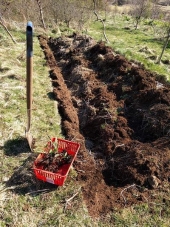
I'm expecting a fair amount of the area to be pretty clear soil eventually, as it is partly covered with the excavated soil from inside the tunnel, which has been there for over a year. Moving that back inside the tunnel footprint will be my winter job this year (or one of them)! Then I can plan out the area properly.
 
Nancy Reading
steward and tree herder
Posts: 11895
Location: Isle of Skye, Scotland. Nearly 70 inches rain a year
6011
5
transportation dog forest garden foraging trees books food preservation woodworking wood heat rocket stoves ungarbage
  • Mark post as helpful
  • send pies
    Number of slices to send:
    Optional 'thank-you' note:
  • Quote
  • Report post to moderator
I paced out the area today, and it is much more square than I'd thought. There is about 18 paces to the edge of the escarpment at both ends of the polytunnel and the polytunnel is a little more than 18 paces long at 45 feet. Even with a bit of a 'wet bed' beside the tunnel and a buffer/wind barrier at the edge of the escarpment, I'll have a fair amount of space - of course I don't need to develop it all at once. Doing it in some sort of modular fashion seems wise.
 
Evildoers! Eat my justice! And this tiny ad's justice too!
Large Lot for Sale Inside an Established Permaculture Community — Bejuco, Costa Rica
https://permies.com/t/366607/Large-Lot-Sale-Established-Permaculture
reply
    Bookmark Topic Watch Topic
  • New Topic