• Post Reply Bookmark Topic Watch Topic
  • New Topic
permaculture forums growies critters building homesteading energy monies kitchen purity ungarbage community wilderness fiber arts art permaculture artisans regional education skip experiences global resources cider press projects digital market permies.com pie forums private forums all forums
this forum made possible by our volunteer staff, including ...
master stewards:
  • Carla Burke
  • John F Dean
  • r ransom
  • Nancy Reading
  • Timothy Norton
  • Jay Angler
stewards:
  • paul wheaton
  • Pearl Sutton
  • Eric Hanson
master gardeners:
  • Christopher Weeks
  • M Ljin
gardeners:
  • thomas rubino
  • Megan Palmer
  • Benjamin Dinkel

Design help needed for RMH fitment.

 
pollinator
Posts: 5842
Location: Bendigo , Australia
524
plumbing earthworks bee building homestead greening the desert
  • Likes 9
  • Mark post as helpful
  • send pies
    Number of slices to send:
    Optional 'thank-you' note:
  • Quote
  • Report post to moderator
I have a small 6M x 4M room, with a 16ft cathedral ceiling.
The timber floor is on 900mm high stumps.
There is plenty of room under the floor.
How would I install a RMH and what type please?
Will steel columns under the floor work? That is easier for me.
What floor print would be taken up ?
Thanks in advance.
 
Posts: 805
Location: Sierra Nevada foothills, 350 m, USDA 8b, sunset zone 7
173
  • Likes 9
  • Mark post as helpful
  • send pies
    Number of slices to send:
    Optional 'thank-you' note:
  • Quote
  • Report post to moderator
John,

For such a room in Australia, probably a Batch Box Rocket of fi 125mm size would be enough.
Is it the only room in the building? Is it masonry, insulated? We could do heat loss calculation.
If fi 125 was chosen then you could do 60x80 cm inner bell size which with single skin would result in 82x102 cm footprint (assuming 11 cm wide bricks in Australia). It would weigh over a ton.
Steel columns would probably work if they were topped with some reinforced small slab on which you could build the heater.
 
Rocket Scientist
Posts: 866
Location: Province of Granada, Andalucía, Spain
628
6
cooking rocket stoves woodworking wood heat
  • Likes 7
  • Mark post as helpful
  • send pies
    Number of slices to send:
    Optional 'thank-you' note:
  • Quote
  • Report post to moderator
Have you checked out the cottage rocket that was designed by Uncle Mud?

https://permies.com/t/40/265502/Cottage-Rocket-experience-building

Seems like a good fit for a small room. You probably wouldn’t need any reinforcements of the floor.
 
Rocket Scientist
Posts: 4717
Location: Upstate NY, zone 5
665
5
  • Likes 6
  • Mark post as helpful
  • send pies
    Number of slices to send:
    Optional 'thank-you' note:
  • Quote
  • Report post to moderator
How cold does it get where you are, and for how long? If you do not consistently have weeks of below freezing, you likely do not need much mass for long-term heating, and a cottage rocket or similar would probably work without the need for structural enhancement.
 
John C Daley
pollinator
Posts: 5842
Location: Bendigo , Australia
524
plumbing earthworks bee building homestead greening the desert
  • Likes 5
  • Mark post as helpful
  • send pies
    Number of slices to send:
    Optional 'thank-you' note:
  • Quote
  • Report post to moderator
The house is about 800 sq. ft, weatherboard walls, timber clad walls inside, floor, wall and roof insulation.
Small windows and double glazed windows with the central room I am asking about.
Temps go down to - 4 C in winter.
We do not get ice or snow here.
Having the long heat bank style of warmth interests me, since others would benefit.
Where do I find details of 'Batch Box Rocket of fi 125mm size'

I had wondered if the new heater Thomas was building would suit?
 
Glenn Herbert
Rocket Scientist
Posts: 4717
Location: Upstate NY, zone 5
665
5
  • Likes 8
  • Mark post as helpful
  • send pies
    Number of slices to send:
    Optional 'thank-you' note:
  • Quote
  • Report post to moderator
The heaters that Thomas has built would be much bigger than you need, but you could certainly use the same methods on a smaller scale. A 125mm (5") size system could be quite compact and not take much floor space, especially as you wouldn't need the large clearances to combustibles that a wood stove needs.

The majority of published builds are 6" systems, so brick layouts for the combustion core would likely need to be worked out from scratch. Batch boxes require close adherence to specified internal proportions. If you do not need full heat all day every day, you might do well with a J-tube build which is very easy to do without welded parts. With an hour or two of part time attention you can have warmth for the day/evening, into the next morning.
 
master rocket scientist
Posts: 6947
Location: latitude 47 N.W. montana zone 6A
3947
cat pig rocket stoves
  • Likes 7
  • Mark post as helpful
  • send pies
    Number of slices to send:
    Optional 'thank-you' note:
  • Quote
  • Report post to moderator
Hi John;
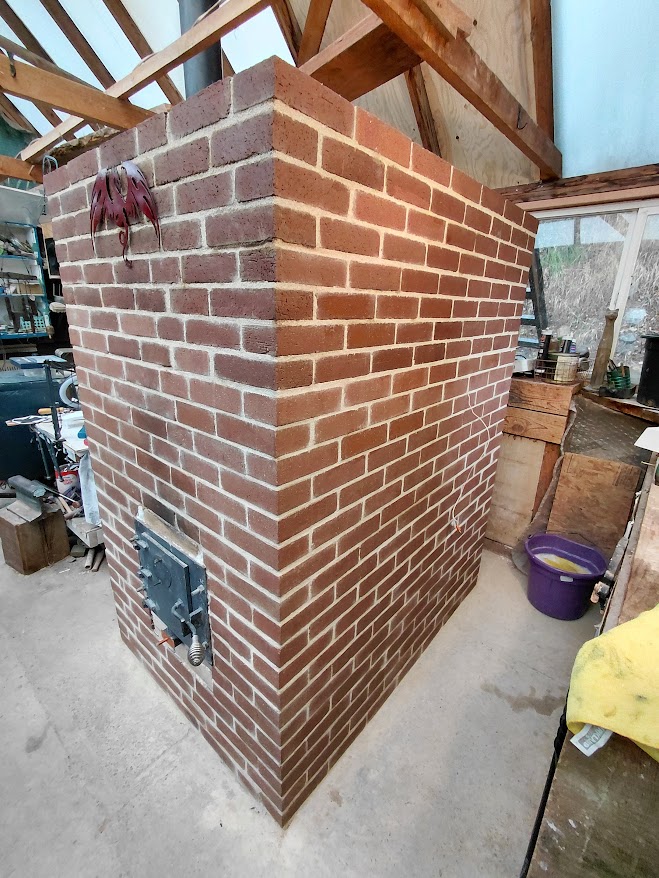
My new double skin Batchbox is much more than I think you would need down under.
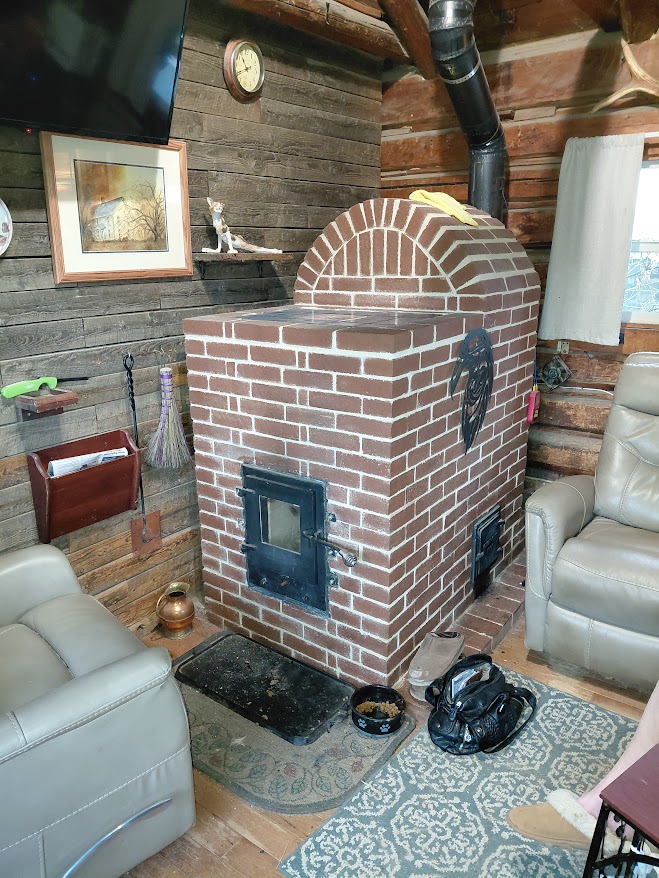
My Shorty core build with a single skin would be more appropriate in a mild climate.
However, my six-inch core is still more than you want.  It has a footprint of 4' x 5' (122cm x 152cm)
Peter used a 5" Shorty core to develop the Shorty design.
He would be happy to share them with you if you were to ask him.

A double skin brick bell uses apx 1000 clay bricks plus firebricks, it weighs in at 6000-7000 pounds, (2721.5 -3175 kilos)
My 6" single skin Shorty has apx 500 clay bricks plus firebricks, it weighs in apx 2500 pounds or 134 kilos.

From a cold (but dry) start, a full single-skin masonry bell will take apx 2 hours to start throwing heat, although the steel door will shed heat quickly.
A full double skin will take 4 hours or more to show heat.

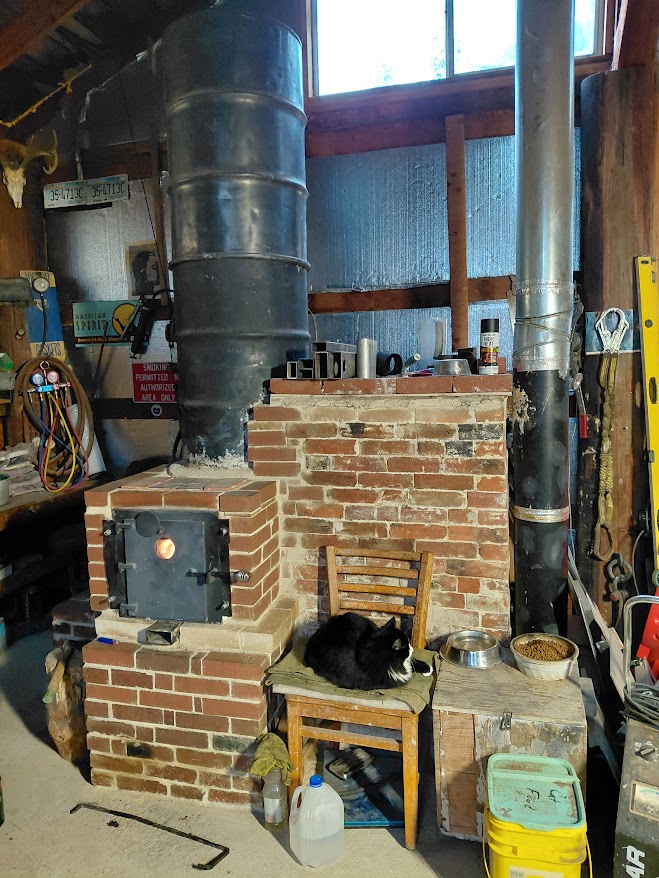
You may benefit from a hybrid design like my Shop stove, which utilizes barrels and a brick masonry bell.
This design sheds heat quickly into your home, and it also has mass storage in the brick bell.
Its weight would be less.


20251106_103846.jpg
The Shop Dragon
The Shop Dragon
20251106_104104.jpg
Shorty core
Shorty core
20251101_135805.jpg
double skin Studio dragon
 
John C Daley
pollinator
Posts: 5842
Location: Bendigo , Australia
524
plumbing earthworks bee building homestead greening the desert
  • Likes 4
  • Mark post as helpful
  • send pies
    Number of slices to send:
    Optional 'thank-you' note:
  • Quote
  • Report post to moderator
I am getting a drift of what will work for me, thanks.
But now I am wondering how is a good way to operate these heaters since they need time to get hot.
Do you feed them every few hours?
Do you feed it continuously?
Do you feed them once a day?
 
thomas rubino
master rocket scientist
Posts: 6947
Location: latitude 47 N.W. montana zone 6A
3947
cat pig rocket stoves
  • Likes 5
  • Mark post as helpful
  • send pies
    Number of slices to send:
    Optional 'thank-you' note:
  • Quote
  • Report post to moderator
In your climate, once a day should be more than enough.
Only in a Northern environment would you need to burn more than that.
 
John C Daley
pollinator
Posts: 5842
Location: Bendigo , Australia
524
plumbing earthworks bee building homestead greening the desert
  • Likes 2
  • Mark post as helpful
  • send pies
    Number of slices to send:
    Optional 'thank-you' note:
  • Quote
  • Report post to moderator
how do i contact

Peter used a 5" Shorty core to develop the Shorty design.
He would be happy to share them with you if you were to ask him.


thanks
 
John C Daley
pollinator
Posts: 5842
Location: Bendigo , Australia
524
plumbing earthworks bee building homestead greening the desert
  • Likes 2
  • Mark post as helpful
  • send pies
    Number of slices to send:
    Optional 'thank-you' note:
  • Quote
  • Report post to moderator
I find the myriad of styles, types and sizes confusing.

I had a look at the site https://batchrocket.eu/en/building#size and it came up with a need for 2.4Kw of heat with a 20 deg. C temp. difference.
So the formula it suggests for heater size is Q = G*V*DT with Q being the heat losses (W), G being the insulation factor, V the volume of the house (m3), and DT the required difference of temperature between the exterior and the interior (°C).
G is estimated in comparison to a set of classical values, listed below:
- 1.8 for an old, leaky, stone and clay mortar house (classical french farmhouses)
- 1.6 for a house in bricks, stones or breeze blocks without insulation
- 1.4 for a house insulated with 4 cm of polystyrene
- 1.2 for a house insulated with 10 cm of polystyrene
- 0.8 for a recent house with 37 cm thick insulating clay bricks for example
- 0.5 for a strawbale house for example
From its chart this may apply - 150 mm — 6.0 kg — 1.9 kW

The next step is to calculate the power of each batchrocket, as a function of its internal diameter (i.e. heat riser diameter). By default, the power of a heater is defined as the mean power it delivers on a 24h period with two fires a day. This power is calculated by considering an overall efficiency of 80%. With this efficiency, the combustion of a kilogram of air-dried wood will deliver 3.7 kWh of energy.

The bigger the internal diameter, the heavier the load of wood for each fire:
Internal diameter (mm) -- Wood load (kg) -- Mean power considering two fires a day (kW)
CHART
125 mm — 3.5 kg — 1.1 kW
140 mm — 4.9 kg — 1.5 kW
150 mm — 6.0 kg — 1.9 kW
175 mm — 9.5 kg — 2.9 kW
200 mm — 14.2 kg — 4.4 kW
230 mm — 21.6 kg — 6.7 kW
250 mm — 27.8 kg — 8.6 kW

From this chart it seems a 1.9 Kw system is needed at my place.
Is this the way others read it?
 
It's never done THAT before. Explain it to me tiny ad:
Learn Permaculture through a little hard work
https://wheaton-labs.com/bootcamp
reply
    Bookmark Topic Watch Topic
  • New Topic