
• Post Reply Bookmark Topic Watch Topic
  • New Topic
permaculture forums growies critters building homesteading energy monies kitchen purity ungarbage community wilderness fiber arts art permaculture artisans regional education skip experiences global resources cider press projects digital market permies.com pie forums private forums all forums
this forum made possible by our volunteer staff, including ...
master stewards:
  • Nancy Reading
  • Carla Burke
  • John F Dean
  • Timothy Norton
  • r ransom
  • Jay Angler
  • Pearl Sutton
stewards:
  • Devaka Cooray
  • Leigh Tate
  • paul wheaton
master gardeners:
  • Christopher Weeks
gardeners:
  • M Ljin
  • thomas rubino
  • Megan Palmer

wood chips: optimum depth over bare soil? over grasses?

 
Posts: 10015
Location: a temperate, clay/loam spot on planet earth, the universe
3180
4
  • Likes 11
  • Mark post as helpful
  • send pies
    Number of slices to send:
    Optional 'thank-you' note:
  • Quote
  • Report post to moderator
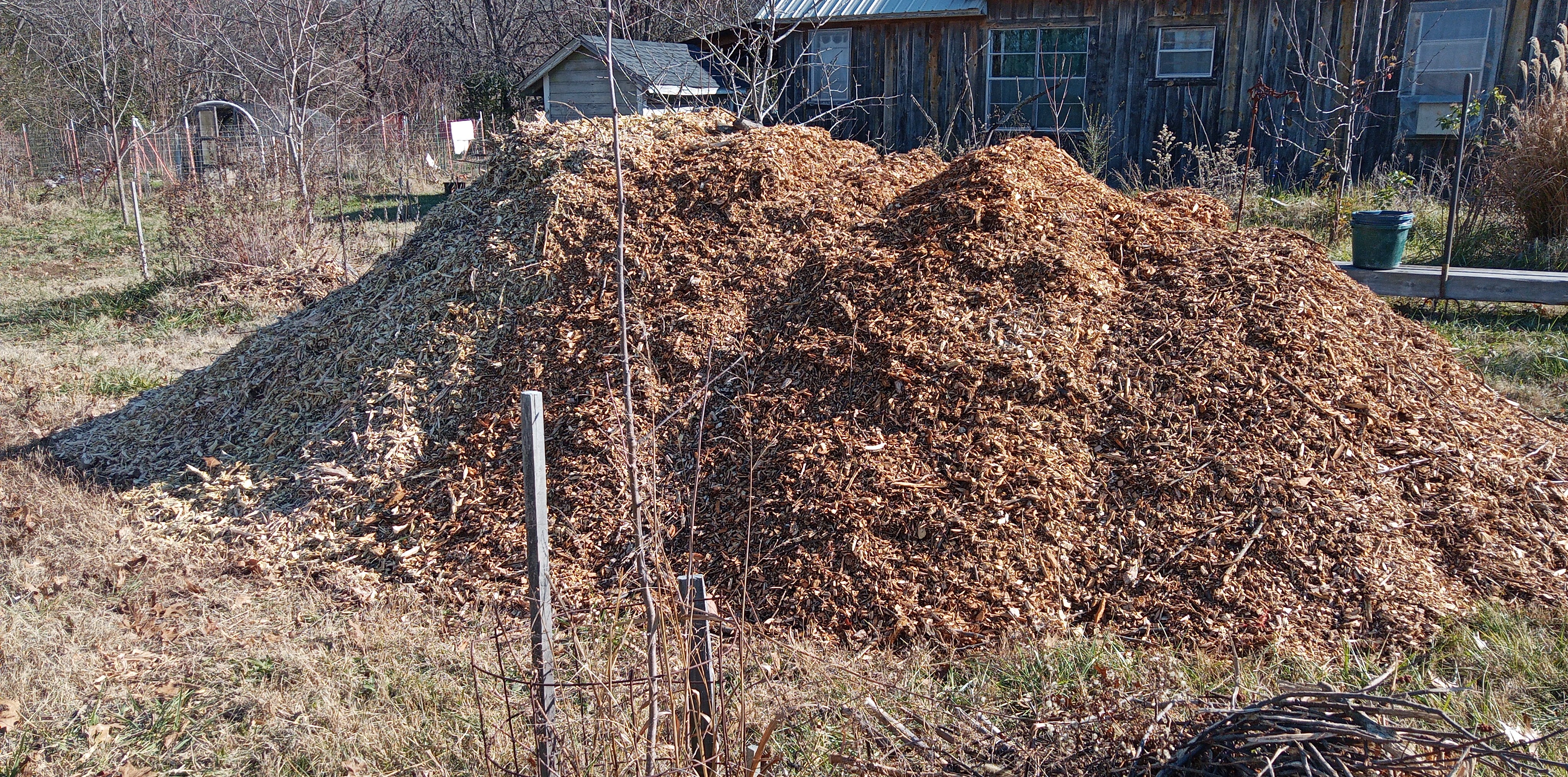
We have a windfall of fresh wood chips.
The first load went to places here that we knew would benefit and now we have two more loads to play with.

We don't use paper or cardboard so looking at some areas with little to a lot of grasses and other annual plant growth.
What depth for soil benefits?
What depth will smother most plant growth?  (bermuda is hopeless I know)

We've used them so far in some garden beds to a depth of 6-8" and in paths and around fruit trees.

Thoughts?


IMG_20251209_123753_304-2.jpg
wood chips
wood chips
 
pollinator
Posts: 639
Location: Zone 8A
132
homeschooling kids rabbit tiny house books chicken composting toilet medical herbs composting homestead
  • Likes 14
  • Mark post as helpful
  • send pies
    Number of slices to send:
    Optional 'thank-you' note:
  • Quote
  • Report post to moderator
Judith, we've found there are some factors other than wood chip depth that will determine if the grass will come up through the chips.

Wood chip make up/size, the amount of rain we get and if the grass is dormant.

If we apply a 8" layer of finer chips (less than 1" in length/diameter) over dormant grass in late fall or winter, with no cardboard underneath, there may be a little grass pop up here and there but nothing a little weeding can't manage. The amount of rain we get seems to also have an impact. The more rain, the more likely to have to do some weeding of grass that will pop through. That same 8" would not work, without cardboard, when the grass is growing unless it was tarped first to slow the growth of the grass.

If the chips are larger, 12" seems to work about the same as the 8" of finer chips over dormant grass.

6" seems to be adequate on bare soil.

 
Steward of piddlers
Posts: 7175
Location: Upstate New York, Zone 5b, 43 inch Avg. Rainfall
3803
monies home care dog fungi trees chicken food preservation cooking building composting homestead
  • Likes 8
  • Mark post as helpful
  • send pies
    Number of slices to send:
    Optional 'thank-you' note:
  • Quote
  • Report post to moderator
I have been utilizing wood chip to convert lawn into growing spaces for the past three years. I use exclusively arborist chip with good results. I first started with a biodegradable smother layer but have now switched to just utilizing chip.

I have found that around 5-6" is the minimum to get the best bang for your buck. While there might be a few plants that work their way through, by the time they do they are easily plucked from the soil with roots mostly intact. After a year of settling, reapplying another smaller layer (2") of chip may be warranted.

Where I live, I get a fair amount of rain which seems to help chew up the chip and enrich the soil so topping off chipped areas is an annual task for me. After the initial application, I may use things like sawdust or straw if I have it available instead of chip.
 
Posts: 106
Location: Colorado Springs, CO [Zone: 5B/6A]
25
hugelkultur goat fungi gear hunting building writing woodworking
  • Likes 6
  • Mark post as helpful
  • send pies
    Number of slices to send:
    Optional 'thank-you' note:
  • Quote
  • Report post to moderator
I never exceed 3", but with fresh leaves and course chips, I may go around 4"-6".

I often use a layer of humus to protect my berms over the winter. I noticed that if I go over 3" it becomes difficult for water and melting snow to penetrate. Same deal with fine wood chips and half-decomposed compressed leaves.
 
Judith Browning
Posts: 10015
Location: a temperate, clay/loam spot on planet earth, the universe
3180
4
  • Likes 8
  • Mark post as helpful
  • send pies
    Number of slices to send:
    Optional 'thank-you' note:
  • Quote
  • Report post to moderator
thanks to all!

Your responses have given me some better ideas!

The first load was more shredded than chipped with lots of loose twigs and green leaves.

These most recent loads are woodier, no leaves and around 1"chips with a good amount of sawdust.

We generally get a lot of rain over the winter so I think adding layers gradually as they get soaked might be best.

I don't want to have to add edges to beds or fruit tree rings so letting the layers compact might help keep in place...I hope.

...and winecaps in the spring Eric  
 
Steward and Man of Many Mushrooms
Posts: 6025
Location: Southern Illinois
1850
transportation cat dog fungi trees building writing rocket stoves woodworking
  • Likes 8
  • Mark post as helpful
  • send pies
    Number of slices to send:
    Optional 'thank-you' note:
  • Quote
  • Report post to moderator
Hi Judith,

I know that I am a little late to this party but I will add in my two cents anyways.

Given your conditions, my thoughts are that a 12" minimum depth would be required to smother out other grasses and competing plants.  And 12" really might not be enough.  For some of those deeply rooted broadleaf plants, maybe 24".  For Bermuda Grass--maybe 72" and even that might not be enough (Bermuda just does not want to quit for anything!)

But after that first year, I would thin down a LOT--perhaps to 6"--and maybe consider using some of the excess to start a new bed or just top off some other place.  The real magic happens when you look at what used to be the surface layer between the soil and the chips--they sort of merge together and there is no clear soil or chip layer.


Nice to have all those chips--good luck!


Eric
 
Eric Hanson
Steward and Man of Many Mushrooms
Posts: 6025
Location: Southern Illinois
1850
transportation cat dog fungi trees building writing rocket stoves woodworking
  • Likes 5
  • Mark post as helpful
  • send pies
    Number of slices to send:
    Optional 'thank-you' note:
  • Quote
  • Report post to moderator
Oh, and one other thing---when you are getting great big dumps of "chips", it is actually more likely that you will get beaten up. shredded chunks of wood rather than chips.  In order to get nice little chips, the blades of the chipper need to be very sharp.  Great big chipping projects dull the blades quickly so the those huge loads tend to shift from chips to shredded chunks rather quickly.  Whenever I have done any of my great big chipping projects, the blades have definitely dulled by the end of the project, which is the end of a solid day of hard chipping.  I get monstrous piles of "chips" which are really beaten up, shredded chunks with the occasional long shredded and beaten up strip of bark & stringy woody fiber.

Moving those chunks, and especially the long strips is strangely awkward.  It certainly can be done, but stuff tends to flop all over the place.


Again, good luck!


Eric
 
pollinator
Posts: 4229
Location: Tennessee 7b
349
  • Likes 4
  • Mark post as helpful
  • send pies
    Number of slices to send:
    Optional 'thank-you' note:
  • Quote
  • Report post to moderator
Oh yeah, there was I reason I had 4, 5, 6, and 8 tine pitchforks. The bigger the shred, the fewer tines work better. P
 
Eric Hanson
Steward and Man of Many Mushrooms
Posts: 6025
Location: Southern Illinois
1850
transportation cat dog fungi trees building writing rocket stoves woodworking
  • Likes 4
  • Mark post as helpful
  • send pies
    Number of slices to send:
    Optional 'thank-you' note:
  • Quote
  • Report post to moderator
I have a pitch fork and a garden fork.  I use either one depending on the size of the chips.
 
steward
Posts: 18356
Location: USDA Zone 8a
4658
dog hunting food preservation cooking bee greening the desert
  • Likes 6
  • Mark post as helpful
  • send pies
    Number of slices to send:
    Optional 'thank-you' note:
  • Quote
  • Report post to moderator

Judith said, What depth will smother most plant growth?  (bermuda is hopeless I know)


6 to 12 inches for optimal results.

Since Bermuda travels underground it might be a good idea to cover a larger area than necessary and check for Bermuda rhizomes.
 
Posts: 1045
Location: In the woods, West Coast USA
217
  • Likes 4
  • Mark post as helpful
  • send pies
    Number of slices to send:
    Optional 'thank-you' note:
  • Quote
  • Report post to moderator
Probably the first thing to consider is what type of wood are the wood chips from?  

On the West Coast wood chips tend to be redwood or cedar which have a lot of suppressant qualities to them.  Other parts of the country vary as to type, and that can make a big difference.

Despite the suppressant qualities, it won't be long before the layer of broken-down chips on top of the soil and below the top layer of the chips will break down, giving everything a real growing boost, at least in my experience.

Grasses are suited to the area they grow in, so I've found suppressing them is harder than suppressing weeds.  Some grasses are annuals, some are perennials and those take different depths of chips.  

After major West Coast fires where everyone chips the burned trees and dumps the results in deep piles, weeds/grasses are suppressed under 5+ inches, hand depth, but that only works until the chips break down like I've described above, even if you keep adding chips to make sure it stays at 5".

I've got perennial timothy grass that was planted decades ago for cattle, and it's a real pain.  It thrives on wood chips.  I keep as much of it mowed as I can, and shovel out clumps in areas where it just can't exist for the sake of the plants it overruns.

The only thing I've found is either cover things with plywood (too expensive, and gives chewing bugs cover) or make sure you catch weeds and grasses when they are little, and less work to get out.

Despite that, I like 4" of chips over clay soil, which keeps the sun off the soil and the pounding rain, which turns out to solidify clay as well.


I didn't like the taste of tongue and it didn't like the taste of me. I will now try this tiny ad:
Learn Permaculture through a little hard work
https://wheaton-labs.com/bootcamp
reply
    Bookmark Topic Watch Topic
  • New Topic