
gift
Willie Smits: Village Based Permaculture Approaches in Indonesia (video)
will be released to subscribers in: soon!
  • Post Reply Bookmark Topic Watch Topic
  • New Topic
permaculture forums growies critters building homesteading energy monies kitchen purity ungarbage community wilderness fiber arts art permaculture artisans regional education skip experiences global resources cider press projects digital market permies.com pie forums private forums all forums
this forum made possible by our volunteer staff, including ...
master stewards:
  • Carla Burke
  • Nancy Reading
  • r ransom
  • John F Dean
  • paul wheaton
  • Jay Angler
stewards:
  • Timothy Norton
  • Pearl Sutton
  • Tereza Okava
master gardeners:
  • Christopher Weeks
  • M Ljin
gardeners:
  • Jeremy VanGelder
  • Matt McSpadden
  • thomas rubino

RMH with cob stratification chamber bench - how to actually build the shape.

 
Posts: 23
Location: Northern Ireland north coast.
2
  • Likes 7
  • Mark post as helpful
  • send pies
    Number of slices to send:
    Optional 'thank-you' note:
  • Quote
  • Report post to moderator
HI All,

I've been reading back and forth for a good while and want to go with a stratification chamber/bell in the traditional RMH style.

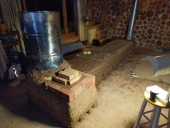
I'm struggling to work out the best way to build it using cob.  With regard structure I can't find any good information on building a bench with cob that won't collapse during the building process.

Anyone able to point me in the right direction?

John  
 
master rocket scientist
Posts: 7009
Location: latitude 47 N.W. montana zone 6A
4057
cat pig rocket stoves
  • Likes 9
  • Mark post as helpful
  • send pies
    Number of slices to send:
    Optional 'thank-you' note:
  • Quote
  • Report post to moderator
Hi John;
The trick is to use a locally available material for the walls and roof.
For example, concrete blocks, large square stones, or clay bricks. Some folks use metal; you can even use wood as your box, away from the core (J-Tube).
Then there is the Walker, half-barrel bench.
Any of these materials can be finished with cob if desired.

For your core, firebricks are the most common.  Clay bricks can be used, but they will not last long term.
Or, you can use fireclay mixed with perlite and cast a core yourself.
 
Posts: 857
Location: Sierra Nevada foothills, 350 m, USDA 8b, sunset zone 7
187
  • Likes 8
  • Mark post as helpful
  • send pies
    Number of slices to send:
    Optional 'thank-you' note:
  • Quote
  • Report post to moderator
John,

if you want to build the bench from the cob then you will have to work in increments, let's say 10 cm high per day or just cast some cob bricks and then use them as normal bricks. Not in all locations though, as cob bricks would be not the best choice to span openings unless some angle bar was used for support.
 
Rocket Scientist
Posts: 4748
Location: Upstate NY, zone 5
689
5
  • Likes 8
  • Mark post as helpful
  • send pies
    Number of slices to send:
    Optional 'thank-you' note:
  • Quote
  • Report post to moderator
The rate at which you can build up cob depends on its composition and wetness. More straw makes it stiffer, as does less water. More straw also makes it more insulating and less massive, so there is a tradeoff. I have found that a mix stiff enough to stand but not so stiff as to have a poor bond with a preceding dry course can rise 8"/20cm a day. For best structure and airtightness it is best to keep building so the previous course has not dried past solid stiffness when new cob is added.

 
John Wilkinson
Posts: 23
Location: Northern Ireland north coast.
2
  • Likes 5
  • Mark post as helpful
  • send pies
    Number of slices to send:
    Optional 'thank-you' note:
  • Quote
  • Report post to moderator
Hi Thomas, Cristobal and Glenn,

Thank you all for the replies.  Very helpful.

Another related question.
Once the walls of the bench have been raised to an appropriate height I would need some form of frame or internal pillars to hold up the cob 'roof'.  any suggestions in this regard.

John
 
Glenn Herbert
Rocket Scientist
Posts: 4748
Location: Upstate NY, zone 5
689
5
  • Likes 6
  • Mark post as helpful
  • send pies
    Number of slices to send:
    Optional 'thank-you' note:
  • Quote
  • Report post to moderator
I wouldn't make the roof from just cob. You want solid slabs of something to cover with several inches of cob. It could be flat stones, concrete pavers, or anything strong and noncombustible.
 
John Wilkinson
Posts: 23
Location: Northern Ireland north coast.
2
  • Likes 4
  • Mark post as helpful
  • send pies
    Number of slices to send:
    Optional 'thank-you' note:
  • Quote
  • Report post to moderator
Hi Glenn,
My desire to have the cob is significant partly due to aesthetics.
If I were to use concrete pavers are you saying I could mask them with a layer of cob?
 
thomas rubino
master rocket scientist
Posts: 7009
Location: latitude 47 N.W. montana zone 6A
4057
cat pig rocket stoves
  • Likes 6
  • Mark post as helpful
  • send pies
    Number of slices to send:
    Optional 'thank-you' note:
  • Quote
  • Report post to moderator
Hey John;
I mentioned the Walker half-barrel method.
It occurred to me that you may not know what that is.
55-gal barrels are cut in half lengthwise and set end to end on the walls for the length of your bench.
The ends are removed, other than a couple of inches, to retain the rounded shape, and cob is used over the barrels.
 
Cristobal Cristo
Posts: 857
Location: Sierra Nevada foothills, 350 m, USDA 8b, sunset zone 7
187
  • Likes 5
  • Mark post as helpful
  • send pies
    Number of slices to send:
    Optional 'thank-you' note:
  • Quote
  • Report post to moderator
You can build some brick pillars and span the ceiling with more bricks and then cob it over, or leave them as they are, because sitting on bricks is more practical than on cob, since they are harder and more resistant to damage.
 
Glenn Herbert
Rocket Scientist
Posts: 4748
Location: Upstate NY, zone 5
689
5
  • Likes 7
  • Mark post as helpful
  • send pies
    Number of slices to send:
    Optional 'thank-you' note:
  • Quote
  • Report post to moderator
Pavers would just be a structural base, same with laid-up bricks. Cob makes beautiful organic forms, but a cob finish on a bench would be constantly shedding dust and getting pants dirty. You need a shield or sealer, like lime plaster or tiles or an oil that strengthens cob surfaces. Bricks can be made organic as a seat, stone slabs not so much.
 
Posts: 393
Location: North East Iowa, USA
119
  • Likes 6
  • Mark post as helpful
  • send pies
    Number of slices to send:
    Optional 'thank-you' note:
  • Quote
  • Report post to moderator

thomas rubino wrote:Hey John;
I mentioned the Walker half-barrel method.
It occurred to me that you may not know what that is.
55-gal barrels are cut in half lengthwise and set end to end on the walls for the length of your bench.
The ends are removed, other than a couple of inches, to retain the rounded shape, and cob is used over the barrels.


If you find barrels with removable tops ( banded barrel lids )  you are well on your way to saving a lot of work.  All barrels have a seam from bottom to top.
Determine which side of the seam is the single thickness for easier cutting. You can tell by looking.
Take a string before cutting, to go from this cut line all around the barrel to where you started.
Take string and just double it over so you have both ends in one hand.
Lay back on barrel and mark this 1/2 way point on opposite side of the seam, and do  on both ends of barrel. Thus one barrel gives you two perfect halves. No lop sided halves, but darn close to ideal.

A zip disk works well for this, no torch required, just your standard 4.5" angle grinder.  A very thin disk works well ( 1/16" )

Best of success.
 
Rocket Scientist
Posts: 584
Location: Northwest Missouri
251
forest garden fungi gear trees plumbing chicken cooking ungarbage
  • Likes 6
  • Mark post as helpful
  • send pies
    Number of slices to send:
    Optional 'thank-you' note:
  • Quote
  • Report post to moderator

John Wilkinson wrote:Hi Glenn,
My desire to have the cob is significant partly due to aesthetics.
If I were to use concrete pavers are you saying I could mask them with a layer of cob?


Masking concrete block is exactly what I'll be doing this week. I also want to use cob, but that will come later in the season when things warm up. In the meantime, I don't want to look at blocks in my dining room so I'll be applying a product called lime wash. It bonds with the concrete but keeps open pores (unlike paint) which should make it still receptive to cob later on. If I like the lime wash look, I might even skip the cob!

There are recipes out there to make your own. I'm cheating and buying a ready made version from Lowes.
 
Cristobal Cristo
Posts: 857
Location: Sierra Nevada foothills, 350 m, USDA 8b, sunset zone 7
187
  • Likes 7
  • Mark post as helpful
  • send pies
    Number of slices to send:
    Optional 'thank-you' note:
  • Quote
  • Report post to moderator
Matt, I have checked the limewash from Lowes.  Someone surely found a way to turn limestone (in this case dolomitic) into gold. 1 liter costs $20 (if 15 l purchased). When I make it myself from high calcium line the cost per liter is $0.30. I limewash entire buildings.
 
pioneer
Posts: 342
35
chicken wood heat rocket stoves
  • Likes 6
  • Mark post as helpful
  • send pies
    Number of slices to send:
    Optional 'thank-you' note:
  • Quote
  • Report post to moderator
You could make a long arch frame out of a decent gage wire fence material.  Then soak some burlap in clay slip and drape it over the frame.  Begin adding your cob from the bottom and work your way to the top.  Shape as needed to get your bench.
 
Evildoers! Eat my justice! And this tiny ad's justice too!
Looking for cold-climate growers to join a GOOF livestream panel (Missoula)
https://permies.com/t/369111/cold-climate-growers-join-GOOF
reply
    Bookmark Topic Watch Topic
  • New Topic