

• Post Reply Bookmark Topic Watch Topic
  • New Topic
permaculture forums growies critters building homesteading energy monies kitchen purity ungarbage community wilderness fiber arts art permaculture artisans regional education skip experiences global resources cider press projects digital market permies.com pie forums private forums all forums
this forum made possible by our volunteer staff, including ...
master stewards:
  • Carla Burke
  • Anne Miller
  • Nancy Reading
  • John F Dean
  • r ransom
  • paul wheaton
  • Timothy Norton
stewards:
  • Jay Angler
  • Pearl Sutton
  • Andrés Bernal
master gardeners:
  • Christopher Weeks
gardeners:
  • M Ljin
  • Thekla McDaniels
  • May Lotito

What Actually Helps Families Reduce Household Waste?

 
Posts: 23
1
  • Likes 7
  • Mark post as helpful
  • send pies
    Number of slices to send:
    Optional 'thank-you' note:
  • Quote
  • Report post to moderator
Hi everyone!

I'm a university student in the UAE currently studying Sustainable Communities. One topic that has interested me is how families can make simple changes to reduce household waste.

I've been learning about the importance of reducing, reusing and recycling. However, I feel that recycling alone isn't enough. We also need to think about how much waste we create in the first place.

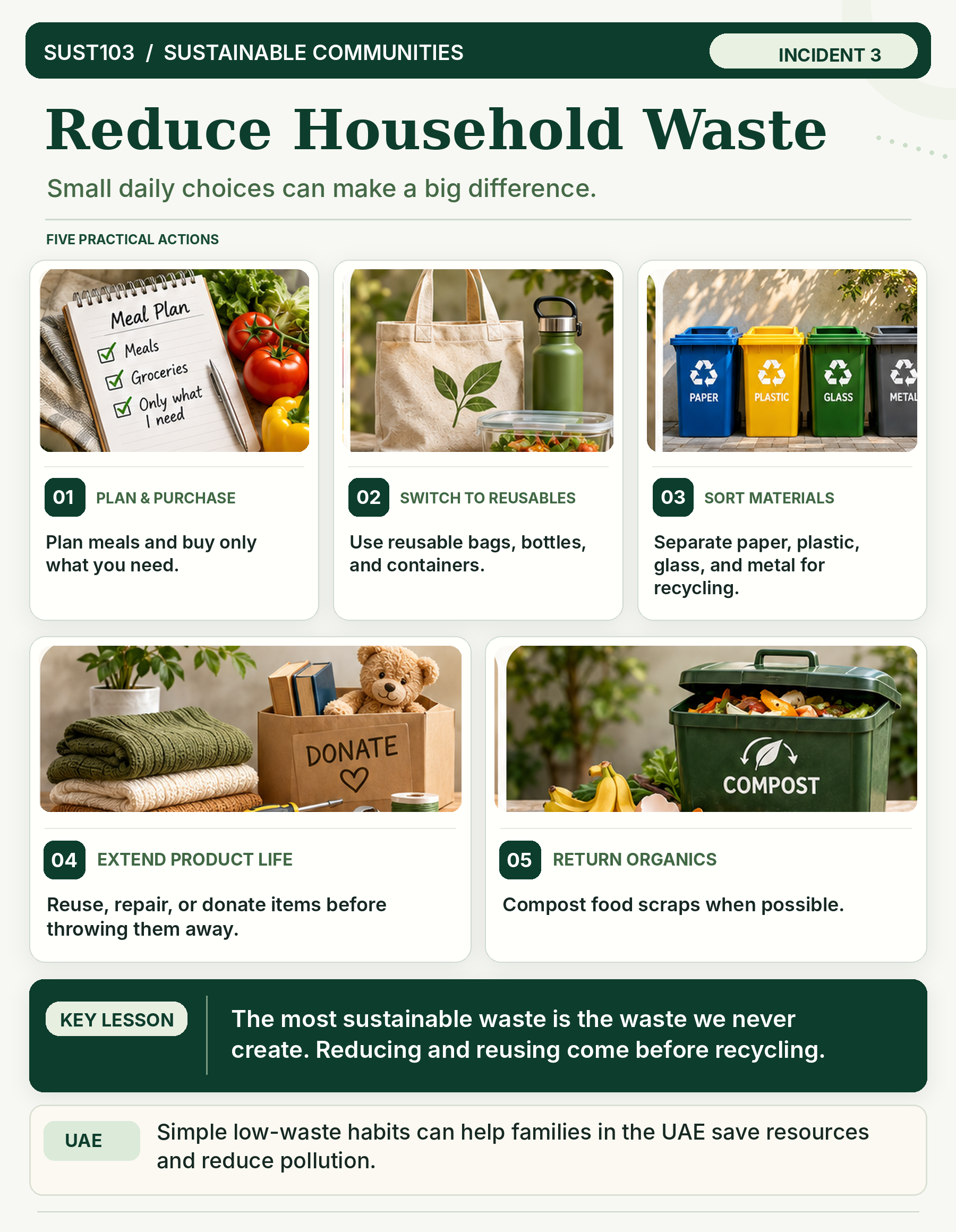
Simple habits like using reusable shopping bags, avoiding unnecessary packaging, reusing containers and separating recyclable materials can all help reduce household waste. I've also attached a poster I created to share some practical ideas.

But I wonder how easy it is for families to maintain these habits in everyday life. I'd love to hear about your experiences!

1. What simple changes have you made to reduce waste in your household?
2. What has been your biggest challenge when trying to maintain a low-waste lifestyle?
3. What advice would you give to families in the UAE who are just starting to reduce their household waste?

I'm particularly interested in practical ideas that have worked for you.

Thank you for sharing your experiences!
Reduce_Household_Waste_Incident_3_Final.png
[Thumbnail for Reduce_Household_Waste_Incident_3_Final.png]
 
pollinator
Posts: 459
138
2
dog trees books bee medical herbs
  • Likes 10
  • Mark post as helpful
  • send pies
    Number of slices to send:
    Optional 'thank-you' note:
  • Quote
  • Report post to moderator
A couple of things that come to mind right away:

- instead of using paper towels, use cloth towels. We have a system where we have many cloth towels, and there is always one hanging on the stove handle, and somewhere else in the kitchen, so they are always readily available. They get put in the laundry once they have a not-so-fresh smell to them. When that is, depends on the amount of people using them and what foods get made in the kitchen.  We have many so that it is easy to switch them out when necessary.

- instead of paper napkins, cloth napkins. It has gotten to the point that I always have a fresh one even in our car for when we are on the road.

- instead of toilet paper, cloth wipes. I found a perfect size basket to fit on our toilet tank. I made many cloth wipes, all the same size, that fit in the basket beautifully. We also have a sprayer that is attached to the toilet tank. Once the cloth is used, it gets put in a little garbage can that has a swinging lid so that it is very easy to put the used cloths into it. Whenever we do laundry, we automatically toss the cloths in the machine with the rest. We've been using this system for over 5 years now. It's been wonderful! It's also much better for the septic system.

- no plastic bottles for water. We don't use them not only for environmental reasons, but also health reasons. We always use stainless steel or glass that we bring with us when we go on longer drives or outings.

- compost instead of throwing away food scraps. It doesn't have to be complicated or fancy. Just having a dedicated pile a little away from the house is enough. Sooner or later it will turn back to earth and all that food that has turned into rich soil can then be used for outside plantings or mixed in with house plants if one doesn't have any outside planting space. If nothing else, one can always just put it under a bush or tree in a park.

- wear only natural materials so they, too, can be composted when they've truly reached the end of their life and have become completely tattered.

- cook from scratch and meal prep. It is amazing how much packaging goes into convenient, ready-made foods that only need to be heated or boiled, etc.

- And last, but certainly not least, become less of a consumer in general. Have a life with less stuff. It's also been shown to be healthy for mind, body, and soul.
 
pioneer
Posts: 622
180
cat trees urban
  • Likes 6
  • Mark post as helpful
  • send pies
    Number of slices to send:
    Optional 'thank-you' note:
  • Quote
  • Report post to moderator
I think the most important lesson I've learned is that avoiding waste takes resources:

You need to have time, energy and/or money to really minimise waste.

I know it can sound counter-intuitive.

But a lot of what goes into minimising waste it me experience is planning - which needs time - plus time & energy to sort potential waste into usable parts - or, if you're short of time & energy, the money to pay for equipment and other people to help with the planning and sorting.

For example, having time & energy to plan and prepare meals, and having the money to pay for good kitchen facilities including refrigerator & freezer, or pay a cook (!) can avoid a lot of food waste!
 
master steward
Posts: 20017
Location: USDA Zone 8a
5018
dog hunting food preservation cooking bee greening the desert
  • Likes 3
  • Mark post as helpful
  • send pies
    Number of slices to send:
    Optional 'thank-you' note:
  • Quote
  • Report post to moderator
Your infographic looks concise.

I like the part about never creating waste.  What would your advice be on how to do this?
 
pollinator
Posts: 6376
Location: Bendigo , Australia
614
plumbing earthworks bee building homestead greening the desert
  • Likes 7
  • Mark post as helpful
  • send pies
    Number of slices to send:
    Optional 'thank-you' note:
  • Quote
  • Report post to moderator
In my experience the issue of waste reduction is really a matter of making the decision to do so, and following through.
I philosophically reduce waste, its not something I need to think about,  and I work in the area of teaching it.
BUT if people dont have the same attitude its a chore.
THESE ARE REASONS PEOPLE STATE THEY DONT RECYCLE ETC;
- I dont have time
- my contribution will not help
- its too complex
- Its messy
- I cannot afford the bins
- It all goes to landfill anyway.
- my bin is too small
MY OBSERVATIONS
- They just dont care
- they cannot be bothered to separate recycle from rubbish
-  they dont flatten any boxes or cartons, hence bin is overflowing so they put it in rubbish
- they put rubbish in the recycle bin because its closer

I have developed a comment that explains it as I see things;"reducing waste is something other people do",
in other words I do not need to carry that out, I am too busy, working too hard, dealing with issues, dont have time.....
 
Posts: 1030
Location: Sierra Nevada foothills, 350 m, USDA 8b, sunset zone 7
304
  • Likes 8
  • Mark post as helpful
  • send pies
    Number of slices to send:
    Optional 'thank-you' note:
  • Quote
  • Report post to moderator
I think that food packaging creates bulk of the waste, because we eat for entire life.

In hot place that I live I need to drink - a lot. If I drank ready made beverages I would create literally tons of waste. I prepare teas, fruit compotes in a large 8 l pot daily.

Purchasing meats generates nasty supply of styrofoam trays and meat "diapers". If I do not have meat from my own animal, I'm trying to always purchase various cuts at the deli, that are packed into plastic bags instead of horrid trays. In my childhood, meat was packed into waxed paper. I hope those times will return.

I never eat outside as I love to cook, so I do not generate unnecessary take-out containers.

When I purchase fruits/vegetables I always take them loose to the cart - not into individual short lifespan bags like most people do.

Dairy products are more difficult with avoiding plastic packaging. In my childhood, most of them were sold in reusable glass containers - also hoping it will come back.

Toilet paper and paper towels are easily avoided by using bidet and reusable sponges/towels.

I never take bags (neither paper nor plastic) from the store as I load everything directly into my car from the shopping cart.
 
Posts: 20
Location: Visalia, CA
4
  • Likes 6
  • Mark post as helpful
  • send pies
    Number of slices to send:
    Optional 'thank-you' note:
  • Quote
  • Report post to moderator
What has helped my family most is clearing out one small area at a time and keeping a box by the door for things to pass on. When we stopped bringing home extras we did not need, the trash shrank on its own. I compost food scraps and yard waste, reuse jars and bags, and fix simple things instead of replacing them. Usable clothes, tools, and household items go to neighbors or a local giveaway spot rather than the bin. It has saved us money and kept our house and garage a lot clearer, and it feels better than throwing good things away. — Mike V.
 
Ac Baker
pioneer
Posts: 622
180
cat trees urban
  • Likes 3
  • Mark post as helpful
  • send pies
    Number of slices to send:
    Optional 'thank-you' note:
  • Quote
  • Report post to moderator
I'd like to push back against the accusation of "not caring" also sometimes framed as "apathy" or laziness".

Yes, there are a few people with all the time, energy & money they need, and who actively choose to consume wastefully.  Back in the 1990s, the World Wildlife Fund found that the mainstay of their income came from the wealthiest c. 10% of their donors, who at the same time had the most harmful lifestyles. Oxfam found that the wealthiest 10% of people on the planet .. anyone who owns a medium sized home outright (no mortgage) in the Global North is likely to be in this band, like myself .. are connected with 50% of all greenhouse gas emissions (their famous champagne bowl diagram).

BUT!  Most people are NOT this wealthy in time, energy & money.  

We're embedded in a world economy based upon linear extractivism: grab, use, discard.  

We need collective ways to turn this extractivism back into circularity in harmony with the living world.

A lot of people DO want better ways of living.  But we're intentionally divided into swamped and struggling individuals or tiny households. We're felling stuck in the linear system.

Mutual Aid, and communal ways of re-circularising our ways of living, are what we need.  

For example, half a dozen households coming together to grow a bit of their own food, organise collective composting, bulk buy what they can't grow themselves, mend and circulate clothing, rescue what local shops would throw away and recurculate iflt, the list goes on.  There were aspects of this in the village my father & grandmother lived in.

Communal organising has so many other benefits, because working on our relationships with one another is so fulfilling, and waste reduction can be a major one.
 
Maryam Green
Posts: 23
1
  • Likes 1
  • Mark post as helpful
  • send pies
    Number of slices to send:
    Optional 'thank-you' note:
  • Quote
  • Report post to moderator

Annie Collins wrote:A couple of things that come to mind right away:

- instead of using paper towels, use cloth towels. We have a system where we have many cloth towels, and there is always one hanging on the stove handle, and somewhere else in the kitchen, so they are always readily available. They get put in the laundry once they have a not-so-fresh smell to them. When that is, depends on the amount of people using them and what foods get made in the kitchen.  We have many so that it is easy to switch them out when necessary.

- instead of paper napkins, cloth napkins. It has gotten to the point that I always have a fresh one even in our car for when we are on the road.

- instead of toilet paper, cloth wipes. I found a perfect size basket to fit on our toilet tank. I made many cloth wipes, all the same size, that fit in the basket beautifully. We also have a sprayer that is attached to the toilet tank. Once the cloth is used, it gets put in a little garbage can that has a swinging lid so that it is very easy to put the used cloths into it. Whenever we do laundry, we automatically toss the cloths in the machine with the rest. We've been using this system for over 5 years now. It's been wonderful! It's also much better for the septic system.

- no plastic bottles for water. We don't use them not only for environmental reasons, but also health reasons. We always use stainless steel or glass that we bring with us when we go on longer drives or outings.

- compost instead of throwing away food scraps. It doesn't have to be complicated or fancy. Just having a dedicated pile a little away from the house is enough. Sooner or later it will turn back to earth and all that food that has turned into rich soil can then be used for outside plantings or mixed in with house plants if one doesn't have any outside planting space. If nothing else, one can always just put it under a bush or tree in a park.

- wear only natural materials so they, too, can be composted when they've truly reached the end of their life and have become completely tattered.

- cook from scratch and meal prep. It is amazing how much packaging goes into convenient, ready-made foods that only need to be heated or boiled, etc.

- And last, but certainly not least, become less of a consumer in general. Have a life with less stuff. It's also been shown to be healthy for mind, body, and soul.


Thank you for sharing these great ideas! I love that you're trying to reduce waste.

I really liked your ideas about using reusable cloths and water bottles. It's amazing how small changes at home can help reduce waste.

Here in the UAE, we're also becoming more aware of how important it is to reduce waste.

Which of these changes do you think would be the easiest for a family to start with?

Thank you so much for sharing your experience!
 
Maryam Green
Posts: 23
1
  • Likes 2
  • Mark post as helpful
  • send pies
    Number of slices to send:
    Optional 'thank-you' note:
  • Quote
  • Report post to moderator

Ac Baker wrote:I think the most important lesson I've learned is that avoiding waste takes resources:

You need to have time, energy and/or money to really minimise waste.

I know it can sound counter-intuitive.

But a lot of what goes into minimising waste it me experience is planning - which needs time - plus time & energy to sort potential waste into usable parts - or, if you're short of time & energy, the money to pay for equipment and other people to help with the planning and sorting.

For example, having time & energy to plan and prepare meals, and having the money to pay for good kitchen facilities including refrigerator & freezer, or pay a cook (!) can avoid a lot of food waste!


Thank you for bringing up such an important point! I hadn't really considered how much time, effort and sometimes money it takes to reduce waste.

Your comment made me realize that sustainable living isn't always as simple as it sounds. I think solutions need to be practical and affordable for different families, not just environmentally friendly.

I really appreciate this perspective!
 
Maryam Green
Posts: 23
1
  • Likes 1
  • Mark post as helpful
  • send pies
    Number of slices to send:
    Optional 'thank-you' note:
  • Quote
  • Report post to moderator

Anne Miller wrote:Your infographic looks concise.

I like the part about never creating waste.  What would your advice be on how to do this?


Thank you, Anne! I think the best place to start is by being more mindful of what we buy and actually need. Simple habits like planning meals, choosing reusable products and avoiding unnecessary packaging can help prevent waste before it happens.

I've learned that reducing waste isn't about being perfect, but about making better everyday choices. Even small changes can add up over time!
 
Maryam Green
Posts: 23
1
  • Likes 1
  • Mark post as helpful
  • send pies
    Number of slices to send:
    Optional 'thank-you' note:
  • Quote
  • Report post to moderator

Cristobal Cristo wrote:I think that food packaging creates bulk of the waste, because we eat for entire life.

In hot place that I live I need to drink - a lot. If I drank ready made beverages I would create literally tons of waste. I prepare teas, fruit compotes in a large 8 l pot daily.

Purchasing meats generates nasty supply of styrofoam trays and meat "diapers". If I do not have meat from my own animal, I'm trying to always purchase various cuts at the deli, that are packed into plastic bags instead of horrid trays. In my childhood, meat was packed into waxed paper. I hope those times will return.

I never eat outside as I love to cook, so I do not generate unnecessary take-out containers.

When I purchase fruits/vegetables I always take them loose to the cart - not into individual short lifespan bags like most people do.

Dairy products are more difficult with avoiding plastic packaging. In my childhood, most of them were sold in reusable glass containers - also hoping it will come back.

Toilet paper and paper towels are easily avoided by using bidet and reusable sponges/towels.

I never take bags (neither paper nor plastic) from the store as I load everything directly into my car from the shopping cart.


Thank you for sharing your experience, Cristobal! You made a really interesting point about how much waste comes from food packaging.

I especially liked how you avoid unnecessary bags and containers when shopping. It made me realize how much waste we can prevent before even bringing products home.

Do you think supermarkets should offer more packaging-free options to make this easier for families?

 
Maryam Green
Posts: 23
1
  • Likes 1
  • Mark post as helpful
  • send pies
    Number of slices to send:
    Optional 'thank-you' note:
  • Quote
  • Report post to moderator

Mike Victor wrote:What has helped my family most is clearing out one small area at a time and keeping a box by the door for things to pass on. When we stopped bringing home extras we did not need, the trash shrank on its own. I compost food scraps and yard waste, reuse jars and bags, and fix simple things instead of replacing them. Usable clothes, tools, and household items go to neighbors or a local giveaway spot rather than the bin. It has saved us money and kept our house and garage a lot clearer, and it feels better than throwing good things away. — Mike V.


I really like your approach, Mike! Starting with one small area at a time sounds much more manageable than trying to change everything at once.

I also love the idea of passing useful items on to others instead of throwing them away. It's a great reminder that reducing waste can save money and help the community at the same time.

Thank you for sharing your family's experience!
 
Maryam Green
Posts: 23
1
  • Likes 1
  • Mark post as helpful
  • send pies
    Number of slices to send:
    Optional 'thank-you' note:
  • Quote
  • Report post to moderator

John C Daley wrote:In my experience the issue of waste reduction is really a matter of making the decision to do so, and following through.
I philosophically reduce waste, its not something I need to think about,  and I work in the area of teaching it.
BUT if people dont have the same attitude its a chore.
THESE ARE REASONS PEOPLE STATE THEY DONT RECYCLE ETC;
- I dont have time
- my contribution will not help
- its too complex
- Its messy
- I cannot afford the bins
- It all goes to landfill anyway.
- my bin is too small
MY OBSERVATIONS
- They just dont care
- they cannot be bothered to separate recycle from rubbish
-  they dont flatten any boxes or cartons, hence bin is overflowing so they put it in rubbish
- they put rubbish in the recycle bin because its closer

I have developed a comment that explains it as I see things;"reducing waste is something other people do",
in other words I do not need to carry that out, I am too busy, working too hard, dealing with issues, dont have time.....


Thank you for sharing your thoughts, John! I agree that our daily choices play an important role in reducing waste.

I also think making recycling more convenient and accessible could encourage more people to participate. Sometimes people want to help but find the process confusing or difficult.

Your comment reminded me that lasting change needs both personal effort and community support!
 
pollinator
Posts: 338
194
  • Likes 6
  • Mark post as helpful
  • send pies
    Number of slices to send:
    Optional 'thank-you' note:
  • Quote
  • Report post to moderator
One strategy for reducing food waste in our household is a large chalkboard listing "things that need to be used up".

- Half a lemon
- Half a cup of cooked mung beans
- Two slices of deli turkey
- etc...

Having it in writing sparks culinary creativity and avoids things drifting to the back of the fridge until they mold.

We also freeze a lot of "in between" things, like meat carcasses, vegetable scraps and herb stalks for stock, until I have the time to use them up.  So good reusable containers for freezing and a good labeling system (which can be masking tape + a sharpie) help.

Going back to unfashionable staple produce that last a long time, like cabbage, turnips, potatoes, apples and celery.

Finally, flexible recipes are useful. A basic muffin recipe. A general formula for meat balls or meat loaf (I always put some grated vegetables in mine). Basic knowledge on how to make soup out of what you have in the fridge. A good technique for fried rice.  

(Yesterday, my daughter left half a bottle of kefir on the countertop overnight. Kefir is not extremely sensitive to bacterial contamination due to its nature, but it was too sour to be pleasant on its own. I made bread out of it so it wouldn't go to waste. I know most liquids can be used instead of water in my basic bread recipe. I can also use bread as a vehicle for using up herbs, grated cheese, small amounts of dried fruits...).
 
pollinator
Posts: 189
Location: Central Iowa, Zone 5b
125
personal care foraging urban chicken bike bee
  • Likes 6
  • Mark post as helpful
  • send pies
    Number of slices to send:
    Optional 'thank-you' note:
  • Quote
  • Report post to moderator
Your info graphic is on point! I think it would help get someone who's thinking about it to good sustainable habits. The meal planning is my favorite suggestion where I have seen the most reduction in our waste. That and stop brining stuff covered in trash it into the household!

I know that living a less wasteful life style and avoiding trash has been cheaper for us, not more expensive. I think if you tried to make all the changes at once you would be over run and need to spend a lot of money and time to reduce ones waste stream. But slowly learning how to cook and meal plan one extra meal a week would see alot of savings if they are not confident in cooking and buy prepackaged foods or eat out at all. If it was a online infographic maybe adding a feature where you can click on the boxes and they would lead you to steps you can take to slowly start incorporating said topic into your life, and the cost and savings in time and money they could lead to in comparison to the more wasteful options would be really cool. If a thing cost more money it also cost you more time at a job to make that money.
 
roses are red, violets are blue. Some poems rhyme and some are a tiny ad:
Building a Better World in Your Backyard - physical book SIGNED by both authors!
https://permies.com/t/393911/Building-World-Backyard-physical-book
reply
    Bookmark Topic Watch Topic
  • New Topic