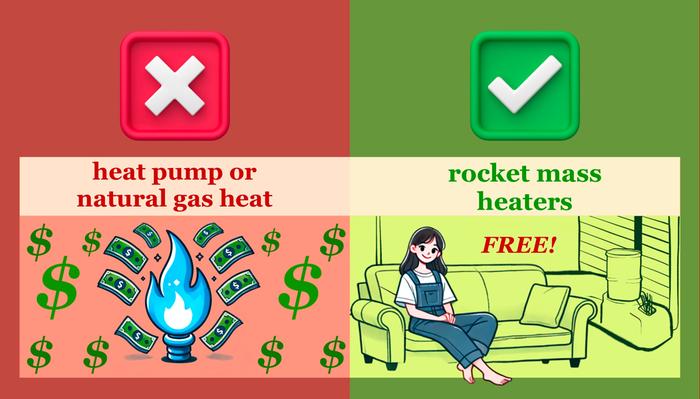
The poster and info graphic with the links are fabulous. I think that this will progress the discussion. To my mind the only way to argue against is "your information is wrong because the salesman told me my thing is better than your thing"
Will we be able to purchase copies? Or will they be available as dailyish freebies or to boost kickstarters?
Don't heat it at all, except with your own activity (cooking mainly). Instead insulate it really well with cellulose (recycled shredded paper), and use a heat recovery ventilator.
I notice there was a section for in ground heat pump (no range for different source such as below ground water table or pond sourced), but no values for air source heat pump. I upgraded my backup propane hydronic system and the contractor attempted to push an air source heat pump as a better system overall than the in ground system. While an in ground is more expensive, I continue to believe that using a large enough heat sink/source in a phreatic (below water table) system will provide better economics over time, especially if local temperatures climb precipitously. I also did not see the fact that an in ground heat pump is far more economical for whole home air conditioning. When one or more family members has breathing issues, the ability to cool and dehumidify the air becomes more important. Really nice infographic, however.
If you want to include all the variations of each type of heat, and all the variations of each state and country, and add cooling, and the other attributes that are worth considering, the infographic would quickly become 500 times bigger. Unwieldy. Further, it would take so much time to create such a massive infographic, the data would be changing faster than you can update the infographic.
So, we intentionally limited it and used averages for one state. A state known for cold.
I fully understand how a document such as this could rapidly outpace manual updating. Have you ever looked at the site "Mike"s Weather Page"? It is a page brimming with updated data from multiple sites that automatically are updated by the hosts of that data. It would be interesting to see if it were possible to pull automatically updated data from multiple sources and serve it in a central location such as he does. Not sure if it is possible, but what utility, especially if different areas could access local information!
Oil isn't on there? 90 % of the homes here in Maine use Oil furnaces, big oil tanks, obscene monthly oil bills. There are still coal furnaces around as well. We have woodstoves for when the power goes out, which is several times a year, but people still fill their tanks and burn the oil. I guess I live in a bubble, because I expected oil to be the first comparison to RMH. But it's not even on there at all? Does anybody have numbers for the carbon footprint, cost, fuel cost etc, for oil furnaces? I really thought it should be on there, since it seems everybody's got one.
Elizabeth Elliot wrote: Does anybody have numbers for the carbon footprint, cost, fuel cost etc, for oil furnaces? I really thought it should be on there, since it seems everybody's got one.
I think so too, for the reason you mention as well as a different one- monitor and toyo (those are brand names) heaters. They are the size of a suitcase, and have models that burn #2 fuel oil, kerosene, propane and natural gas. They are extremely efficient and off-grid friendly (well, except for natural gas models) as the ignition and fan use very little electricity. They are also UL approved, so no code or insurance issues. Years ago I had a monitor in a two story rental property and it used about 3 gallons of oil a day in the winter (average maybe +20° F) to heat what was a very old, not tight building. For natural gas models I’m told the current cost is estimated at 10¢ per square foot per month for a properly insulated house, on par with a high efficiency furnace at 95%. Cost installed is less than $2000 and life expectancy about 15 years. They may not be common in Montana but they are in a lot of northern states.
The info graphic is neat but I’m also curious about the cost of wood calculation for both the wood stoves and the masonry heater and rmh. Even if your wood is free, your time isn’t. We heat with wood from our property, but we still have time cutting, splitting, stacking, bringing inside, and loading the stove (and an rmh, while using less wood, requires hours of constant feeding during the burn cycle). There’s also chainsaw maintenance/gas/oil which is still far cheaper than time spent cutting wood to length with a hand saw! So, given an average wage of maybe $20/hr, what is the time cost of wood heat?
Julie Reed wrote:The info graphic is neat but I’m also curious about the cost of wood calculation for both the wood stoves and the masonry heater and rmh. Even if your wood is free, your time isn’t. We heat with wood from our property, but we still have time cutting, splitting, stacking, bringing inside, and loading the stove (and an rmh, while using less wood, requires hours of constant feeding during the burn cycle). There’s also chainsaw maintenance/gas/oil which is still far cheaper than time spent cutting wood to length with a hand saw! So, given an average wage of maybe $20/hr, what is the time cost of wood heat?
Paul and Chris (Uncle Mud) agonized over this at length here. It was open for public comment for a while before they had to decide on a viewpoint to express in that one single box on the graphic.
For me, if working within the constraints of private land ownership, wood heating is the epitome of free. One can go out and cut/gather wood, or rely on a family member to do so. One can choose between axe, saw, chainsaw, widowmaker buzz saw, whirley impaling death implement attached to truck wheel, what have you to process it. One can spend a half hour every morning and evening processing over a number of months, or spend three intensive days putting up a year's worth of wood. One can produce eggs or wool or moonshine and barter with a neighbour to have them put your wood up.
Compare that to oil, gas, electricity, or any highly system dependant sources where one must come up with the local currency to pay a corporate entity. You of course have the 'freedom' to flip burgers or any number of mindless clock based tasks to keep you busy and show loyalty to some vacuous bureaucratic structure. Ultimately you will be servicing the mob attitude of the masses that make demands of an economic system spiralling out of control, depleting natural resources and filling the environment with toxicity at an increasing rate.
The whole issue of 'freedom' is kind of a rhetorical quagmire, but I think the concept expressed here does a good job of quantifying how wood heating in an appropriate environment has widespread benefits.
Why is there no mention of heat distribution methods? How do you pipe the heat to multiple rooms in a typical house? Any system that relies on radiant heat, whether or not stored in a mass, seems limited to warming a single room. It seems to me that any comparison of heating systems should include the heat distribution capability. For wood, that means furnaces indoors and out. The basic RMH you show can work well in a single room (or a greenhouse) but lacks multi-room distribution.
I own a relatively new home in a forest. All my wood is FREE other than the cost to myself for the time and chainsaw maintenance. So, on first pass the RM heater described here, sounds pretty good. But, my house heating experience strongly believes that this simple central heat method has no ability to transport the heat any distance at all.
On the other hand ALL other heat sources mentioned (heat pumps, some wood stoves with heat transfer tubes in them, gas and propane furnaces and boilers) have such capability using air or water to move the heat from the generator to remote points.
The comparison you make really sounds good but is simply not fairly comparing these heat generators because of this simply fact.
NOW. If the RMH was expanding or modified by providing a water tube jacket inserted into the "mass" a simple pump could be used to utilize that heat to remote points. However, this presupposes that there is some way to RE-transfer that heat once more. The best way that comes to mind is to combine a RMH with a water tube transfer system that moves the heated water to a concrete pad under a single floor home-- a VERY common and comfortable way to heat a home. In fact, the way I use in my home with a propane boiler. The other shortcoming I see with the RMH is its size. If its design could be such that more of it could be below ground(but insulated) and with a much smaller foot print this idea will surely "take off" as you appear to be hoping for and see widespread adoption. But hold it. There is ONE other thing: automatic feeding and control. I won't go into that but you get the point. The RMH is great for a cabin, not so much for modern adoption for what most humans expect in a comfortable home.
If you have a central heat system where all the rooms in your home are ducted, and you have an utterly massive home - say 4000 square feet. And it is sprawling all over the place ....
And rather than do like conventional wood stoves (one or two stoves, maybe even three, at different locations in this giant house) or like mini splits (probably six different units throughout the house) or like baseboard heat (probably a dozen heaters throughout the house) .... you are CERTAIN that all of these things, and a rocket mass heater are not worth consideration unless they can be operated as a central furnace, then I have a solution ...
Have exactly one of these things. And when you think that the rooms at the far end of this sprawling home are getting cold, turn on the fan of your central system. The heat from the one room will be mixed with all of the other rooms.
....
As for me ... I have one rocket mass heater, centrally located. If I leave the doors open to the rooms, they end up warming up a lot. If it is 74 in the central spot, it is 71 on the extremeties. That's good enough for me, but I think it is a fair point that it is NOT good enough for others.
I would like to know if anyone knows what type of alternative fuel can I use instead of kerosene? I am staying warm with a kerosene heater and it cost here in the south jersey area $5.49 a gallon. If anyone can provide information of another form of fuel to use with the kerosene would greatly appreciate. I cannot build clay or other type of heating source. The house that I am staying doesn't have electricity and is under foreclosure.
Iris,
I would suggest that you consider making a micro heat bubble. There is a lot of information in the heat info graphic above. While your circumstances are uncertain, mini rocket heaters can be easily made and you can fill a hot water bottle which will stay hot for several hours. Kerosene heaters have a number of down sides apart from the cost. We used to have one and it used to smoke sometimes, as well as giving off carbon monoxide. Fortunately ours we in a well ventilated space but we still got headaches. Here is a zero cost option
It just uses twigs and you have a residual heat bank for a couple of hours.
The top is a discarded gas stove trivet - again no cost.
Best wishes for saving some dollars
The A series paper sizes are now in common use throughout the world apart from in the US, Canada and parts of Mexico. The A4 size has become the standard business letter size in English speaking countries such as Australia, New Zealand and the UK, that formerly used British Imperial sizes. In Europe the A paper sizes were adopted as the formal standard in the mid 20th century and from there they spread across the globe. https://www.papersizes.org
Paper-Sizes-imperial-metric-and-A0-format.jpeg
Check your country's sizing here for the best fit.
If I am going to print this, do you know what size of paper it would be?
Most printing, here in the US, is on 8.5x11 inches. After that, is 8.5x14. This looks like it might fit on 8.5x14.
Yes 8.5 x 14 fits better.
Here is a file ready to print with the dimensions:
Well, that didn't turn out.
They arrived. The small print was unreadable. And the not-so-small print was still too small.
There is a lot of black on the left and right edges. My guess is that you would have to zoom in on the main part of the table which would make the top and bottom shrink. But even if you did that, I'm not sure that that would be enough "zoom"
If we "zoom in" on the table and sacrifice some of the images at the top ... or shrink that stuff at the top .... or maybe shuffle between the top and bottom a bit ... but overall "grow" the table to use up the black stuff on the left and right ...
I guess I am looking at paying a lot extra for printing on the bigger sheets and I'm not sure if it will be worth it. So I am trying to figure out a way to at least gain what I need from this: to make the table more readable.
If we "zoom in" on the table and sacrifice some of the images at the top ... or shrink that stuff at the top .... or maybe shuffle between the top and bottom a bit ... but overall "grow" the table to use up the black stuff on the left and right ...
I guess I am looking at paying a lot extra for printing on the bigger sheets and I'm not sure if it will be worth it. So I am trying to figure out a way to at least gain what I need from this: to make the table more readable.
The printing is expensive. I am hoping that a little about the book could help offset some of the cost. Maybe the book with just the first paragraph can somehow be worked in?
We need that paragraph at the top about montana and square feet. Maybe that can be nudged back into the top?
paul wheaton wrote:The printing is expensive. I am hoping that a little about the book could help offset some of the cost. Maybe the book with just the first paragraph can somehow be worked in?
We need that paragraph at the top about montana and square feet. Maybe that can be nudged back into the top?
paul wheaton wrote: So I am trying to figure out a way to at least gain what I need from this: to make the table more readable.
One way to make the table more readable is to spread the image over multiple pages that can then be taped or otherwise fastened together. That way you avoid the considerable cost of specialty printing, and anyone with a colour printer can do the job. See "How to print an image or poster on multiple pages" (https://www.digitalcitizen.life/print-large-image-multiple-pages-4-steps-using-microsoft-paint/) for an example.
Hello, i am a bit confused as to why nobody sees solar thermal collectors as another relativly cheap option. I had one in my old house and plan to install one in the house i am currently renovating. The main thing to have them efficiently heat your home is to have a decent amount of insulated tanks filled with water as a buffer.
So space to hold the heat is the biggest issue, (1000 liter of water at 85Celcius holds about 127kwh of heat) and the conversion ratio of those collectors can be up to 1/45.
in my old house i had 5 panels on the roof each panel was 1 meter by 2.5 meter and together they produced up to 19kw/hour in autumn weather. However the cost for DIY installation is not very high depending on how many buffertanks of water you place.
![[Logo]](/templates/default/mobile/images/mobile-permies-2015.png)


![[Download heat-infographic-for-print.pdf]](https://permies.com/templates/default/images/icon_disk.gif)

![[Paper-Sizes-imperial-metric-and-A0-format.jpeg]](/t/230113/a/235219/Paper-Sizes-imperial-metric-and-A0-format.jpeg "Filename: Paper-Sizes-imperial-metric-and-A0-format.jpeg
Description: Check your country's sizing here for the best fit.")
![[Thumbnail for heat-infographic-print.jpeg]](/t/230113/a/236013/heat-infographic-print.jpeg "Filename: heat-infographic-print.jpeg
Description: heat-infographic-print")
![[Thumbnail for heat-infographic-print.jpeg]](/t/230113/a/236026/heat-infographic-print.jpeg "Filename: heat-infographic-print.jpeg
Description: heat-infographic-print")