• Post Reply Bookmark Topic Watch Topic
  • New Topic
permaculture forums growies critters building homesteading energy monies kitchen purity ungarbage community wilderness fiber arts art permaculture artisans regional education skip experiences global resources cider press projects digital market permies.com pie forums private forums all forums
this forum made possible by our volunteer staff, including ...
master stewards:
  • Carla Burke
  • Nancy Reading
  • John F Dean
  • r ransom
  • paul wheaton
  • Jay Angler
  • Timothy Norton
stewards:
  • Pearl Sutton
  • Tereza Okava
  • Nicole Alderman
master gardeners:
  • Christopher Weeks
gardeners:
  • M Ljin
  • Megan Palmer
  • Pete Podurgiel

Three Sisters Year 4

 
pollinator
Posts: 1094
Location: Illinois
258
  • Likes 5
  • Mark post as helpful
  • send pies
    Number of slices to send:
    Optional 'thank-you' note:
  • Quote
  • Report post to moderator
2 days ago 27 ears of sweet corn. Today, 72 ears. My spouse was a bit peeved! We gave a bunch away to her friend, who gave us okra and cucumbers. I expect in 2 days there will be a lot more. Time to sharpen the knife and freeze some.

In my wife's home country, ears of sweet corn are $4 for ONE EAR! So we joke that in the last few days we have eaten hundreds of dollars worth of corn.

I planted multiple rows over a few weeks, so the corn season should be long. Hope she doesn't kill me before it's done. It's affecting my diet too. My attempt to lose weight (18 pounds so far in 2 years) has stalled.
 
Thom Bri
pollinator
Posts: 1094
Location: Illinois
258
  • Likes 4
  • Mark post as helpful
  • send pies
    Number of slices to send:
    Optional 'thank-you' note:
  • Quote
  • Report post to moderator
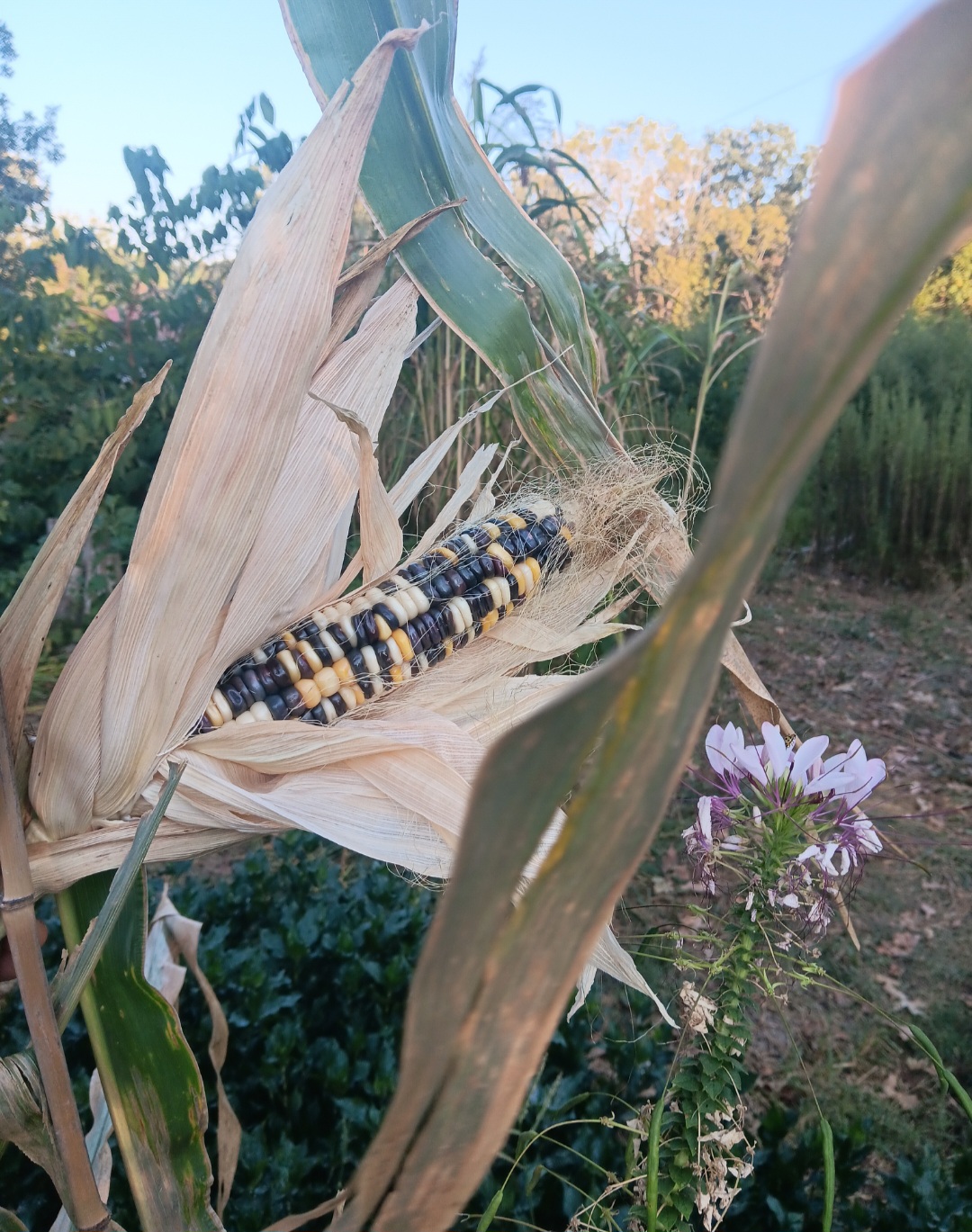
Sweet corn. Some have purple cobs and leaves but only a few with odd-colored kernels. A few red ears. The result of about 20 years of crossing a dozen different commercial seed varieties plus my purple corn, and selecting for sweet. Still occasionally get a tough, semi-sweet ear, but most of them are very good.
PXL_20260808_191449165-2.jpg
[Thumbnail for PXL_20260808_191449165-2.jpg]
 
Thom Bri
pollinator
Posts: 1094
Location: Illinois
258
  • Likes 4
  • Mark post as helpful
  • send pies
    Number of slices to send:
    Optional 'thank-you' note:
  • Quote
  • Report post to moderator
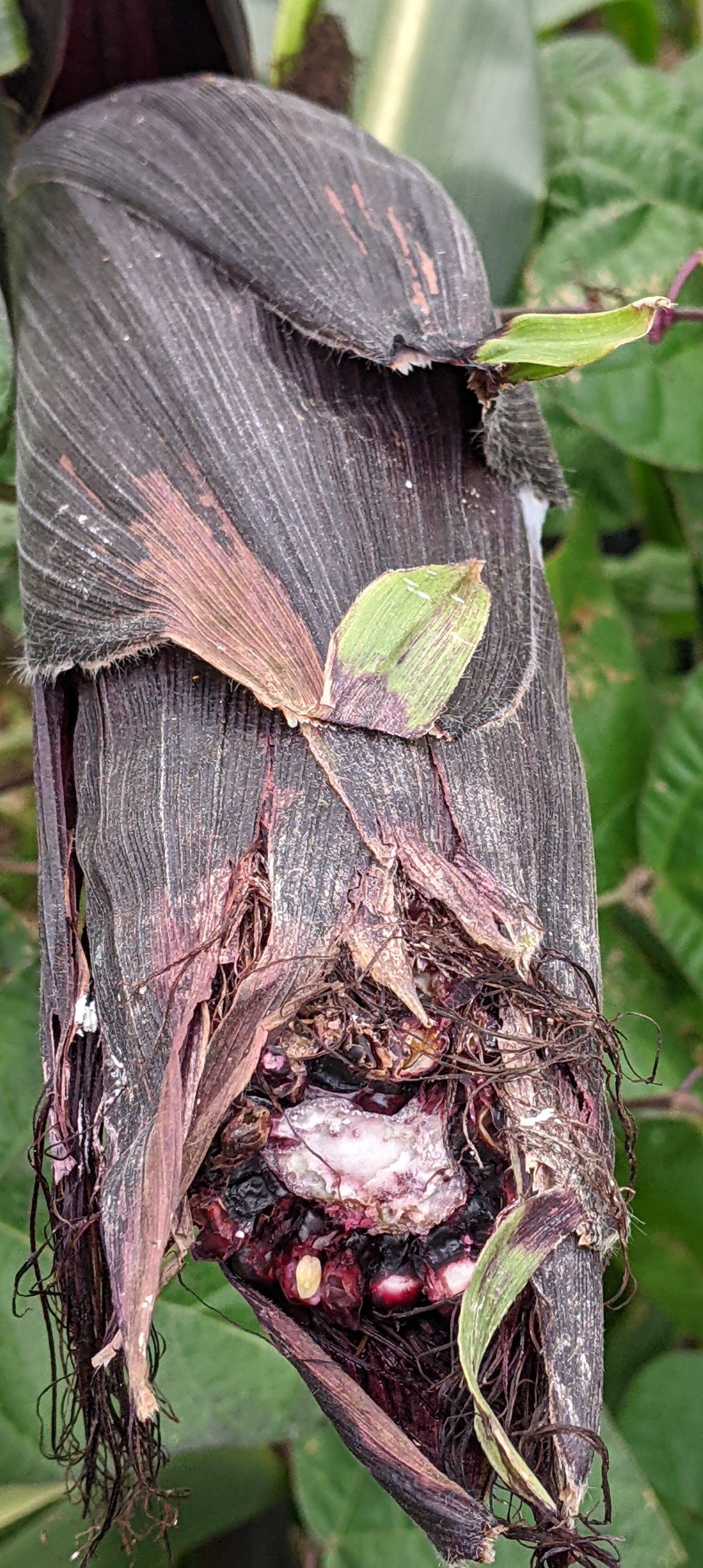
Deer bit the end right off! Have had a dozen or so of this sort this year. Annoying because it lets the bugs and mold in even if the deer only eats one bite. Not usually a big problem.
PXL_20260809_184059739.jpg
Deer damage to corn
Deer damage to corn
 
Thom Bri
pollinator
Posts: 1094
Location: Illinois
258
  • Likes 6
  • Mark post as helpful
  • send pies
    Number of slices to send:
    Optional 'thank-you' note:
  • Quote
  • Report post to moderator
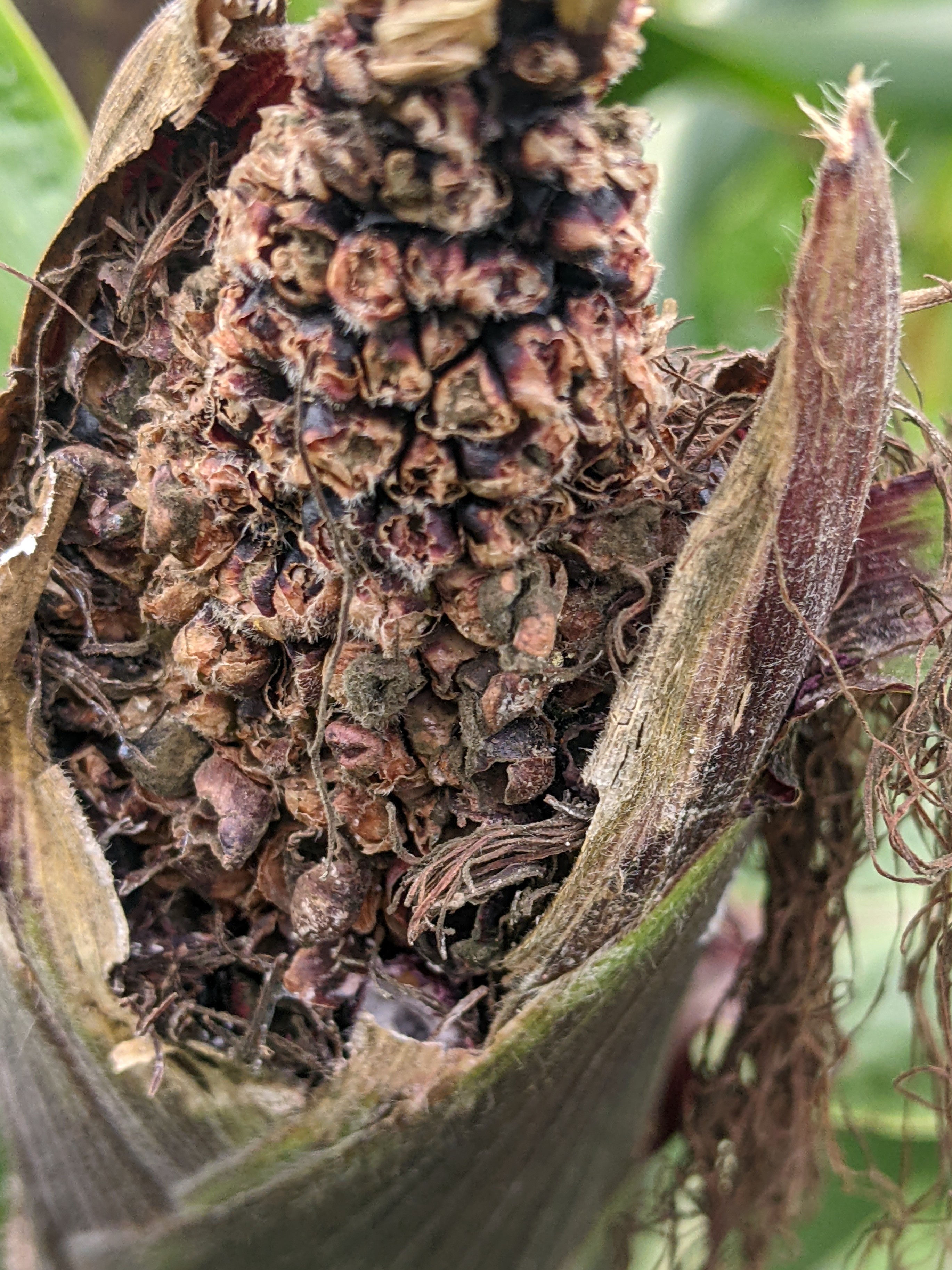
Lessor problem this year than many years is bird damage. Quite a few look like the pic below, but I am not seeing any deeply stripped down ears. They seem to be eating a few off the tip and moving on. Not good, but it has been a lot worse.
PXL_20260809_184135557.jpg
Bird damaged corn
Bird damaged corn
 
Thom Bri
pollinator
Posts: 1094
Location: Illinois
258
  • Likes 5
  • Mark post as helpful
  • send pies
    Number of slices to send:
    Optional 'thank-you' note:
  • Quote
  • Report post to moderator
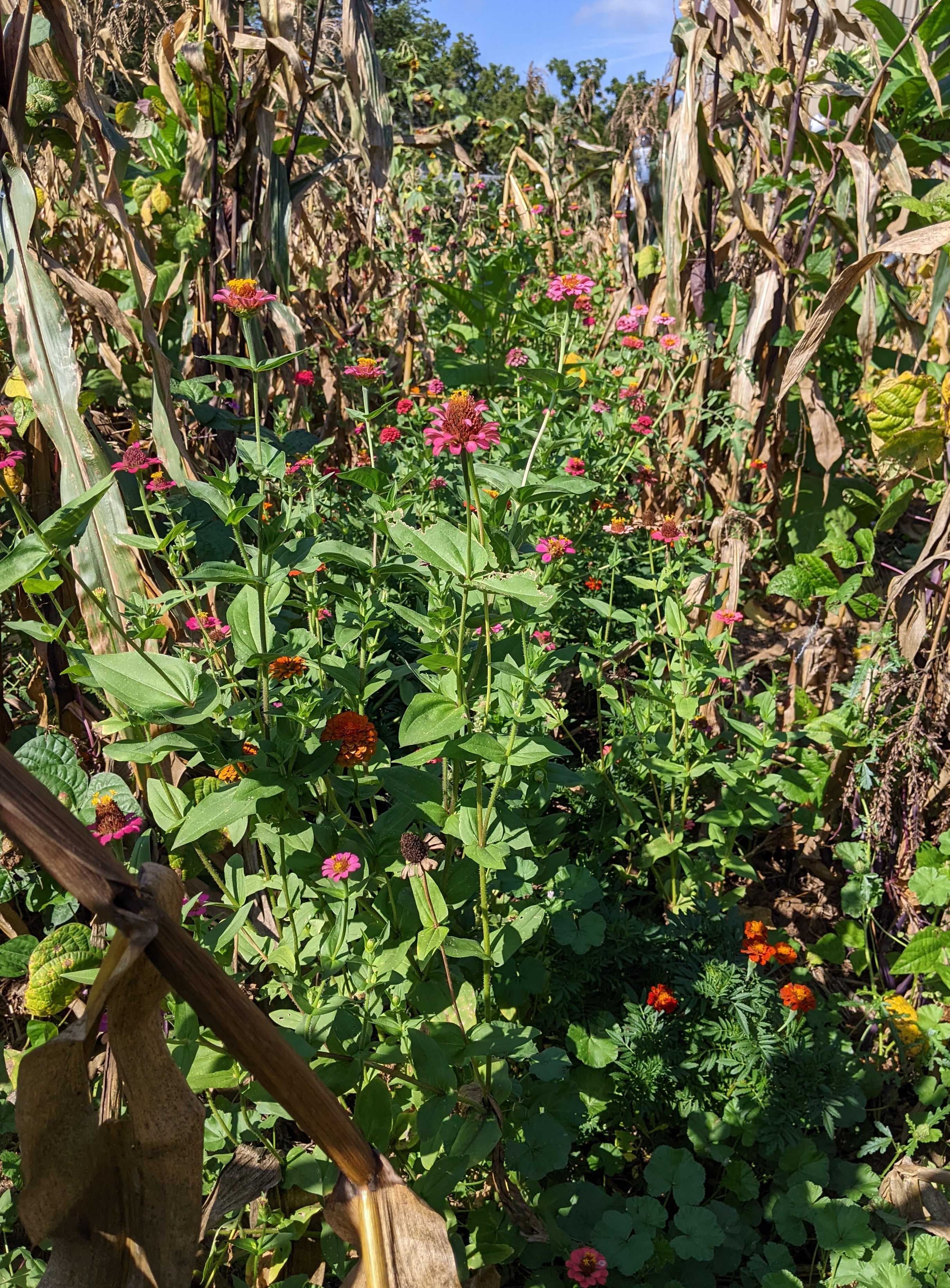
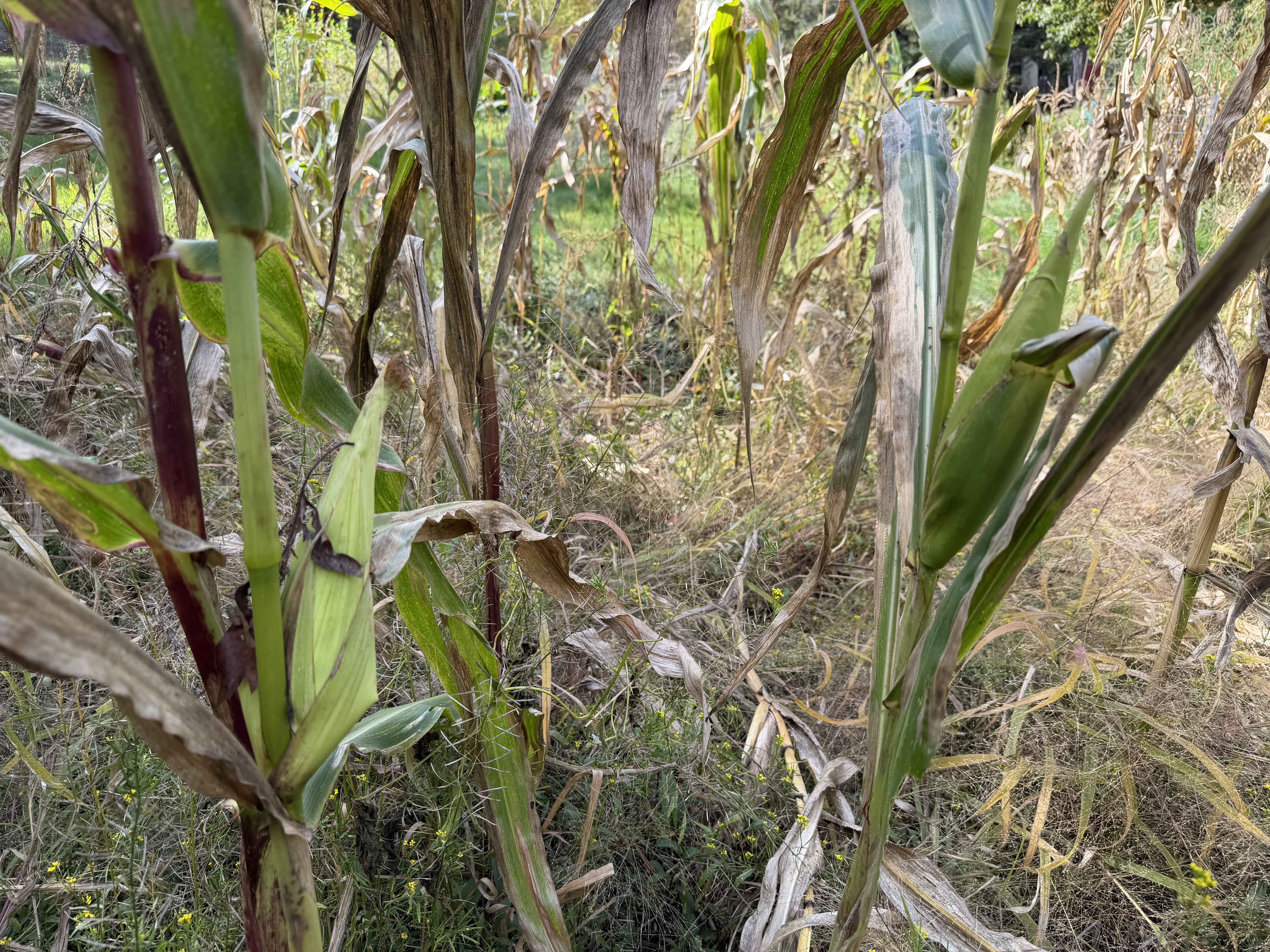
Random pics down the rows. Lots of ground cover of various sorts.
PXL_20260809_184302076.jpg
[Thumbnail for PXL_20260809_184302076.jpg]
PXL_20260809_184342325.jpg
[Thumbnail for PXL_20260809_184342325.jpg]
PXL_20260809_184409277.jpg
[Thumbnail for PXL_20260809_184409277.jpg]
 
Thom Bri
pollinator
Posts: 1094
Location: Illinois
258
  • Likes 6
  • Mark post as helpful
  • send pies
    Number of slices to send:
    Optional 'thank-you' note:
  • Quote
  • Report post to moderator
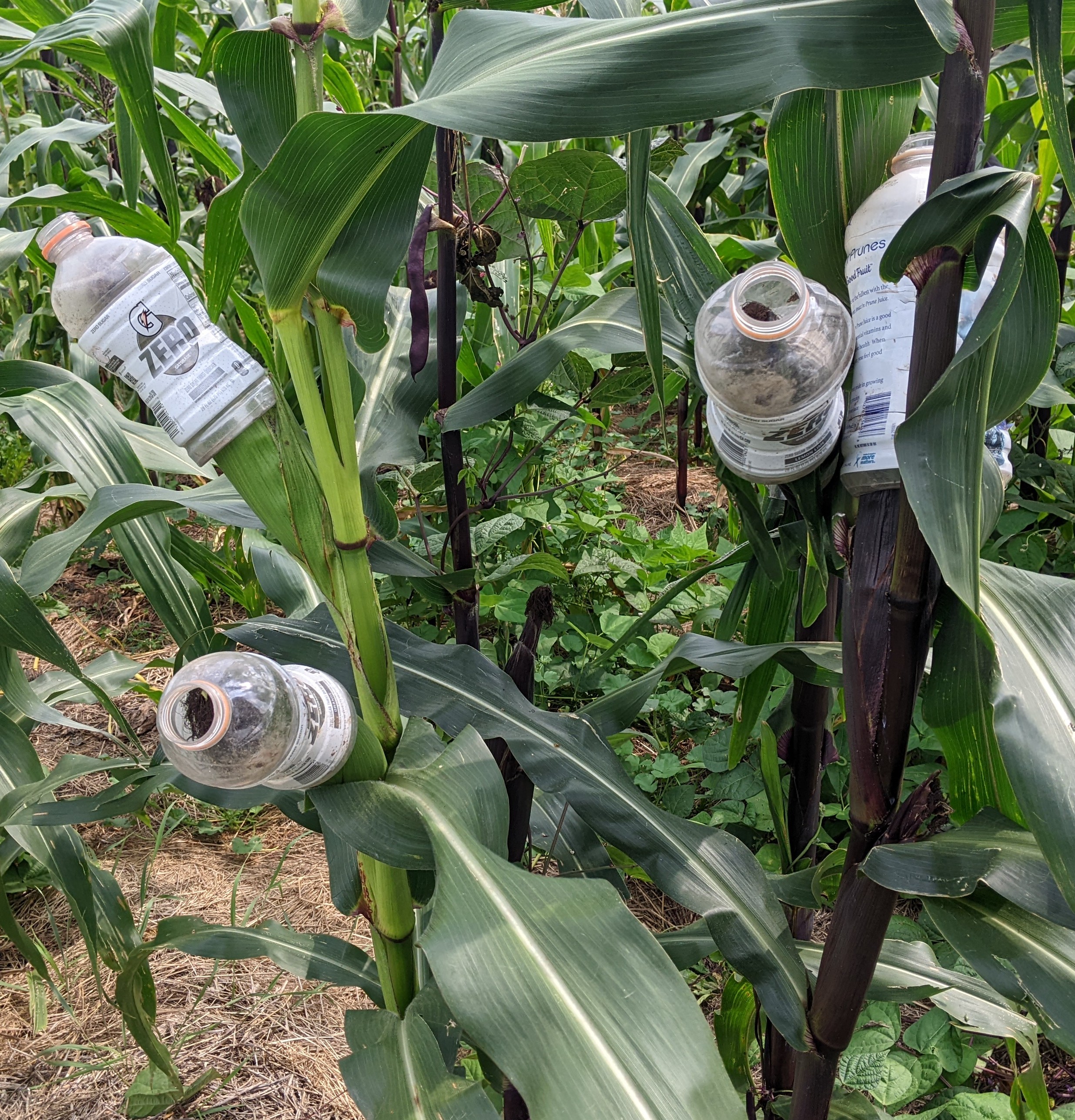
What I am doing about the deer and birds. This method works very well. It seems to help keep bugs out of the ears too. Period of greatest loss if right after pollination, during the milk to dough stages. Once the seeds harden I see very little new damage.
PXL_20260809_194021911.jpg
Recycling plastic bottles
 
Thom Bri
pollinator
Posts: 1094
Location: Illinois
258
  • Likes 8
  • Mark post as helpful
  • send pies
    Number of slices to send:
    Optional 'thank-you' note:
  • Quote
  • Report post to moderator
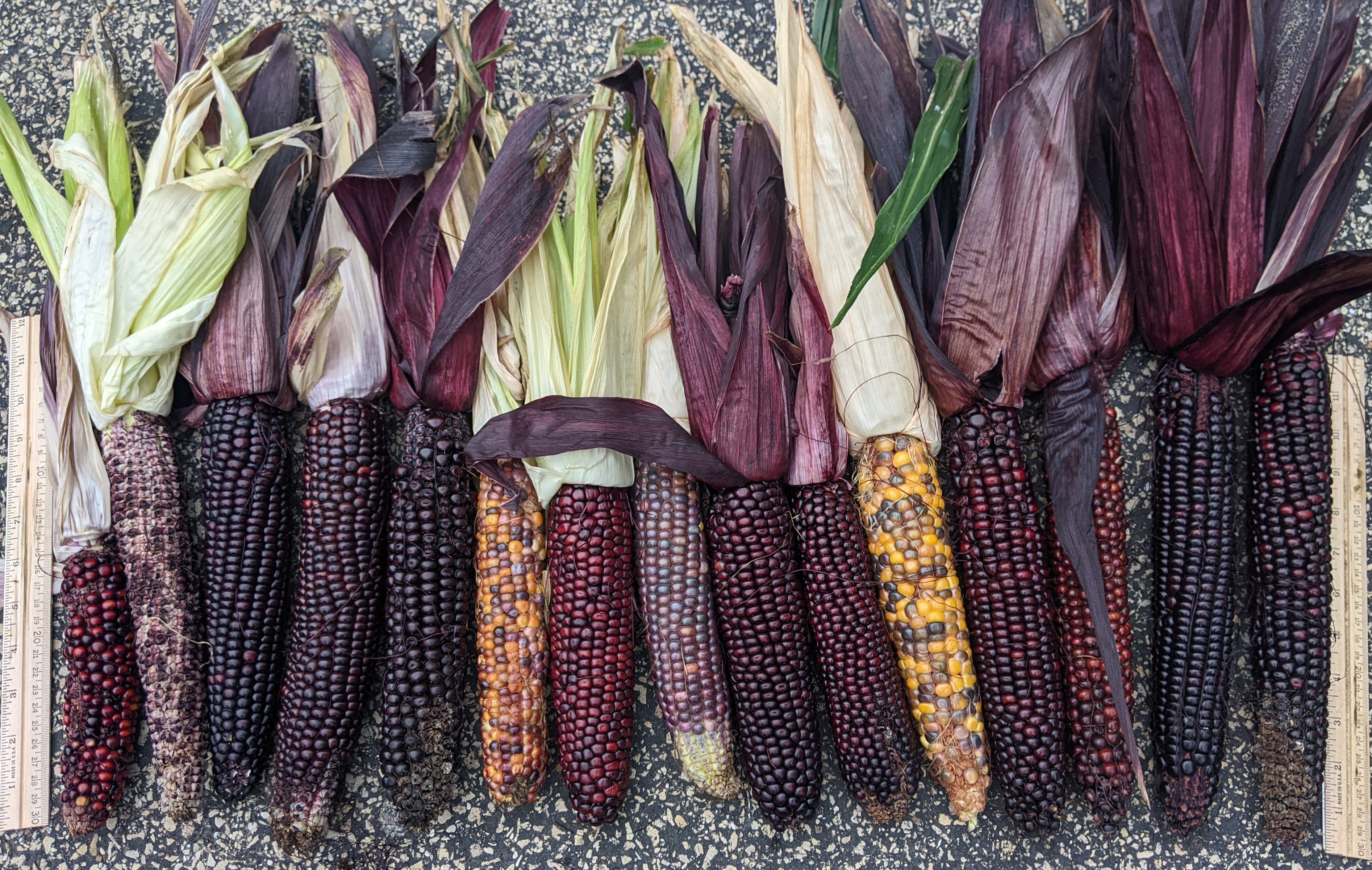
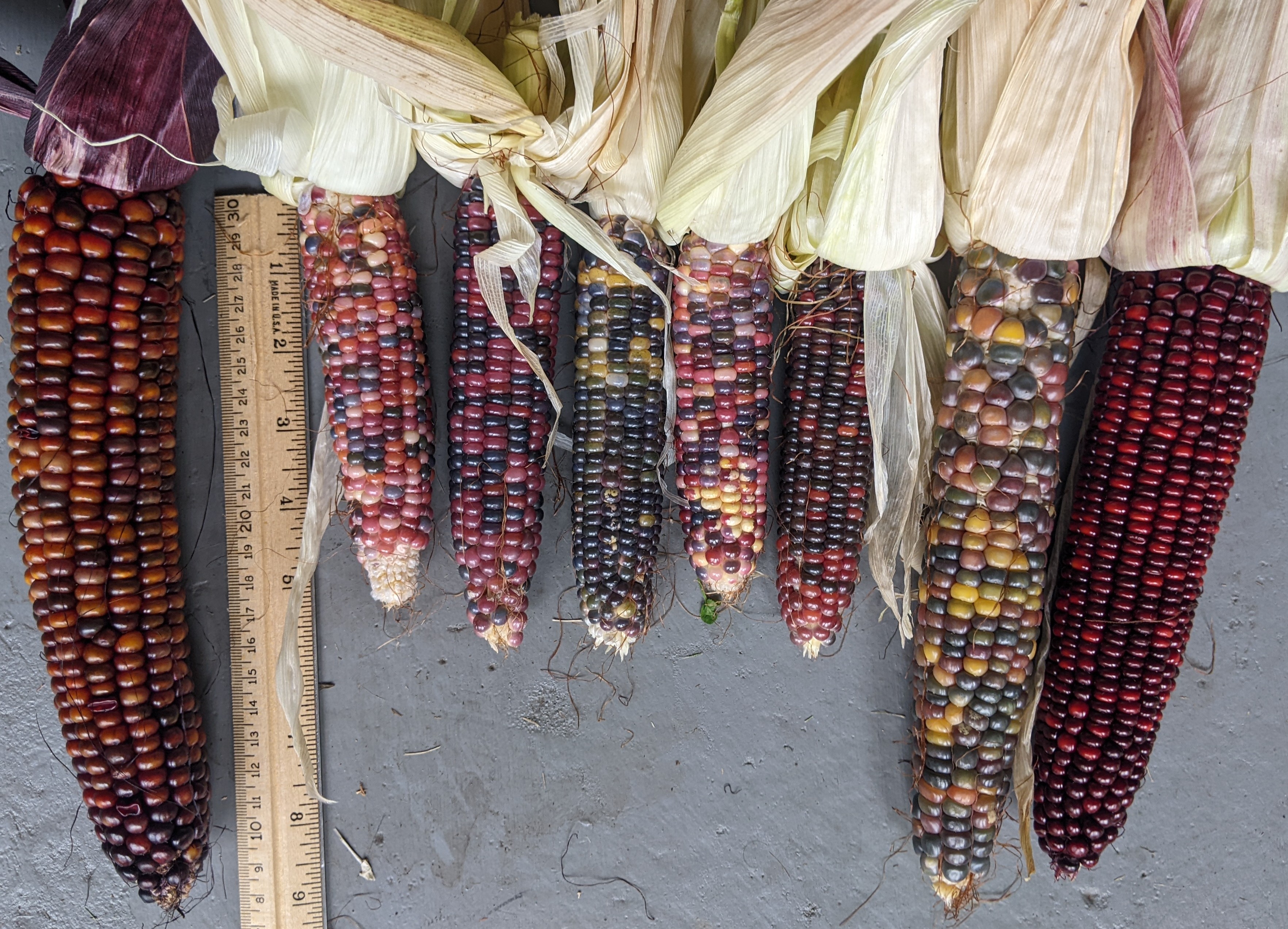
Corn harvest is starting! It's early, but I have learned to harvest when I see the outer layers of husk drying. Done early eliminates a huge amount of bird and insect damage. If I left them a month longer the ears would fill out a little more, but I would have to throw away a lot of moldy ears. Particularly since all the sudden the weather has decided to get wet. So today I picked about a dozen ears, most of them pictured below.

I am happy to see good pollination. A couple of these ears did not pollinate well but the great majority so far look good. Still seeing a fair amount of sweet corn seeds scattered among the normal seeds. Trying to eliminate this trait since it leads to more insect damage and mold. A few with double tips. I see a few tiny earworm larvae on the tips of some ears. Good to harvest before they destroy the ear.

The ruler is 12 inches or 30 cm. Longest ear right at 12 inches, but with dry-down will end up about 10 inches. The ears on the far right are what I am selecting for.
PXL_20260818_231323433.jpg
2026 corn harvest
2026 corn harvest
 
gardener
Posts: 2309
Location: Zone 6b
1537
forest garden fungi books chicken fiber arts ungarbage
  • Likes 3
  • Mark post as helpful
  • send pies
    Number of slices to send:
    Optional 'thank-you' note:
  • Quote
  • Report post to moderator
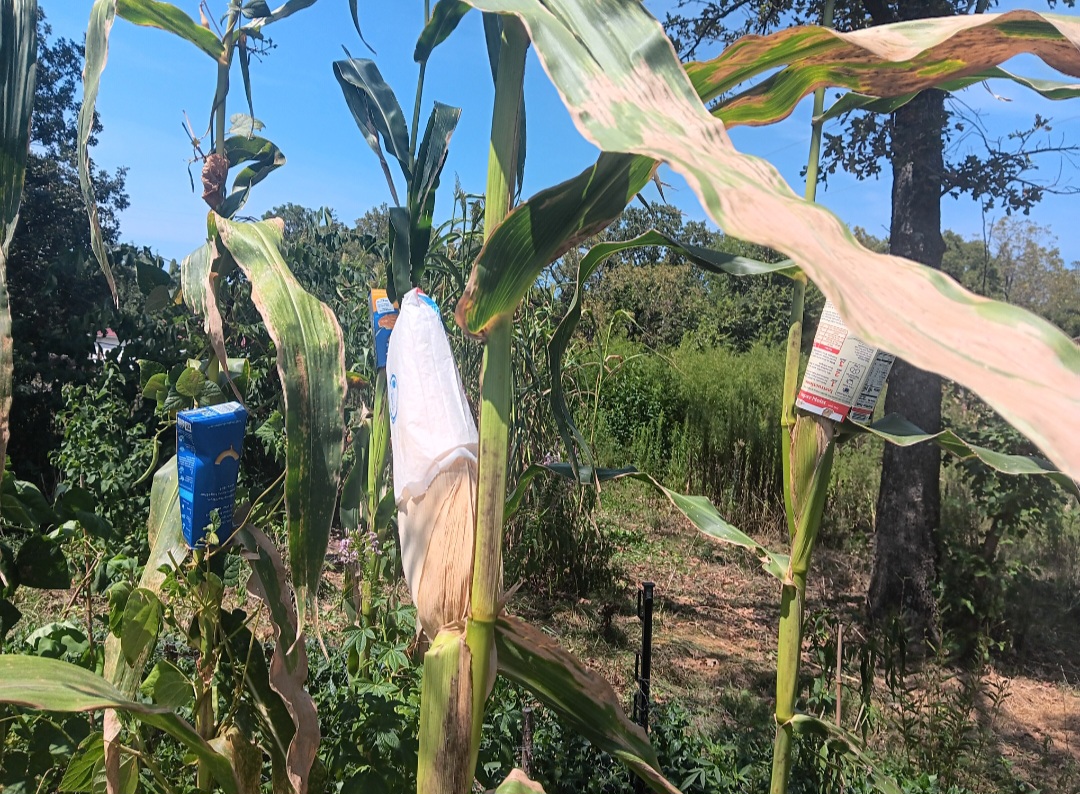
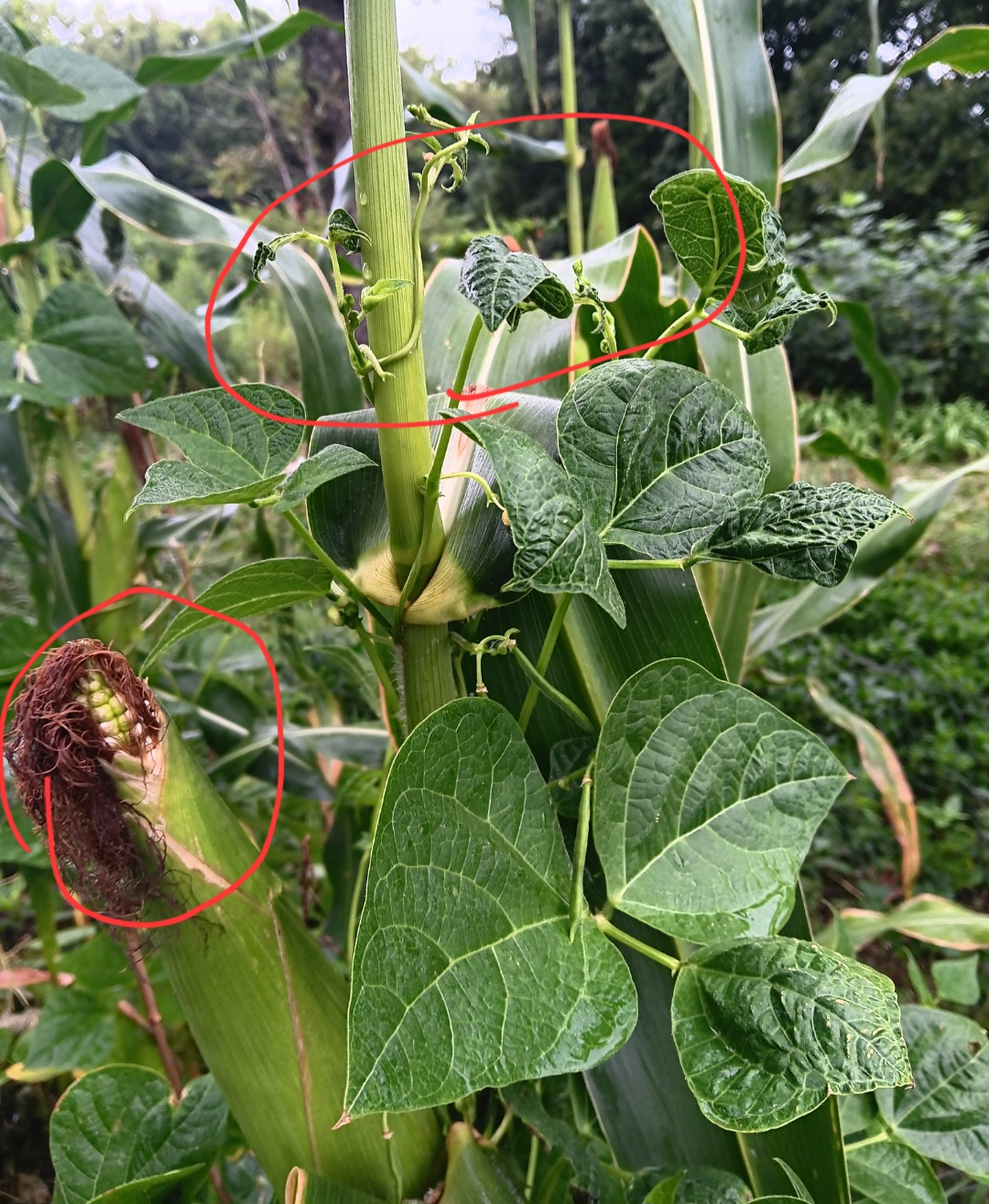
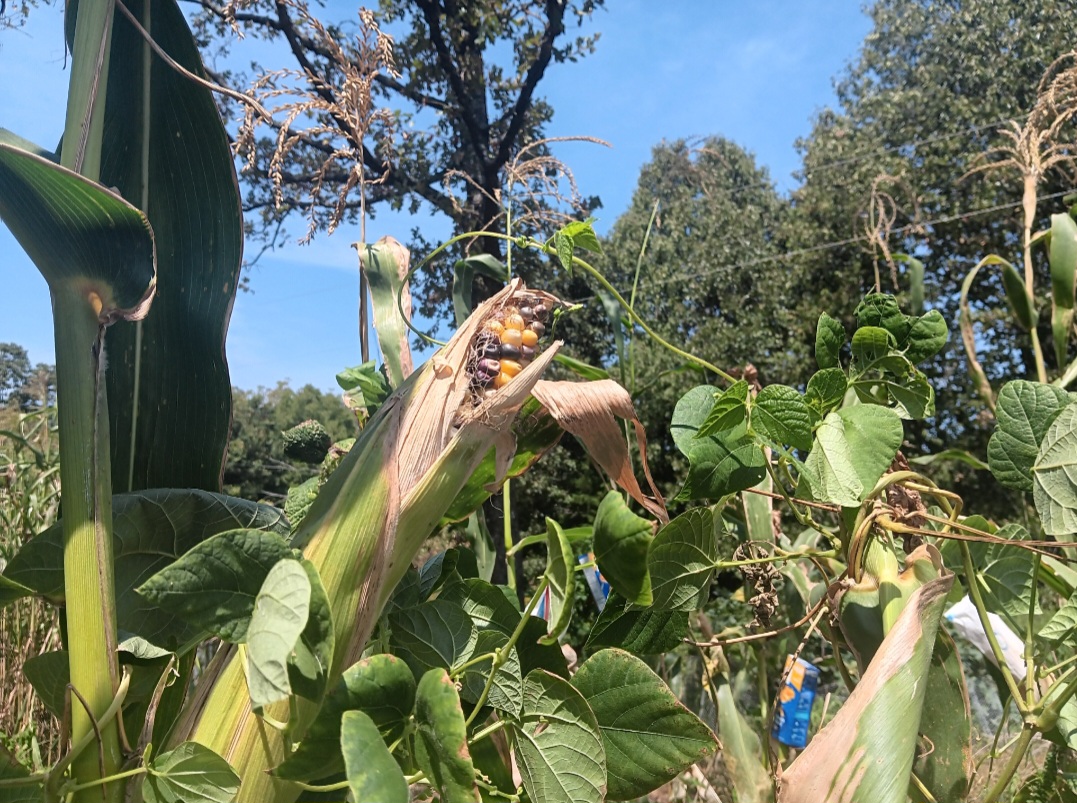
Last week I picked two droopy ears of corn that the husks have dried and turned pale. But they were not matured at closer inspection, the lower half of the kernel still can be dented with finger nail. Plus the leaves are still green. So I watered the other plants and let them finish naturally. This is the first year my corns don't die back suddenly. I do protect the ears somehow with paper bags and boxes because some of them have short husks: the cob outgrowing the husks leaving the tip exposed. 10 more days to go.
20260821_134659.jpg
Drying down
Drying down
20260806_112107.jpg
Tip back and short husks. Bean new growth abnormal
20260821_134653.jpg
Short husks
Short husks
 
Thom Bri
pollinator
Posts: 1094
Location: Illinois
258
  • Likes 6
  • Mark post as helpful
  • send pies
    Number of slices to send:
    Optional 'thank-you' note:
  • Quote
  • Report post to moderator

May Lotito wrote:Last week I picked two droopy ears of corn that the husks have dried and turned pale. But they were not matured at closer inspection, the lower half of the kernel still can be dented with finger nail. Plus the leaves are still green. So I watered the other plants and let them finish naturally. This is the first year my corns don't die back suddenly. I do protect the ears somehow with paper bags and boxes because some of them have short husks: the cob outgrowing the husks leaving the tip exposed. 10 more days to go.


I expect your boxes work as well as my plastic bottles.
I get a lot of open tips too, and that's certainly attractive to birds and bugs.
Funny thing, my sweet corn, which is crosses with my purple corn, has very long husks that deeply cover the tips. I wonder if that is some genetic trick picked up from the sweet corn or if it is just because the cobs are shorter so the same length husk covers better.

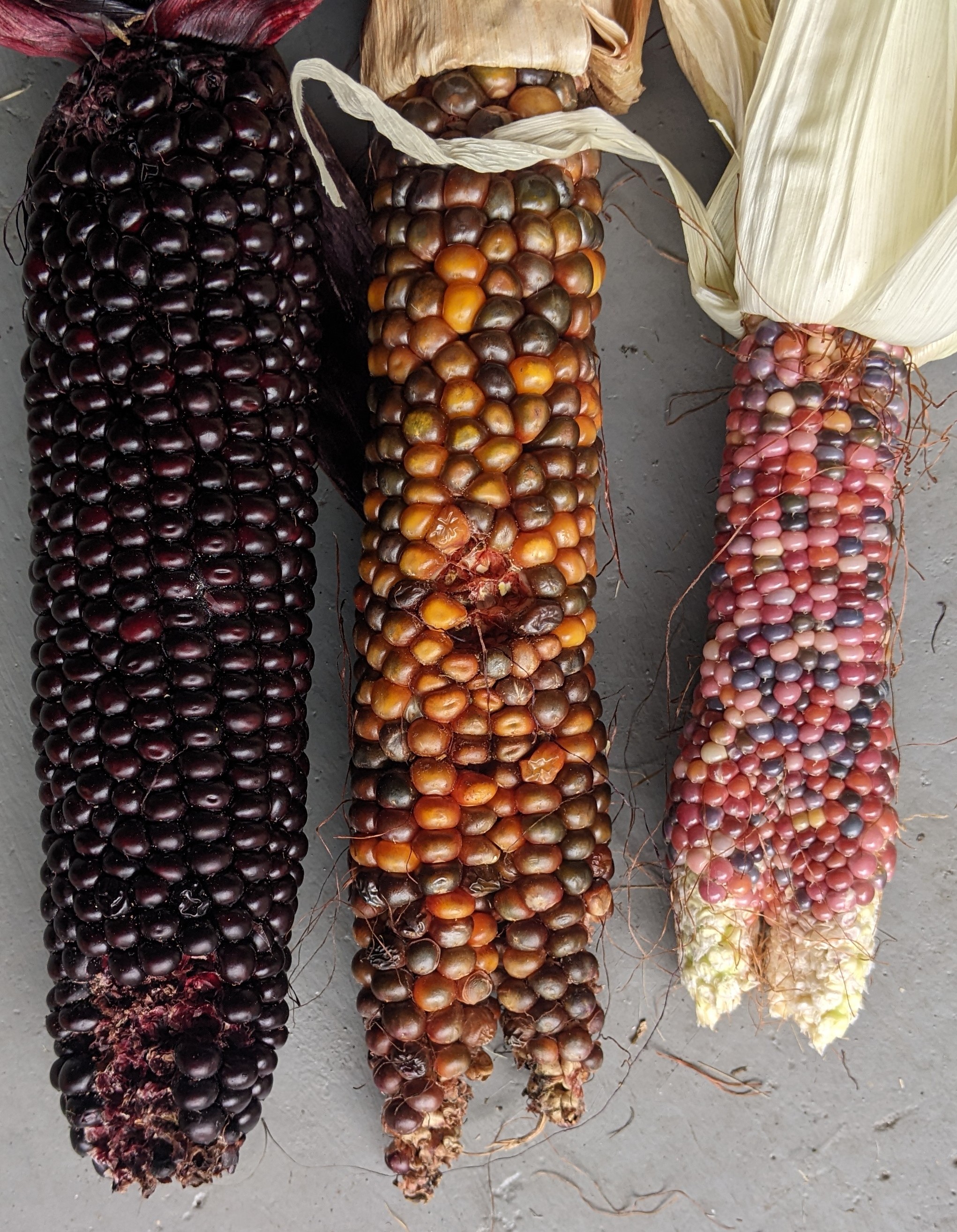
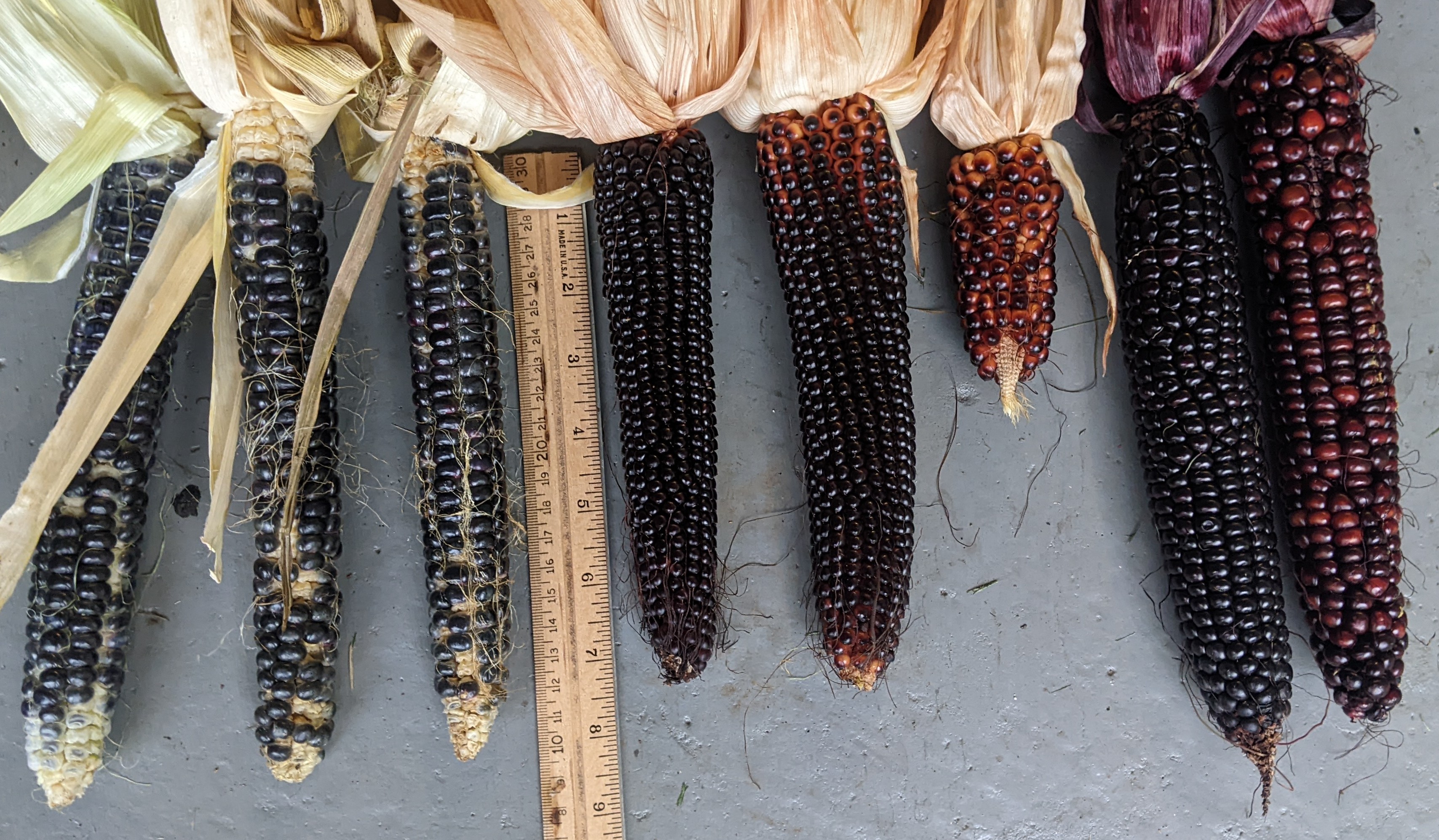
Pic shows 3 new varieties I got this year and my purple corn on the far right to compare. The 3 middle ears are pop corn just picked today, 2 varieties. The left 3 are either Baker Creek Delaware Black Flint, or Dakota Black. I don't recall which one got planted where.

PXL_20260822_001136888.jpg
[Thumbnail for PXL_20260822_001136888.jpg]
 
Thom Bri
pollinator
Posts: 1094
Location: Illinois
258
  • Likes 5
  • Mark post as helpful
  • send pies
    Number of slices to send:
    Optional 'thank-you' note:
  • Quote
  • Report post to moderator
After last year's failure of the Glass Gem corn I hesitated whether to plant much of it again. As it turns out I ended up putting in more than I expected. Almost a full row, and I also used it for replanting on hills that failed to germinate or too few germinated. But I have had good luck with it in other years, and it has several characteristics I like.

It is tall and has sturdy stems.
It is prolific, lots of ears result from one seed planted.
It suckers heavily, and the suckers are nearly as good as the main stalk. I counted 7 ears on one cluster, the main stalk plus good ears on several suckers.
Generally healthy plants, very little insect damage, and the birds mostly leave it alone. Husks completely cover the ears. Very little mold.
It is pretty. The ears are small, 4-5 inches long, slim, and brightly colored.
The crosses seem about halfway between the Glass Gem and my other corn.

Below is a pic of 4 Glass Gem ears just picked today and yesterday. Nice lavender color. Surprising since what I planted had lots of green seeds, but so far this year few green seeds. Next to them are two pretty average ears of my purple corn for comparison. If you wanted to start growing corn it would not be a mistake to start with Glass Gem.
PXL_20260824_001008373.jpg
Glass Gem Corn
Glass Gem Corn
 
Thom Bri
pollinator
Posts: 1094
Location: Illinois
258
  • Likes 7
  • Mark post as helpful
  • send pies
    Number of slices to send:
    Optional 'thank-you' note:
  • Quote
  • Report post to moderator
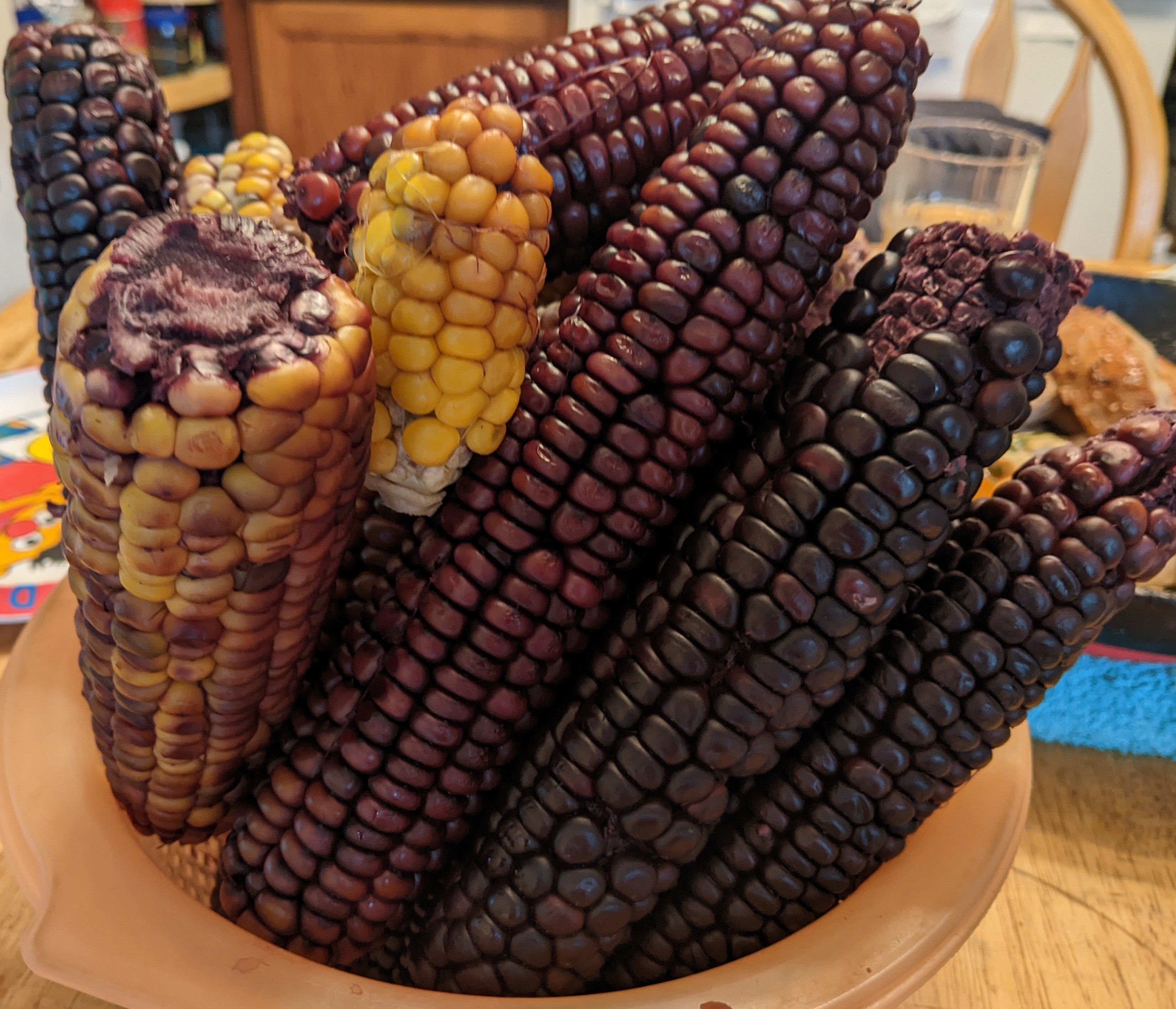
What we are eating, purple sweet corn. This is repeated crossings of standard commercial sweet corn with my purple corn. It has been several years since I added any pure sweet corn seed to the mix. Last year I had a lot of purple ears that had sweet corn seeds scattered among them. I saved some of those seeds and mixed them in with my sweet corn seeds. The result was pretty good. Most of the purple ears were soft and sweet, but a few were not so sweet. I have saved a lot of seed for 2027 already.

According to my wife, we have eaten about 500 ears of corn this summer, plus I gave a way maybe a hundred more. Sadly, I only have one more pick left in the garden, then no more corn until next summer.
PXL_20260826_223924519.jpg
Purple sweet corn
Purple sweet corn
 
Thom Bri
pollinator
Posts: 1094
Location: Illinois
258
  • Likes 6
  • Mark post as helpful
  • send pies
    Number of slices to send:
    Optional 'thank-you' note:
  • Quote
  • Report post to moderator
Double-tip ears. This year I got a lot of these. I think it is because the double tip ears are generally thicker so I may have selected for this trait by accident. It's not always obvious that an ear is double, as the one dark purple ear shows. If you didn't look carefully you might not notice.

This is a trait I don't like, because it thickens the tip so the husks do not fully cover the tip, allowing birds and insects a highway into the ear.
PXL_20260829_192018420.jpg
Double tipped corn ears
 
Thom Bri
pollinator
Posts: 1094
Location: Illinois
258
  • Likes 6
  • Mark post as helpful
  • send pies
    Number of slices to send:
    Optional 'thank-you' note:
  • Quote
  • Report post to moderator
More on Glass Gem. I got two obvious crosses with my corn. I have a lot of ears that I think are crosses, but on these two I know they are, because I picked them from my glass gem row, and the plants looked like typical Glass Gem plants and not like my purple corn plants. Quite distinct.

These ears are not quite twice as long as the Glass Gem ears, and considerably thicker. I think it will make a good addition to the pool of genetics.

Pic shows several typical Glass Gem ears. One ear, on the left, that I suspect is partly Glass Gem, and the two ears on the right that I know are crosses:
PXL_20260829_191936242.jpg
Glass Gem Corn
Glass Gem Corn
 
May Lotito
gardener
Posts: 2309
Location: Zone 6b
1537
forest garden fungi books chicken fiber arts ungarbage
  • Likes 3
  • Mark post as helpful
  • send pies
    Number of slices to send:
    Optional 'thank-you' note:
  • Quote
  • Report post to moderator
My

Thom Bri wrote:Double-tip ears.


This is a rare case of fasciation .  
 
Thom Bri
pollinator
Posts: 1094
Location: Illinois
258
  • Likes 2
  • Mark post as helpful
  • send pies
    Number of slices to send:
    Optional 'thank-you' note:
  • Quote
  • Report post to moderator

May Lotito wrote:My

Thom Bri wrote:Double-tip ears.


This is a rare case of fasciation .  


Seeing more of it than usual this year. Most years get a few.
 
Thom Bri
pollinator
Posts: 1094
Location: Illinois
258
  • Likes 4
  • Mark post as helpful
  • send pies
    Number of slices to send:
    Optional 'thank-you' note:
  • Quote
  • Report post to moderator
Leaving for a short vacation in a few days, so I went ahead and bundled up my corn and hung it to dry in the basement. I have a dehumidifier down there so it is very dry, and I turned a fan on as well. Dry and moving air to prevent mold. Weather is predicted to be humid and rainy the coming week, so leaving the corn on the garage floor wasn't the best option.

Bundles are with string tied around the husks and hanging point-down, typically about 5 ears per bundle. 41 bundles so far, so roughly 200+ ears of corn.
 
May Lotito
gardener
Posts: 2309
Location: Zone 6b
1537
forest garden fungi books chicken fiber arts ungarbage
  • Likes 8
  • Mark post as helpful
  • send pies
    Number of slices to send:
    Optional 'thank-you' note:
  • Quote
  • Report post to moderator
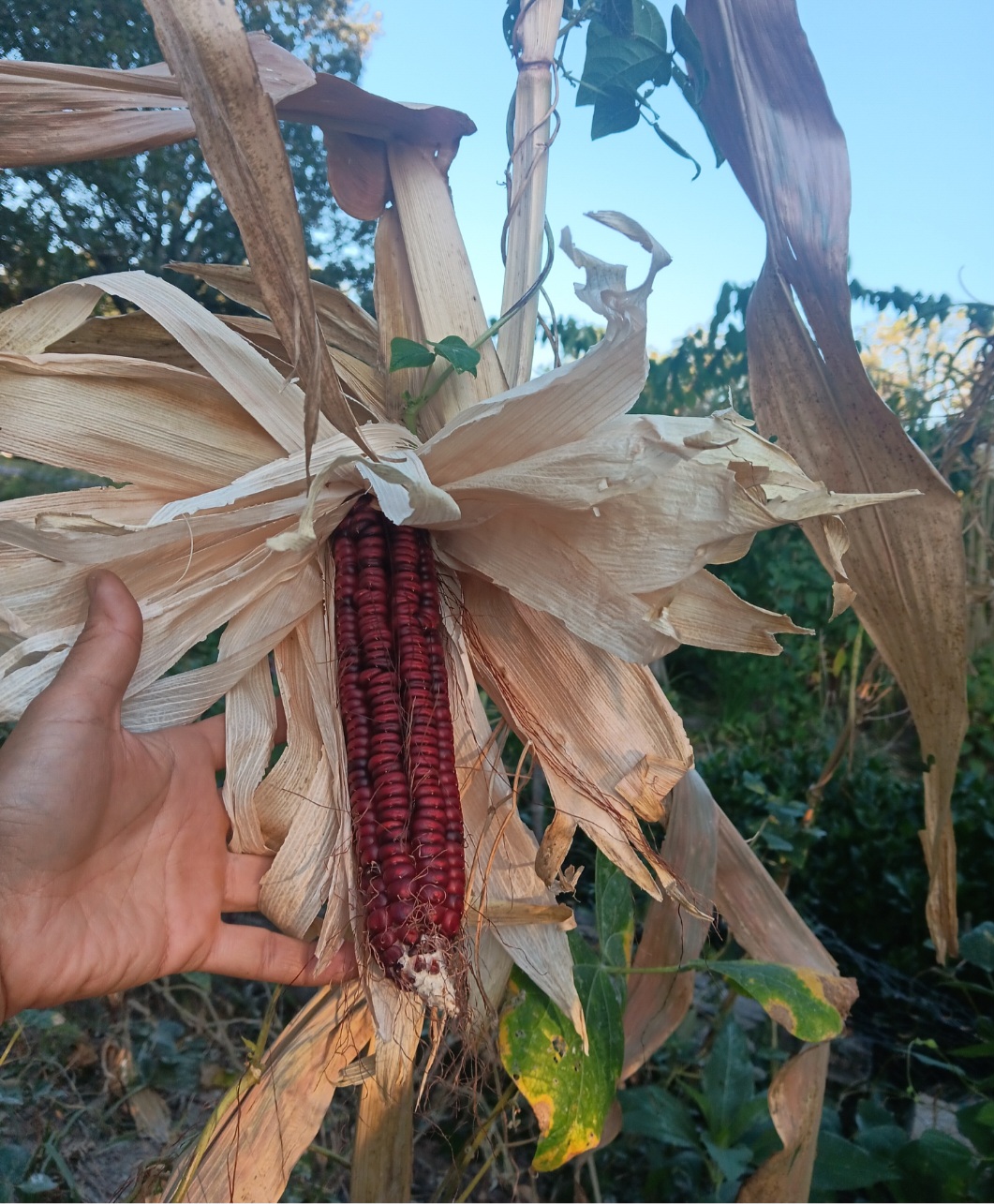
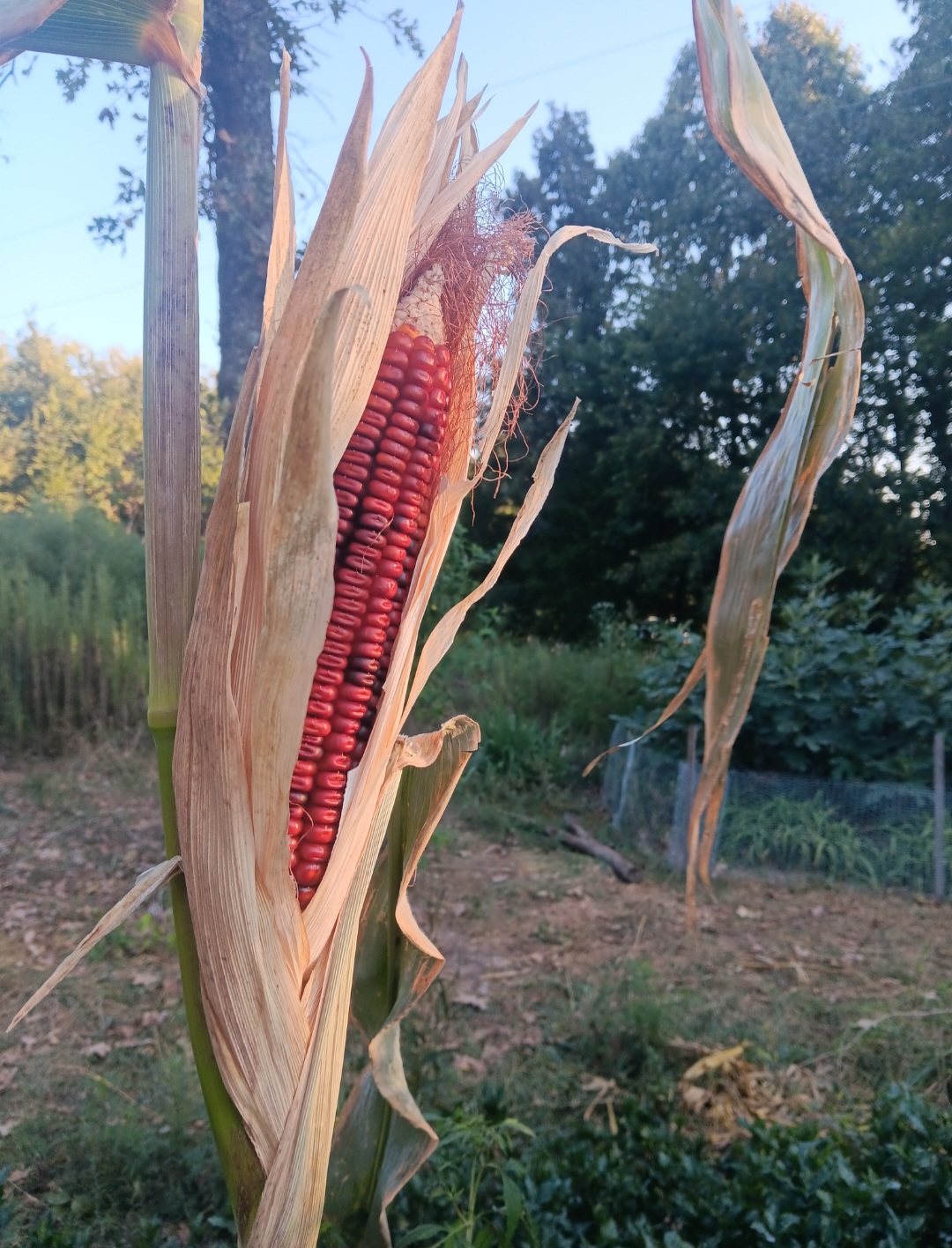
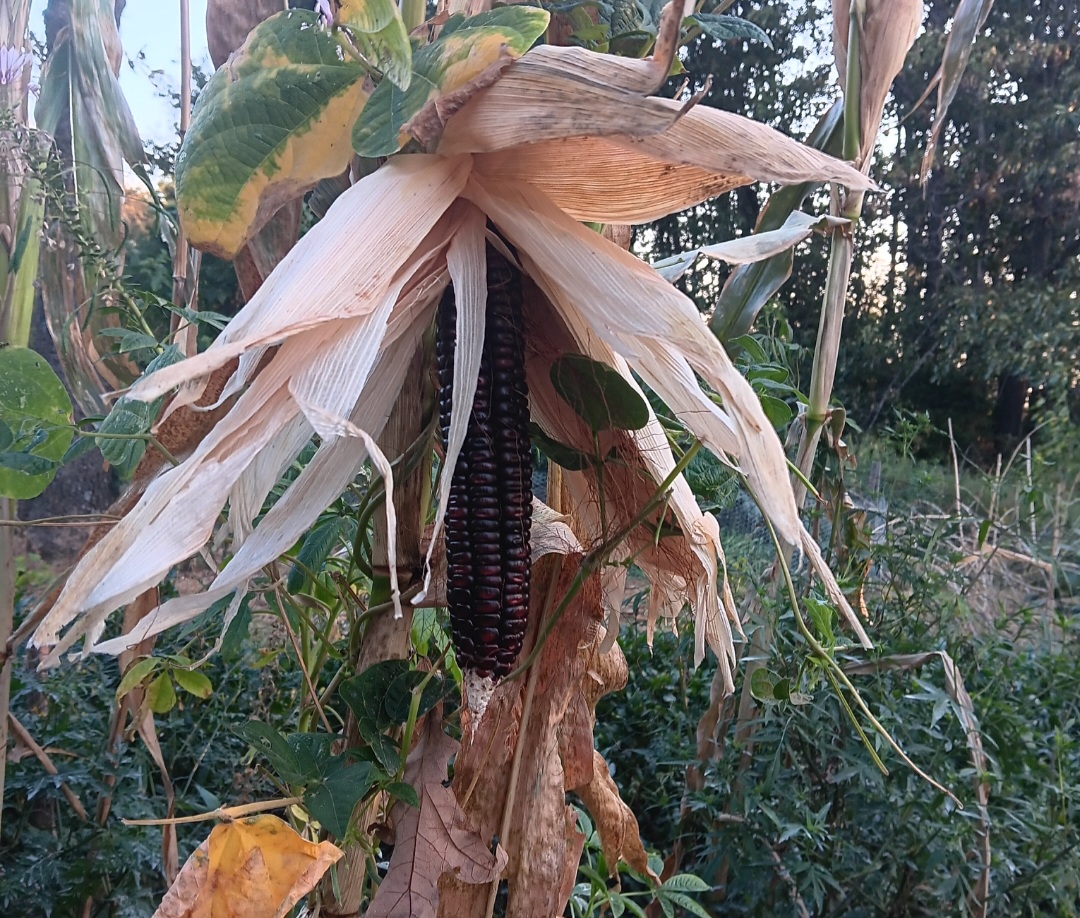
The stalks start to dry and the heavy ear just droop down. The husks also puff out a bit. I guess that makes corn kernels to dry faster to avoid spoilage naturally. The whole week it will be 100F and no rain, everything would finish up except a few giant Inca maize. I gave the ears a sneak peek, there seemed to be little cross pollination.
20260831_075213.jpg
135 days
135 days
20260831_074534.jpg
Bloody butcher
Bloody butcher
20260831_074411.jpg
Bloody butcher
Bloody butcher
20260831_074823.jpg
Blue clarage?
Blue clarage?
20260831_074453.jpg
Cherokee white eagle?
 
Thom Bri
pollinator
Posts: 1094
Location: Illinois
258
  • Likes 5
  • Mark post as helpful
  • send pies
    Number of slices to send:
    Optional 'thank-you' note:
  • Quote
  • Report post to moderator

May Lotito wrote: ...everything would finish up except a few giant Inca maize. I gave the ears a sneak peek, there seemed to be little cross pollination.


Very pretty!

My Inca corn, Baker Creek Maiz Morado, is also quite a bit slower than any of my other corns. I suspect not a lot of cross-pollination either. Some of them are still trying to pollinate now, while my purple corn started pollinating in early July. Both planted on the same day. Stalks are tall and very sturdy with lots of brace roots. The ears are very high on the stalk, some above 6 feet. I have picked two early. They are fairly small, 5 inches or so, dark purple-black, and 8 rows. None of the plants are producing large ears, so I think this will be a low productive variety.
 
Thom Bri
pollinator
Posts: 1094
Location: Illinois
258
  • Likes 5
  • Mark post as helpful
  • send pies
    Number of slices to send:
    Optional 'thank-you' note:
  • Quote
  • Report post to moderator
Took a few pics today. The story today is corn cross breeding.
First pic is my purple flint corn crossed with the commercial hybrid dent corn that grows in the field next to my garden. The gap is about 40 feet around two sides of the garden. Most pollen falls within a few feet of the plant, but it doesn't take much wind to carry it quite a bit farther. I walked 11 rows into that field and still easily found purple-colored seeds from my corn on his ears.
So obviously it is equally easy for his corn to pollinate mine. I try to eliminate the crosses in next year's seed, but inevitably quite a bit gets through. Even though my corn looks nothing like standard yellow dent hybrid, I'd guess a genetic test would show it's a large % of the total genetics.
The pic below shows some of the ears that show obvious signs of crossing with commercial yellow dent corn. The solid yellow ear on the end shows the original hybrid dent corn, the others are all crosses. It's interesting that when the hybrid corn crosses with my corn the result is often a longer, thicker ear than either parent. Hybrid vigor, I suppose:
PXL_20260910_193556104.jpg
[Thumbnail for PXL_20260910_193556104.jpg]
 
Thom Bri
pollinator
Posts: 1094
Location: Illinois
258
  • Likes 6
  • Mark post as helpful
  • send pies
    Number of slices to send:
    Optional 'thank-you' note:
  • Quote
  • Report post to moderator
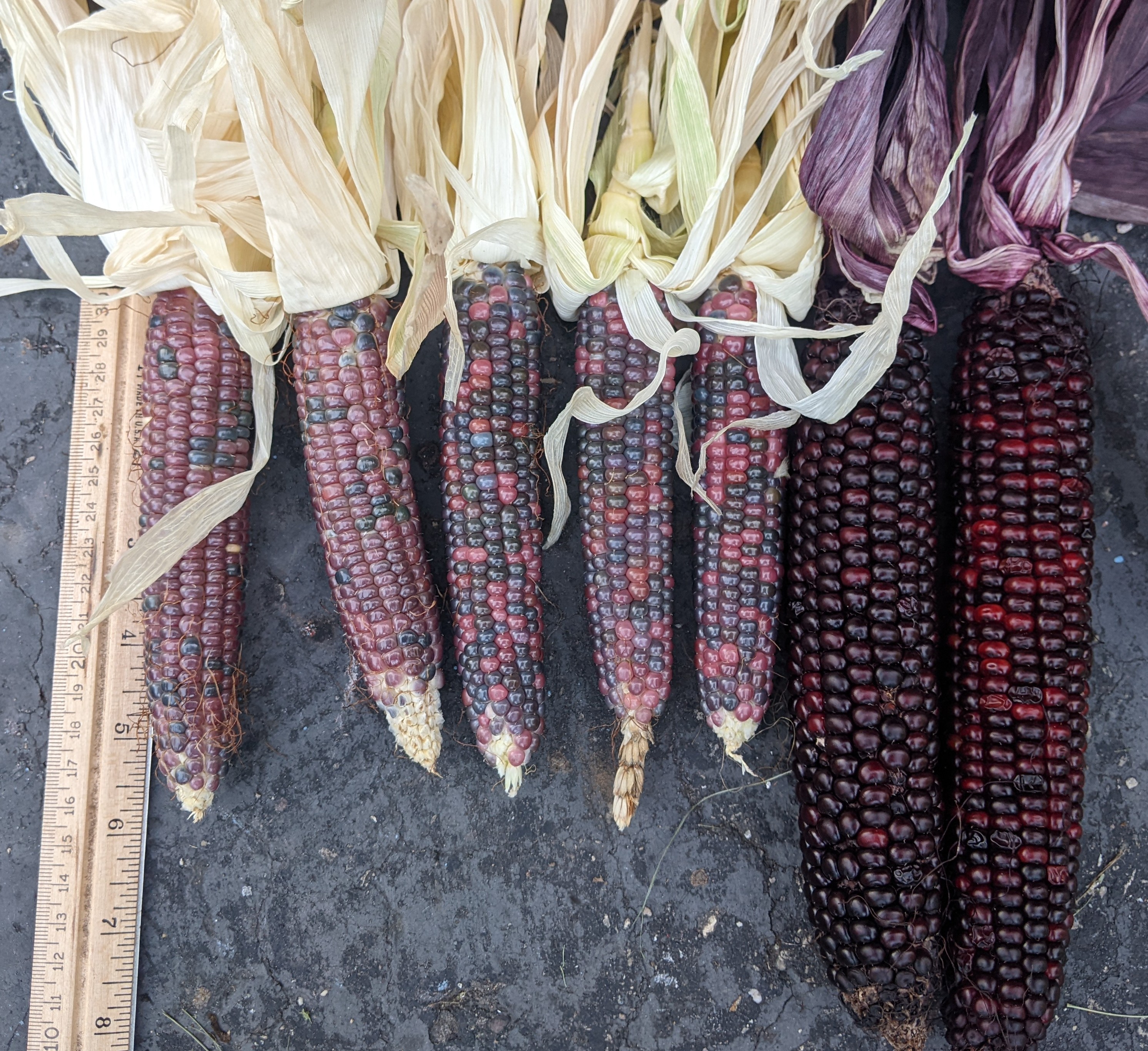
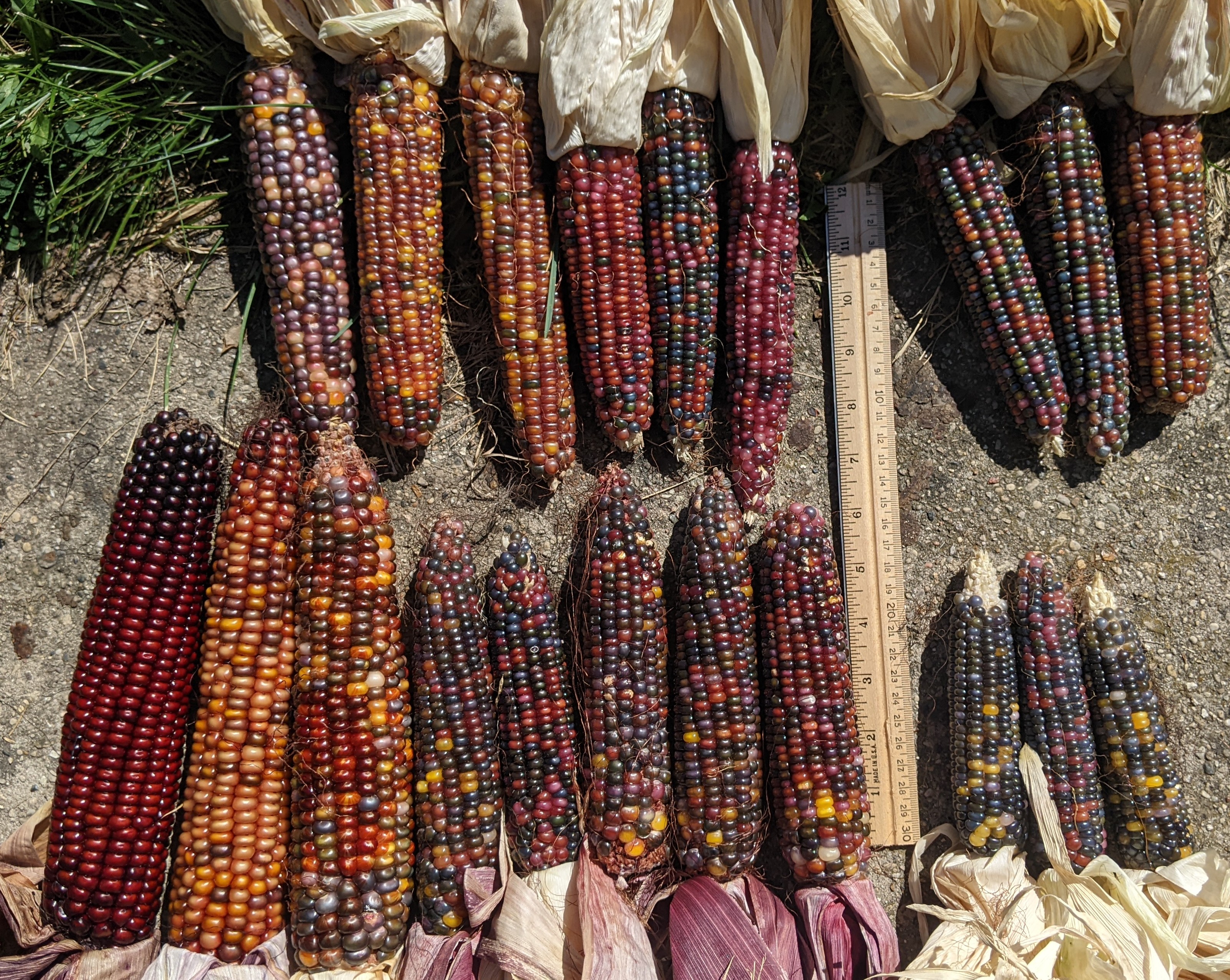
Next pic is the Glass Gem crosses with my purple corn. I have been planting it alongside my corn for several years and am seeing the results of obvious crosses.
Glass Gem is usually quite slim, tiny ears, 4-5 inches or so. It has tiny, glossy, brightly colored seeds. Cob is white and plant leaves and husks green. One planted seed will result in a cluster of stalks and 4-5 or more ears of corn. Very prolific.
I planted one row of Glass Gem right down the middle of my garden this year, the same as last year, using the seeds that resulted from last year's crop. So I was hoping that I would see a lot of half-and-half ears, and that is what I got.
I plan to plant back again these crosses, blending it with my corn. Hope is to increase the insect resistance of my corn and also the prolificacy. The individual ears may be smaller, but with more ears and less bug and mold damage hopefully I will not lose total production.

The three ears on the bottom row right are typical pure Glass Gem. The large red ear one the bottom row far left is a typical ear of my corn. All the others show crosses between the two varieties. Sadly, my photos don't really catch the colorful beauty.
PXL_20260910_193526097.jpg
Glass Gem Corn Crosses
 
pioneer
Posts: 511
137
cat trees urban
  • Likes 5
  • Mark post as helpful
  • send pies
    Number of slices to send:
    Optional 'thank-you' note:
  • Quote
  • Report post to moderator
By zooming in on the photos, I can see quite a lot of colourful beauty! Lovely.
 
Thom Bri
pollinator
Posts: 1094
Location: Illinois
258
  • Likes 7
  • Mark post as helpful
  • send pies
    Number of slices to send:
    Optional 'thank-you' note:
  • Quote
  • Report post to moderator
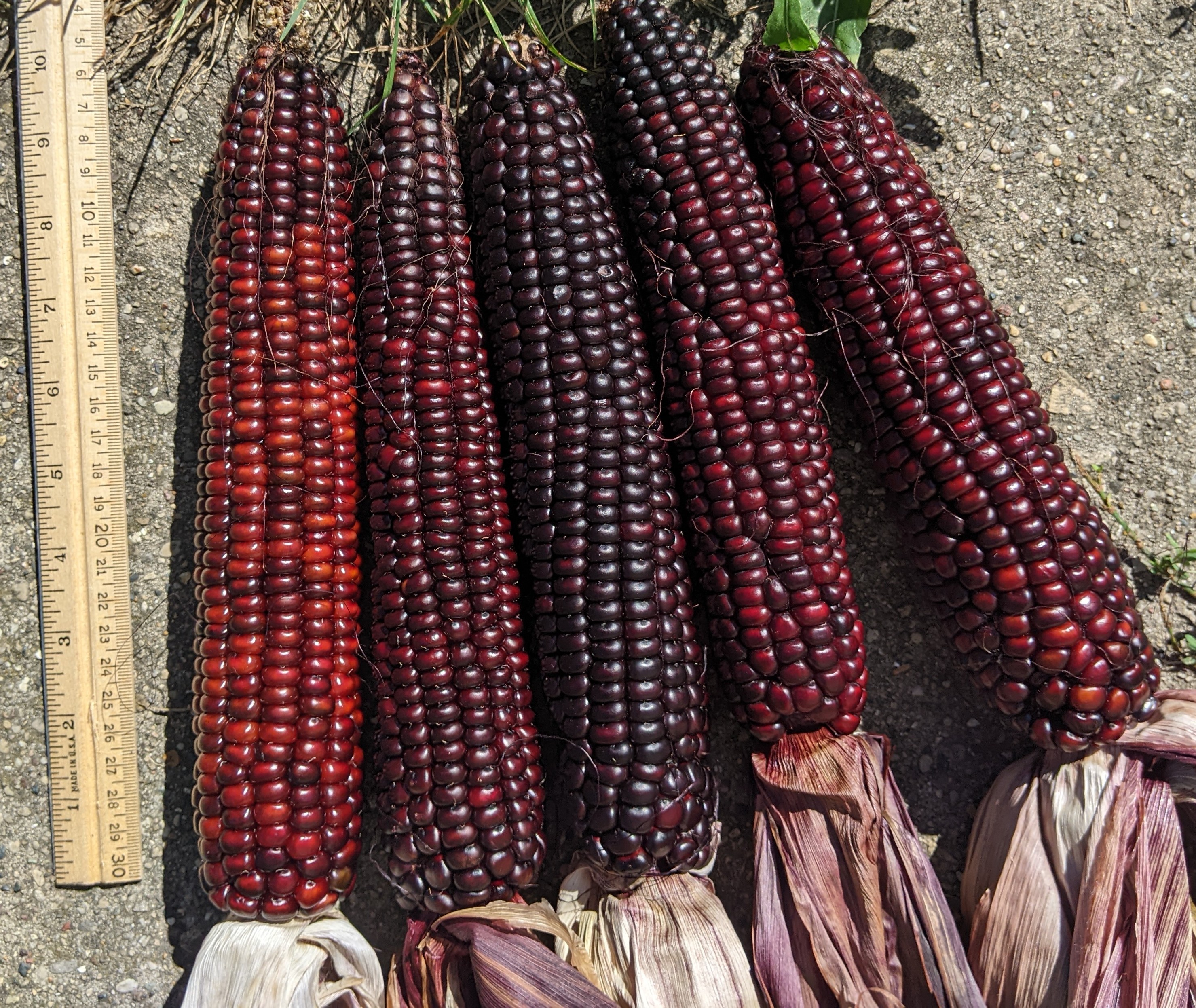
A few of the better ears. These may end up as seed for next year. I have a lot more to harvest so don't know yet if there are not better ones still in the field. These look like what I am aiming for.
PXL_20260910_193619381.jpg
Purple corn
Purple corn
 
Posts: 305
Location: Payson, Utah, US of A - Zone6B/High Desert/4500' /14" Rainfall
162
hugelkultur forest garden building seed writing greening the desert
  • Likes 2
  • Mark post as helpful
  • send pies
    Number of slices to send:
    Optional 'thank-you' note:
  • Quote
  • Report post to moderator
This is awesome.
 
Ac Baker
pioneer
Posts: 511
137
cat trees urban
  • Likes 2
  • Mark post as helpful
  • send pies
    Number of slices to send:
    Optional 'thank-you' note:
  • Quote
  • Report post to moderator
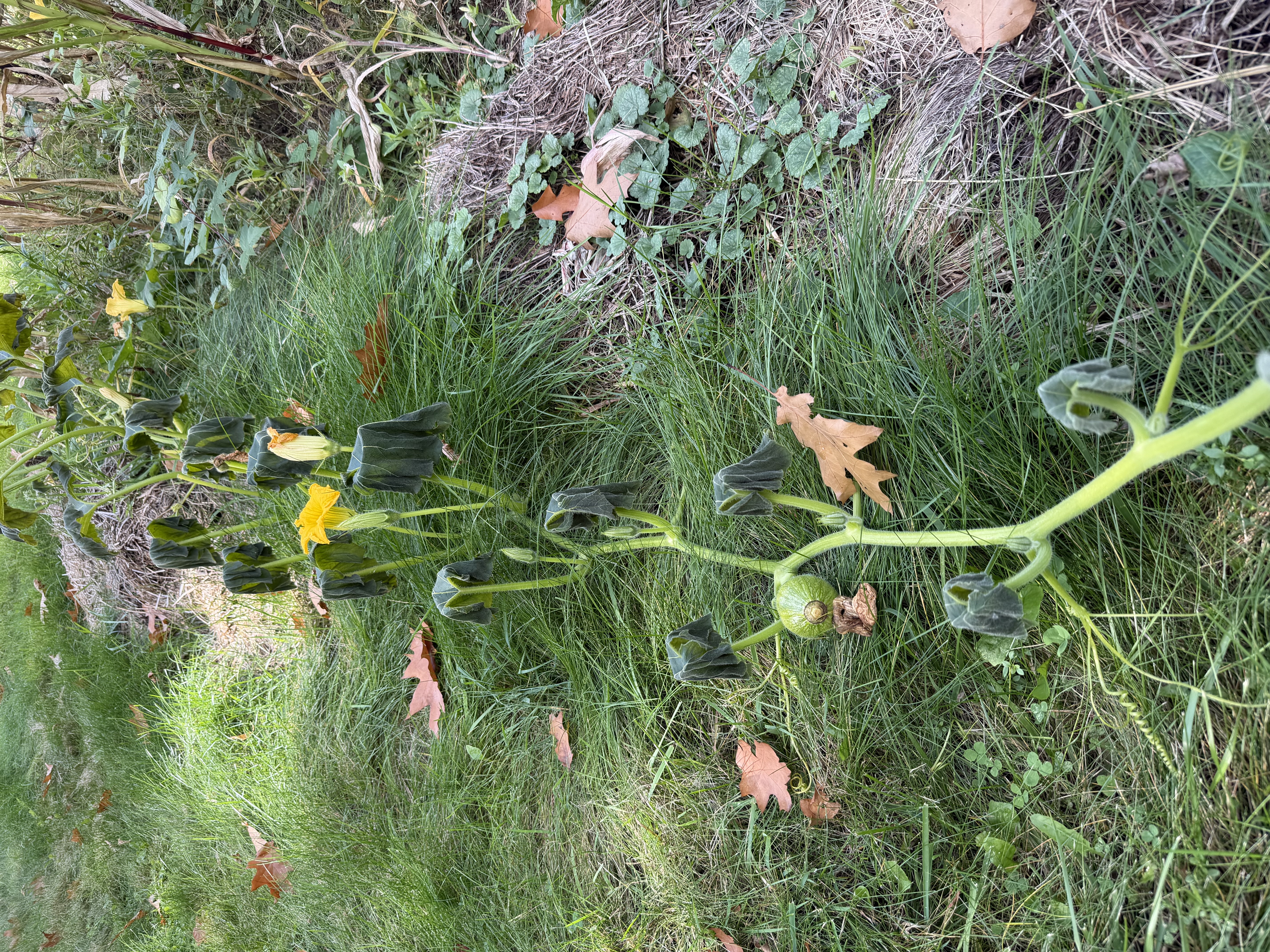
I adore your maize!  I'm thinking you must know a lot about maize, beans & gourd growing by now .. May I ask a question about gourd family, specifically pumpkins & courgette/zucchini, however?

We seem to have had zero fruiting flowers on our pumpkins & courgettes this year.  Could this be due to the hot, dry weather? Or are there other causes which we should consider?

Many thanks!
 
Thom Bri
pollinator
Posts: 1094
Location: Illinois
258
  • Likes 2
  • Mark post as helpful
  • send pies
    Number of slices to send:
    Optional 'thank-you' note:
  • Quote
  • Report post to moderator

Ac Baker wrote:I adore your maize!  I'm thinking you must know a lot about maize, beans & gourd growing by now .. May I ask a question about gourd family, specifically pumpkins & courgette/zucchini, however?

We seem to have had zero fruiting flowers on our pumpkins & courgettes this year.  Could this be due to the hot, dry weather? Or are there other causes which we should consider?

Many thanks!


I am not an expert on gourds. Severe dry weather can kill flowers.
Have you watered?
Have you grown those varieties successfully in the past in that location?
 
May Lotito
gardener
Posts: 2309
Location: Zone 6b
1537
forest garden fungi books chicken fiber arts ungarbage
  • Likes 6
  • Mark post as helpful
  • send pies
    Number of slices to send:
    Optional 'thank-you' note:
  • Quote
  • Report post to moderator
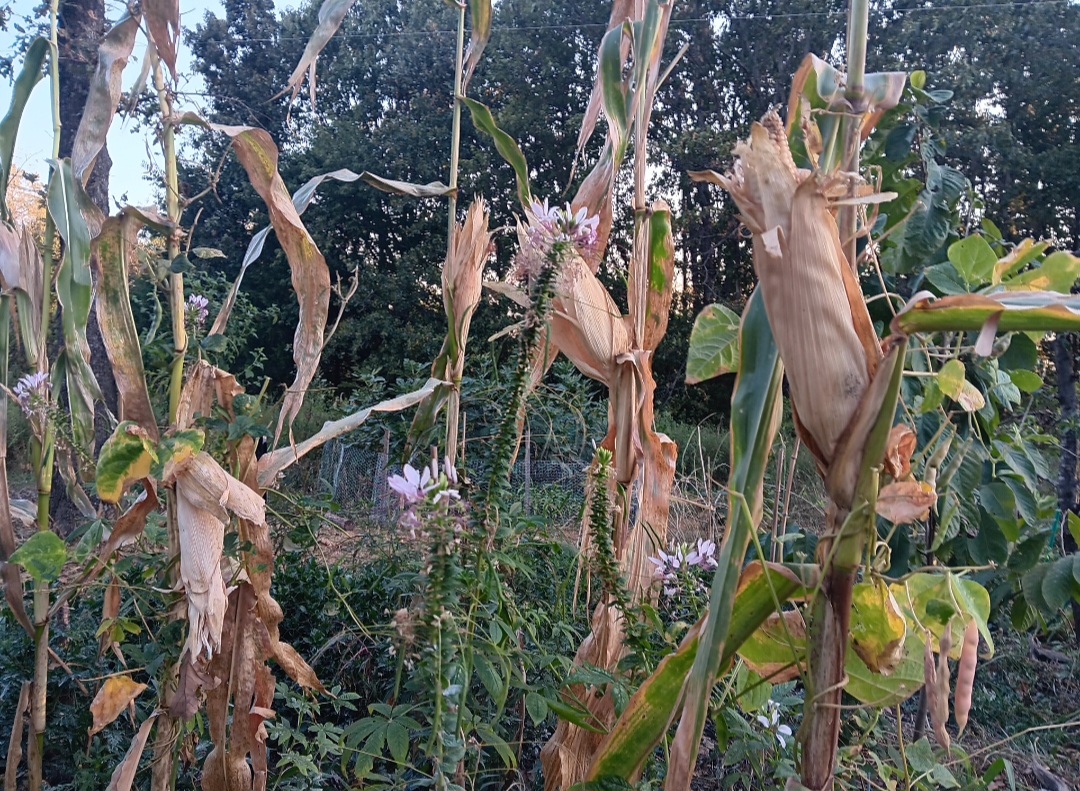
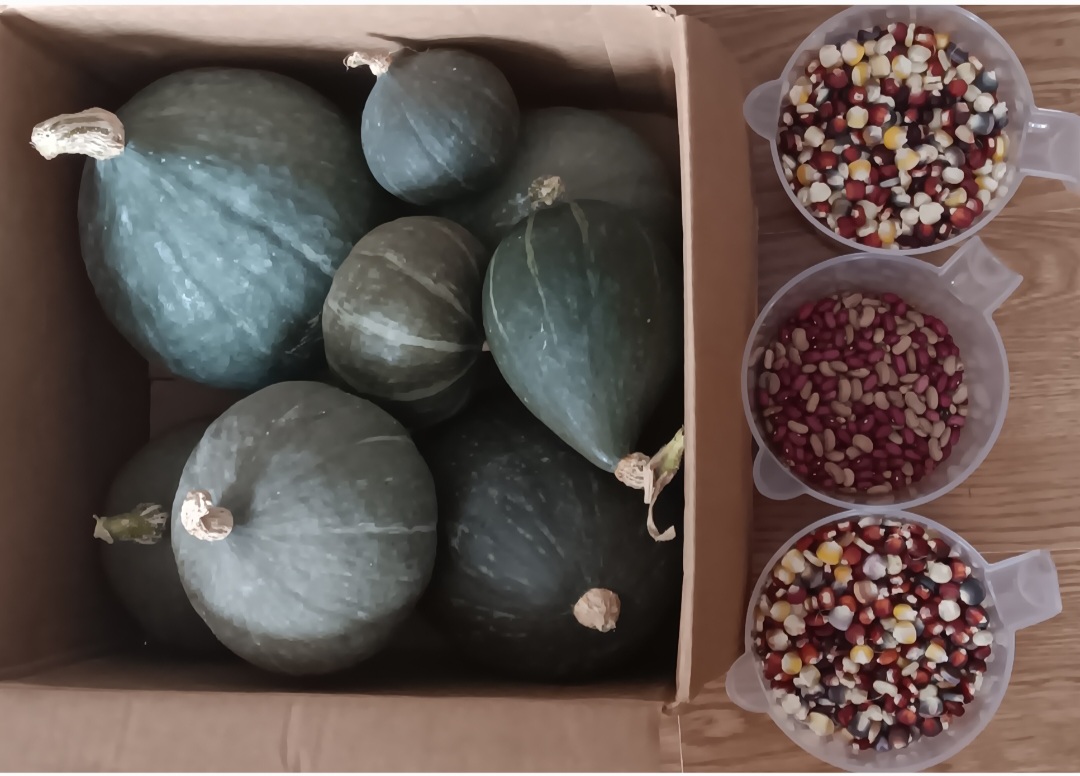
OkI got 12 ears out of 12 plants of heirloom corn seeds from Judith in Arkansas Ozarks, 5/6 mountain morado from the 3rd planting. Zero from 9 giant Inca: 4 of them snapped in the storms and 4 tasseled without ear, one had normal ear but died later in drought and heat. The corn kernels are a little over 4 lbs.

The Arkansas heirloom seeds out perform the other two that are originally from very different climates, one with very short growing season and the other requires very long season. Yet I feel I can improve my soil mineral content to get all the varieties to grow better and healthier. The bloody butcher can go from 8-row to 12-row, for example. Despite low to no yield, Mountain Morado and Inca Giant provide valuable information about soil nutrition so I will still trial them next year.
20260913_3612.jpg
Corn
Corn
20260917_093513.jpg
Squashes beans
Squashes beans
 
Thom Bri
pollinator
Posts: 1094
Location: Illinois
258
  • Likes 3
  • Mark post as helpful
  • send pies
    Number of slices to send:
    Optional 'thank-you' note:
  • Quote
  • Report post to moderator

May Lotito wrote:OkI got 12 ears out of 12 plants of heirloom corn seeds from Judith in Arkansas Ozarks, 5/6 mountain morado from the 3rd planting. Zero from 9 giant Inca: 4 of them snapped in the storms and 4 tasseled without ear, one had normal ear but died later in drought and heat. The corn kernels are a little over 4 lbs.

The Arkansas heirloom seeds out perform the other two that are originally from very different climates, one with very short growing season and the other requires very long season. Yet I feel I can improve my soil mineral content to get all the varieties to grow better and healthier. The bloody butcher can go from 8-row to 12-row, for example. Despite low to no yield, Mountain Morado and Inca Giant provide valuable information about soil nutrition so I will still trial them next year.


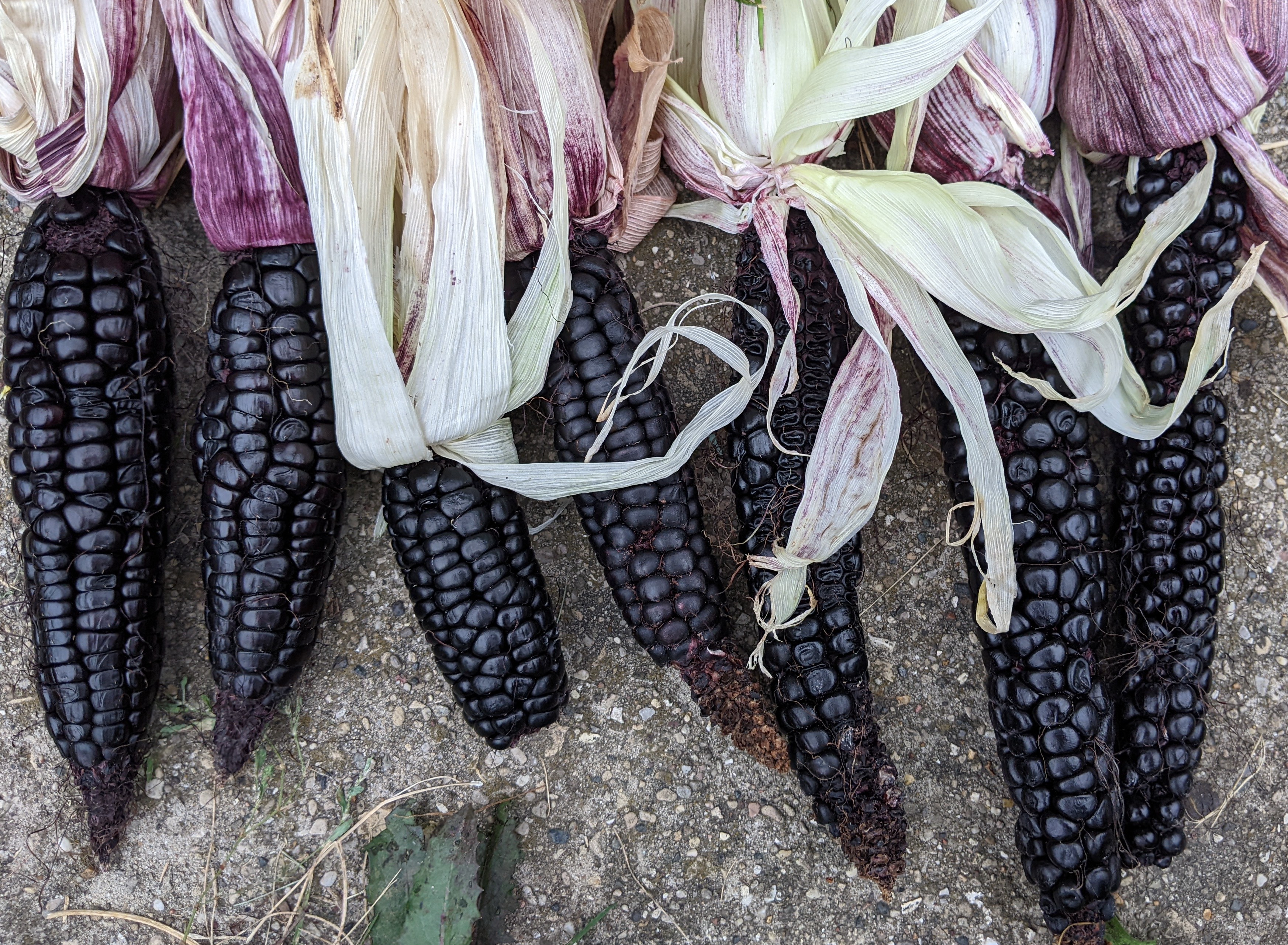
I think your Mountain Morado are the 4 ears in the upper right. If so, they look the same as the ones I got. I was pretty disappointed in that variety and will not be planting it back next year. I'll post a pic of some of the Inca corn that did a little better, Maiz Morado.

Looking back at your garden pics I suspect the corn would yield more if there was less competition right next to the corn plants. Other than beans I don't let anything else grow right next to the corn, within a foot or so of the base of the plant. I am not obsessive about weeding between the rows but I do keep the hills clear at least until the corn is pollinating, and I remove taller, aggressive plants near the corn. I use a lot of mulch on the corn hills. A lot of the mulch is actually the weeds pulled from between the rows so I am harvesting nutrients and putting them where they will aid the corn. The weeds grow back quickly so this happens over and over during the growing season.

Pic shows Maiz Morado. I picked it pretty green and there are several more still green in the garden. I will probably plant one or two hills of this just for the variety, but not more. I was unhappy that it appears to be partly sweet corn, making me wonder if the seed company is maintaining enough distance between their growing plots.
PXL_20260912_190841752.jpg
Maiz Morado
Maiz Morado
 
Thom Bri
pollinator
Posts: 1094
Location: Illinois
258
  • Likes 2
  • Mark post as helpful
  • send pies
    Number of slices to send:
    Optional 'thank-you' note:
  • Quote
  • Report post to moderator
Lots of rain last week and this week. I am worried that the unharvested corn will have a lot of spoiled, moldy ears. That's why I like to harvest early even when the seeds are still a bit soft. But I went on vacation and missed my chance!
Pic shows aggressive beans that have completely overwhelmed a hill of corn and dragged down the plant. I kept the beans back while the corn was growing by pinching off the bean tendrils climbing the corn. But once pollination was done I let the beans go wild. I expect to get decent ears off the corn even if it is covered with bean vines at this stage:

PXL_20260912_153333187.jpg
[Thumbnail for PXL_20260912_153333187.jpg]
 
Thom Bri
pollinator
Posts: 1094
Location: Illinois
258
  • Likes 3
  • Mark post as helpful
  • send pies
    Number of slices to send:
    Optional 'thank-you' note:
  • Quote
  • Report post to moderator
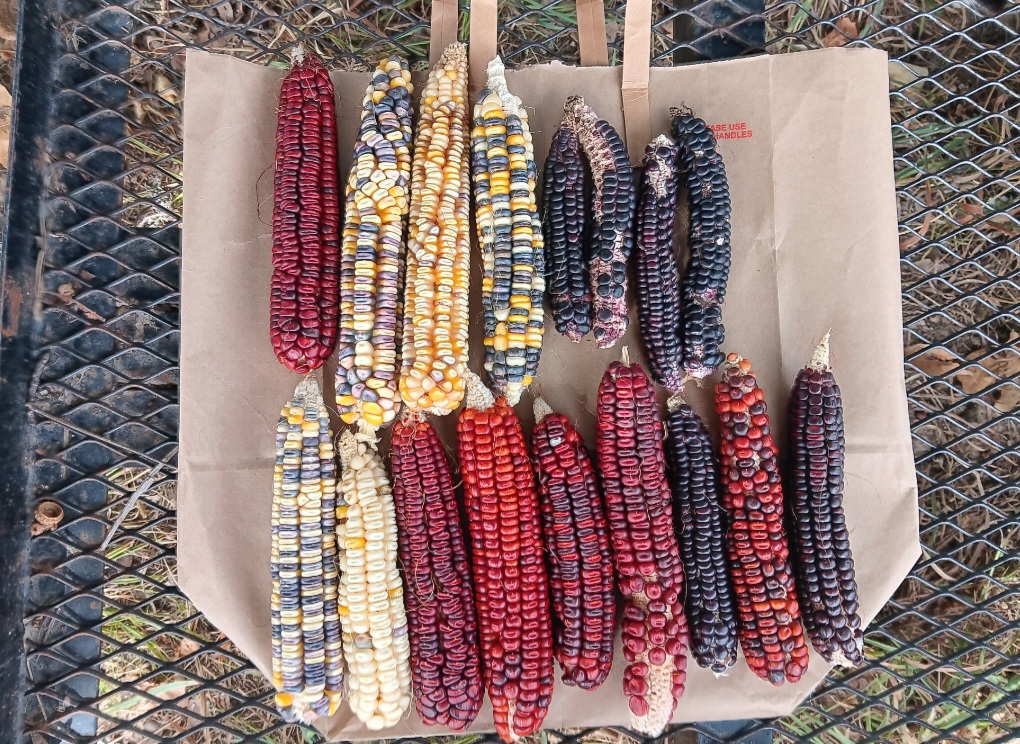
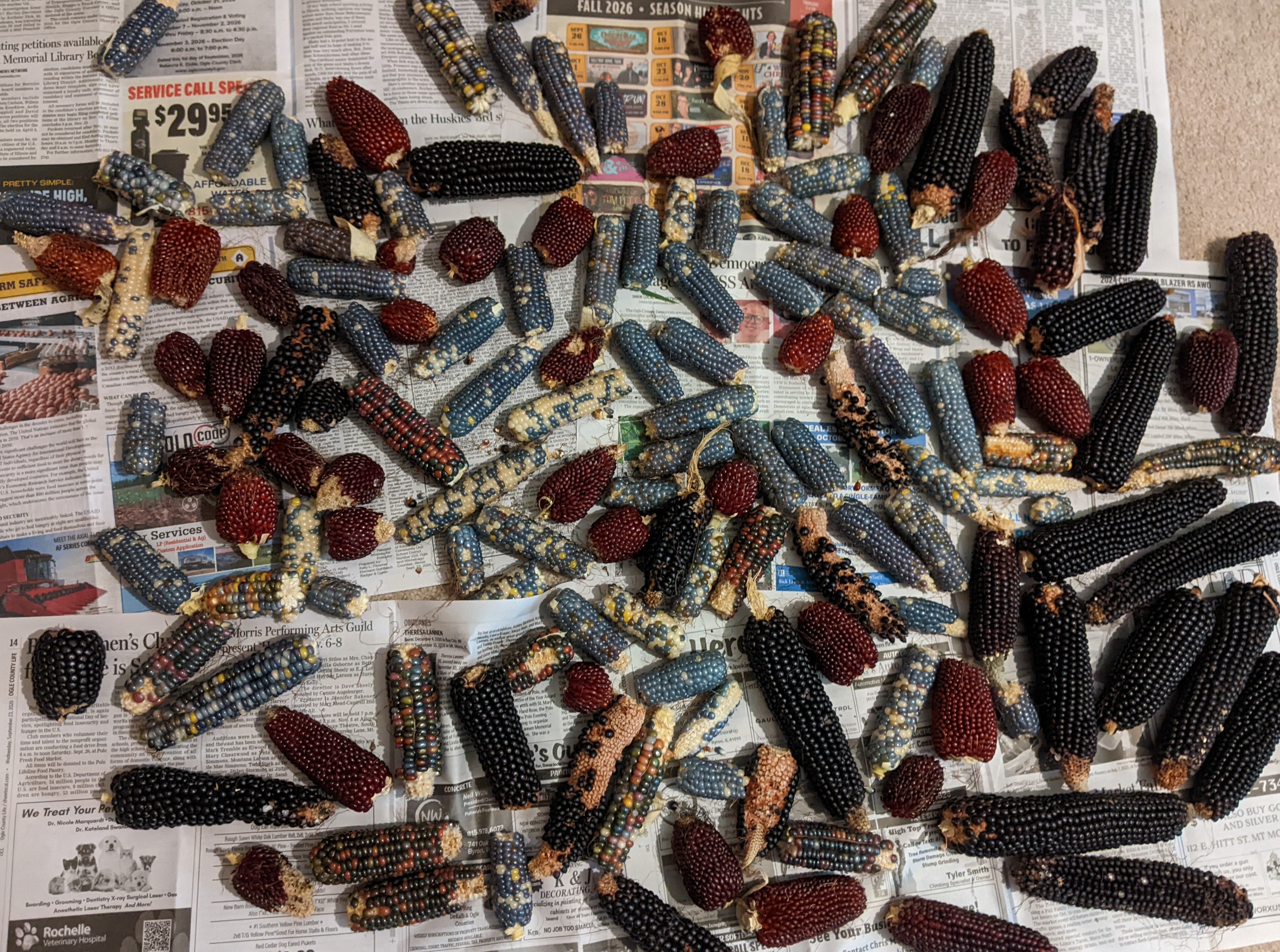
About half of the harvest so far. The other half is hanging in the basement with a fan and dehumidifier.
Pretty happy with this year's harvest.
Relatively few rejects, moldy corn. Only a few ears have smut, a lot less than other recent years. That's due mainly to weather. Smut increases with dry weather, and mold with hot, humid, wet weather.
PXL_20260912_190815727.jpg
[Thumbnail for PXL_20260912_190815727.jpg]
 
Thom Bri
pollinator
Posts: 1094
Location: Illinois
258
  • Likes 2
  • Mark post as helpful
  • send pies
    Number of slices to send:
    Optional 'thank-you' note:
  • Quote
  • Report post to moderator
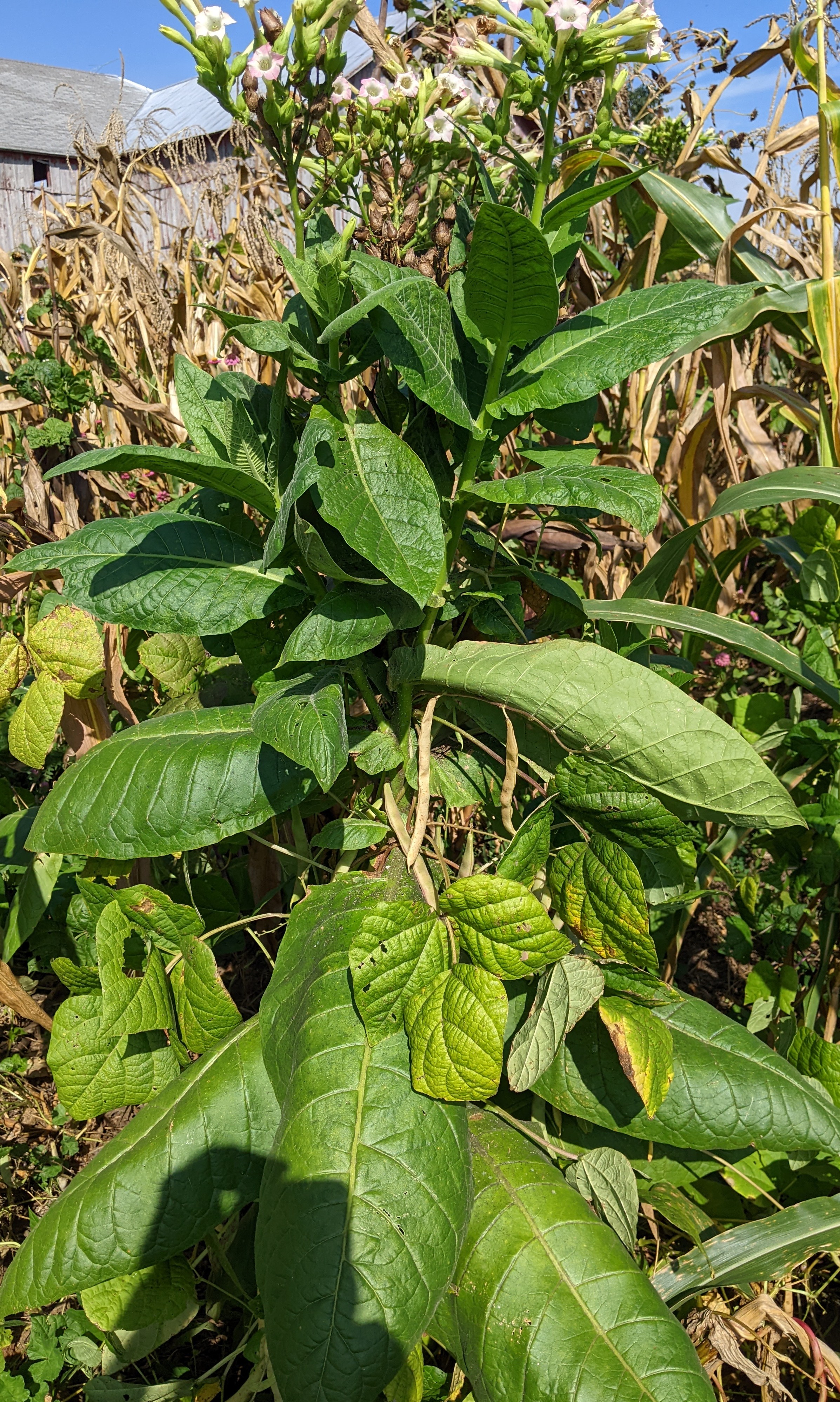
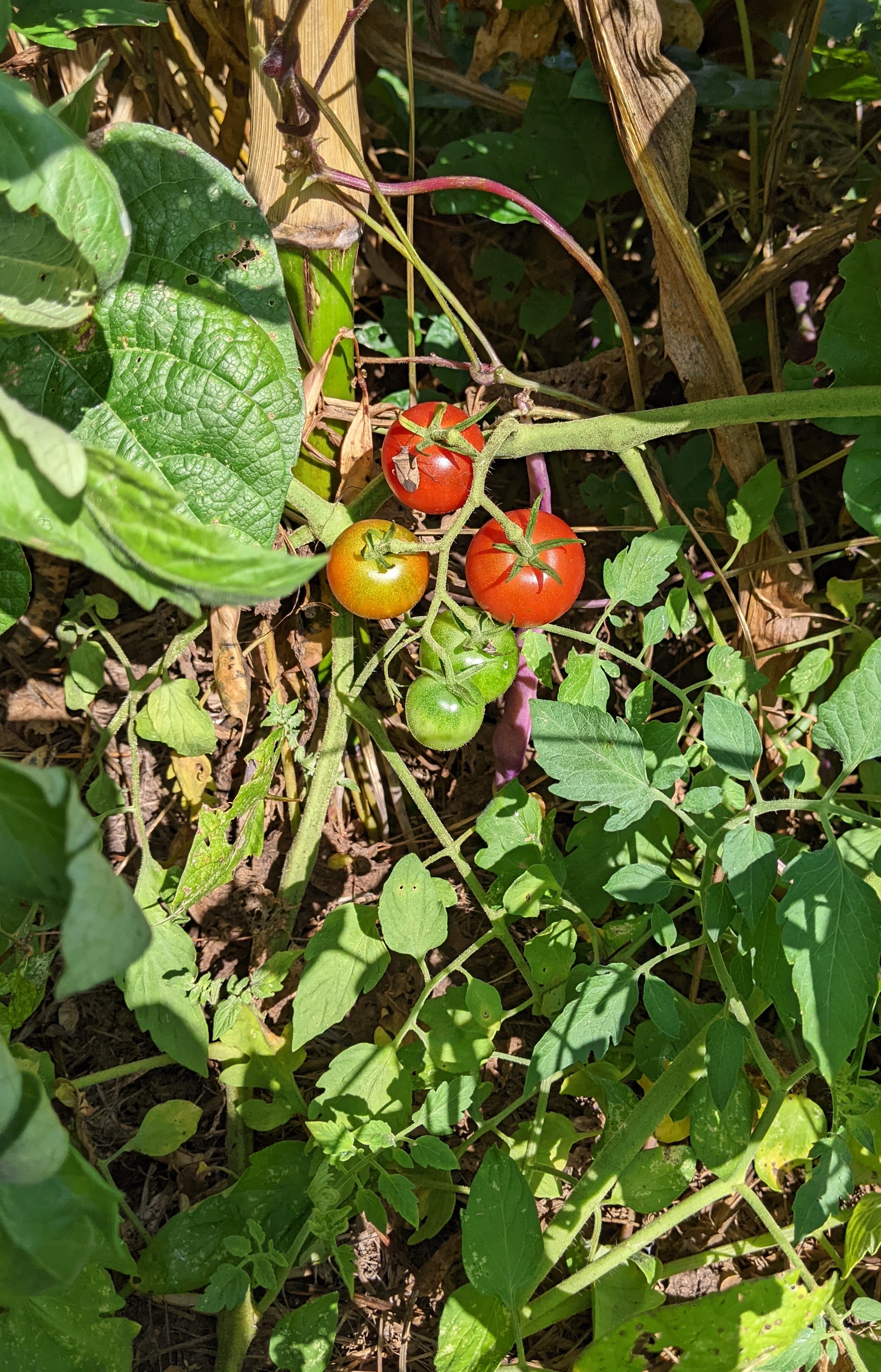
Other stuff I let grow in the garden. Volunteers I encourage:
PXL_20260912_153339032.jpg
Tobacco
Tobacco
PXL_20260912_153506023.jpg
Tomato
Tomato
PXL_20260912_153552169.jpg
Flowers
Flowers
 
So there I was, trapped in the jungle. And at the last minute, I was saved by this tiny ad:
Permaculture Voices 1, 2 and 3 - all 117 hours of video!
https://permies.com/t/voices123
reply
    Bookmark Topic Watch Topic
  • New Topic