• Post Reply Bookmark Topic Watch Topic
  • New Topic
permaculture forums growies critters building homesteading energy monies kitchen purity ungarbage community wilderness fiber arts art permaculture artisans regional education skip experiences global resources cider press projects digital market permies.com pie forums private forums all forums
this forum made possible by our volunteer staff, including ...
master stewards:
  • Carla Burke
  • Nancy Reading
  • r ransom
  • John F Dean
  • paul wheaton
  • Jay Angler
stewards:
  • Timothy Norton
  • Pearl Sutton
  • Tereza Okava
master gardeners:
  • Christopher Weeks
  • M Ljin
gardeners:
  • Jeremy VanGelder
  • Matt McSpadden
  • thomas rubino

Pond Muck - Additive to Compost or Biochar?

 
master pollinator
Posts: 5647
Location: Canadian Prairies - Zone 3b
1599
  • Likes 14
  • Mark post as helpful
  • send pies
    Number of slices to send:
    Optional 'thank-you' note:
  • Quote
  • Report post to moderator
Hey folks, I have access to a large, mature dugout, clay base, with tons of cattails and water plants rotting merrily on the edges. This offers an infinite supply of nice stinky pond mud that is chock full of bio matter.

I'm contemplating dredging some of this out as natural fertilizer for raspberries, an additive to compost, or a soak to inoculate biochar. I dont mind that it's anaerobic; I work with that sort of stuff all the time.

What do you think?

[Edited thread title to "muck" - much better description!]
 
steward & bricolagier
Posts: 15977
Location: SW Missouri
12126
2
goat cat fungi books chicken earthworks food preservation cooking building homestead ungarbage
  • Likes 11
  • Mark post as helpful
  • send pies
    Number of slices to send:
    Optional 'thank-you' note:
  • Quote
  • Report post to moderator
OOOH YES!!
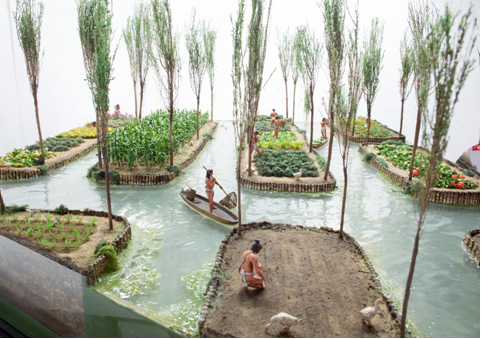
The Aztec chinampas were fertilized that way, and were amazingly productive!
I'd say you could mix the mud with either one.

Chinampas in Mexico
 
Steward of piddlers
Posts: 7446
Location: Upstate New York, Zone 5b, 43 inch Avg. Rainfall
4084
monies home care dog fungi trees chicken food preservation cooking building composting homestead
  • Likes 10
  • Mark post as helpful
  • send pies
    Number of slices to send:
    Optional 'thank-you' note:
  • Quote
  • Report post to moderator
I'm envious of your supply of pond muck. I think it hosts a diversity of things that would be beneficial to either application. A nice spike of microbes and nutrients to add to any party.
 
gardener
Posts: 2159
Location: Zone 6b
1353
forest garden fungi books chicken fiber arts ungarbage
  • Likes 11
  • Mark post as helpful
  • send pies
    Number of slices to send:
    Optional 'thank-you' note:
  • Quote
  • Report post to moderator
Before synthetic nitrogen fertilizer is available, pond muck had been one important source of nitrogen for agriculture, besides manure/humanure and biological N fixation. Just drain, sun dry and break it up in to small clots. Pond muck is likely to have a low pH due to the accumulation of organic acids under anaerobic conditions. Mix with lime to adjust pH if needed.
 
gardener
Posts: 722
Location: Poland
393
forest garden tiny house books cooking fiber arts ungarbage
  • Likes 11
  • Mark post as helpful
  • send pies
    Number of slices to send:
    Optional 'thank-you' note:
  • Quote
  • Report post to moderator
Yes! You can mix it with drier compost if it's too thick and dense. I remember that soil which was under water for some time contains some mineral which plants need... but I don't rememer which one. Was it phosphorus, or maybe potassium...? Of course not just this one, but maybe it's more concentrated in pond mud. I should probably find that source again ;)
 
master steward
Posts: 15000
Location: Pacific Wet Coast
9328
duck books chicken cooking food preservation ungarbage
  • Likes 13
  • Mark post as helpful
  • send pies
    Number of slices to send:
    Optional 'thank-you' note:
  • Quote
  • Report post to moderator
A friend's dad dredged out a bunch of muck from his pond and dumped it in a big heap on the shore, and then the summer drought hit and it turned into concrete. Ecosystem is everything!
Take away lessons:
1. don't just dig it out and dump it... try incorporating it, or building an actual hugel with it, tucking it in around branches and logs maybe?
2. not all muck is the same - some will be mostly decomposing organic matter, some will have a heavy clay component, some may have more sand.
3. consider working with it a little like lasagne gardening, where it's layered and most importantly, where there are planting holes so lots of seeds with roots get established quickly.

Notice that in the pictures Pearl posted, the raised beds have a ready source of water - I think that's an important feature, but I've never had the privilege of trying it. I did try a couple of wicking pots last year, and found it was a fine balance between too much moisture so the roots didn't get enough oxygen vs drying out too far and the plants suffering - *very* small scale here - 5" x 6 1/2" by 4" deep growing lettuce plants. I wanted "front porch lettuce" so I could grab a few leaves for sandwiches just because I *wanted* to. But it was also to learn more about the concept by doing.
 
Douglas Alpenstock
master pollinator
Posts: 5647
Location: Canadian Prairies - Zone 3b
1599
  • Likes 11
  • Mark post as helpful
  • send pies
    Number of slices to send:
    Optional 'thank-you' note:
  • Quote
  • Report post to moderator
Hey Jay, it's always been my intention to use this as a part of a mix and not by itself. I also haven't used it before so I'll be diluting it and testing its quirks and moods. The location is also surrounded (but buffered) with big ag farming operations, and I'm always amused by placing thumb on nose and giving a raspberry. Guess it's my wayward nature haha.

Edit:
I'm hoping this can be a source of very early nitrogen and bioactivity, to get the ball rolling long before traditional compost wakes up from the deep freeze sleep. It's beyond frustrating to be completely shut down for 5+ months every year. I require hands in soil. Give me some stinky stuff to work with.
 
pollinator
Posts: 142
Location: Memphis (zone 7b/8a)
57
  • Likes 12
  • Mark post as helpful
  • send pies
    Number of slices to send:
    Optional 'thank-you' note:
  • Quote
  • Report post to moderator
I'm dumping heaps of this stuff on my hugel mounds - great for filling in the cracks.  I'll report back on how things grow.  Planting kale and mallow.
 
master steward
Posts: 8386
Location: southern Illinois, USA
3302
goat cat dog chicken composting toilet food preservation pig solar wood heat homestead composting
  • Likes 9
  • Mark post as helpful
  • send pies
    Number of slices to send:
    Optional 'thank-you' note:
  • Quote
  • Report post to moderator
In the late summer, when my pond level drops, I take several wheelbarrow loads of muck out of my pond for my garden.  How much depends upon my energy levels.  I try to rotate around my pond so my am not harvesting muck from the same location.   Also, there us one area that seems to be favored by the Wood Ducks that I stay away from.
 
You can thank my dental hygienist for my untimely aliveness. So tiny:
montana community seeking 20 people who are gardeners or want to be gardeners
https://permies.com/t/359868/montana-community-seeking-people-gardeners
reply
    Bookmark Topic Watch Topic
  • New Topic