|

|

|

|

|

|
|
|
|
|
|
|
|

|

|

|

|

|
 5
5


 2
2
2
2
Ned Harr wrote:
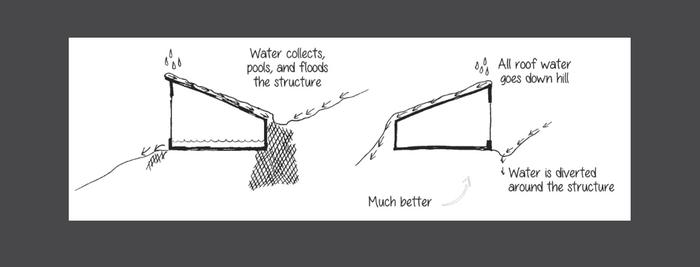
The thing I don't understand is why, in the rendering on the right, water can be simply diverted around the structure, but it can't be on the left--why wouldn't the left-side structure-builder use whatever those same means are to divert water? ...
Am I missing something?
Invasive plants are Earth's way of insisting we notice her medicines. Stephen Herrod Buhner
Everyone learns what works by learning what doesn't work. Stephen Herrod Buhner


 2
2
Ned Harr wrote:The thing I don't understand is why, in the rendering on the right, water can be simply diverted around the structure, but it can't be on the left--why wouldn't the left-side structure-builder use whatever those same means are to divert water?
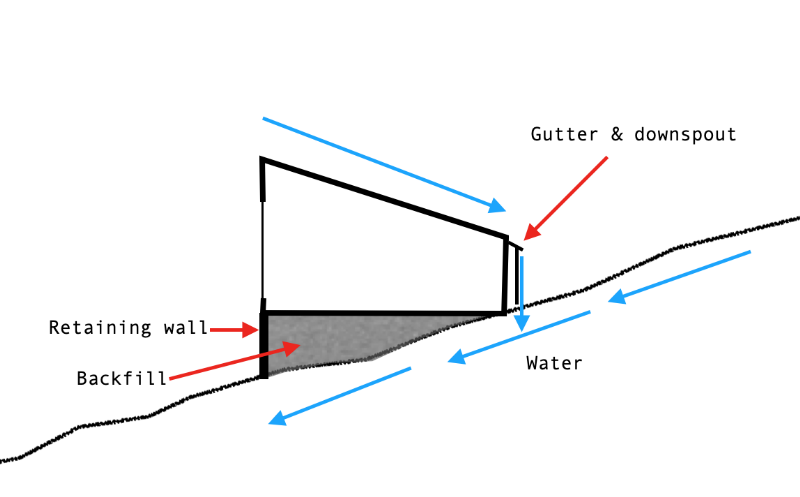
Even with the excavated foundation, a well-planned and -executed French drain ought to work. And of course you'd have a gutter at the low end of the roof, with a downspout that channels water off to the side where it can continue downslope unhindered. And there are other tricks we've got up our sleeves as well, like sump pumps. This should all work especially well if the structure is not monstrously large.
And of course there's no reason you need an excavated foundation; you could instead build up a foundation on the downslope side with a retaining wall and backfill, a design which I'm favoring lately:
How Permies works: https://permies.com/wiki/34193/permies-works-links-threads
My projects on Skye: The tree field, Growing and landracing, perennial polycultures, "Don't dream it - be it! "
4
Nancy Reading wrote:
I think if I were building this, I'd be tempted to make the space underneath useful space - root cellar perhaps? rather than backfill, unless I had surplus soil to get rid of.
That makes sense to me too but then the same logic applies to Wofati. Why build an underground house at all when above ground is always simpler when it comes to water intrusion?I think the point is that the lower the structure, the more and complex are the design features that need to be built in to compensate for the water ingress risk. Simple (minimising the risk) is generally better and will probably end up cheaper.
8
Ned Harr wrote: Anyway, regarding this:
That makes sense to me too but then the same logic applies to Wofati. Why build an underground house at all when above ground is always simpler when it comes to water intrusion?I think the point is that the lower the structure, the more and complex are the design features that need to be built in to compensate for the water ingress risk. Simple (minimising the risk) is generally better and will probably end up cheaper.
Visit Redhawk's soil series: https://permies.com/wiki/redhawk-soil
How permies.com works: https://permies.com/wiki/34193/permies-works-links-threads


 7
7
John Daley Bendigo, Australia The Enemy of progress is the hope of a perfect plan
Benefits of rainfall collection https://permies.com/t/88043/benefits-rainfall-collection
GOOD DEBT/ BAD DEBT https://permies.com/t/179218/mortgages-good-debt-bad-debt
9
The thing I don't understand is why, in the rendering on the right, water can be simply diverted around the structure, but it can't be on the left--why wouldn't the left-side structure-builder use whatever those same means are to divert water?
Why build an underground house at all when above ground is always simpler when it comes to water intrusion?
Visit Redhawk's soil series: https://permies.com/wiki/redhawk-soil
How permies.com works: https://permies.com/wiki/34193/permies-works-links-threads
7
John C Daley wrote:As a Civil Engineer, I would come at the issue differently.
I firstly will ask, what are you aiming to achieve at the end?
Is it a home, do you want a big window, do you want thermal mass, do you want an underground stucture.
I may have some ideas if I know the asnswers.
As Jay has said, water travels underground and your fill area may get very damp.
People tend to not maintain anything and you may find leaves, branches build up against the outside wall, creating moisture and drainage issues.
There is a reason Wofti buildings have not taken over the world.
What size is this structure going to finish up?
6
John Daley Bendigo, Australia The Enemy of progress is the hope of a perfect plan
Benefits of rainfall collection https://permies.com/t/88043/benefits-rainfall-collection
GOOD DEBT/ BAD DEBT https://permies.com/t/179218/mortgages-good-debt-bad-debt
7
2
John C Daley wrote:Thanks NED.
Some ideas;
- cot a wide swale up the hill sau 10 feet wide that will not fill with leaves etc quickly.
- have its low point below your proposed floor level, say 12 inches if possible.
- drain the roof to one side of the building to a water tank, 5000 gallons.
- build the retaining wall either as a dry stone wall or poured reinforced concrete wall with a heel and toe.
- install a membrane on the floor of the filled area, with drains under that leading sideways on a slope.
- insulate the space if need be
- fill that volume with aggregate, plastic drums of water or broken concrete and larger stones and rubble. That may work as a heat bank as well.
- pave the ' floor' to draw in heat to the bank.
11
Ned Harr wrote:1. I like thermal mass too--it's been an integral part of my planned design since I started dreaming it up--but I want to insulate the envelope of my structure very well, so I have come around to wanting that mass inside, underneath, or otherwise "enclosed" by the structure.
2 ... I want to build this house in a place where I believe the most likely natural disaster would be a forest fire. ... So I am thinking about perimeter earthen walls (at a distance from the house itself) with ceramic tiles embedded in them. These would absorb heat (just like the Space Shuttle's heat shield) and block flying embers. Meanwhile I would reduce the amount of flammable vegetation growing near the house, probably by hardscaping or something like that. These ideas came from some post-analysis of houses that survived the recent fires in Los Angeles, and another house that survived a forest fire in the PNW.
Visit Redhawk's soil series: https://permies.com/wiki/redhawk-soil
How permies.com works: https://permies.com/wiki/34193/permies-works-links-threads
2
Jay Angler wrote:John C Daley will always suggest *very* large water tanks. If you think you can fill one, and fire is your greatest risk, just think of how being able to wet down your property all around your house will help your sense of security! That is definitely part of the plan for my son's house also.
3
4
2
John Daley Bendigo, Australia The Enemy of progress is the hope of a perfect plan
Benefits of rainfall collection https://permies.com/t/88043/benefits-rainfall-collection
GOOD DEBT/ BAD DEBT https://permies.com/t/179218/mortgages-good-debt-bad-debt
2
4
Ned Harr wrote:My take on what Brenda is saying is, "don't build on mountainsides". I am not seeing how the type of construction or water mitigation techniques would matter, it's all gonna get washed downhill if there is a once-in-a-millennium rainstorm.
Visit Redhawk's soil series: https://permies.com/wiki/redhawk-soil
How permies.com works: https://permies.com/wiki/34193/permies-works-links-threads
4


 3
3
Become extra-civilized!
 1
1
John Daley Bendigo, Australia The Enemy of progress is the hope of a perfect plan
Benefits of rainfall collection https://permies.com/t/88043/benefits-rainfall-collection
GOOD DEBT/ BAD DEBT https://permies.com/t/179218/mortgages-good-debt-bad-debt
1
 Especially anything to do with history, geology, archaeology, paleontology... 2
John Daley Bendigo, Australia The Enemy of progress is the hope of a perfect plan
Benefits of rainfall collection https://permies.com/t/88043/benefits-rainfall-collection
GOOD DEBT/ BAD DEBT https://permies.com/t/179218/mortgages-good-debt-bad-debt
3
Coydon Wallham wrote:I'm guessing at the motivation here- is this a south facing slope where you are seeking greater solar input to reach the taller wall under the high point of the roof with?
Given access to enough resources, practically any 'design flaw' can be compensated for. But if designing from scratch, why not utilize the best ideals from the start?
4
Ned Harr wrote: In this case, I don't think it would be all that much harder to keep the lowest levels of a slope-built house dry, it just requires the application of a few time-tested engineering tricks. We're not making toilets swirl backward, and we're not trying to support a space station, we're just building stuff like retaining walls, putting down barriers under the backfill behind those walls, and maybe installing some French drains or digging some swales. These aren't costless and they aren't guarantees but they're known to work, they aren't difficult or super expensive, and they'd likely be needed no matter which way the roof is sloping, given the same building site.
Visit Redhawk's soil series: https://permies.com/wiki/redhawk-soil
How permies.com works: https://permies.com/wiki/34193/permies-works-links-threads

| I agree. Here's the link: http://stoves2.com |