So, this was an interesting question that got me thinking, and then researching.
There's now, though there wasn't when this question was first raised, a good amount of research.
I've compiled a summary and links, with the aid of AI, but here are some pertinent points:
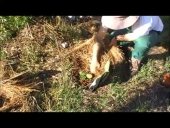
1) Most studies dry and powder the cactus to use as an amendment, but traditional use suggests burying whole pads at the base of shrubs and trees in arid climates to create moisture sponges
2) It works, mostly through the polysaccharides found in the mucilage which affect soil moisture cycles in a similar way to the rhizosphere, i.e. improved water retention, deceased drying, improved aeration, improved structure, and beneficial impacts on soil microbes
3) Improved yields at certain densities, but overuse can create waterlogging and destabilizing swelling effects
4) Long after the mucilage degrades, impacts on the soil structure and microbial populations persist
POTENTIAL USES:
1) Direct mulching demonstrated no toxicity, so you can chop and drop and it will improve moisture retention right at the surface.
2) Dehydration would be pretty straightforward in the desert. Chop the pads up and set them in the sun, or on a drying rack in a breezy areas with dappled shade, which would give you a material much less bulky for transport and storage
3) The dehydrated material could be used as a mulch, or as an amendment, either in chunks, ground, or powdered
4) Makes a great compost which has higher moisture retention properties than compost from most other feedstocks
5) Makes a high-nutrient, high-ash, high-pH char which is similar in composition to manure char, but generally less contaminated
6) Makes a great addition to cob, adobe, bricks, mortars, etc by improving cohesion, moisture resilience, and deterring microbial activity
Here's the research list, if you want to go digging:
**Soil Amendment / Agricultural Uses**
- Powdered cactus pear (*Opuntia ficus-indica*) pruning waste incorporated at 10–40% (w/w) increases soil water-holding capacity and reduces bulk density.
https://link.springer.com/article/10.1007/s13165-024-00462-9
- At 20% incorporation, basil plant biomass increases by 21%.
https://link.springer.com/article/10.1007/s13165-024-00462-9
- Fresh cactus pear cladodes can be composted into a stabilized product with high moisture content (~65%), favorable C:N ratio, high potassium, and low phytotoxicity.
https://link.springer.com/article/10.1007/s13165-024-00462-9
- Powdered cactus pear pruning waste improves plant-available water capacity and reduces bulk density in contrasting soils (e.g., red loamy and black clayey), with benefits for arid/semi-arid regions.
https://www.sciencedirect.com/science/article/pii/S2352186424000786
- Nopal (*Opuntia*) cladode components (whole, solid, or liquid), alone or with goat manure, increase soil cation-exchange capacity.
https://www.mdpi.com/2073-4395/14/6/1221
- Liquid nopal fractions increase seed germination rates (up to 1.7-fold in carrots) and germination percentage.
https://www.mdpi.com/2073-4395/14/6/1221
- Nopal amendments increase plant resistance to water stress by approximately 10–15 days in tomato and carrot.
https://www.mdpi.com/2073-4395/14/6/1221
- Nopal amendments increase carrot plant length by up to 100% and yield by up to threefold; tomato production and survival also improve.
https://www.mdpi.com/2073-4395/14/6/1221
- Cactus mucilage improves soil aggregation, structural stability, and wheat performance (water use, plant height, grain yield) in clayey and sandy soils.
http://colposdigital.colpos.mx:8080/jspui/bitstream/10521/1969/3/Garcia_Favela_B_DC_Edafologia_2013.pdf
- Mucilage of *Opuntia ficus-indica* cladodes improves engineering properties of lateritic soil (reduced plasticity index, permeability, and swell; increased CBR) via bioclogging and biocementation.
http://www.techno-press.org/content/?page=article&journal=gae&volume=8&num=5&ordernum=2
- Cactus mucilage (optimal ~6%) improves soil compaction (higher maximum dry density) and cohesion.
https://srees.sggw.edu.pl/article/view/10861
**Construction Materials Uses**
- Cactus mucilage has been used since pre-Hispanic times in Mesoamerica as an additive in lime mortars, plasters, adobe, and earthen renders for improved plasticity, adhesion, moisture retention, and water resistance.
https://www.sciencedirect.com/science/article/abs/pii/S0141813024059178
- Cactus mucilage improves rheological properties (viscosity, workability, consistency, water retention) of Portland-cement-based, lime, and earth-based building materials.
https://www.sciencedirect.com/science/article/abs/pii/S0141813024059178
- *Opuntia ficus-indica* mucilage as a mixing-water replacement increases compressive strength of microconcrete (up to 17% at 100% replacement after 28 days; 9% at 10% replacement after 180 days).
https://www.sciencedirect.com/science/article/abs/pii/S0950061824043964
- Mucilage additions improve durability of cementitious materials (reduced water absorption, permeability, shrinkage; corrosion inhibition of steel; lower bioreceptivity).
https://www.sciencedirect.com/science/article/abs/pii/S0950061824043964
https://www.mdpi.com/2079-6412/11/1/75
- Mucilage enhances mechanical strength, cohesion, and water resistance in lime mortars and raw-earth systems used for cultural-heritage restoration.
https://www.sciencedirect.com/science/article/abs/pii/S0141813024059178
https://www.mdpi.com/2079-6412/11/1/75
**Persistence of Effects in Soil**
- Soil physical improvements (water retention, bulk density reduction) from cactus biomass or mucilage are observed in short-term experiments (weeks to ~3 months).
https://link.springer.com/article/10.1007/s13165-024-00462-9
https://www.sciencedirect.com/science/article/pii/S2352186424000786
- Mucilage powder maintains water- and oil-holding capacity during storage for up to 8 months under controlled conditions.
https://pubs.acs.org/doi/10.1021/acsomega.4c05691










 1
1