I have been trying to wrap my head around the idea of soil cation exchange capacity and believe it deserves its own thread. I am actively learning about this topic so if I have misunderstood anything please let me know!
Cation Exchange Capacity (CEC) is a measurement of a soil's ability to retain cations in the soil particulates. Cations are positively charged molecules that can be held in place by negative charges that exist in soil. When water travels through the soil, these cations can be exchanged between water and the soil. This phenomenon is important because many of these cations are in fact fertilizer for the plants that we hope to grow! I will not get into the physical instructions in order to conduct a CEC test but we can still benefit from understanding the principles of why it is important to consider.
Soils with a high CEC hold a higher capacity of nutrients and water locally that then may be drawn upon by plants for their needs. Soils with low CEC might require more frequent care when it comes to nutritional and watering needs. What influences if a soil has a higher or lower capacity? The two factors that I can consider easily without any complicated testing involve is considering how much clay and organic matter exists in the soil. Higher levels of clay and organic matter coincide with higher CEC levels. PH is reported to have an effect but this is not something I have explored yet (A future post maybe?).
Does the soil have mostly clay? It probably has a high CEC rating.
Does the soil consist of mostly sand? It probably has a low CEC rating.
A great way to figure this out at a low cost would be to conduct a Mason Jar Soil Test.
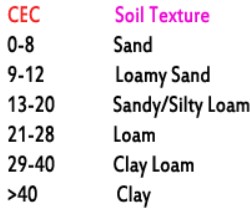
Soil Cation Exchange Capacity in relation to Soil Texture
As gardeners, we can influence the levels of organic matter (OM) in our gardens through a variety of ways including adding compost, chop and drop, and the use of mulches. We then can take advantage of soils with increased CEC capabilities as the OM content develops over time.
Biochar is a wonderful way of increasing a soil's CEC potential through application. Biochar's porous structure creates a network of negatively charged surfaces to snag cations and hold them in place. These structures also happen to be wonderful sites for microbes to flourish and form in. I like to consider biochar to be like a nutrient sponge, ready to be drawn upon by plant roots at a moments notice. Biochar will increase the soils CEC almost double that of compost when the same amount is compared.
Not all biochar are created equal when it comes to influencing soil CEC. There is evidence that biochars sourced from hardwoods or crop residues have the best chance at influencing soil CEC compared to other feedstocks. Biochars produced at a lower temperature have a larger effect on soil CEC levels compared to biochars produced at higher temperatures.
Timothy Norton wrote:I have been trying to wrap my head around the idea of soil cation exchange capacity and believe it deserves its own thread. I am actively learning about this topic so if I have misunderstood anything please let me know!
Cation Exchange Capacity (CEC) is a measurement of a soil's ability to retain cations in the soil particulates. Cations are positively charged molecules that can be bind by negative charges that exist in soil. When water travels through the soil, these cations can be exchanged between water and the soil. This phenomenon is important because many of these cations are in fact fertilizer for the plants that we hope to grow! I will not get into the physical instructions in order to conduct a CEC test but we can still benefit from understanding the principles of why it is important to consider.
Soils with a high CEC hold a higher capacity of nutrients and water locally that then may be drawn upon by plants for their needs. Soils with low CEC might require more frequent care when it comes to nutritional and watering needs. What influences if a soil has a higher or lower capacity? The two factors that I can consider easily without any complicated testing involve is considering how much clay and organic matter exists in the soil. Higher levels of clay and organic matter coincide with higher CEC levels. PH is reported to have an effect but this is not something I have explored yet.
Does the soil have mostly clay? It probably has a high CEC rating.
Does the soil consist of mostly sand? It probably has a low CEC rating.
A great way to figure this out at a low cost would be to conduct a Mason Jar Soil Test.
Soil Cation Exchange Capacity in relation to Soil Texture
As gardeners, we can influence the levels of organic matter (OM) in our gardens through a variety of ways including adding compost, chop and drop, and the use of mulches. We then can take advantage of soils with increased CEC capabilities as the OM content develops over time.
That's pretty much right.
Ph affects the availability of certain nutrients more than others, so at high pH, manganese cannot be absorbed by many plants (hollies, blueberries, azaleas) and they tell you that by turning yellow. The manganese is in the soil but can't be absorbed. Adding sulfur helps in those cases but sulfur reacts quickly and is a short term solution.
Other plants require higher levels of calcium which is abundant in alkaline soils, think limestone (calcium carbonate), and they've adapted to getting enough manganese at those high pH (tomatoes, black walnuts, stinging nettle) You won't find those plants in acid soil and vice versa. Which is why gypsum or lime prevents blossom end rot in tomatoes.
Acid soil isn't inherently poor, but if you look at the globe, the acid soil is in rainy areas because the acid rain dissolve all the bases. And the rain can leach a lot of nutrients, so there is a correlation
Organic matter can change the pH of soil. Wood ash is used to make lye, right? So in particular, hardwood bark mulch raises pH substantially.
The nitrogen in organic matter is not released all at once, it is released as bacteria break it down which makes it hard to quantify how much nitrogen there is available. On top of that, not all plant matter contains nitrogen. Cellulose and lignin i.e. wood don't have nitrogen and decomposing wood requires nitrogen from the soil to feed the bacteria. So using paper as fertilizer will decrease nitrogen and raise carbon
Best sources for nitrogen in organic matter would be high protein forages like alfalfa.
Also, organic matter breaks down in high temperature exposed to oxygen. So the father north you go, the blacker the soil because the bacteria can't break down all the carbon when they're cold. The closer to the equator and it's very hard to build up organic matter especially if the soil is tilled and oxygenated. It will have to be applied frequently
One of the biggest benefits of organic matter is it's moisture retention. It can hold a lot of water but it doesn't drown plants, it's a literal sponge, and acting as a slow release fertilizer it can do wonders to sand. If you ever watch an old pile of construction sand, it won't grow anything until a few leaves fall in it. And it will loosen clay up too.
One last point is because the nutrients are in the form of ions, they are basically salt. And when you overdue the fertilizer, you are making the soil too salty for the plant, so don't fertilize excessively during a drought.
I'm going on my mid fifties and always have had a feeling for what soil needs. The last couple years I've come to understand the best farmers and gardeners are DIRT farmers not vegetable or "crop" farmers.
The biggest thing I've learned is waste from one process is gold for another. We just have to figure out where!
Air and opportunity are all that stand between you and realizing your dreams!
Timothy Norton
Steward of piddlers
Posts: 8408
Location: Upstate New York, Zone 5b, 43 inch Avg. Rainfall
Firstly, fungi increase the amount of organic matter in the soil by breaking down debris into aggregates. Fungi are especially critical in the process of breaking down cellulose and lignin into easier to handle compounds. All of this eventually gets broken down into more bioavailable compounds that plants can eventually make use of.
Secondly, fungus that develop mycelium create a network in the soil creating an exchange (it's a middleman) between plant roots and soil nutrients. The structure of the mycelium cell walls develops a negative charge which starts snagging and exchanging cations across it. This, in essence, allows plants a larger area to uptake nutrients from than it normally would with just its own roots.
This is something that gardeners should consider, especially if they work with predominately acidic soils. Fungi thrives in these soils (While predominately alkali soils lean more towards bacterial populations). By encouraging fungal communities in these soils (low soil disturbance), CEC can be improved without needing to import CEC improving materials. Some fungi do well in alkali soil so this is hard a set-in-stone rule but you get the gist of what I'm trying to say.
I used to prefer sandy soils because they didn’t stick to my shoes… Pure clay has the potential to become rich loam, which sandy soils will never match. Of course a blend is nice.
I would like to mention the book “The Intelligent Gardener” by Steve Solomon. That’s where I learned about CEC, about soil pH and how it affects nutrient availability to plants. Living in the arid and alkaline and dry west, I was so glad to learn this, as well as soil testing and the futility of chasing lower soil pH.
I bet it’s available second hand from online book resellers for very little 😊.
Solomon founded Territorial Seed Company. Later sold it. He also tells of his experiences with soil amendment through large amounts of compost, the health challenges of his family, and how they were alleviated by an extended trip to a region with mineral rich volcanic soils, and eating the food from that soil.
Thanks for the important post of CEC. I run an organic lawn/plant care business and we soil test every property. I've read thousands of reports. Sometimes we have to ask for the CEC which isn't always included. You are correct that more clay and organic matter can increase CEC but there is not always a direct relationship per your chart. We like to see our customers' properties at a minimum 25 which rarely happens before we begin Services no matter what their clay and organic matter is. Most initial reports are in the teens. Some properties with high organic matter but low CEC show us a low performing exchange of nutrients with the plants. Our brewed teas seem to help with that. We also consult with organic, soil-based cannabis growers and I grabbed some spent soil after a grow and the CEC was 98. Crazy!
Bill Peregrin wrote:Thanks for the important post of CEC. I run an organic lawn/plant care business and we soil test every property. I've read thousands of reports. Sometimes we have to ask for the CEC which isn't always included. You are correct that more clay and organic matter can increase CEC but there is not always a direct relationship per your chart. We like to see our customers' properties at a minimum 25 which rarely happens before we begin Services no matter what their clay and organic matter is. Most initial reports are in the teens. Some properties with high organic matter but low CEC show us a low performing exchange of nutrients with the plants. Our brewed teas seem to help with that. We also consult with organic, soil-based cannabis growers and I grabbed some spent soil after a grow and the CEC was 98. Crazy!
So you're saying that CEC it's most effected by biology?
Hi I would recommend reading “Dirt to Soil” by Gabe Brown. He explains the regeneration of dirt into soil which does exactly what you want to have happen in your soils. He is a rancher/farmer but I am sure his methods will work on a smaller scale like your garden. My wife and I are, I hope, going to follow his example in our garden next year.
Thank you Timothy for the nice summary posts on CEC - that's probably saved me a lot of research! It sounds like I'm on the right track with my silty acidic soil - adding wood ash, organic matter and charcoal (I add that on the soil surface at the same time as compost, so hope it will make biochar in time). I wasn't aware that fungi were also so useful for improving the soil CEC and that they like acidic soils - at least that is one advantage I may have!
I'm interested that the water content isn't mentioned and I guess it's just that soil is a multifaceted thing and anything in excess is detremental (even nutrients!). My climate is very damp which means the soil can get compacted and anaerobic quite easily. Luckily that is solved by adding organic matter and biochar too (as well as making slightly raised beds) so no conflict of interest there!
Does anyone know if there is a simple way of measuring CEC? I don't suppose it matters, since the proof is in the way the plants grow...
Nancy Reading wrote:
Does anyone know if there is a simple way of measuring CEC? I don't suppose it matters, since the proof is in the way the plants grow...
There are many portable devices with prongs you stick in the soil that will measure CEC usually along with PH and temps. Hard to say how accurate they are.
I've noticed that the more alive with diverse life your soil is the less these things matter. The plants and fungi etc. etc. just work together and make it work. Plant's that can't survive in a dead soil without a specific PH can thrive in a diverse alive soil even if the PH is supposedly out of range.
I believe paramagnetic rock alone can improve overall CEC. I have no "proof".
Les is right on track, life in the soil is paramount. CEC quite honestly is only a measure of a soil's nutrient holding capacity and not where I focus on our soil. CEC is largely the negatively charged clay fraction of a soil and this is what holds the positive charged cations. Humus should be the focus of those trying to build their soils, percentage organic matter is what we are trying to increase and with that increasing the stable humus in the soil. Gary Zimmer has done some fabulous things with his WI farm with soils in the 10 to 12 CEC range, this is light soil. He adds copious amount of organic matter with cover crops as this type soil will use up the incorporated organic matter quickly. That 10 to12 CEC soil will also not hold leachable nutrients (nitrogen, sulfur, boron) so much attention has to be paid to fertility levels.
Much of what I say is my own theory so take it with a grain of silicon dioxide. Inherent soil quality as I stated in another post is the constitution of your soil, can't be changed to any degree. Focus on the dynamic soil quality (soil life) as this is what can improved dramatically and quite quickly and affordably. Humus has a very high CEC so even low CEC soils can be brought to good production by increasing organic matter and soil life. Consider Humates as part of your soil improvement, they do things in the soil that are not fully understood but it is all good. blackearth.com is an excellent source.
I agree Doug, with one caveat: very sandy soil (like mine) in addition to lots of organic material, benefits greatly from a small amount of clay. I soak dry clay chunks in a bucket over night, stir and water the garden with it. The soil retains moisture much better after treatment.
There is a fascinating (shocking, even) recount in Intelligent Gardener by Steve Solomon of dietary deficiencies developed from his family eating primarily from their very composted humus rich garden soil.
It’s not that I don’t support the idea of humus and compost improving soil fertility and productiveness. I very much do, but IMO it’s just not the whole story.
Nathanael, what a great contribution here. I have read somewhat extensively on soil amendments and improvements but adding clay as a tea is new to me. Nice work and this gives clay a boost in terms of usefulness. Clay particles can be small, microscopic or smaller. Stands to reason they could infiltrate your soil when watered in. Where do you source the clay? Too often we focus on the macro and not the micro when the micro might be the missing link to better fertility. Jerry Brunetti in The Farm As Ecosystem has about 5 pages on clay, its energy and complexity. Had to read it again after your post.
Doug McEvers wrote:Nathanael, what a great contribution here. I have read somewhat extensively on soil amendments and improvements but adding clay as a tea is new to me. Nice work and this gives clay a boost in terms of usefulness. Clay particles can be small, microscopic or smaller. Stands to reason they could infiltrate your soil when watered in. Where do you source the clay? Too often we focus on the macro and not the micro when the micro might be the missing link to better fertility. Jerry Brunetti in The Farm As Ecosystem has about 5 pages on clay, its energy and complexity. Had to read it again after your post.
I got the idea when I read about the Chinese growing crops in the desert with the addition of "micro clay". I wasn't about to start separating micro from macro clay-- even though it is doable-- so I just tried this watering method and it works great.
In this part of Africa there are water holes every few kilometers. These are solid clay as far down as anyone has dug. It stands to reason: clay forms from soluble minerals, so where the water gathers clay will gather. Towns are built from bricks made in these water holes. That's where I get my clay.
-Nathanael
Well don't expect me to do the dishes! This ad has been cleaned for your convenience:

.png)


.png)






 13
13




![[Thumbnail for atl_soilph.jpg]](/t/365321/a/279433/atl_soilph.jpg "Filename: atl_soilph.jpg
Description:")