• Post Reply Bookmark Topic Watch Topic
  • New Topic
permaculture forums growies critters building homesteading energy monies kitchen purity ungarbage community wilderness fiber arts art permaculture artisans regional education skip experiences global resources cider press projects digital market permies.com pie forums private forums all forums
this forum made possible by our volunteer staff, including ...
master stewards:
  • Carla Burke
  • Nancy Reading
  • r ransom
  • John F Dean
  • paul wheaton
  • Jay Angler
stewards:
  • Timothy Norton
  • Pearl Sutton
  • Tereza Okava
master gardeners:
  • Christopher Weeks
  • M Ljin
gardeners:
  • Jeremy VanGelder
  • Matt McSpadden
  • thomas rubino

Ceramic tile on outside of bell? American kachelofen?

 
Posts: 571
Location: Southern Michigan, USA
46
duck trees hunting food preservation wood heat rocket stoves
  • Likes 5
  • Mark post as helpful
  • send pies
    Number of slices to send:
    Optional 'thank-you' note:
  • Quote
  • Report post to moderator
Good evening!

I dream of an ornate kachelofen like this.

It's simply a rectangle, no reason it couldn't be a bell and a shorty core firebox inside.

I've looked around a bit for salvaged kachelofen tiles and not found many. None that are near, cheap, and attractive to my taste. So I'm wondering about "fireplace" tile from a typical tile retailer. They're rated for high heat, but they're not thick and structural like traditional stove tiles are.

Would they be doomed to cracking if I mortared them to the outside of a red-brick bell with refractory mortar? A CMU (cinderblock) bell? Is there some number of expansion joints that would save the day? Perhaps the outside of a double-skinned red-brick bell?
Green-kachelofen.png
[Thumbnail for Green-kachelofen.png]
 
master rocket scientist
Posts: 7007
Location: latitude 47 N.W. montana zone 6A
4052
cat pig rocket stoves
  • Likes 8
  • Mark post as helpful
  • send pies
    Number of slices to send:
    Optional 'thank-you' note:
  • Quote
  • Report post to moderator
Hi Mike;
I know of a single skin bell with a second covering of granite slabs, which are thick enough to provide some support.
Rather than refractory mortar, high-temperature silicon was used, which worked very well!
That stove is a 7" Batchbox and can get plenty hot. It has been in service for several years with no issues with the silicon.

The 1/4" ceramic tiles hold up to the heat, although some may fade in color.

 
Posts: 393
Location: North East Iowa, USA
119
  • Likes 12
  • Mark post as helpful
  • send pies
    Number of slices to send:
    Optional 'thank-you' note:
  • Quote
  • Report post to moderator

thomas rubino wrote:Hi Mike;
I know of a single skin bell with a second covering of granite slabs, which are thick enough to provide some support.
Rather than refractory mortar, high-temperature silicon was used, which worked very well!
That stove is a 7" Batchbox and can get plenty hot. It has been in service for several years with no issues with the silicon.

The 1/4" ceramic tiles hold up to the heat, although some may fade in color.


I know that guy too.   As it is me! Ha!

So my take after a few years.
I would do as good of job on your brick bell as you can such as smooth strait walls.  If you want the look of the smooth  glossy ceramic tile it can certainly be done, if you bought all the same tile.
With my 7" Stove it was and is a complete experiment in looks, I tried everything I had.

Some slate tile, 4x4" granite, and every dimension of granite up to 24x24" The later being darn hard to handle as all of the granite was 1 1/8" thick, so it does add excellent mass. By the way, I already had every bit of granite at zero cost, so using what I had was no problem.

On the entire back wall of the bell, I laid the granite on its side, thus adding 4" thick of mass. Plusgave a unique look.
Front was large pieces of granite one side and tile on the other.

Left side was various layouts, again as a experiment, this is not in my living room or an area that many people see.

100% was applied with lines of silicon and pressed on, and held for a bit. ( thus the smooth walls needed)

I keep a lot of records of bell temps, vs flue temps, And at 175F. I shut it down as my flue temp starts getting up to 200F   If my bell is getting to 150F my temps are about 170F on the flue   so the correlation is pretty steady.   With a bit of calculations, I determined that my best cost efficient  gain of heat per pound of wood starts dropping off at the 175F -- other results may very. Truly this is where you start becoming a rocket scientist, in figuring out what works best, ( not the design of the unit ) but how to get the most out of it.   Where I am going with this is, at these temps no fault can be found with the silicon.

I made the front of the bell removeable or at least large enough that I could crawl in, thus this large metal plate is way above the 175F mark. It also is sealed with silicon,  And at 350 degrees, has also faired very well.  I am not going to push it any more for the above stated reasons.

So the short story-YOU could build your bell with a dozen different colors of bricks but then cover this bell with one very nice uniform type of tile-granite-soap stone  and you have a beautiful stove. Depending on your tile size, you can easily cover the bell in 1/2 day if you have a tile saw handy. Personally I would not go under 6 x 12" size, and I did use a lot of 12 x24" that cover a lot of area very quickly.

Sorry to get long winded on this.

Best of success!
Scott Weinberg
 
Mike Cantrell
Posts: 571
Location: Southern Michigan, USA
46
duck trees hunting food preservation wood heat rocket stoves
  • Likes 4
  • Mark post as helpful
  • send pies
    Number of slices to send:
    Optional 'thank-you' note:
  • Quote
  • Report post to moderator

thomas rubino wrote:high-temperature silicon was used, which worked very well!


Thank you, Tom - this is useful!

Scott Wienberg wrote:100% was applied with lines of silicon and pressed on, and held for a bit. ( thus the smooth walls needed)


Thank you, Scott, very helpful!
Clarifying question: I read through your build thread. Was it specifically high-temp silicone caulk, or did you happen to find that a typical silicone caulk just happened to be good enough for the surface temps you expected? Do you maybe recall what silicone product it was?
 
Rocket Scientist
Posts: 881
Location: Guernsey a small island near France.
377
  • Likes 10
  • Mark post as helpful
  • send pies
    Number of slices to send:
    Optional 'thank-you' note:
  • Quote
  • Report post to moderator
Hi, I think silicone is an option for you, in general there are a few silicone options namely, high modulus, low modulus and high heat.
Although none of these are suitable for anywhere in a flame path, they will stick tiles to an outer surface.
Low modulus is rated somewhere around 150c it remains very flexible. High modulus is rated up to 250c and is a great choice. High temp is rated to 300c, personally I don’t like it much as it is not as adhesive as the others and twice the price!

However there are other options for adhering tiles in the form of purpose high heat tile adhesive!
This comes in various forms, I like the tube variety (just like a silicone tube) and is often rated to over 1000c but it won’t be at all flexible at that rating, so you might want the 300c tile adhesive as that allows a tiny bit of movement but sticks very well indeed.
My local store can offer about 20 choices of high heat tile adhesive…..
IMG_1848.jpeg
[Thumbnail for IMG_1848.jpeg]
IMG_1847.jpeg
[Thumbnail for IMG_1847.jpeg]
 
Posts: 854
Location: Sierra Nevada foothills, 350 m, USDA 8b, sunset zone 7
187
  • Likes 6
  • Mark post as helpful
  • send pies
    Number of slices to send:
    Optional 'thank-you' note:
  • Quote
  • Report post to moderator
Mike,

Vitcas HRTA is the 1000 C tile adhesive. This rating is a little bit funny, because already at 600 C the tiles would glow red, but maybe it just proves that it's really good.
New kachels sell for around $400/m2 for basic white 22x24 cm size. Colors are usually 40-60% more expensive. Full sets may have discounts. In Europe it's possible to find used sets from demolished heaters. Importing would not be too difficult - they would fit on one pallet.
 
Scott Weinberg
Posts: 393
Location: North East Iowa, USA
119
  • Likes 7
  • Mark post as helpful
  • send pies
    Number of slices to send:
    Optional 'thank-you' note:
  • Quote
  • Report post to moderator

Mike Cantrell wrote:

thomas rubino wrote:high-temperature silicon was used, which worked very well!


Thank you, Tom - this is useful!

Scott Weinberg wrote:100% was applied with lines of silicon and pressed on, and held for a bit. ( thus the smooth walls needed)


Thank you, Scott, very helpful!
Clarifying question: I read through your build thread. Was it specifically high-temp silicone caulk, or did you happen to find that a typical silicone caulk just happened to be good enough for the surface temps you expected? Do you maybe recall what silicone product it was?


I did start out with a silicon that was marked right on the tube 500 degree's for $11.99  But then read a tube with the exact  same wording, same mfg as the other for $6.99  and ended up with one more for $4/ tube  Again same words.    I could not and can not tell any difference.   I did use one tube that was white instead of clear, and probably my fault but I discolored that, not with heat but a darn bird went down my chimney and caused some smoke for a few hours. Pretty sure it was the smoke.

I am pretty sure the brand varied, but always 100% silicon,  Note: there are some creative marketing folks out there that try to get others to think that latex caulk is the same thing.   It is NOT!

Hope this helps.
Scott
 
Scott Weinberg
Posts: 393
Location: North East Iowa, USA
119
  • Mark post as helpful
  • send pies
    Number of slices to send:
    Optional 'thank-you' note:
  • Quote
  • Report post to moderator
I also like Fox James suggestions for possible high heat solutions.
 
Posts: 27
Location: Güéjar Sierra, Granada, Spain
15
kids purity chicken rocket stoves homestead
  • Likes 2
  • Mark post as helpful
  • send pies
    Number of slices to send:
    Optional 'thank-you' note:
  • Quote
  • Report post to moderator
I'm working on my design where i want to incorperate an excisting wall into my bell. Im not sure yet what the wall is made of (there is a big chimney in the way), but is probably either natural stones with cement or concrete blocks filled with cement. On one side of the wall there are the tiles of the kitchen.

Is this also doomed to crack? With inside bell temperatures of 500°C and outside temperatures of 90°C (i think)? Would constructing an extra brick wall in front of this wall (so extra wall inside the bell) help to reduce the thermal stress on this kitchen wall? Would the kitchen wall still get very toasty with an extra wall in the bell?

I dont want to redo my entire kitchen with new tiles with silicone...
 
Scott Weinberg
Posts: 393
Location: North East Iowa, USA
119
  • Likes 6
  • Mark post as helpful
  • send pies
    Number of slices to send:
    Optional 'thank-you' note:
  • Quote
  • Report post to moderator

Mark Roelofs wrote:I'm working on my design where i want to incorperate an excisting wall into my bell. Im not sure yet what the wall is made of (there is a big chimney in the way), but is probably either natural stones with cement or concrete blocks filled with cement. On one side of the wall there are the tiles of the kitchen.

Is this also doomed to crack? With inside bell temperatures of 500°C and outside temperatures of 90°C (i think)? Would constructing an extra brick wall in front of this wall (so extra wall inside the bell) help to reduce the thermal stress on this kitchen wall? Would the kitchen wall still get very toasty with an extra wall in the bell?

I don't want to redo my entire kitchen with new tiles with silicone...


As I stated in previous messages, I have quit heating before the bell is up to 90C,  And I am pretty sure the inside of my bell has never been at 500C/

What is your existing wall?  and does this wall go from Floor to ceiling?  Are you expecting this side of your bell to produce heat as much as the other three sides? it is just a matter of physics, that the thinnest wall will get the most hot first, and to get a double or triple wall "toasty" the others will be more than that if they are thinner,   I know in the above posting you didn't know the make up of the wall, but if your expecting to reach that 500C all the time, well I will let others chime in on the effects of that heat on concrete blocks, over and over ( daily )  Generally to have even temps on all 4 sides of the bell, the bell itself tends to be evenly thick.  I don't mind to be corrected on this. This is just my experience.

Now back to the wall, If I am reading this right,  your wondering if you have a double brick bell placed  against the existing wall. if your going to get this third wall just as toasty?  I am thinking not.

Not sure how the previous discussions of a facade of kachelofen style tile, on the bell is translated to having to redo your entire kitchen with new tiles with silicone. Perhaps a better drawing and description of what you hope to do is in order.
 
Mark Roelofs
Posts: 27
Location: Güéjar Sierra, Granada, Spain
15
kids purity chicken rocket stoves homestead
  • Likes 5
  • Mark post as helpful
  • send pies
    Number of slices to send:
    Optional 'thank-you' note:
  • Quote
  • Report post to moderator
Scott, thank you for your reply, I have not read your message properly, I thought that you were talking about flue temperatures only. Do you have your riser inside your bell? Or do you have a steel barrel first? Or a cookstove? The 500C I got from Peter van den Berg from a different thread with a similar design as mine. I will have my riser inside my bell, and since the exit temperature of the riser can be 900C, i think the 500C does not sound like a crazy number.

Makes sense what you say about adding an extra wall which will hold back the heat transfer to the kitchen, and thus either make the other side of the bell very hot, or the kitchen not warm. I have checked under the cupboards of the kitchen, but the make-up of the wall is not very clear. I see natural stone, bricks, perferated brick, a lot of cement..... The wall does go from the floor to the ceiling. Most walls in this house a very thick, so i'm assuming this will also be the case here.

This is my design/build thread: https://permies.com/t/367670/tube-Bell-heat-living-room#3737237

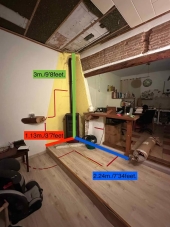
From the picture: the gray part is the new bell I will construct. The white wall is already exsisting, behind it is the kitchen with the tiles. At the moment there is a gaint stone chimney in front of the wall, i will take this out after the heating season is over. Only then will I know what the makeup of the wall is.

The relevance with this thread is that somebody wants to know if they can decorate their constructed bell with tiles due to thermal expansion. I have a similar situation, but the tiled wall of the bell is already there. And i'm wondering if the tiles of the kitchen are going to hold out now  that the wall becomes part of the bell.

Maybe it is better if I keep my questions in my own thread, instead of interfering in other threads with similarities.
Schermafbeelding-2026-02-04-190111.png
[Thumbnail for Schermafbeelding-2026-02-04-190111.png]
 
Fox James
Rocket Scientist
Posts: 881
Location: Guernsey a small island near France.
377
  • Likes 7
  • Mark post as helpful
  • send pies
    Number of slices to send:
    Optional 'thank-you' note:
  • Quote
  • Report post to moderator
Hi Mark, If I recall rightly you are thinking about building a 6” J tube?
If so then you may possibly see 500c exiting the top of the riser but a more average temperature would 300-375c.
Given perfect conditions, a well insulated straight up and tall chimney, 1” square lengths of softwood in the fire box with no ash build up, then maybe 500c for a short time.
A 6” batch box is more likely to offer 900c at peak burn.
There is a good reason for the big temperature difference, a J tube burns the tips of the fuel in a six inch square box, a batch box burns a whole load (batch) of wood right down the whole length in a much bigger box!
 
Mark Roelofs
Posts: 27
Location: Güéjar Sierra, Granada, Spain
15
kids purity chicken rocket stoves homestead
  • Likes 7
  • Mark post as helpful
  • send pies
    Number of slices to send:
    Optional 'thank-you' note:
  • Quote
  • Report post to moderator
I'm planning on doing a 8" J-tube. So peaks of 500C seem reasonable right? Either way i'm also planning on putting a lot of distance between the top of the riser and the inside top of the bell. About 35-40cms, so the hot air can spread out and cool of quickly.
 
Fox James
Rocket Scientist
Posts: 881
Location: Guernsey a small island near France.
377
  • Likes 5
  • Mark post as helpful
  • send pies
    Number of slices to send:
    Optional 'thank-you' note:
  • Quote
  • Report post to moderator
Yes 500 + at peak burns depending on what you are burning and how diligent you are at feeding the fire.
Every stove will perform slightly differently (some times very differently) it is a compromise of how much wood you cram in and how much air is being pulled through the system.
No doubt you will soon discover what is best for your particular circumstances..
 
Cristobal Cristo
Posts: 854
Location: Sierra Nevada foothills, 350 m, USDA 8b, sunset zone 7
187
  • Likes 5
  • Mark post as helpful
  • send pies
    Number of slices to send:
    Optional 'thank-you' note:
  • Quote
  • Report post to moderator
Mark,

How will you tie the 3 other walls of the bell to the existing house wall to make sure that it's gas tight?
The dividing wall will heat up and expend at a different rate than actual walls of the bell.  Bells are built as separate units. I'm not saying it can not be done, but I'm seeing potential problems. In masonry construction, material compatibility is important and it's even more pronounced in the heaters.
 
Scott Weinberg
Posts: 393
Location: North East Iowa, USA
119
  • Likes 7
  • Mark post as helpful
  • send pies
    Number of slices to send:
    Optional 'thank-you' note:
  • Quote
  • Report post to moderator

Mark Roelofs wrote:Scott,   I thought that you were talking about flue temperatures only. Do you have your riser inside your bell? Or do you have a steel barrel first? Or a cookstove? The 500C I got from Peter van den Berg from a different thread with a similar design as mine. I will have my riser inside my bell, and since the exit temperature of the riser can be 900C, i think the 500C does not sound like a crazy number.

Makes sense what you say about adding an extra wall which will hold back the heat transfer to the kitchen, and thus either make the other side of the bell very hot, or the kitchen not warm. I have checked under the cupboards of the kitchen, but the make-up of the wall is not very clear. I see natural stone, bricks, perferated brick, a lot of cement..... The wall does go from the floor to the ceiling. Most walls in this house a very thick, so i'm assuming this will also be the case here.

This is my design/build thread: https://permies.com/t/367670/tube-Bell-heat-living-room#3737237

From the picture: the gray part is the new bell I will construct. The white wall is already exsisting, behind it is the kitchen with the tiles. At the moment there is a gaint stone chimney in front of the wall, i will take this out after the heating season is over. Only then will I know what the makeup of the wall is.

The relevance with this thread is that somebody wants to know if they can decorate their constructed bell with tiles due to thermal expansion. I have a similar situation, but the tiled wall of the bell is already there. And i'm wondering if the tiles of the kitchen are going to hold out now  that the wall becomes part of the bell.

Maybe it is better if I keep my questions in my own thread, instead of interfering in other threads with similarities.


Hello Mark,
I will try to clarify what I meant,  by the temps.  
 I have a batch box 7" in size exactly to specs at the time of build a few years ago, and I don't those specs have changed.  I did add the ( 25% ) allowed fire box length dimension, mostly because when I buck up wood, I tend to do just about as long as my bar on the saw, and already had 10 years worth bucked and split.

So yes, a single bell, with the bacth box inside, so pretty standard set up,  and at the exit height of the riser, is 100% fire brick, all around and roof of bell.  again exactly as recommended.  But here might be where we may have a misunderstanding.  While the temps of the exit of my riser, can easily be the increadible effcient burn levels of 500-900C, that is not saying my bricks get that warm, exposed yes, glowing read hot, NO.  And of course, on the outside of the bricks even less, as all bells work.    93-95C and I am letting the fire coal out, and then closing up shop until the next day.  Thus the reason the silicon is working for me.

Would I try silicon anywhere I think might hit 250-260C,  ?  NO.

I think your question and others about where/how and what as far as adhering til to the bell works well in this forum thread. But I do want to say, the difference of the exit riser temp and the exterior of the bell is huge,  When we look at expanion and contraction of the very exterior it is very low in comparison to the batch box or J tube.  And lastly, if you wish, ( and I have done ) you can place all of your tile with a small coin crack between each piece.  Then use painters tape along side every joint.  caulk up these very thin joints, and remove the tape.   NO stress, no clean up, just done and flexible.  The facade is almost entirely for looks and a bit more mass. It is not a barrier for smoke or exhaust. That work has already been done.

Best of success.
Scott
 
Mark Roelofs
Posts: 27
Location: Güéjar Sierra, Granada, Spain
15
kids purity chicken rocket stoves homestead
  • Likes 6
  • Mark post as helpful
  • send pies
    Number of slices to send:
    Optional 'thank-you' note:
  • Quote
  • Report post to moderator
Hi Scott,

Thank you for your explanation. Everything is more clear now for me with the temperatures. And good to know that tiling should not be an issue when using some silicone.

@Cristobal: I see you life in the Sierra Nevada mountains as well, as do I. Except in a different country, I guess having snow covered mountains is not as original as people used to think when they were naming mountains haha.
Thank you for raising this concern, I'm also thinking about this challenge and will start drawing up some sketches with ideas. I will share there in my own design thread, because it is not really related anymore to this thread, and very specific for my build. You are very welcome to think along when I put some ideas on paper: https://permies.com/t/367670/tube-Bell-heat-living-room#3738687
 
A "dutch baby" is not a baby. But this tiny ad is baby sized:
permaculture thorns, A Book About Trying to Build Permaculture Community - draft eBook
https://permies.com/wiki/123760/permaculture-thorns-Book-Build-Permaculture
reply
    Bookmark Topic Watch Topic
  • New Topic