• Post Reply Bookmark Topic Watch Topic
  • New Topic
permaculture forums growies critters building homesteading energy monies kitchen purity ungarbage community wilderness fiber arts art permaculture artisans regional education skip experiences global resources cider press projects digital market permies.com pie forums private forums all forums
this forum made possible by our volunteer staff, including ...
master stewards:
  • Carla Burke
  • John F Dean
  • Nancy Reading
  • r ransom
  • Jay Angler
  • Timothy Norton
stewards:
  • paul wheaton
  • Pearl Sutton
  • Anne Miller
master gardeners:
  • Christopher Weeks
  • M Ljin
gardeners:
  • Jim Garlits
  • thomas rubino
  • William Bronson

do you prune your mimosa? (Albizoa julibrissin Durazz)

 
Posts: 10518
Location: a temperate, clay/loam spot on planet earth, the universe
3705
4
  • Likes 6
  • Mark post as helpful
  • send pies
    Number of slices to send:
    Optional 'thank-you' note:
  • Quote
  • Report post to moderator
This is how it is listed in our Trees of Arkansas'book from 1972.
I see this is not how it is id'd now.
Albizoa julibrissin Durazz
Silktree, also called Mimosa


I started these from locally collected seed a few years ago and have several spotted in for their dappled shade and blooms.

Now though, they've become a bit overwhelming and I would like to try to prune some lower branches without detering their lovely feathery branches from shading our house and gardens.

I think I can just cut off lower branches at the trunk to a height we can walk under easily without loosing much of the canopy?  and also cut suckers? cut back to one trunk?

I would like to encourage them to grow taller....maybe that will happen with time.

Some of them are freezing back to the ground over the winter here but regrowing larger each time....maybe I'll need to prune those every year?

I'm interested to hear if anyone grows them in their yard or gardens where they might need a trim.

I know some consider them a 'weed' tree.
IMG_20260626_141307_465-2.jpg
[Thumbnail for IMG_20260626_141307_465-2.jpg]
 
Posts: 30
Location: Spartanburg, SC USA
16
  • Likes 12
  • Mark post as helpful
  • send pies
    Number of slices to send:
    Optional 'thank-you' note:
  • Quote
  • Report post to moderator
Here in SC, I've cut them to the ground mid-summer and they bounce right back the next year. This has worked on trees 3+ inches in diameter, maybe 5+ year old trees. In fact, in the past, we were trying to kill them! (In our area they are considered weedy/invasive, as you mentioned.)

I'm no longer at war with the silk trees, but I'm very aggressive with harvesting them. They're so rugged here I cut poles and leaves (green mulch) any time it's convenient. I cut them back if I notice flowering, since I do want to avoid them spreading. (There are plenty of mimosa seeds spreading onto the property from elsewhere, very abundant here)

If I wanted to be more gentle to the tree, I would cut no more than 1/3 in a year, and I would avoid peak summer heat. That's how I treat some of my other chop-and-drop trees.

 
pollinator
Posts: 302
Location: UK
96
kids urban seed
  • Likes 10
  • Mark post as helpful
  • send pies
    Number of slices to send:
    Optional 'thank-you' note:
  • Quote
  • Report post to moderator
Mine needed thinning more than anything, the canopy gets so dense it shades out everything underneath. I just removed the lowest branches to raise the canopy a bit and thinned a few crossing ones in the middle. They heal fast, much faster than I expected for a tree that looks so delicate. Late winter before it leafs out worked best for me, less sap weeping and you can actually see the structure.
 
Judith Browning
Posts: 10518
Location: a temperate, clay/loam spot on planet earth, the universe
3705
4
  • Likes 9
  • Mark post as helpful
  • send pies
    Number of slices to send:
    Optional 'thank-you' note:
  • Quote
  • Report post to moderator
Thank You Aaron!
Thar's just the sort of first hand information I was looking for.
I really like the idea of using leaves for mulch.  There are some areas where I might try laying light branches down as protection and shade for new seedlings.

I suppose if I regret any pruning the tree will grow back soon enough and give me another chance😊

 
Judith Browning
Posts: 10518
Location: a temperate, clay/loam spot on planet earth, the universe
3705
4
  • Likes 7
  • Mark post as helpful
  • send pies
    Number of slices to send:
    Optional 'thank-you' note:
  • Quote
  • Report post to moderator
Thank you Joao!
I think that I will have that 'problem' also where the foliage becomes denser than I would like.

I need to prune a bit now though as a couple paths have closed in at the big garden and out front some sun loving plants are too well shaded....plus the rope broke on the trunk I had pulled back out of the way so we are walking into it all day long...

Otherwise I'll add it to the pileup of late winter pruning!

 
Judith Browning
Posts: 10518
Location: a temperate, clay/loam spot on planet earth, the universe
3705
4
  • Likes 9
  • Mark post as helpful
  • send pies
    Number of slices to send:
    Optional 'thank-you' note:
  • Quote
  • Report post to moderator
I started on the most urgent pruning yesterday...both front yard gates and paths were blocked by mimosa branches so I pruned them up high....so far so good.

There is a trunk I want to keep but it is leaning on the porch roof and I thought if I lightened it up by cutting lower branches it might straighten up some.

Next the lost paths in the big garden.
IMG_20260701_145041_711-2.jpg
[Thumbnail for IMG_20260701_145041_711-2.jpg]
IMG_20260701_145128_808-2.jpg
[Thumbnail for IMG_20260701_145128_808-2.jpg]
IMG_20260701_145200_553-2.jpg
[Thumbnail for IMG_20260701_145200_553-2.jpg]
 
pollinator
Posts: 1832
Location: southern Illinois, USA
379
  • Likes 12
  • Mark post as helpful
  • send pies
    Number of slices to send:
    Optional 'thank-you' note:
  • Quote
  • Report post to moderator
This could actually be a very useful tree in a permaculture system, almost like a temperate version of Leucaena.  It coppices readily, it fixes nitrogen, it makes good forage for ruminants.  I have heard of people trying to do alley cropping with this....chopping and dropping annually or every two years and growing corn and other things between the trees or rows.  It's "invasive-ness" is actually key to it's benefits.  Like many other such maligned plants, it's a pioneer....colonizing disturbed sites, and it is short-lived and does not propagate in shade; so it is replaced by other species as forests age.
    What's more, it's a valuable medicinal in Asia and is catching on elsewhere....the flowers and bark of young branches are taken for "unhappiness".  My partner swears by it as a mood stabilizer, and it works well in combination with St. John's wort.  I have spent quite a lot of time harvesting flowers to make tincture, sometimes from a ladder.  Once I grow some trees to adequate size I will probably coppice them on rotation simply to keep the flowers accessible for harvest.
 
Judith Browning
Posts: 10518
Location: a temperate, clay/loam spot on planet earth, the universe
3705
4
  • Likes 7
  • Mark post as helpful
  • send pies
    Number of slices to send:
    Optional 'thank-you' note:
  • Quote
  • Report post to moderator
I agree Allder!
I've always loved how they look and now find so much shade value in having them spotted in around our yard.
I'm looking forward to them blooming and using the flowers for a tea.

From just a bit of pruning I got quite a lot of leaf mulch and some nice long straight whips left for small trellises or stakes around the garden...the leaves were very easy to strip from the branches.
 
pollinator
Posts: 111
Location: Atlanta, Ga
52
forest garden foraging trees medical herbs wood heat woodworking
  • Likes 10
  • Mark post as helpful
  • send pies
    Number of slices to send:
    Optional 'thank-you' note:
  • Quote
  • Report post to moderator
I'm also in the southeast like Aaron above and am rather aggressive in my pruning of Albizzia for biomass. I've always been fond of the tree since childhood, and though I remove many saplings in unwanted places I want them in all my tree zones and near to hand to vegetable gardens. I have trees that I've coppiced to the ground multiple times and several that I harvest mulch from in an ongoing way during the active growing season, like twice a month or something. I'm treating it more and more as a syntropic mainstay for this region. If I cut large trunks down I do it while active and peel the bark for nitrogen rich mulch also and use the wood for charcoal feedstock. I also tincture the flowers as a product, which I need to find time to do in the next week or so. If they get big and old (10-12" diameter) they appear to get much more rot resistant heartwood than the younger wood would suggest. I haven't used it for a fence post or anything ( I have plenty of black locust available) but it's an observation worth noting.
 
master pollinator
Posts: 2174
Location: Ashhurst New Zealand (Cfb - oceanic temperate)
760
duck forest garden fungi trees chicken cooking solar sheep wood heat woodworking rocket stoves
  • Likes 10
  • Mark post as helpful
  • send pies
    Number of slices to send:
    Optional 'thank-you' note:
  • Quote
  • Report post to moderator
I've got two mature ones in the "pretty" gardens up by the house. They have both tended to have very sparse, open canopies and a habit of dropping branches, so I never really did anything to them.

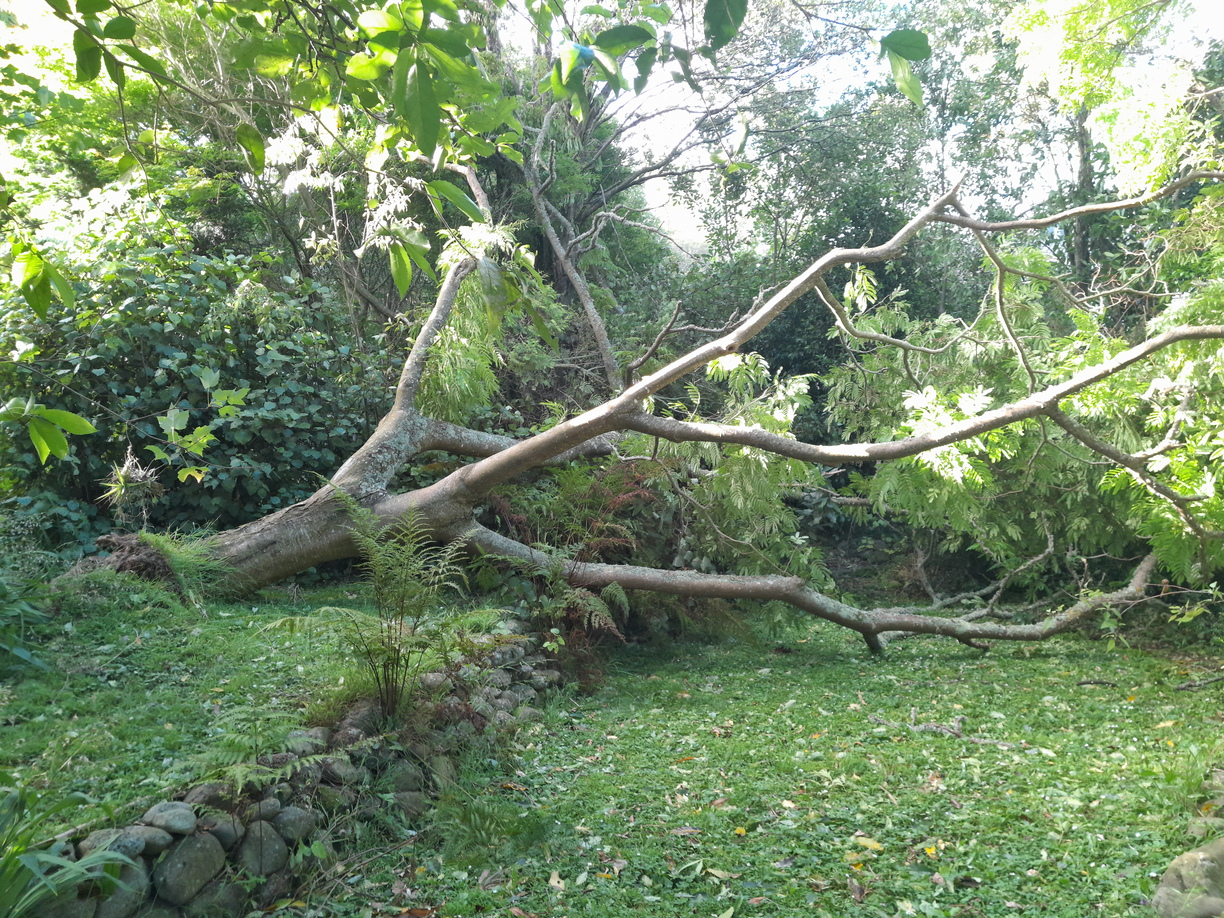
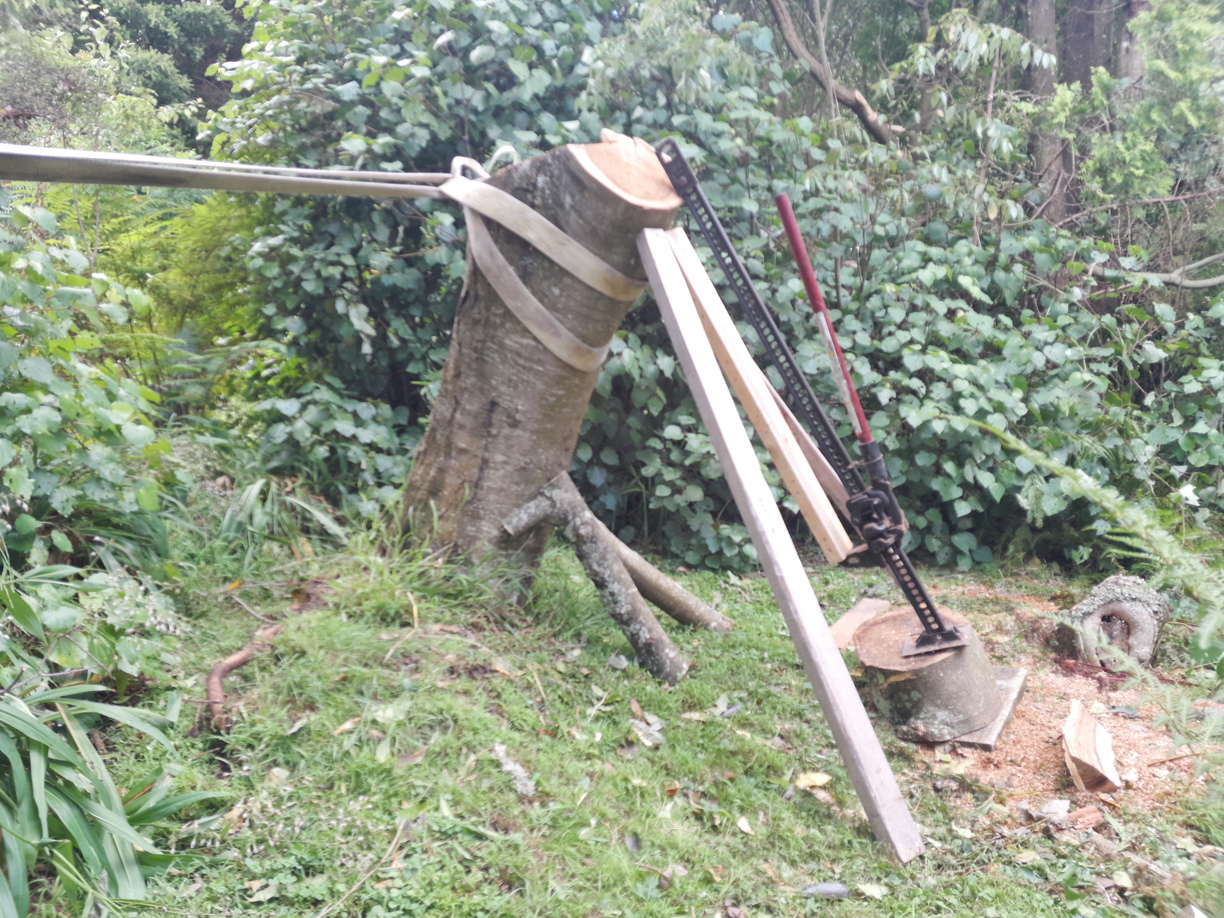
Until we had a hellacious windstorm right before new year's. Two straight days of gale easterlies, including most of a day out of the NE, which is a quarter we rarely see any wind come from. The bigger tree got wrenched out of the ground and tossed in a heap. I wasn't prepared to write it off completely, since it was the kids' swing and climbing tree, so I cut it back to just the trunk, and used a block and tackle plus a hi-lift and some stout timber props to hoist it back up to something resembling vertical.

[edit to add] For an idea of the physics involved in how this tree went down, the direction of the fall is directly into the strongest winds. This is a really sheltered spot, with tall trees all around, so I can only imagine how some combination of turbulence and possibly a few intense downdrafts must have twisted the crown and uncrewed the base of the tree from the ground.

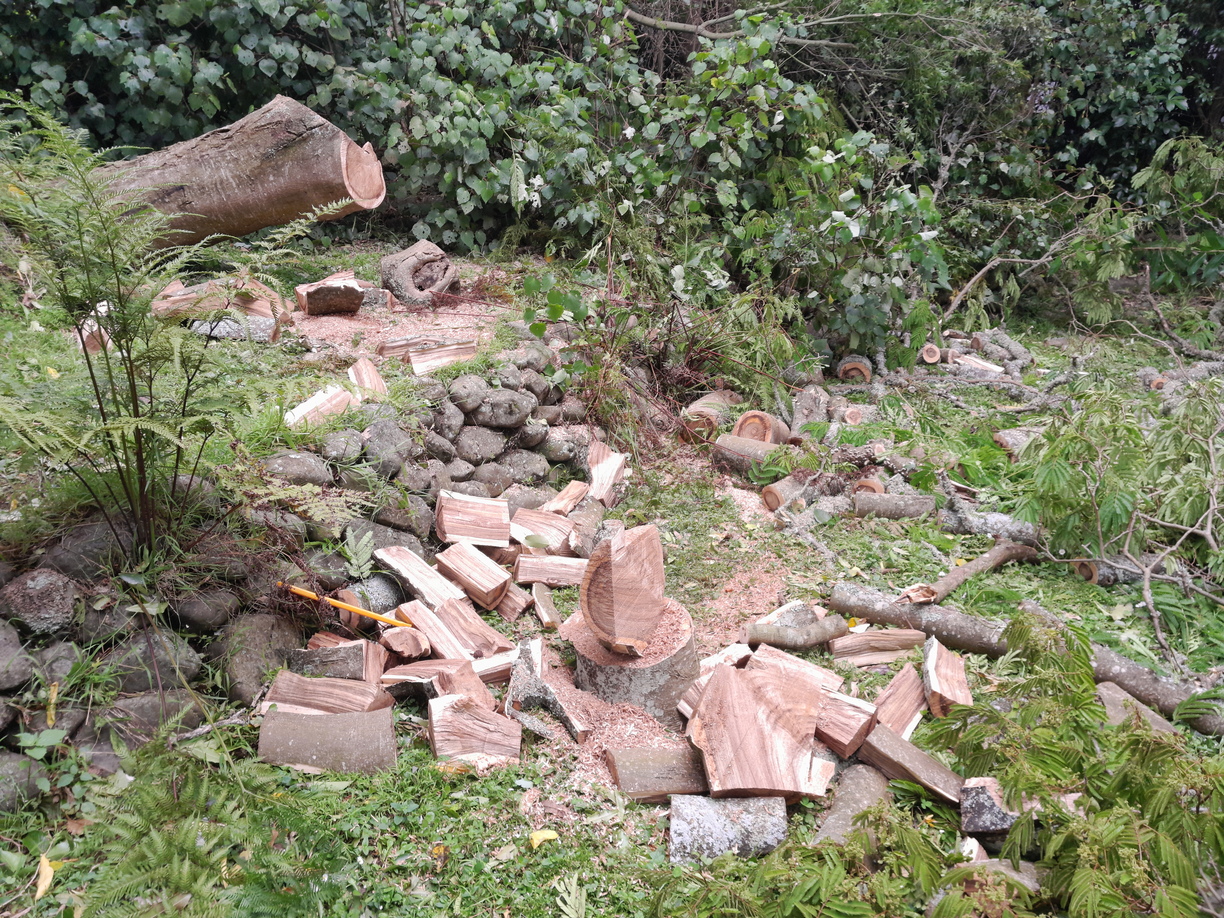
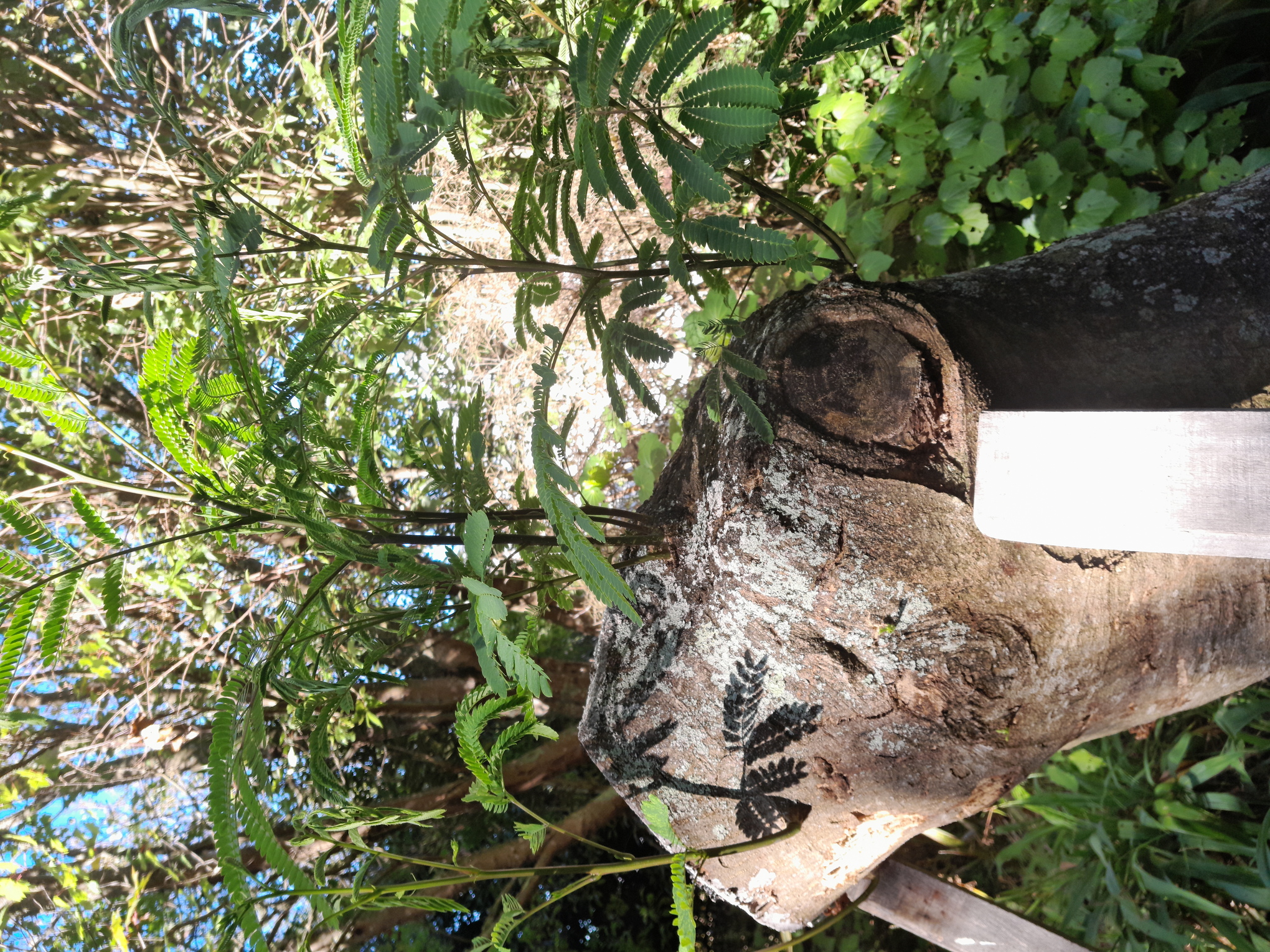
After bucking, splitting, and stacking, I estimated half a cube of firewood for my time and trouble. It's a dense wood, like lots of legumes, so I expect it will have a lot of heat value. Really attractive colouring and figure, too...reminiscent of mesquite and Tasmanian blackwood. The tree started putting out new growth within a month and now has a few clusters of shoots. It's dropped most of its leaves now and gone dormant for the winter, so I'll keep my fingers crossed for a resurgence in the spring. There's a big dead/rotting strip running up one side of the trunk, so it might be on borrowed time anyway. If that's the case, I have allowed one root sucker to come up and if the original stem packs it in, there's a replacement right next to it.
tree_down.jpg
tree down
tree down
chopped_up.jpg
firewood
firewood
winched_upright.jpg
levitating
levitating
regrowth.jpg
ides of march progress
 
Judith Browning
Posts: 10518
Location: a temperate, clay/loam spot on planet earth, the universe
3705
4
  • Likes 8
  • Mark post as helpful
  • send pies
    Number of slices to send:
    Optional 'thank-you' note:
  • Quote
  • Report post to moderator
Thanks Chris!
I'm happy to hear how well mimosa handle pruning...now I want them to grow faster!
good to hear from more folks finding this tree useful.

Phil, I'm not sure I've ever seen a mimosa that large😯

Steve has carved spoons out of small pieces and says it's a little soft compared to some woods and looks like fudge ripple ice cream.  We don't see very large ones here.
 
Phil Stevens
master pollinator
Posts: 2174
Location: Ashhurst New Zealand (Cfb - oceanic temperate)
760
duck forest garden fungi trees chicken cooking solar sheep wood heat woodworking rocket stoves
  • Likes 6
  • Mark post as helpful
  • send pies
    Number of slices to send:
    Optional 'thank-you' note:
  • Quote
  • Report post to moderator

Judith Browning wrote:
Phil, I'm not sure I've ever seen a mimosa that large😯

Steve has carved spoons out of small pieces and says it's a little soft compared to some woods and looks like fudge ripple ice cream.  We don't see very large ones here.


It's only 25-30 years old, tops. Some trees grow insanely fast here, like the English oak that's a similar age and almost 15 m tall with a trunk that I can't even begin to wrap my arms around. The wood felt really dense as I was cutting and splitting, but as far as the chainsaw response goes, it's definitely not as hard as the desert legumes or our native kowhai. I'll know in another month or so what it's like in terms of heat, since it's at the back of the wood pile.
 
Judith Browning
Posts: 10518
Location: a temperate, clay/loam spot on planet earth, the universe
3705
4
  • Likes 6
  • Mark post as helpful
  • send pies
    Number of slices to send:
    Optional 'thank-you' note:
  • Quote
  • Report post to moderator
Phil, I think I misinterpreted Steve's comment about the wood....not a soft wood but a softer hardwood is more what he meant🙄

I guess the spoons he made from it are long gone to customers...was hoping I could find one here, but no luck.
 
straws are for suckers. tiny ads are for attractive people.
hands on gardening and natural building
https://wheaton-labs.com/bootcamp
reply
    Bookmark Topic Watch Topic
  • New Topic