• Post Reply Bookmark Topic Watch Topic
  • New Topic
permaculture forums growies critters building homesteading energy monies kitchen purity ungarbage community wilderness fiber arts art permaculture artisans regional education skip experiences global resources cider press projects digital market permies.com pie forums private forums all forums
this forum made possible by our volunteer staff, including ...
master stewards:
  • Carla Burke
  • John F Dean
  • Nancy Reading
  • r ransom
  • Jay Angler
  • Timothy Norton
stewards:
  • paul wheaton
  • Pearl Sutton
  • Anne Miller
master gardeners:
  • Christopher Weeks
  • M Ljin
gardeners:
  • Jim Garlits
  • thomas rubino
  • William Bronson

Biochar as a tool for evaporative cooling?

 
master pollinator
Posts: 5848
Location: Canadian Prairies - Zone 3b
1687
  • Likes 9
  • Mark post as helpful
  • send pies
    Number of slices to send:
    Optional 'thank-you' note:
  • Quote
  • Report post to moderator
Okay, the title sounds crazy and probably is, but biochar that is fully saturated with moisture is really hard to dry out.

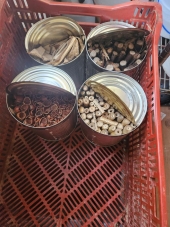
So much so that when I complete a biochar burn in a barrel, I seal the barrel with dead-wet biochar and pack it in. It's one of the few things that will fully kill the burn and seal the barrel. This seriously works. The char underneath is dry.

So I'm speculating -- could a fully saturated biochar roof add cooling inside a building? Like a chicken coop or something? Could it create an evaporative flow from the top (black, hot) to the bottom (wet, cool)?

For the first time in years I have enough rain (for the moment anyway). So I can't hope to test this nutty proposition anytime soon.

What do you think of my crackpot idea? Worth an experiment?
 
pollinator
Posts: 306
Location: UK
97
kids urban seed
  • Likes 8
  • Mark post as helpful
  • send pies
    Number of slices to send:
    Optional 'thank-you' note:
  • Quote
  • Report post to moderator
Interesting thought. Biochar holds something like 5x its weight in water so the moisture retention is definitely real. I could see it working as a passive cooling layer on a coop roof, especially if you could rig a simple drip system to keep it saturated during the hottest part of the day. The evaporation would pull heat away from the surface the same way a wet towel on your head works. Whether it's worth the effort vs just painting the roof white and adding ventilation, not sure, but as an experiment it sounds fun.
 
pollinator
Posts: 919
Location: Appalachian Foothills-Zone 7
242
  • Likes 7
  • Mark post as helpful
  • send pies
    Number of slices to send:
    Optional 'thank-you' note:
  • Quote
  • Report post to moderator
Test it.  Build a couple desk top “houses”, one with, one without biochar.  I’d be interested in seeing if mixing lime in with the biochar would lighten it color wise and improve reflectivity.
 
steward and tree herder
Posts: 13821
Location: Isle of Skye, Scotland. Nearly 70 inches rain a year
7541
6
transportation dog forest garden foraging trees books food preservation woodworking wood heat rocket stoves ungarbage
  • Likes 6
  • Mark post as helpful
  • send pies
    Number of slices to send:
    Optional 'thank-you' note:
  • Quote
  • Report post to moderator
I think charcoal could have an advantage over some other materials that it is fairly lightweight. The voids between the particles would mean that it should drain well, so would be less heavy than (for example) terra cotta tiles which I've seen suggested as a matrix for evaporating cooling.
The idea of a pale coloured surface has appeal too though, as it would reduce heat absorption - although charcoal should be a good thermal insulator too (and fire retardant?)
 
Nancy Reading
steward and tree herder
Posts: 13821
Location: Isle of Skye, Scotland. Nearly 70 inches rain a year
7541
6
transportation dog forest garden foraging trees books food preservation woodworking wood heat rocket stoves ungarbage
  • Likes 7
  • Mark post as helpful
  • send pies
    Number of slices to send:
    Optional 'thank-you' note:
  • Quote
  • Report post to moderator

Douglas Alpenstock wrote:Okay, the title sounds crazy and probably is


Wheaton eco-scale - wait for everyone else to catch up!
 
gardener
Posts: 819
Location: Semi-nomadic, main place coastal mid-Norway, latitude 64 north
538
  • Likes 10
  • Mark post as helpful
  • send pies
    Number of slices to send:
    Optional 'thank-you' note:
  • Quote
  • Report post to moderator
Neat idea! How do you think it'd work in the winter? I'd guess the lower temperature would mean way less evaporation, even if the char is humid, leading to less cooling, and the cooling would be counteracted by the insulative properties of the char. At least as long as the char isn't completely saturated with water in winter...

Here's a spinoff idea: use the char as part of the growing medium in a green roof. Okay, you'd lose the increased evaporation from sun heating the black char, but on the other hand you'd gain transpiration from the plants. The biochar would then mainly function as a moisture reserve for the plants, and a booster of plant growth, ie standard biochar function.

As a side note, we're planning to build with charcoal, not in the roof but in the wall. The idea is a cordwood wall with a mortar consisting of char, clay and straw - basically cob with the sand replaced at least partially by char. In our climate, insulation is generally more valuable than cooling, and it'll be under a roof overhang anyway, but I suppose if the heat became unbearable we could always throw a few buckets of water at the outside of the wall for cooling. Although I strongly suspect that might decrease the lifetime of the wall!
 
gardener
Posts: 5725
Location: Cincinnati, Ohio,Price Hill 45205
1332
forest garden trees urban
  • Likes 9
  • Mark post as helpful
  • send pies
    Number of slices to send:
    Optional 'thank-you' note:
  • Quote
  • Report post to moderator

I've often thought about a building topped with a shallow pool, for cooling/ heating.
The saturated char would be durable and easily replaced, protecting the water proof liner from the sun.
I'm not sure if the evaporation would cool the building, but I think it would prevent the building from gaining heat, and any dry char would be insulative.
In the cold seasons, charcoal on the roof would traxp water/ice up there.
Freeze thaw cycles will probably degrade the charcoal.

I think a charcoal version of a gabion basket would work for deployment on the roof and walls.


gardener
Posts: 4614
792
7
forest garden fungi trees food preservation bike medical herbs
  • Likes 7
  • Mark post as helpful
  • send pies
    Number of slices to send:
    Optional 'thank-you' note:
  • Quote
  • Report post to moderator
It's speculative, but it makes sense in a way.  Kelpie Wilson has touted biochar as a means of preventing future forest fires.  The idea is that it absorbs 6 times it's volume in water, so the forest wouldn't burn as likely with all that water in it. One step away is cooling from evaporation.
JohnS
PDX OR
 
I think he's gonna try to grab my monkey. Do we have a monkey outfit for this tiny ad?
Escape to a permaculture life in Montana
https://wheaton-labs.com/bootcamp
reply
    Bookmark Topic Watch Topic
  • New Topic