
• Post Reply Bookmark Topic Watch Topic
  • New Topic
permaculture forums growies critters building homesteading energy monies kitchen purity ungarbage community wilderness fiber arts art permaculture artisans regional education skip experiences global resources cider press projects digital market permies.com pie forums private forums all forums
this forum made possible by our volunteer staff, including ...
master stewards:
  • paul wheaton
  • Anne Miller
  • Carla Burke
  • Nancy Reading
  • John F Dean
  • Timothy Norton
  • Jay Angler
stewards:
  • r ransom
  • Pearl Sutton
  • Tereza Okava
master gardeners:
  • Christopher Weeks
gardeners:
  • M Ljin
  • Megan Palmer
  • Kate Downham

Solar well pump recommendations for 325ft deep well in PNW

 
pollinator
Posts: 182
Location: Mason County, WA USA:Ha; Harstine gravel ashy sandy loam
137
duck rabbit chicken medical herbs bee solar wood heat rocket stoves
  • Likes 4
  • Mark post as helpful
  • send pies
    Number of slices to send:
    Optional 'thank-you' note:
  • Quote
  • Report post to moderator
Hi Permies,

I have gotten a bid to drill a well on my property. Usual well depth is about 280 - 320 feet here (average for neighboring properties).  
Since I am off grid, I will be installing a solar well pump.
I am looking for recommendations for configurations of solar + pump that can be reliable in Washington state Olympic Peninsula.

Looking forward to hearing any suggestions you have.
Thanks!
K
 
Kara Ann
pollinator
Posts: 182
Location: Mason County, WA USA:Ha; Harstine gravel ashy sandy loam
137
duck rabbit chicken medical herbs bee solar wood heat rocket stoves
  • Likes 4
  • Mark post as helpful
  • send pies
    Number of slices to send:
    Optional 'thank-you' note:
  • Quote
  • Report post to moderator
Would be great to have a referral for a reliable professional who can help me assess and recommend a plan. Anyone have suggestions for a consultant?
 
Posts: 59
Location: BC Interior
22
  • Likes 3
  • Mark post as helpful
  • send pies
    Number of slices to send:
    Optional 'thank-you' note:
  • Quote
  • Report post to moderator
Following, although my well is 800'.
 
master pollinator
Posts: 3066
Location: RRV of da Nort, USA
1033
  • Likes 9
  • Mark post as helpful
  • send pies
    Number of slices to send:
    Optional 'thank-you' note:
  • Quote
  • Report post to moderator
Kara Ann,   I went to school for a spell at Evergreen State College but that was a while ago and can't help with the referrals to a solar well installer.  However, I did notice through some sleuthing at their campus website that there is now a community organization in Olympia called 'Olympia Community Solar' --  Since you may be located not far from Olympia, those within that organization may know of installers who would be able to advise you if nothing shows up here in this thread.  Beautiful area there on the Penninsula....Good luck!

Link for the website:   https://olysol.org/
 
Posts: 4
  • Likes 7
  • Mark post as helpful
  • send pies
    Number of slices to send:
    Optional 'thank-you' note:
  • Quote
  • Report post to moderator
I would get in touch with backwoods solar out of sandpoint, Idaho . They have been around for many years and design complete systems ,etc. you can check them out online also. Good luck.
 
Posts: 161
Location: Klamath-Siskiyou CA
35
monies trees tiny house
  • Likes 8
  • Mark post as helpful
  • send pies
    Number of slices to send:
    Optional 'thank-you' note:
  • Quote
  • Report post to moderator
I don't have specific pointers, but a couple additional considerations: for one, the water table or depth to standing water in your well may be much shallower, for purpose of your pump rating calculations. There is always some standing 'water column' in the bottom of the well that can fluctuate a bit seasonally or based on use, but may average 100' or more of total well depth. Your neighbors or the well driller may have local insight on estimating that. Second, the pump will need to be suited for a particular water system design and usage. There are different ways to set things up, like using a cistern/tank and gravity feed (how far above well head?) vs pressure tank that's more 'on demand'. What kind of water (volume) usage do you expect, and when (daytime & season)? What's the power supply going to be - standalone unit, or connected to house/other system? No need to elaborate here, but those are things you probably want to get clear on to discuss with a professional or installer.
 
pollinator
Posts: 6339
Location: Bendigo , Australia
609
plumbing earthworks bee building homestead greening the desert
  • Likes 5
  • Mark post as helpful
  • send pies
    Number of slices to send:
    Optional 'thank-you' note:
  • Quote
  • Report post to moderator
Can I ask what does a 320 ft well cost?
Would rainfall collection be better value?
 
Kara Ann
pollinator
Posts: 182
Location: Mason County, WA USA:Ha; Harstine gravel ashy sandy loam
137
duck rabbit chicken medical herbs bee solar wood heat rocket stoves
  • Likes 9
  • Mark post as helpful
  • send pies
    Number of slices to send:
    Optional 'thank-you' note:
  • Quote
  • Report post to moderator
Hey All - thanks very much for chiming in! I appreciate the comments.  

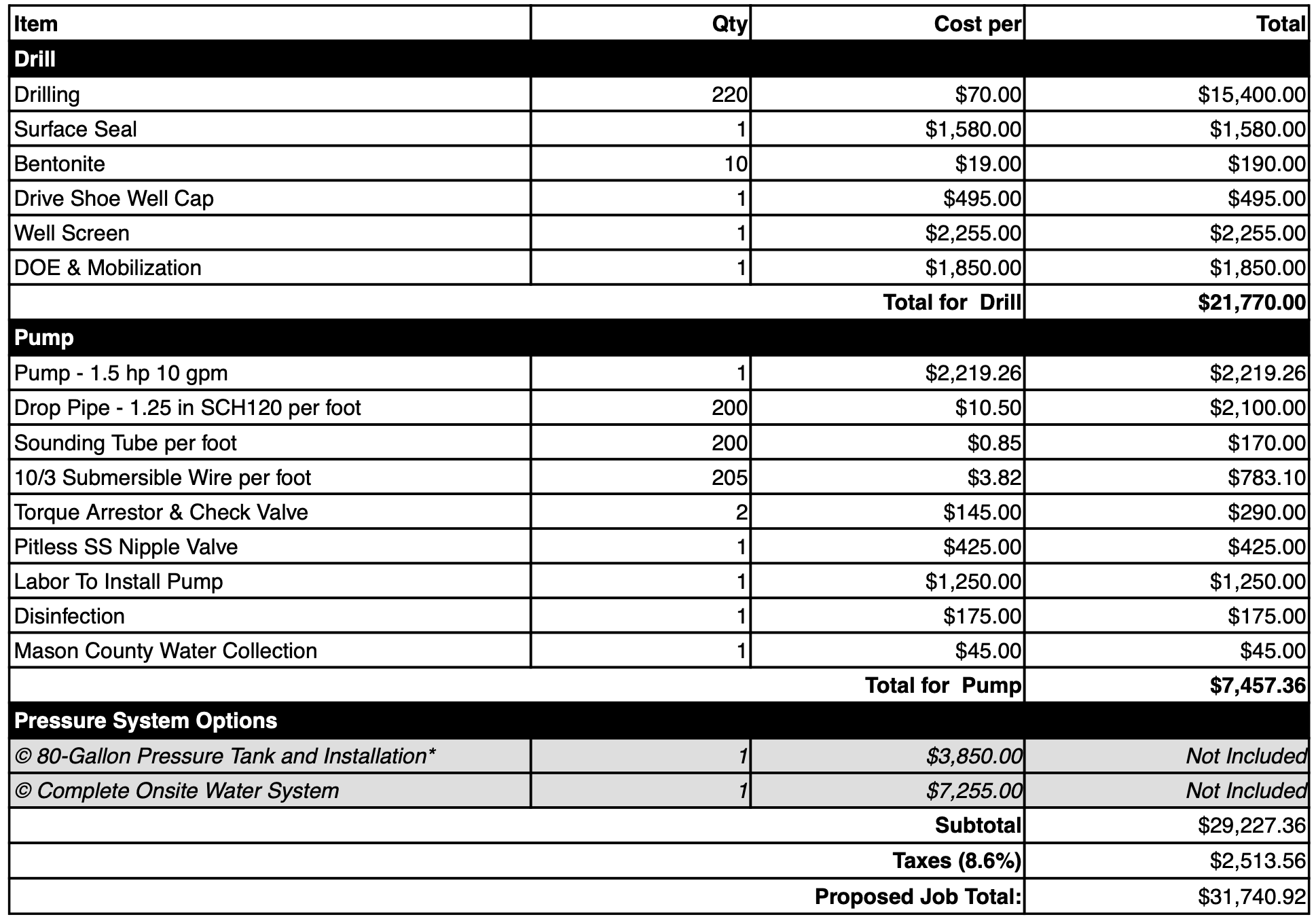
John - Good question! I have attached the drilling company's estimate. The numbers/details for pump /pressure system that are part of their standard estimate will be different for my off-grid / solar pump situation.  And this is not instead of rainfall, this is in ADDITION to water catchment from hoophouse and greenhouse/barn, and dew catcher installation on the windward side of a berm on the property, and set up for pigs to gley a pond in a natural geographic depression on the property. Western Washington is softly soggy from October through May, and dry in June - September (Tucson, AZ gets more rain in summer time than my farm). So water collection can only get me so far in the goal to have sustainable water for peeps, flocks, herds, orchards and gardens year round.

Ben - thanks for laying out these points! Just knowing the questions to consider is a big step, especially for a newbie, first timer like me on getting a well put in.  All of these questions are getting on the table, and I appreciate your thoroughness - always lots to learn.  It makes the most sense to figure out the well pump details AFTER it is absolutely clear what the conditions of the well are! I have been talking to a solar designer this week, and currently looking at doing something like this


Joe and John - thanks for these suggestions. I will contact Backwoods Solar and also reach out the Oly Community Solar group at Evergreen. Great to have these contacts.

Lawren - OH MY - I was feeling like this was rough because of the potential for 325ft - but you REALLY have some depth there!!! Is that common where you are?  In the area around my property, some wells have come in at 145ft, many in the low 200s - neighbor to the south just drilled a well at 215ft, and several deeper than 300.

I will post here again once the rig is onsite and we are in the drilling process. It's going to be noisy for a few days, isn't it???
Thanks again!
Well_Drill_Estimate.png
[Thumbnail for Well_Drill_Estimate.png]
 
John C Daley
pollinator
Posts: 6339
Location: Bendigo , Australia
609
plumbing earthworks bee building homestead greening the desert
  • Likes 7
  • Mark post as helpful
  • send pies
    Number of slices to send:
    Optional 'thank-you' note:
  • Quote
  • Report post to moderator
Kara, so going backwards what volume of water would you need in a 12 month period of time?
I can work out how much storage you would need knowing your average rainfall.
Peopleare often surprised at what can be caught!

 
Kara Ann
pollinator
Posts: 182
Location: Mason County, WA USA:Ha; Harstine gravel ashy sandy loam
137
duck rabbit chicken medical herbs bee solar wood heat rocket stoves
  • Likes 7
  • Mark post as helpful
  • send pies
    Number of slices to send:
    Optional 'thank-you' note:
  • Quote
  • Report post to moderator
Thanks, John - that is a great question, and I would appreciate your input.

I have been working on estimating water storage inputs and goals with Claude.ai;  attached is a .pdf of the worksheet with the documentation so far.
(Yes, I know there seem to be a lot of strong opinions about using AI... and the research capacity it gives me has been really helpful in researching / comparing / identifying. It would honestly be very difficult for me to do what I'm doing as I fly solo here, without the information I get with Claude's assistance. And always important to reality check!)

It would surely be helpful to have a wise set of eyes to review and assess, so thanks for your offer.
The worksheet has multiple tabs (assumptions / plants / livestock / household / catchment etc) that has laid out the various inputs and outputs.
This is based on the farm plan over the next 5 years.

I can work out how much storage you would need knowing your average rainfall.


That really is the crucial point, isn't it? Since I live in a place with lots of water input during the long rainy months, the storage is the primary constraint, rather than the amount that can be collected.

Looking forward to your thoughts on this...
Filename: IslandSage_Storage_Wksht_Permies.pdf
File size: 334 Kbytes
 
John C Daley
pollinator
Posts: 6339
Location: Bendigo , Australia
609
plumbing earthworks bee building homestead greening the desert
  • Likes 7
  • Mark post as helpful
  • send pies
    Number of slices to send:
    Optional 'thank-you' note:
  • Quote
  • Report post to moderator
Kara, I will study that chart later, when I make time to think about it.
I see you appear to have used existing data, that is great.
The Israelis have become masters at water usage for growing things and the equipment they have developed is amazing.
Consider using that stuff.
Consumption by animals will be listed somewhere.
Other points to consider are steps to reduce losses;
- windbreaks to reduce evaporation
- loss from in ground storage, IE ponds, dams, channels
- time of watering
- method of watering
- at water troughs, make sure animals cannot damage water floats.
Historic rainfall records will help in determining;
- what length of time you will need to draw from tank storage.
- what volume of water you can expect from roof catchment.
 
Kara Ann
pollinator
Posts: 182
Location: Mason County, WA USA:Ha; Harstine gravel ashy sandy loam
137
duck rabbit chicken medical herbs bee solar wood heat rocket stoves
  • Likes 1
  • Mark post as helpful
  • send pies
    Number of slices to send:
    Optional 'thank-you' note:
  • Quote
  • Report post to moderator
Thanks John! Great points to consider - I appreciate your input!
 
Kara Ann
pollinator
Posts: 182
Location: Mason County, WA USA:Ha; Harstine gravel ashy sandy loam
137
duck rabbit chicken medical herbs bee solar wood heat rocket stoves
  • Likes 10
  • Mark post as helpful
  • send pies
    Number of slices to send:
    Optional 'thank-you' note:
  • Quote
  • Report post to moderator
Hi All,

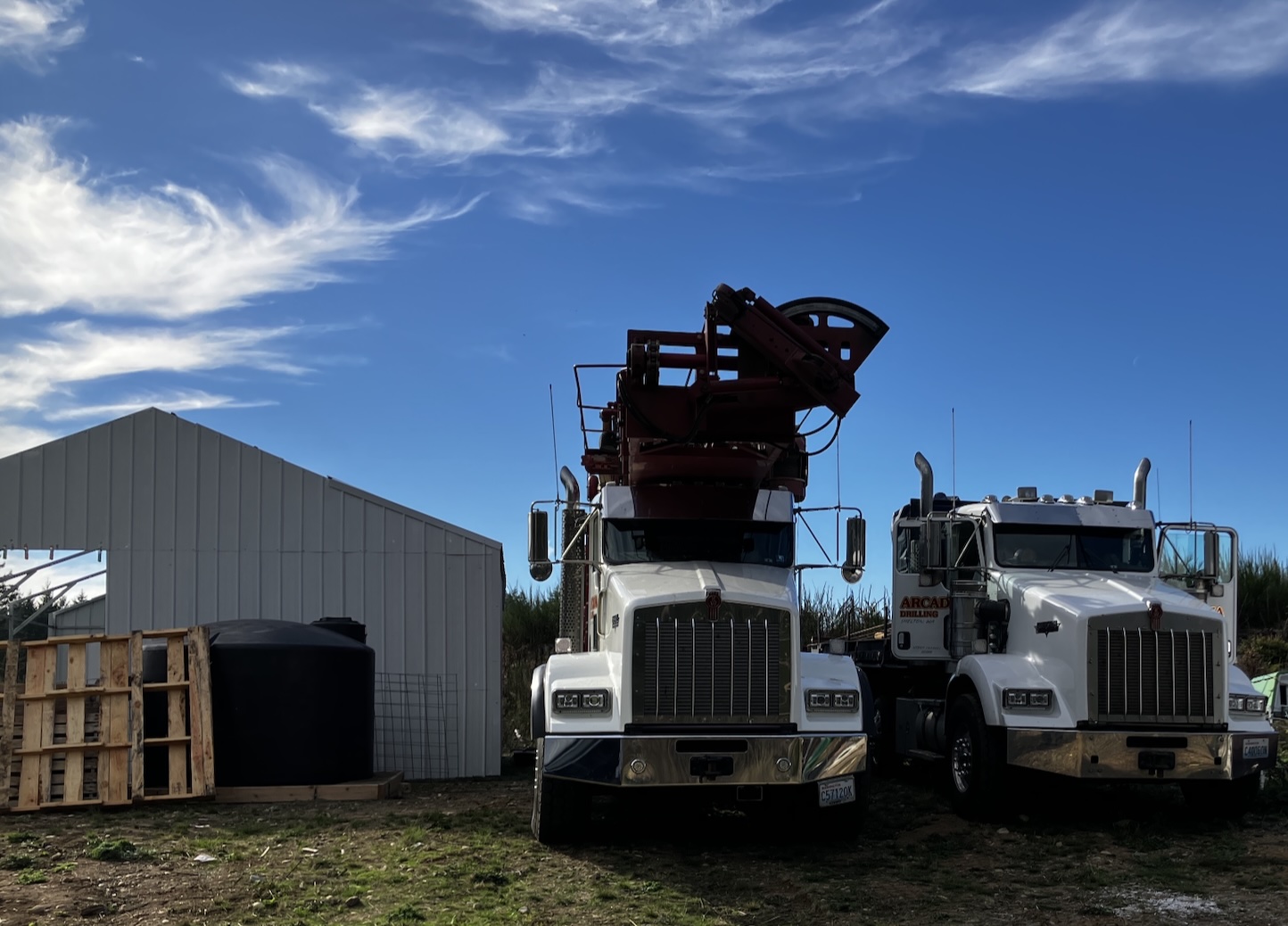
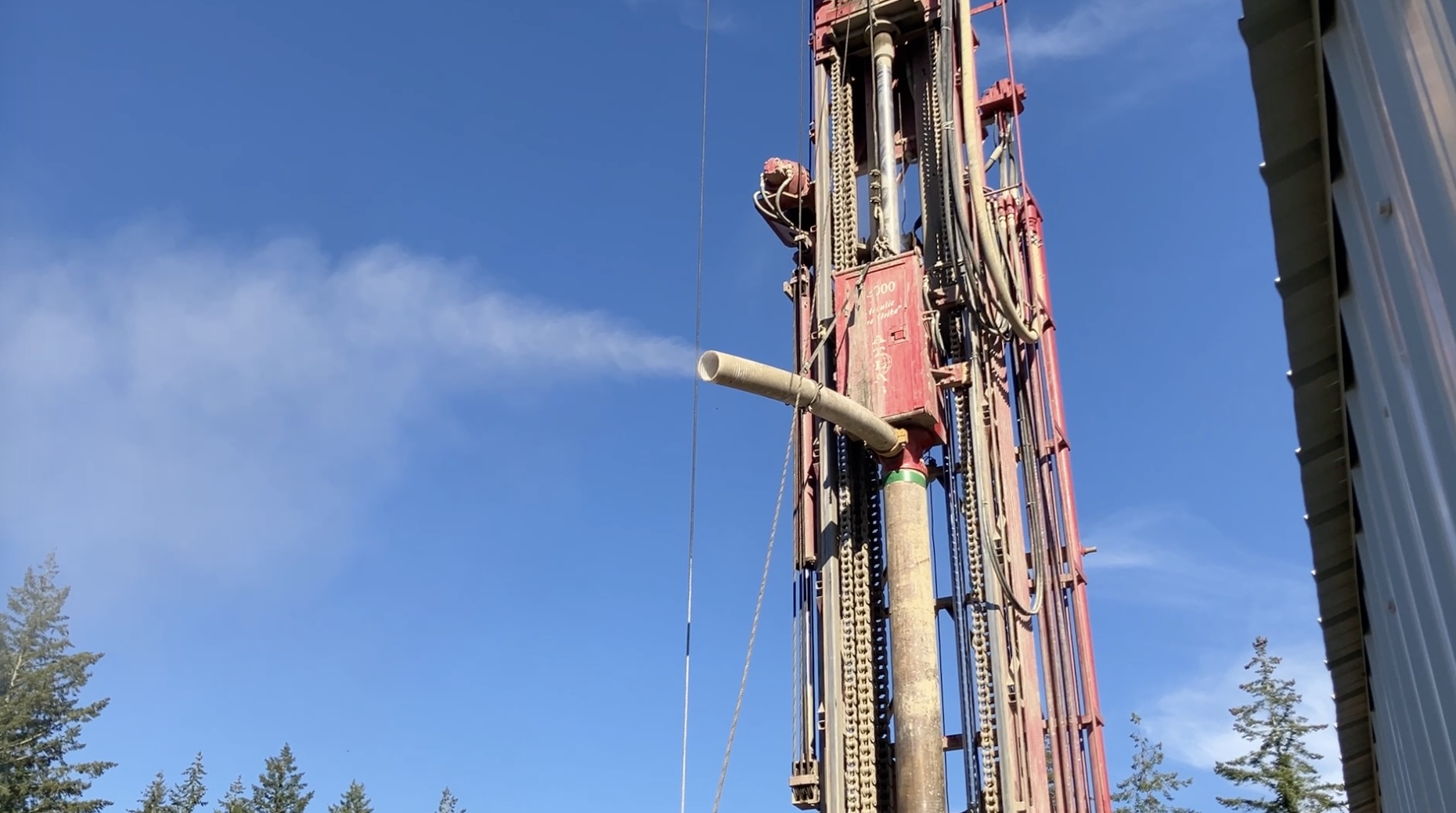
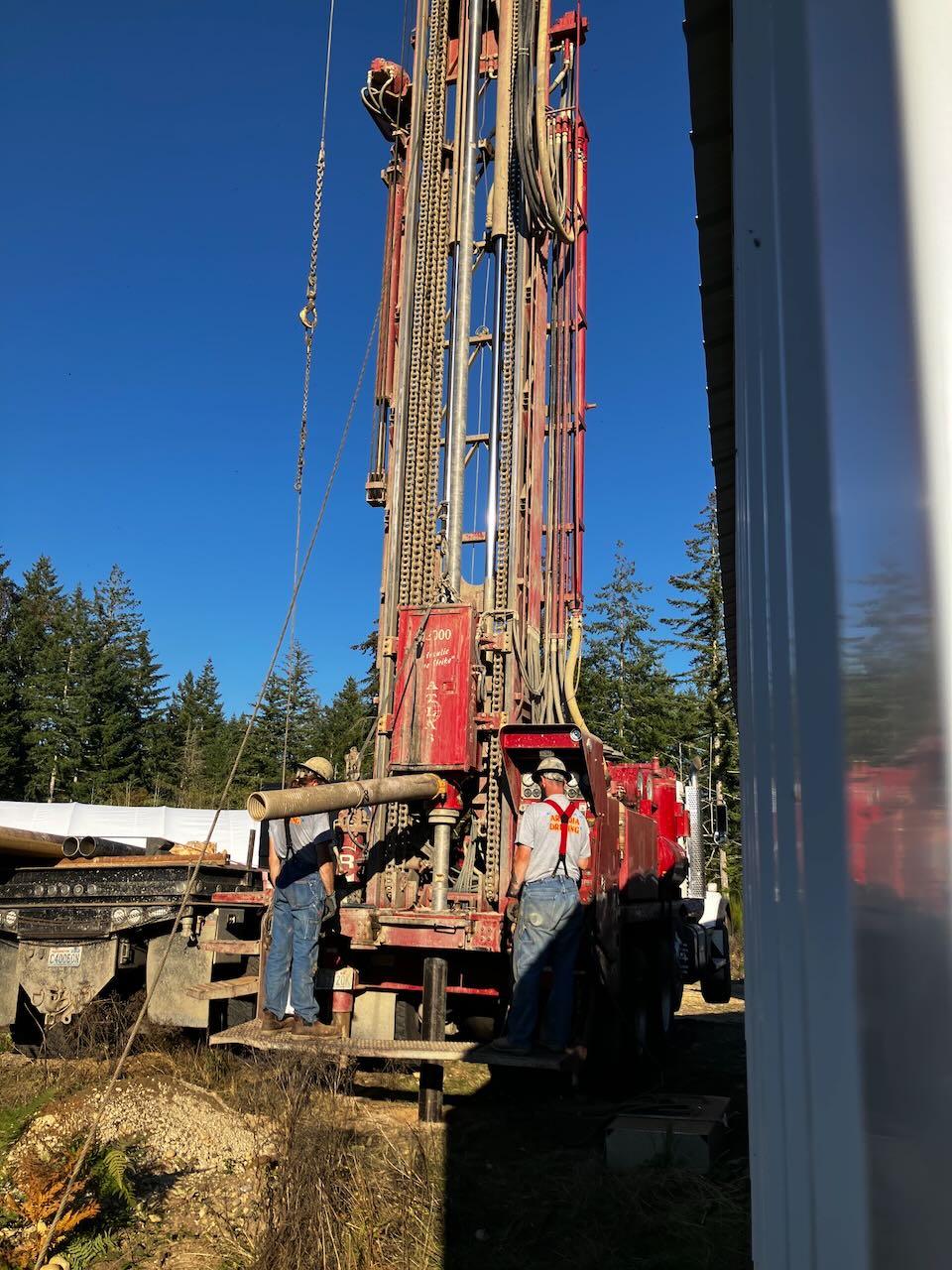
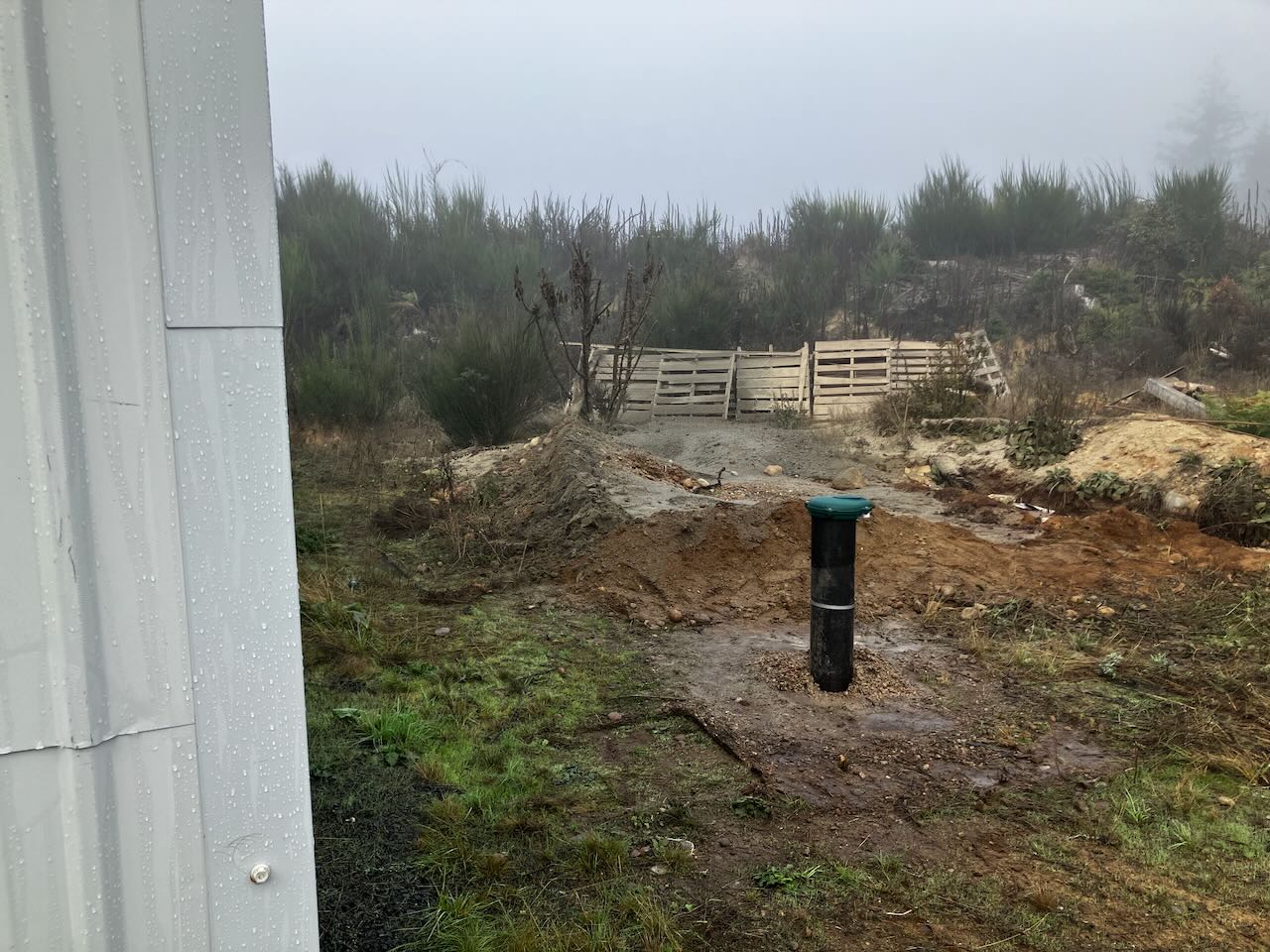
Drillers were here this week, reached water yesterday at 224 depth. We have 15gpm with 33 ft static water. Hooray.  Working now with consultant on off grid pump / solar etc.  Running water on demand - such a gift!

When I get the final set up for the pump / solar / etc I will post here again.
Drill_Rigs_Arrived.jpg
[Thumbnail for Drill_Rigs_Arrived.jpg]
Drill_Rig_Spout.jpg
[Thumbnail for Drill_Rig_Spout.jpg]
IMG_7975.jpeg
drilling for water
Well_Capped1.jpeg
new well capped off
 
steward and tree herder
Posts: 14910
Location: Isle of Skye, Scotland. Nearly 70 inches rain a year
8537
6
transportation dog forest garden foraging trees books food preservation woodworking wood heat rocket stoves ungarbage
  • Likes 1
  • Mark post as helpful
  • send pies
    Number of slices to send:
    Optional 'thank-you' note:
  • Quote
  • Report post to moderator
Yay! such good news
 
John C Daley
pollinator
Posts: 6339
Location: Bendigo , Australia
609
plumbing earthworks bee building homestead greening the desert
  • Likes 7
  • Mark post as helpful
  • send pies
    Number of slices to send:
    Optional 'thank-you' note:
  • Quote
  • Report post to moderator
Kara, some questions;
- you have not allowed for any catchment off roofs in the wet period
  what is your expected rainfall in that period?
- A couple of large, 5000 gallon tanks will be better value than IBC units. joined together.
  Just connecting them together will be expensive and prone to leaks.
- Dexter cattle may use more than 12 gallons a day it may be calculates 10 gal / day winter, 20 gal/ day summer for a start

 
Kara Ann
pollinator
Posts: 182
Location: Mason County, WA USA:Ha; Harstine gravel ashy sandy loam
137
duck rabbit chicken medical herbs bee solar wood heat rocket stoves
  • Likes 8
  • Mark post as helpful
  • send pies
    Number of slices to send:
    Optional 'thank-you' note:
  • Quote
  • Report post to moderator

John C Daley wrote:Kara, some questions;
- you have not allowed for any catchment off roofs in the wet period
  what is your expected rainfall in that period?
- A couple of large, 5000 gallon tanks will be better value than IBC units. joined together.
  Just connecting them together will be expensive and prone to leaks.
- Dexter cattle may use more than 12 gallons a day it may be calculates 10 gal / day winter, 20 gal/ day summer for a start


Hello, John - hey thank you so much for taking time to look at my water spreadsheet - it is really wonderful the way you share your passion for water management and your experience with all of us here on Permies!

You are absolutely right about the dry season documentation. We were sizing/estimating to get through the dry season because the wet season is... welllll... really wet here in the PNW, with frequent rain and easy expectation of full tanks and ponds, with attention going to ground work for  redirection of excess into swales.

Rain: Oct–May brings about 58.9", out of 65.2" a year.
Catchment: the 1,425 sq ft of greenhouse / tinyhome roof catches about 710 gal per inch of rain (1,425 × 0.623 × 0.8 efficiency). Over the wet season that’s about 41,800 gal.
Wet-season drinking water for animals roughly 18,700–30,400 gal over those 243 days, depending on whether you use the low or average rates.
What’s left to store: about 11,000–23,000 gal. Most of it arrives November through March. By May the roofs fall behind what the animals drink.

And thanks for the update on the Dexters - updating the documents now.

For the IBC tote series, I am using nozzle splitters / hoses at the spigots to connect them, rather than drilling holes/pipe connections in their lower sidewalls. Definitely less prone to leaks. A food grade, cleaned, used 275gal tote (which I buy from a cider pub) is $125. So these are practical, easy to move and connect, and in my budget for now. Longer term, I do expect to move to larger tanks and repurpose some of these for channel catfish tanks in the greenhouse.
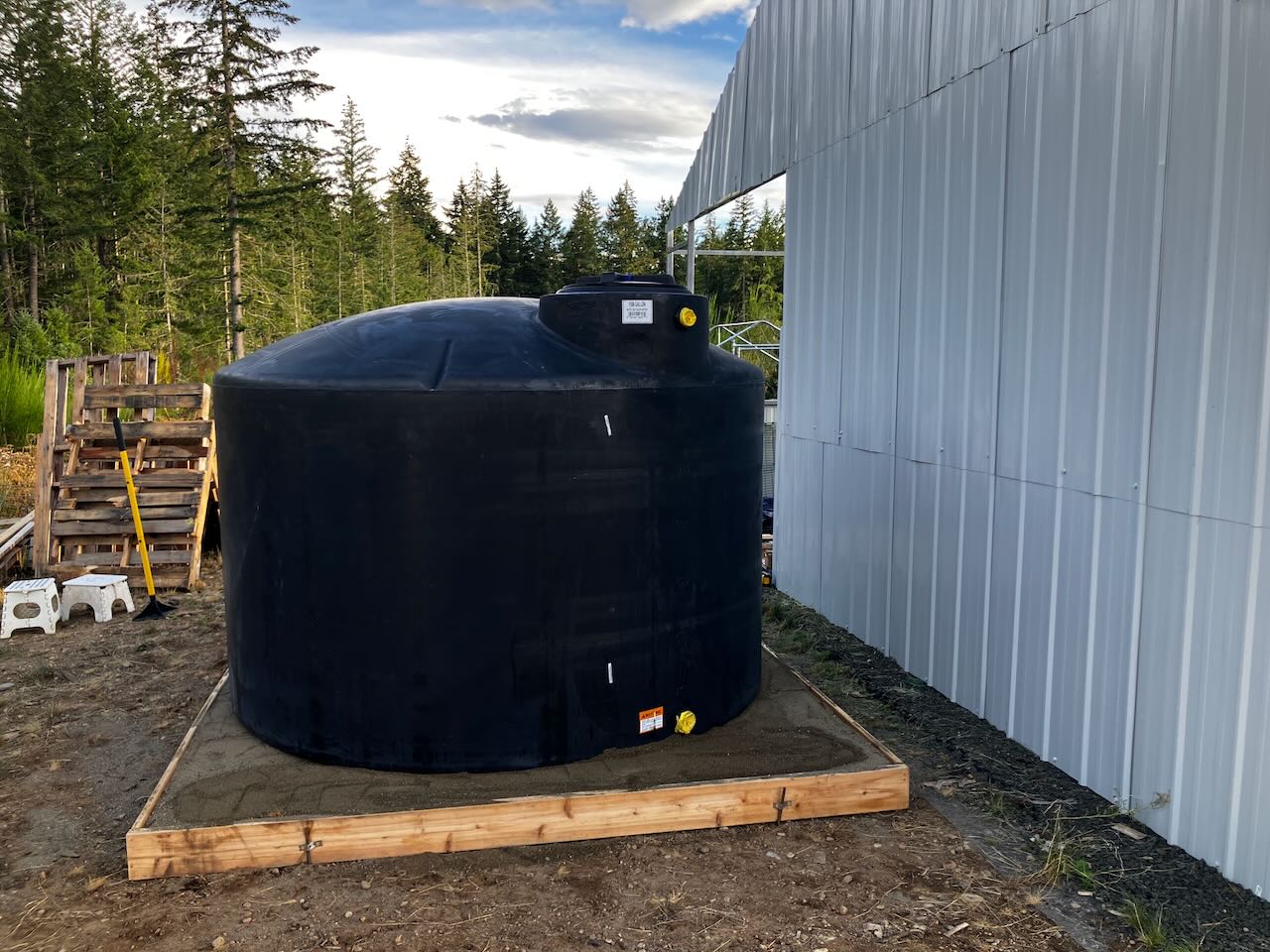
The 5000 gal tank cost (over $6K) is an overly big step for me right now, and a lot of those tanks are too tall to support rainwater catchment from the structures I have onsite. A farmer buddy a little further south in the state  has a very large water tank on their property that they do not want, and it will be coming here soon. I don't know the exact capacity and dimensions of it, but will add it in to the planning once those are known.

I appreciate your help  
 
Posts: 527
82
  • Likes 7
  • Mark post as helpful
  • send pies
    Number of slices to send:
    Optional 'thank-you' note:
  • Quote
  • Report post to moderator
You can operate a standard AC-powered well-pump via solar.  I have a 1hp pump 380' down the well-hole, powered by a Schneider XW+ 6848 sine-wave inverter fueled by 4500W of solar.  The solar charges the 48V battery bank, and the bank fuels the inverter.  The 6848 has the starting surge capacity to start heavy loads like a well-pump, which starts with about 9200W (< 1 second), and runs at about 2000W.  I find I can generate the 2000W required from ~8am to 4pm.  I've since added another 3000W of solar facing due West, which allows me to pump later in the afternoon till past 6pm.  My pump produces about 300 gallons per hour.

When shopping for an inverter, you need to know the numbers you are working with before you start buying solar equipment.  I have a clamp meter that can read "inrush current", which is the starting surge that electric motors demand.  They are typically 3-5X the running wattage.  You place the clamp around one of the power wires (not both), press the inrush button, and start the pump.  The inrush current is reported in Amps, which you can convert to Watts by multiplying by your AC voltage.

Please note that a lot of cheap imported inverters will state how MUCH they can surge, but that number is of little/no value for heavy starting appliances.  What you want to pay close attention to is how LONG the inverter can surge.  Cheaper inverters may claim they can surge to 200%, but that is only for 8-16 milliseconds.  Quality inverters surge for 5-60 seconds, totally adequate for starting a well-pump.  In illustration, my XW+ can surge to 12,000W for 60 seconds.  So, it starts my big pump effortlessly.

A good rule of thumb is to have 2X capacity for every component.  So, if you have a pump that needs 1500W to run, make sure you have at least 3000W of solar. Also, have at least a 3000W inverter to run that 1500W load.  As a general rule of thumb, you end of spending less money overbuilding, then underbuilding.  Finding out a smallish piece of electronics can't handle the power demand means you have to then sell it and build a bigger model.

One of the great things about designing you solar system around the well-pump, is that most likely is the single biggest load you will ever run on your homestead.  So, if you system can run your well-pump, it pretty much can run just about anything else.  At my own homestead, I've done just that, and have all AC appliances in the cabin/workshop.
 
John C Daley
pollinator
Posts: 6339
Location: Bendigo , Australia
609
plumbing earthworks bee building homestead greening the desert
  • Likes 5
  • Mark post as helpful
  • send pies
    Number of slices to send:
    Optional 'thank-you' note:
  • Quote
  • Report post to moderator

The 5000 gal tank cost (over $6K) is an overly big step for me right now, and a lot of those tanks are too tall to support rainwater catchment from the structures I have onsite.  


Dont forget tank makers who work in steel can make any size tank shape, tall squat, so you can order what you want or need.
I am comfortable with poly tanks, instead of galvanised tanks.
Big tanks are very hard to move, how will you do that?

WHAT ARE THESE For the IBC tote series,

For the IBC tote series, I am using nozzle splitters / hoses at the spigots to connect them,
 
Kara Ann
pollinator
Posts: 182
Location: Mason County, WA USA:Ha; Harstine gravel ashy sandy loam
137
duck rabbit chicken medical herbs bee solar wood heat rocket stoves
  • Likes 4
  • Mark post as helpful
  • send pies
    Number of slices to send:
    Optional 'thank-you' note:
  • Quote
  • Report post to moderator

Michael Qulek wrote:You can operate a standard AC-powered well-pump via solar.  I have a 1hp pump 380' down the well-hole, powered by a Schneider XW+ 6848 sine-wave inverter fueled by 4500W of solar.  The solar charges the 48V battery bank, and the bank fuels the inverter.  The 6848 has the starting surge capacity to start heavy loads like a well-pump, which starts with about 9200W (< 1 second), and runs at about 2000W.  I find I can generate the 2000W required from ~8am to 4pm.  I've since added another 3000W of solar facing due West, which allows me to pump later in the afternoon till past 6pm.  My pump produces about 300 gallons per hour.

When shopping for an inverter, you need to know the numbers you are working with before you start buying solar equipment.  I have a clamp meter that can read "inrush current", which is the starting surge that electric motors demand.  They are typically 3-5X the running wattage.  You place the clamp around one of the power wires (not both), press the inrush button, and start the pump.  The inrush current is reported in Amps, which you can convert to Watts by multiplying by your AC voltage.

Please note that a lot of cheap imported inverters will state how MUCH they can surge, but that number is of little/no value for heavy starting appliances.  What you want to pay close attention to is how LONG the inverter can surge.  Cheaper inverters may claim they can surge to 200%, but that is only for 8-16 milliseconds.  Quality inverters surge for 5-60 seconds, totally adequate for starting a well-pump.  In illustration, my XW+ can surge to 12,000W for 60 seconds.  So, it starts my big pump effortlessly.

A good rule of thumb is to have 2X capacity for every component.  So, if you have a pump that needs 1500W to run, make sure you have at least 3000W of solar. Also, have at least a 3000W inverter to run that 1500W load.  As a general rule of thumb, you end of spending less money overbuilding, then underbuilding.  Finding out a smallish piece of electronics can't handle the power demand means you have to then sell it and build a bigger model.

One of the great things about designing you solar system around the well-pump, is that most likely is the single biggest load you will ever run on your homestead.  So, if you system can run your well-pump, it pretty much can run just about anything else.  At my own homestead, I've done just that, and have all AC appliances in the cabin/workshop.


Thanks Mike for sharing all of this detail about your set up. I appreciate the explanation and examples - really helpful - that is a LOT of capacity, well planned. Can you say more about your water use? You are pumping for household use for a few people in your cabin/workshop? For irrigation / livestock? Are you in a climate that tends to have grouped days of overcast that exceed your battery / recharge capacity?
 
Kara Ann
pollinator
Posts: 182
Location: Mason County, WA USA:Ha; Harstine gravel ashy sandy loam
137
duck rabbit chicken medical herbs bee solar wood heat rocket stoves
  • Likes 8
  • Mark post as helpful
  • send pies
    Number of slices to send:
    Optional 'thank-you' note:
  • Quote
  • Report post to moderator

John C Daley wrote:
Dont forget tank makers who work in steel can make any size tank shape, tall squat, so you can order what you want or need.
I am comfortable with poly tanks, instead of galvanised tanks.
Big tanks are very hard to move, how will you do that?

WHAT ARE THESE For the IBC tote series,

For the IBC tote series, I am using nozzle splitters / hoses at the spigots to connect them,
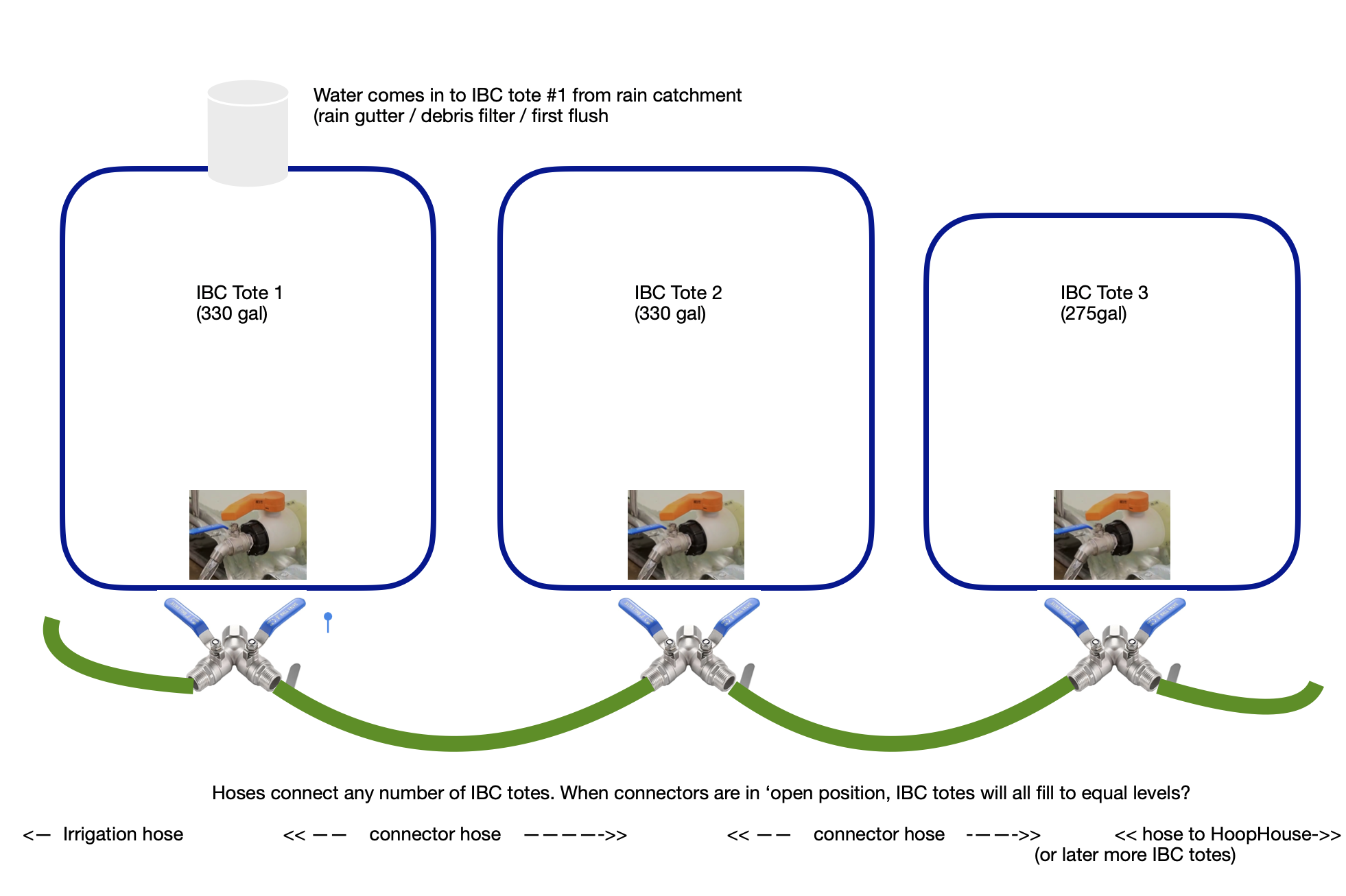


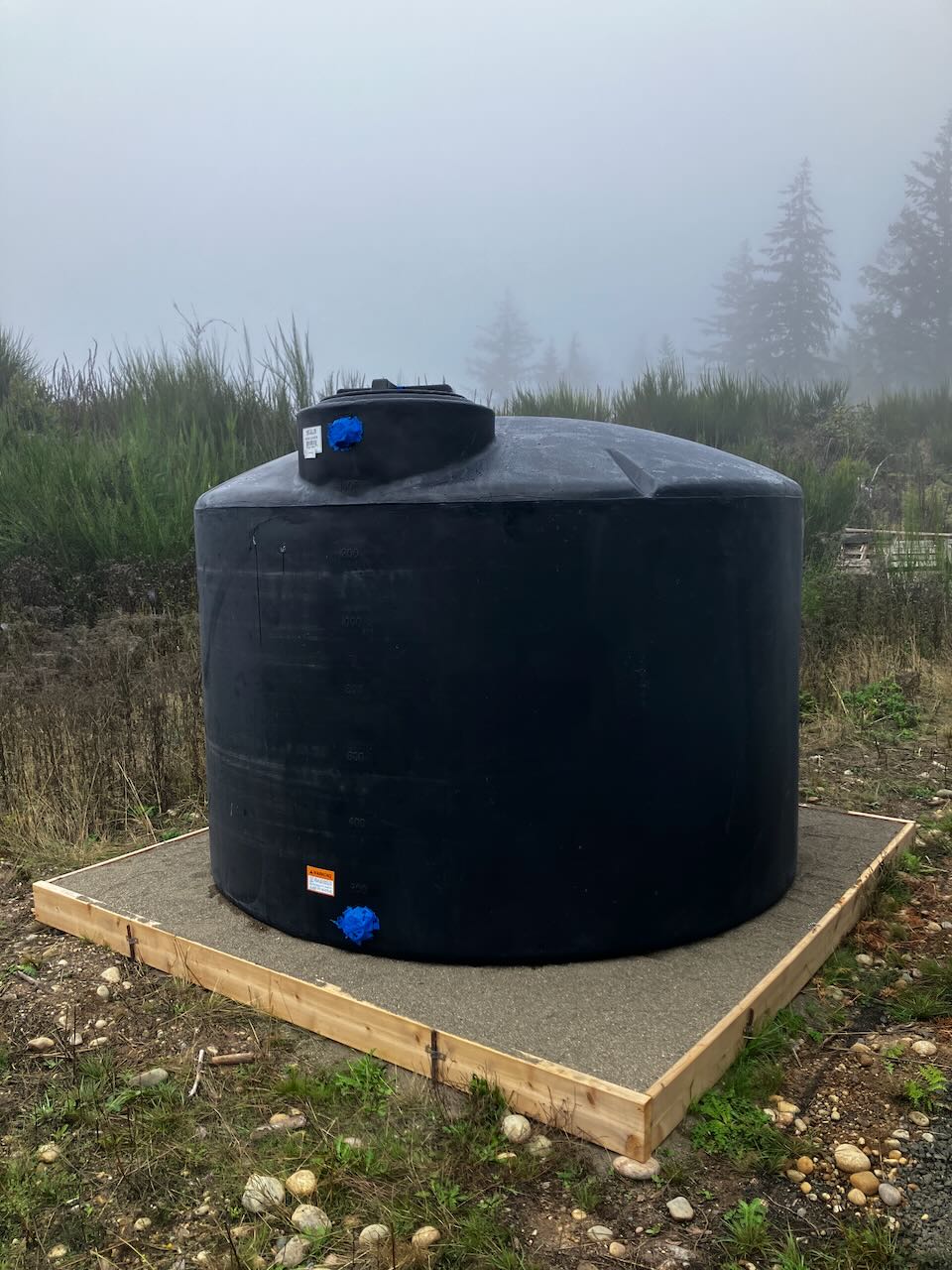
So far we have been able to move the empty 1550 gal tanks without trouble - about 300 pounds - from the delivery point to their sand pad destinations as we set up for the rainwater catchment (see pics).  For the next (bigger) tank, whenever it gets here, it will surely be a team sport to get it settled in to its location by the hoop house!

For the IBC totes, the usual method I see to connect a set of them in series is with drilled holes / grommets and pipes in the lower sides between the totes. Not a fan of that approach - it is a detailed work that introduces unnecessary vulnerabilities into the reservoir.  The same result can be achieved with a nozzle splitter at the spigot of the tote, connecting them with short hoses, using the IBC tote's factory hardware. The debris filtered rainwater goes into one end of the series and the water is drawn from the other end. No drilling, no grommets, no little pipes, preserves each tote's integrity so that a change of plans can allow for drain and repurpose of a tote used in this way... See the attached pic.

A hose adapter converts each tote's native S60x6 valve to standard garden-hose thread, a hose splitter at any junction tote allows a branch (water draw, or continuing the chain), and short hoses connect adjacent totes. Checked against field precedent (this is a documented  IBC connection technique — a full installation guide built around this exact adapter style, cross-published by an IBC installer and an Ace Hardware plumbing manager can be found on recycledh2o.net.  Each tote has an air vent to allow air to escape as water fills.

The hose adapter steps the tote's native 2" outlet down to 3/4" garden hose thread — a real bottleneck if you were ever running a pump or sprinklers off it (one documented case limited a 1500 GPH pump to 10-20 sprinklers on 3/4" vs. 40 on a 1-1/4" line), but irrelevant for me, as that is not my use case for these totes.

For freeze-forecast days (usually less that a weeks worth of days over a winter in my location): it is simple to disconnect the hoses and cap the adapter's outlet valve directly (most hose adapters ship with a built-in shutoff). The freeze-vulnerable point is the small trapped water volume right at the valve, not the tote itself, so closing the valve and removing the hose prevents a problem.

If anyone wants the detailed parts list that was worked out to implement this for my use, I can post it.
WaterTank_NorthEast_Greenhouse.jpeg
[Thumbnail for WaterTank_NorthEast_Greenhouse.jpeg]
Watertank_S2.jpeg
[Thumbnail for Watertank_S2.jpeg]
IBC_Connection_Proposal.png
[Thumbnail for IBC_Connection_Proposal.png]
 
John C Daley
pollinator
Posts: 6339
Location: Bendigo , Australia
609
plumbing earthworks bee building homestead greening the desert
  • Likes 3
  • Mark post as helpful
  • send pies
    Number of slices to send:
    Optional 'thank-you' note:
  • Quote
  • Report post to moderator
2 inch to 3/4 inch fittings is a real blockage.
Will that drive you mad?
 
Kara Ann
pollinator
Posts: 182
Location: Mason County, WA USA:Ha; Harstine gravel ashy sandy loam
137
duck rabbit chicken medical herbs bee solar wood heat rocket stoves
  • Likes 3
  • Mark post as helpful
  • send pies
    Number of slices to send:
    Optional 'thank-you' note:
  • Quote
  • Report post to moderator
Well there are those who might question whether I already am..... regenerating land into a fertile farm again in my 7th decade...
But with respect to the water flow, no, this is for rain catchment water storage where 2in slow transfer is not one of the things that could push me over any edges of lunacy!

 
Michael Qulek
Posts: 527
82
  • Likes 4
  • Mark post as helpful
  • send pies
    Number of slices to send:
    Optional 'thank-you' note:
  • Quote
  • Report post to moderator

Kara Ann wrote: Can you say more about your water use? You are pumping for household use for a few people in your cabin/workshop? For irrigation / livestock? Are you in a climate that tends to have grouped days of overcast that exceed your battery / recharge capacity?


I use a few hundred gallons for domestic use, but the big consumer of water is the orchard.  I have ~100 trees in the ground right now.  Apples, peaches, pears, plums, cherries, walnuts, chestnuts, hazelnuts, pecans, pistachios, ect.  I consume about 2500 gallons per irrigation, which I'm now doing every two weeks.  

I'm in the Sierra Nevada foothills at ~5000 feet elevation.  Mediterrean climate still.  Enough natural rain to support Oak and Pine, but 95% of the natural rainfall occurs outside of the normal growing season, say May 1'st till November 1'st.  If I start pumping at 8am, and irrigate as I pump, I can keep the pump running till 4pm.  At that point the tank might not be totally full, so I usually finish up the next morning.  I'm actively pumping irrigation water from June till winter shutdown, around the first or second week of November.  I have the whole outside piping drained before freezing weather arrives.  So, maybe next weekend will be the last watering of the season.

In the winter when there are cloudy/rainy days, I don't consume more than 4-5kWh of power, just for household needs. I have enough solar now that I can still make 500-700W even in the rain.  If I'm conservative, I can have the batteries at or almost full charge by the end of a rainy day.  So, I really don't have to deal with serious battery drain.  That being said, I have a very BIG 35kWh Rolls battery, and it take about a week to drop it down to 50% if I'm not at the cabin using stuff.
 
Kara Ann
pollinator
Posts: 182
Location: Mason County, WA USA:Ha; Harstine gravel ashy sandy loam
137
duck rabbit chicken medical herbs bee solar wood heat rocket stoves
  • Likes 4
  • Mark post as helpful
  • send pies
    Number of slices to send:
    Optional 'thank-you' note:
  • Quote
  • Report post to moderator
Sounds like a great place you have there, Michael!

Can you comment on the water needs of your pecans? I am preparing now to plant a swarm of hicans, getting nuts in the ground / biodynamic planting to get ready for spring baby trees... In my Pacific Northwest area, we don't get the summer heat to fill out pecans (though who knows... in another decade we might!), so I am working with some hickory / pecan crosses.  At your elevation, do you get good production with the pecans? And are those trees heavy drinkers?
 
Michael Qulek
Posts: 527
82
  • Likes 4
  • Mark post as helpful
  • send pies
    Number of slices to send:
    Optional 'thank-you' note:
  • Quote
  • Report post to moderator
Pecans on my site have been an utter disappointment.  I had 8 different varieties planted, two died, none of them is doing well, most are barely hanging on, and I have gotten ZERO nuts since they were planted back in 2007.

Walnuts however are doing much better.  Interestingly, the variety that is performing the best, and has given me the greatest harvest so far is "Chandler", a variety of English/Persian Walnut specifically bred for California.

I've just purchased some additional Chandler's that I'm planning on planting into the empty holes left by the pecans that have died this coming spring.

The key illustration here is diversity.  Do NOT focus your attention one just one or two different trees, but plant multiple varieties of many different things, and find out what works best for your site.  Visit your neighbors and find out what trees worked for them.  Then buy and plant those.  Remember that there are two different biotypes of pecan, so you need at least two different varieties for pollination.

All my trees are on the same water valves, so each individual tree gets about the same amount of water, maybe 20-25 gallons?  2500 Gallons of water/ 100 trees = 25gallons?  I use above-ground bubblers, which sometimes clog, so I routinely unscrew them while watering to blow out the plugging debris.  If a tree appears to be getting less water than it's peers, I unscrew the bubbler head, and fill up the swale with an equivalent amount of water.

BTW, the other trees that have proven to work well on my site are Chestnuts, European plums, and peaches.  Remember though that what works for me, might not be what works for you.
 
Kara Ann
pollinator
Posts: 182
Location: Mason County, WA USA:Ha; Harstine gravel ashy sandy loam
137
duck rabbit chicken medical herbs bee solar wood heat rocket stoves
  • Likes 3
  • Mark post as helpful
  • send pies
    Number of slices to send:
    Optional 'thank-you' note:
  • Quote
  • Report post to moderator
Thanks, Michael, for the update on your place! It really does come down to the individual land / weather / specific location, doesn't it? Sorry to hear about your pecans - bummer to watch a tree for 20 years and never harvest!  Were these seedlings, or grafted trees?  Worst case, pecan is a beautiful wood for carpentry....

And your other trees all seem to be doing well.  I am pulling from several cultivars for the hicans to broaden the chance for success, and as you say, hoping to hit one that works well enough on the soil and climate here to be a productive tree!


But how did the elephant get like that? What did you do? I think all we can do now is read this tiny ad:
Own 37 Acres in AZ - good water wells - 44% discount, only $22k!
https://permies.com/t/96159/Acre-site-Northwestern-AZ-sale
reply
    Bookmark Topic Watch Topic
  • New Topic