• Post Reply Bookmark Topic Watch Topic
  • New Topic
permaculture forums growies critters building homesteading energy monies kitchen purity ungarbage community wilderness fiber arts art permaculture artisans regional education skip experiences global resources cider press projects digital market permies.com pie forums private forums all forums
this forum made possible by our volunteer staff, including ...
master stewards:
  • Nancy Reading
  • Carla Burke
  • John F Dean
  • Timothy Norton
  • r ransom
  • Jay Angler
  • Pearl Sutton
stewards:
  • Devaka Cooray
  • Leigh Tate
  • paul wheaton
master gardeners:
  • Christopher Weeks
gardeners:
  • M Ljin
  • thomas rubino
  • Megan Palmer

What is the best way to sharpen a knife?

 
pollinator
Posts: 93
Location: New Hampshire
56
duck forest garden trees chicken sheep wood heat
  • Likes 4
  • Mark post as helpful
  • send pies
    Number of slices to send:
    Optional 'thank-you' note:
  • Quote
  • Report post to moderator
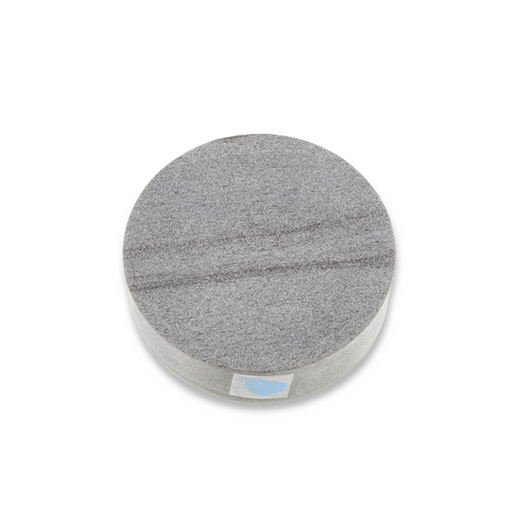
I own a lot of fancy sharpeners, but this is the one that I use the most.

Portable Whetstone

You still need some amount of technique. My own technique is sloppy, so I tried to make up for it by getting expensive sharpeners. Yet this thing gives me the best results and is portable and affordable.
 
pollinator
Posts: 470
58
  • Likes 3
  • Mark post as helpful
  • send pies
    Number of slices to send:
    Optional 'thank-you' note:
  • Quote
  • Report post to moderator
I pick up my pen, er, keyboard, with great respect Douglas.  
I envision all the time spent with tools , and also machinery, that results in your skill level.  Sharpening by hand with your degree of exactitude is world class. As my Scottish cousin might say I am gobsmacked.

This classic skill is why I try my best to guide our teenager toward handiwork.... be it tending the garden or using an old miter box or splitting wood.  I am no expert , but have aspirations to at least be proficient.

Here's an example of my boy Hugh's work from 4th grade

 
Rico Loma
pollinator
Posts: 470
58
  • Likes 1
  • Mark post as helpful
  • send pies
    Number of slices to send:
    Optional 'thank-you' note:
  • Quote
  • Report post to moderator
Let's see if I can attach correctly this time

20220910_103829.jpg
[Thumbnail for 20220910_103829.jpg]
 
Rico Loma
pollinator
Posts: 470
58
  • Mark post as helpful
  • send pies
    Number of slices to send:
    Optional 'thank-you' note:
  • Quote
  • Report post to moderator
One more try
20221028_120430.jpg
[Thumbnail for 20221028_120430.jpg]
 
Rico Loma
pollinator
Posts: 470
58
  • Mark post as helpful
  • send pies
    Number of slices to send:
    Optional 'thank-you' note:
  • Quote
  • Report post to moderator
Not able to post well today
20220910_104148.jpg
[Thumbnail for 20220910_104148.jpg]
 
Rico Loma
pollinator
Posts: 470
58
  • Likes 1
  • Mark post as helpful
  • send pies
    Number of slices to send:
    Optional 'thank-you' note:
  • Quote
  • Report post to moderator
Sorry folks, my intent was to show results of sharp knife, saw and drawkife used by my 4th grade kid.  He used a draw knife to carve that kayak paddle.
But I now realize I most likely " hijacked " the thread... many apologies
 
pollinator
Posts: 5552
Location: Canadian Prairies - Zone 3b
1549
  • Likes 2
  • Mark post as helpful
  • send pies
    Number of slices to send:
    Optional 'thank-you' note:
  • Quote
  • Report post to moderator
No problem! I certainly understood what you meant. I would rather have kids be "producers" using their creativity to make stuff with tools than "consumers" sitting in front of screens.
 
Douglas Alpenstock
pollinator
Posts: 5552
Location: Canadian Prairies - Zone 3b
1549
  • Likes 3
  • Mark post as helpful
  • send pies
    Number of slices to send:
    Optional 'thank-you' note:
  • Quote
  • Report post to moderator

Rico Loma wrote:I envision all the time spent with tools , and also machinery, that results in your skill level.  Sharpening by hand with your degree of exactitude is world class. As my Scottish cousin might say I am gobsmacked.


Thanks, but I think I'm somewhere in the middle of the pack. No high priest robes. I'm looking for a good working edge that is satisfying to work with, and I had to learn all this by trial and error -- I had no-one to teach me.

These days I have opportunities to share what I've learned the hard way. In an hour or so I can show anyone who's interested how the "magic" works. It's not magic at all, just a skill that hasn't been passed down. Once you know the principles, and know how to feel the blade and the edge as you sharpen, the rest is just practice, practice, practice.

I personally know people who hand-forge knives and straight razors from exotic steels. Incredible work, and incredible edges -- they blow my doors off. I just want grannies to have sharp knives in their kitchens; they know how to cook, and they appreciate a blade that cuts well.
Content minimized. Click to view
 
Posts: 7
  • Likes 2
  • Mark post as helpful
  • send pies
    Number of slices to send:
    Optional 'thank-you' note:
  • Quote
  • Report post to moderator
I like to use an orbital sander / belt sander, whatever you have available. Sit the sander on my lap, upside down so that I can squeeze between my legs. Hold the knife with two hands, knife, chisel, hatchet, anything you wish to sharpen, to whatever degree bevel you require, and sand away through the different grits of paper. Start with an 80, move up to 120/180/240/400
 
Posts: 418
Location: Eastern Washington
115
  • Likes 6
  • Mark post as helpful
  • send pies
    Number of slices to send:
    Optional 'thank-you' note:
  • Quote
  • Report post to moderator
On the 80 grit, unless you have a quality knife, and I'd put even cheap kitchen knives in that category. Then you'd be leaving horrendous marks on the blade, in addition to taking a lot of metal off and, possibly, changing the critical temper of the blade from heat build up.

To be fair, a well-used 80 grit belt is not nearly as aggressive as a new one, so might pass as a bastard 120 or 150 grit.

If I went that route, which grit I started with would depend on what I'm sharpening. An ax, hoe or mower blade might play well with an 80 grit belt or disc. For more delicate jobs, I'd start with 320 or 220. I run the latter and a 1"x42" Delta belt sander, and it makes touching up lathe knives a quick task.  In any event, I would move fast to keep the metal from heating.

 
Posts: 20
Location: Quitman, United States
2
  • Likes 5
  • Mark post as helpful
  • send pies
    Number of slices to send:
    Optional 'thank-you' note:
  • Quote
  • Report post to moderator
One of the tips I found from watching youtube videos on this topic is the importance of finishing with a leather strop. Used properly, the strop will deliver a true edge. free from burrs overlapping from either side of the blades' edge.
 
Posts: 310
Location: Manotick (Ottawa), Ontario
23
  • Likes 2
  • Mark post as helpful
  • send pies
    Number of slices to send:
    Optional 'thank-you' note:
  • Quote
  • Report post to moderator
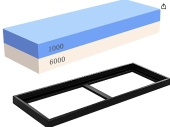
After decades of sharpening knives with a variety of methods and abrasives, I've settled on diamond sharpeners as giving consistently good results quickly and with minimal effort. The results depend primarily on a few things, namely the quality of the blade steel, the condition of the blade to be sharpened, the quality and amount of diamond dust on the sharpener, and the angle of the blade against the sharpener. It's been years since I last used the Japanese waterstone in the knife drawer, although I acheved good results with it, because it takes much longer than using a diamond "stone" (which wasn't even readily available when I got the waterstone). However, waterstones and diamond stones share the virtue of removing a minimal amount of steel in the sharpening, greatly extending the life of the knife. (I can see using a grinder or belt sander in making a knife or restoring a seriously abused one, but I wouldn't do that for a commercial kitchen knife in good condition.)

I've learned that a key technique for quickly getting a usefully sharp edge (I don't intend to ever shave with a kitchen knife) is ensuring the knife is angled carefully against the stone and that the blade is pushed diagonally onto it rather than drug away. Because I'm old, I need strong light to see the edge well enough to know when it's at the correct angle, just touching the stone. (Increasing the angle is likely to actually dull the edge.) But another way to know the angle is right is by feel. When the angle is too low, the blade just slides. But when it's raised to the right angle, with the edge grazing the stone, I can feel the light cutting action. A few strokes is then enough to restore a "kitchen keen" edge.
 
Posts: 276
15
8
  • Mark post as helpful
  • send pies
    Number of slices to send:
    Optional 'thank-you' note:
  • Quote
  • Report post to moderator
I just wonder how this is sharpened.

https://www.youtube.com/shorts/LSJID03a6MI
 
pollinator
Posts: 924
Location: 10 miles NW of Helena Montana
527
hugelkultur chicken seed homestead
  • Likes 5
  • Mark post as helpful
  • send pies
    Number of slices to send:
    Optional 'thank-you' note:
  • Quote
  • Report post to moderator
I just went to cut off the plastic wrap from an all weather electrical cover I was going to install outside my garage.  My knife poked a hole in it but would not cut the plastic wrap on the first 2 inches of blade.
Time to sharpen.
I have an old whetstone that was my grandpa's sitting by my utility sink in the garage.  I gets plenty of use from me.  I am never without a pocket knife on me.  (When we fly somewhere on vacation I feel naked without one on me, but one always goes into checked luggage).
One minute or so and my knife is now very sharp again.
Several years ago a guy I worked with had gone to a garage sale and picked up a bucket full of whetstones for a couple of dollars.  He asked if I wanted any, of course my answer was "YES".  I now have whet stones in all my various tool boxes, vehicles, hunting packs, etc.
Favorite pasttime for me is sitting around the fire at hunting camp sharpening all the knives.
 
Posts: 134
48
  • Likes 3
  • Mark post as helpful
  • send pies
    Number of slices to send:
    Optional 'thank-you' note:
  • Quote
  • Report post to moderator
I use a stropping system instead of a whetstone.
I read from knife makers that this was great, and it IS excellent in my opinion.
One can make or buy the stropping piece.  
Here’s a YouTube on that process of sharpening knives by stropping:
https://m.youtube.com/watch?v=p3WGTvzLu30&list=LL&index=61&pp=gAQBiAQBsAgC
 
Posts: 207
Location: North East Wisconsin
175
  • Likes 3
  • Mark post as helpful
  • send pies
    Number of slices to send:
    Optional 'thank-you' note:
  • Quote
  • Report post to moderator
I teach knife sharpening so I made this video.

 
Edward Lye
Posts: 276
15
8
  • Likes 2
  • Mark post as helpful
  • send pies
    Number of slices to send:
    Optional 'thank-you' note:
  • Quote
  • Report post to moderator

Douglas Alpenstock wrote: Ceramic works, but any sharpener using ceramics will load up with metal over time and stop cutting.  


Agreed. I have a Kyocera ceramic plate about 4 inches by 3 inches.
They don't make/sell this anymore . . . like Tullen Snips. One of
my treasures.

As soon as you rub any metal across the surface, it darkens which shows
how effective it is. Diamond doesn't show that. I mostly use it to sharpen
penknives and sewing needles.

OK, here is my trick. I use a pencil rubber to clean it. It whitens up showing
that it is effective.

I collected defective computer chips before I retired. But these were stamp sized.
White, thin and fragile. I gave them away to my sisters-in-laws to sharpen
their sewing needles.
 
Posts: 33
12
forest garden plumbing earthworks wood heat homestead
  • Likes 2
  • Mark post as helpful
  • send pies
    Number of slices to send:
    Optional 'thank-you' note:
  • Quote
  • Report post to moderator
Remarkably, I get unexpected and best results by periodically swiping my kitchen knife up and down a few times on the exposed corner of a concrete block wall in my kitchen.  It doesn't end up with an attractive result because it does not make for a smooth edge...,  Rather it makes for a rough (serrated) edge which seems to cut things considerably easier...  (tomatoes and meat for instance)...   Out of curiosity I googled the difference in effectiveness between smooth and serrated edges in knives and there is quite a lot of discussion...  All I know is that the occasional up and down swipe on the concrete block corner works wonders....
 
Ron Kulas
Posts: 207
Location: North East Wisconsin
175
  • Likes 4
  • Mark post as helpful
  • send pies
    Number of slices to send:
    Optional 'thank-you' note:
  • Quote
  • Report post to moderator

Edward Lye wrote:

Douglas Alpenstock wrote: Ceramic works, but any sharpener using ceramics will load up with metal over time and stop cutting.  


Agreed. I have a Kyocera ceramic plate about 4 inches by 3 inches.
They don't make/sell this anymore . . . like Tullen Snips. One of
my treasures.

As soon as you rub any metal across the surface, it darkens which shows
how effective it is. Diamond doesn't show that. I mostly use it to sharpen
penknives and sewing needles.

OK, here is my trick. I use a pencil rubber to clean it. It whitens up showing
that it is effective.

I collected defective computer chips before I retired. But these were stamp sized.
White, thin and fragile. I gave them away to my sisters-in-laws to sharpen
their sewing needles.


I use AJAX or Comet or barkeepers friend. All do a great job of unloading my ceramics.
 
Posts: 6
Location: West Central Arkansas
  • Likes 2
  • Mark post as helpful
  • send pies
    Number of slices to send:
    Optional 'thank-you' note:
  • Quote
  • Report post to moderator
I give them to my grandson, he makes them and sells them at our farmers market.  He also sharpens scissors for people that cut hair. Salons barber shops)
 
Posts: 4
1
3
  • Likes 3
  • Mark post as helpful
  • send pies
    Number of slices to send:
    Optional 'thank-you' note:
  • Quote
  • Report post to moderator
I see this thread is getting some attention again from the newsletter link, so I will offer my opinion.

If you ask three knife sharpeners for the best technique you will get five different opinions. I have been sharpening my own knives after serious study and experimentation for about ten years now. I also sharpen knives for people who attend our monthly "Repair Cafe" community event.

First off, any sharpening is probably better than none. That eight dollar pull-through thing at the grocery store will do a better job than nothing. So will stroking your knife across the bottom of a ceramic coffee mug or a red paving stone (a thing I have seen street food vendors do in Asia). The worst thing you can do for your knives is nothing. The second worst is to put them in a drawer that rattles around so they knock into each other multiple times a day.

I currently store my knives on double-sided magnetic strip that attaches itself to the side of our refrigerator. Wooden knife blocks are OK, but they can be a humid environments for the blades, and they also take up counter space.

In ten years of teaching sharpening to scared people at Repair Cafe, I have observed that the most difficult part of learning to sharpen is understanding the correct angle the knife needs to be at as it contacts the sharpening surface. Generally, 10-15 degrees for a scalpel or other very sharp point, 15-20 degrees for a general kitchen or pocket knife, and 20-30 degrees for something like an axe head. Almost everyone-- including me with 30 years of sharpening experience-- can't really accurately hold those angles by hand for multiple passes.

So buy a tool that maintains that angle for you. I recommend something like the Lansky five stone set already mentioned multiple times in the discussion. Even today, you can get them for less than $50 if you look around. And you can definitely get a Chinese copy for 1/3 that price on Ali Express, although the one time I ordered it the stones were of poorer quality.

As for the tool I use at Repair Cafe, it is a Ken Onion model Work Smart sharpening set. These are a little more than $120, although they often go on sale. It is a motorized system with multiple belts and a jig that holds the blade at the correct angle you want.

Too Long, Didn't Read -- Buy a Lansky five stone kit ($40) or a Ken Onion Worksmart machine ($120)
 
Grow a forest with seedballs and this tiny ad:
A book about luxuriant recipes for green living
https://greenlivingbook.com/
reply
    Bookmark Topic Watch Topic
  • New Topic