• Post Reply Bookmark Topic Watch Topic
  • New Topic
permaculture forums growies critters building homesteading energy monies kitchen purity ungarbage community wilderness fiber arts art permaculture artisans regional education skip experiences global resources cider press projects digital market permies.com pie forums private forums all forums
this forum made possible by our volunteer staff, including ...
master stewards:
  • Carla Burke
  • John F Dean
  • Nancy Reading
  • r ransom
  • Jay Angler
  • Timothy Norton
stewards:
  • paul wheaton
  • Pearl Sutton
  • Anne Miller
master gardeners:
  • Christopher Weeks
  • M Ljin
gardeners:
  • Jim Garlits
  • thomas rubino
  • William Bronson

Small space composting

 
Posts: 24
8
purity urban homestead
  • Likes 7
  • Mark post as helpful
  • send pies
    Number of slices to send:
    Optional 'thank-you' note:
  • Quote
  • Report post to moderator
I live in an urban home with a small garden, extremely small compared to the standards i see in most posts and blogs, websites, etc.
I have been composting as much as possible but i can't get even close to composting enough for my needs with my space. Every year i am buying in compost to grow what i need to grow.
I also have a very low budget so i don't top up my beds as i would like to, i usually only fill a hole where i am about to plant in to. The rest of the slack is picked up with fertilizers, both bought and home made.

Can anybody share pointers on how to create the most compost possible in a small space? Ideally i would love a closed loop system, but i think i will need animals for that. I plan to get ducks soon if all goes well, but that is all i have space for. I also plan to try humanure soon, if i can do that without modifying my toilet, as it is not my house.
I don't create much kitchen waste either, as i hate to waste food! i even eat my apple cores, minus the seeds

Am i doomed to buy in compost every year?

Any tips would be appreciated. Thank you all <3
 
gardener
Posts: 5719
Location: Cincinnati, Ohio,Price Hill 45205
1321
forest garden trees urban
  • Likes 7
  • Mark post as helpful
  • send pies
    Number of slices to send:
    Optional 'thank-you' note:
  • Quote
  • Report post to moderator
Every bed is a place to compost.
I layer leaves onto my beds in the fall, pour pee onto the leaves over the winter and move the remaining material to a compost pile in the spring.
This adds nutrients directly to the place you want them to be anyway.

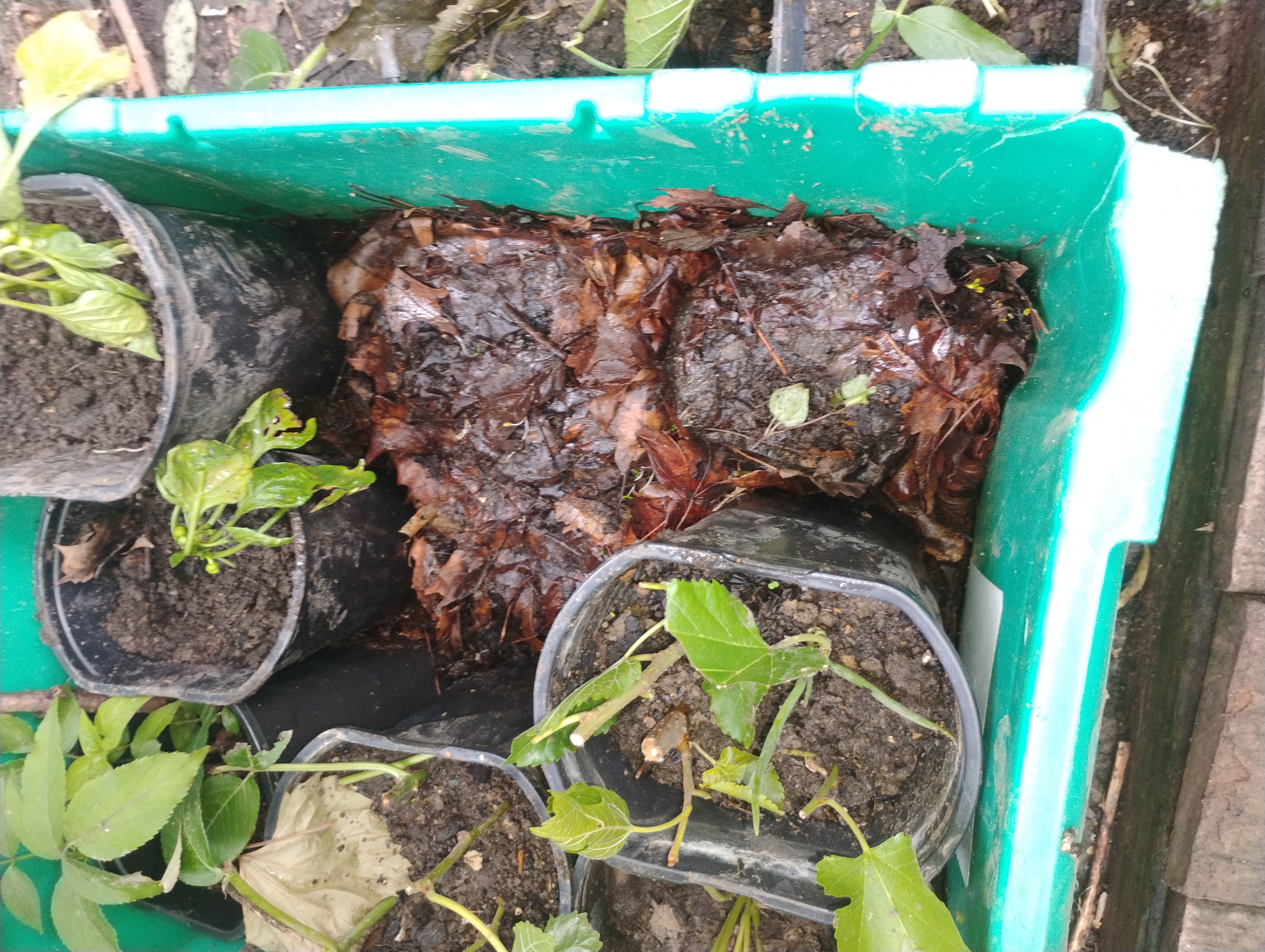
I've recently started using totes filled with leaves to put 5-6 nursery pots in.
This serves multiple purposes.
The leaves hold water like a sponge, providing it for the the plants on the pots, without drowning them.
At the same time the leaves decay, becoming leaf mold.

Something I've yet to try is a bucket stepstone.
Basically a bottomless bucket, sunk into the ground and covered with a stepping stone.
 
pollinator
Posts: 275
80
kids urban seed
  • Likes 8
  • Mark post as helpful
  • send pies
    Number of slices to send:
    Optional 'thank-you' note:
  • Quote
  • Report post to moderator
Chop and drop directly onto the beds works well for small spaces too. Instead of hauling everything to a pile, just chop up any plant waste and leave it on the surface. Worms pull it down over time and it feeds the soil where you actually need it.
 
pollinator
Posts: 139
45
fungi composting toilet composting greening the desert homestead
  • Likes 7
  • Mark post as helpful
  • send pies
    Number of slices to send:
    Optional 'thank-you' note:
  • Quote
  • Report post to moderator
To put a term to the concept being described, "lasagna gardening," or genetically layering up to a couple inches thick of compostable materials in an area you want to prepare to plant. Typically I think the term is introduced in the context of creating a new bed, but you could also do it right on top of the existing bed to break down over winter. Aside from chop and drop of plants that were growing in the bed and adding leaves and pee (things already mentioned), consider adding layers of grass clippings (thin layers), old straw, manure, etc.. Keep it a little moist and not too exposed to the wind to help with breakdown if you live in a dry environment. Don't use materials that would attract pests, are diseased, have pesticides or fungicides.
 
steward
Posts: 19157
Location: USDA Zone 8a
4830
dog hunting food preservation cooking bee greening the desert
  • Likes 6
  • Mark post as helpful
  • send pies
    Number of slices to send:
    Optional 'thank-you' note:
  • Quote
  • Report post to moderator
Have you thought about composting in bins like 55 gallon drums or trash cans?

That would let you compost on a larger scale:

https://www.instructables.com/Double-Decker-Drum-Composter/
 
pollinator
Posts: 790
Location: SE Indiana
464
dog fish trees writing
  • Likes 9
  • Mark post as helpful
  • send pies
    Number of slices to send:
    Optional 'thank-you' note:
  • Quote
  • Report post to moderator
It sounded to me like the primary issue might be obtaining the material to compost rather than how to compost it. I myself do not compost as it is often thought of. I don't worry over proper mixture of green/dry or whether or not a proper temperature is achieved to make it biologically sterile. I just put stuff in piles or use it as mulch until it rots.

I'm also not accustomed to gardening in an urban environment, but I think gardening as much as you can, wherever you are, is really important. To get stuff to compost maybe you can scrounge it in the neighborhoods or in a rural area if one isn't too far off, and you have a way to collect and haul it. If your neighborhood or one close by has trees you might find people who would let you rake and take leaves or just swipe them already bagged up by the curb. A simple rule to me of what I might call "natural" gardening because I don't like any of the other words people use is just don't poison it. With that in mind try to make sure you don't collect stuff from a "chem lawn".

If you do have access to a rural area lots of good stuff often accumulates in roadside ditches, especially if the area is wooded. You might be able to jump out of your car with a big trash bag and swipe some. I'm not all that sold on the whole Hügelkultur thing especially if you don't really have space for it, but rotted wood is great to compost, bury in the ground or put in the bottom of containers. It needs to be well-rotted as in you can tear it up with your hands or it will take too long to break down, it works kind of like a sponge too. You might could even swipe that from a public park or something. You're allowed to collect and burn downed wood in campgrounds so why not just bag up some of the more rotted stuff and take it home.

I think closed loop system in a very small space might be tough, but I think the budget issue might be solvable and without wondering just exactly what might be in that purchased stuff.  


steward & manure connoisseur
Posts: 5201
Location: South of Capricorn
3157
dog rabbit urban cooking writing homestead ungarbage
  • Likes 8
  • Mark post as helpful
  • send pies
    Number of slices to send:
    Optional 'thank-you' note:
  • Quote
  • Report post to moderator
Hi there! i also have a very small urban garden. Unlike you, I have LOTS of fresh organic waste (we forage and cook a LOT, and I'm not eating orange/avocado/banana peels), plus rabbits for manure, and we chip up whatever they don't eat. I do bokashi in barrels to not waste any precious garden space. We have some threads around here specifically about that.
But if you have so little organic waste, I think Joao and William are right on the money-- put it back in your beds directly. Either tuck it under the soil if you really have so little, or blend it up in your blender with water and dump it on an area of the garden. In the meantime, you could also consider gathering leaves in fall (threads about that here too) or looking at other forms of compostables you might be able to find. Coffee grounds, for example.

It took me a long time to accept that I needed to add things to my dirt in order to see results. But the plants need to eat, and it needs to come from somewhere.
 
Noah Robinson
Posts: 24
8
purity urban homestead
  • Likes 5
  • Mark post as helpful
  • send pies
    Number of slices to send:
    Optional 'thank-you' note:
  • Quote
  • Report post to moderator

William Bronson wrote:Every bed is a place to compost.
I layer leaves onto my beds in the fall, pour pee onto the leaves over the winter and move the remaining material to a compost pile in the spring.
This adds nutrients directly to the place you want them to be anyway.

I've recently started using totes filled with leaves to put 5-6 nursery pots in.
This serves multiple purposes.
The leaves hold water like a sponge, providing it for the the plants on the pots, without drowning them.
At the same time the leaves decay, becoming leaf mold.

Something I've yet to try is a bucket stepstone.
Basically a bottomless bucket, sunk into the ground and covered with a stepping stone.


Thank you
I don't really have many plants to get leaves from apart from the ones growing in the beds/pots themselves. I do have plenty of pee though, and in winter i waste a lot of it, so i will be better with that!
Is it possible to provide enough food for the plants using only the leaves from on site? I imagine the bigger the area you have the more you grow and the more leaves you need, until you have a space bigger than you need to grow everything you will eat for the year. So the result in my head is you can never have enough leaves until you have enough land to grow extra. Am i missing something there?
Maybe i should accept that a portion of my space has to be dedicated to plants grown just to feed the other plants? but then how do i feed those plants? I feel like i am missing something huge.
Also, how does that work along side cover crops over winter? do you do both in the same place? or do you not grow cover crops?

Can you tell me more about the bucket stepstone please? I don't think i know what you mean by your description

Thank you for the help
 
Noah Robinson
Posts: 24
8
purity urban homestead
  • Likes 3
  • Mark post as helpful
  • send pies
    Number of slices to send:
    Optional 'thank-you' note:
  • Quote
  • Report post to moderator

Joao Winckler wrote:Chop and drop directly onto the beds works well for small spaces too. Instead of hauling everything to a pile, just chop up any plant waste and leave it on the surface. Worms pull it down over time and it feeds the soil where you actually need it.


Thank you. I have started doing this recently, but it all seems to just disappear. It is early days for me though so i assume i will see the benefits from this in the future.
Maybe i have to accept sourcing composts from outside until my beds improve.
 
Noah Robinson
Posts: 24
8
purity urban homestead
  • Likes 3
  • Mark post as helpful
  • send pies
    Number of slices to send:
    Optional 'thank-you' note:
  • Quote
  • Report post to moderator

Burton Sparks wrote:To put a term to the concept being described, "lasagna gardening," or genetically layering up to a couple inches thick of compostable materials in an area you want to prepare to plant. Typically I think the term is introduced in the context of creating a new bed, but you could also do it right on top of the existing bed to break down over winter. Aside from chop and drop of plants that were growing in the bed and adding leaves and pee (things already mentioned), consider adding layers of grass clippings (thin layers), old straw, manure, etc.. Keep it a little moist and not too exposed to the wind to help with breakdown if you live in a dry environment. Don't use materials that would attract pests, are diseased, have pesticides or fungicides.


Thank you. I will do that. And i will add as much as i possibly can find from my space. Fingers crossed it is enough.
 
Posts: 5
2
  • Likes 3
  • Mark post as helpful
  • send pies
    Number of slices to send:
    Optional 'thank-you' note:
  • Quote
  • Report post to moderator

William Bronson wrote:Every bed is a place to compost.
I layer leaves onto my beds in the fall, pour pee onto the leaves over the winter and move the remaining material to a compost pile in the spring.
This adds nutrients directly to the place you want them to be anyway.

I've recently started using totes filled with leaves to put 5-6 nursery pots in.
This serves multiple purposes.
The leaves hold water like a sponge, providing it for the the plants on the pots, without drowning them.
At the same time the leaves decay, becoming leaf mold.

Something I've yet to try is a bucket stepstone.
Basically a bottomless bucket, sunk into the ground and covered with a stepping stone.


You’re doing fine small spaces just make it harder to produce a lot of compost. I’d focus on making small amounts of really rich stuff, like with a worm bin. Also, try to bring in free materials like cardboard or coffee grounds.

And don’t stress about not being fully closed-loop most small urban gardens still need some compost brought in. That’s just part of it.
 
Noah Robinson
Posts: 24
8
purity urban homestead
  • Likes 3
  • Mark post as helpful
  • send pies
    Number of slices to send:
    Optional 'thank-you' note:
  • Quote
  • Report post to moderator

Anne Miller wrote:Have you thought about composting in bins like 55 gallon drums or trash cans?

That would let you compost on a larger scale:

https://www.instructables.com/Double-Decker-Drum-Composter/


That is a cool instructable, thank you for the link.
I do have 2 compost bins which i alternate between, but my problem is more a matter of where the material comes from in the first place as i only have space for a few plants, not even enough space to grow my needs for a year, not even close to that much space. So with very few plants to take material from, and very little food wastage, i am left with no option (it seems) but to source material from elsewhere.
I'm sure i'm missing a trick though.
 
Noah Robinson
Posts: 24
8
purity urban homestead
  • Likes 3
  • Mark post as helpful
  • send pies
    Number of slices to send:
    Optional 'thank-you' note:
  • Quote
  • Report post to moderator

Mark Reed wrote:It sounded to me like the primary issue might be obtaining the material to compost rather than how to compost it. I myself do not compost as it is often thought of. I don't worry over proper mixture of green/dry or whether or not a proper temperature is achieved to make it biologically sterile. I just put stuff in piles or use it as mulch until it rots.

I'm also not accustomed to gardening in an urban environment, but I think gardening as much as you can, wherever you are, is really important. To get stuff to compost maybe you can scrounge it in the neighborhoods or in a rural area if one isn't too far off, and you have a way to collect and haul it. If your neighborhood or one close by has trees you might find people who would let you rake and take leaves or just swipe them already bagged up by the curb. A simple rule to me of what I might call "natural" gardening because I don't like any of the other words people use is just don't poison it. With that in mind try to make sure you don't collect stuff from a "chem lawn".

If you do have access to a rural area lots of good stuff often accumulates in roadside ditches, especially if the area is wooded. You might be able to jump out of your car with a big trash bag and swipe some. I'm not all that sold on the whole Hügelkultur thing especially if you don't really have space for it, but rotted wood is great to compost, bury in the ground or put in the bottom of containers. It needs to be well-rotted as in you can tear it up with your hands or it will take too long to break down, it works kind of like a sponge too. You might could even swipe that from a public park or something. You're allowed to collect and burn downed wood in campgrounds so why not just bag up some of the more rotted stuff and take it home.

I think closed loop system in a very small space might be tough, but I think the budget issue might be solvable and without wondering just exactly what might be in that purchased stuff.  


Thank you
Yes it is more a matter of where i will get the materials from than how to compost it. That said, i have definitely learnt some ideas from the posts above about lasagna gardening and over winter leaf mulch with pee on top, etc, so i will definitely be doing that.
I will try to find what i can from the surrounding areas. I don't drive so can't get to a rural area very easily but maybe i can ask somebody for a favour. There is a lot of chemical spraying going on around here and roadside poisons, but i'm sure i can find some neglected spots somewhere.
It will be a lot of labour but better than buying it all!

Thank you
 
Noah Robinson
Posts: 24
8
purity urban homestead
  • Likes 3
  • Mark post as helpful
  • send pies
    Number of slices to send:
    Optional 'thank-you' note:
  • Quote
  • Report post to moderator

Tereza Okava wrote:Hi there! i also have a very small urban garden. Unlike you, I have LOTS of fresh organic waste (we forage and cook a LOT, and I'm not eating orange/avocado/banana peels), plus rabbits for manure, and we chip up whatever they don't eat. I do bokashi in barrels to not waste any precious garden space. We have some threads around here specifically about that.
But if you have so little organic waste, I think Joao and William are right on the money-- put it back in your beds directly. Either tuck it under the soil if you really have so little, or blend it up in your blender with water and dump it on an area of the garden. In the meantime, you could also consider gathering leaves in fall (threads about that here too) or looking at other forms of compostables you might be able to find. Coffee grounds, for example.

It took me a long time to accept that I needed to add things to my dirt in order to see results. But the plants need to eat, and it needs to come from somewhere.


Thank you.
I think animals is a big part of the puzzle that i am missing. I will work on that! I have heard of bokashi but not really looked into it yet, i will do that too.
I think you and others that have posted are right, i am going to have to accept that i need to find what i can from my surrounding areas.
Thanks
 
Noah Robinson
Posts: 24
8
purity urban homestead
  • Likes 3
  • Mark post as helpful
  • send pies
    Number of slices to send:
    Optional 'thank-you' note:
  • Quote
  • Report post to moderator
Thank you all for the great replies <3

You have all given me a lot to work from. It does look like a closed loop system is not going to be possible just yet, but i can do a lot to prevent having to buy compost.
I have a lot of work to do

Thank you all <3 you are all amazing!
 
steward and tree herder
Posts: 13688
Location: Isle of Skye, Scotland. Nearly 70 inches rain a year
7438
6
transportation dog forest garden foraging trees books food preservation woodworking wood heat rocket stoves ungarbage
  • Likes 6
  • Mark post as helpful
  • send pies
    Number of slices to send:
    Optional 'thank-you' note:
  • Quote
  • Report post to moderator
In a small space I think it is very difficult to achieve a zero inputs balance closed loop - think of an aquarium versus a lake. An aquarium takes much more looking after and fiddling with, cleaning out, whereas the lake looks after itself pretty much.

If I were you I would consider widening the area you consider as your space - look at your neighbours - do they even have a compost bin? What about coffee shops - coffee grounds make a pretty good (slug repellant?) soil additive. Have you a neighbourhood greengrocers? Ac has one nearby them that is providing almost more green waste than they can deal with due to the hot weather they're having! Businesses often have to pay to have "waste" taken away, so are pleased to have it gone.

(edit: cross posted - looks like you're heading in the same direction!)
 
Tereza Okava
steward & manure connoisseur
Posts: 5201
Location: South of Capricorn
3157
dog rabbit urban cooking writing homestead ungarbage
  • Likes 7
  • Mark post as helpful
  • send pies
    Number of slices to send:
    Optional 'thank-you' note:
  • Quote
  • Report post to moderator
I would add to Nancy's wise response: things can vary a lot, so consider your space as well as your environment.
You're getting answers here from all over the world. I have heavy tropical clay and garden year round-- any organic matter I put in vanishes almost immediately, but because we don't have the flood of deciduous leaves that temperate climates have in the fall, I need to rely heavily on animal manure.
Other places freeze hard in the winter and can pile up deciduous leaves. Have a good look at what is being done (and has traditionally been done) in your area and feel free to ask specifics-- we have Permies posting here from all over.
 
Noah Robinson
Posts: 24
8
purity urban homestead
  • Likes 3
  • Mark post as helpful
  • send pies
    Number of slices to send:
    Optional 'thank-you' note:
  • Quote
  • Report post to moderator

Nancy Reading wrote:In a small space I think it is very difficult to achieve a zero inputs balance closed loop - think of an aquarium versus a lake. An aquarium takes much more looking after and fiddling with, cleaning out, whereas the lake looks after itself pretty much.

If I were you I would consider widening the area you consider as your space - look at your neighbours - do they even have a compost bin? What about coffee shops - coffee grounds make a pretty good (slug repellant?) soil additive. Have you a neighbourhood greengrocers? Ac has one nearby them that is providing almost more green waste than they can deal with due to the hot weather they're having! Businesses often have to pay to have "waste" taken away, so are pleased to have it gone.

(edit: cross posted - looks like you're heading in the same direction!)


Thank you very much. Great suggestions. And some great ideas in the other thread too. I actually posted a rant on here a few days ago complaining about slugs and snails so win win on the coffee grounds I didn't know they were good for that too.
If i can find a business that has clean green waste i will ask them, but i am a bit concerned about including chemically treated waste to my chemical free garden.
Thank you for the great ideas <3
 
Noah Robinson
Posts: 24
8
purity urban homestead
  • Likes 3
  • Mark post as helpful
  • send pies
    Number of slices to send:
    Optional 'thank-you' note:
  • Quote
  • Report post to moderator

Tereza Okava wrote:I would add to Nancy's wise response: things can vary a lot, so consider your space as well as your environment.
You're getting answers here from all over the world. I have heavy tropical clay and garden year round-- any organic matter I put in vanishes almost immediately, but because we don't have the flood of deciduous leaves that temperate climates have in the fall, I need to rely heavily on animal manure.
Other places freeze hard in the winter and can pile up deciduous leaves. Have a good look at what is being done (and has traditionally been done) in your area and feel free to ask specifics-- we have Permies posting here from all over.


Thank you.
I am in UK, so i should be golden really! it is very green and wet here overall, though it is getting more and more grey every year but the wet should help me keep the compost wet during the winter.
I will pay close attention locally and keep it in mind. Thank you
 
master steward
Posts: 15723
Location: Pacific Wet Coast
10103
duck books chicken cooking food preservation ungarbage
  • Likes 6
  • Mark post as helpful
  • send pies
    Number of slices to send:
    Optional 'thank-you' note:
  • Quote
  • Report post to moderator
Some pictures of your space would be helpful, Noah.

Because you regularly produce Fertilizer Pee and show a willingness to use it, your issue is likely producing/collecting sufficient "browns" to balance it and to produce large quantities of Carbon. One of the books I read talks about making lots of compost and applying 3" of finished compost to every bed once a year. Considering that my fall leaf bin goes from 3 ft tall, to 6 inches tall over my wet winter, I totally empathize with your situation.

It may have been John Seymour's, The Self-sufficient Gardener, but don't quote me.  He talked about growing some crops that produce a lot of "browns" while still providing a food crop. Examples would be, corn, wheat, and large sunflowers. Unfortunately, none of those plants particularly like my ecosystem!

Finding a way to grow up trellises to increase your "space" is a possibility. My grape vine creates a *lot* of biomass each year, but it has to be chopped up to help. (Luckily, Hubby bought some battery pruners, making this task much easier on me.) In fact it seems as if I'm chopping it back on a near weekly basis at this time of year, so that it doesn't take over my front porch entirely.

A local fellow used Cattails in a couple of bathtubs to both clean his greywater and produce biomass on his small lot, and it "looked" like a water feature, rather than an essential part of his backyard growing system.

Look around your local environment, including plants in your neighborhood which might help you out. Your concern is real, and the solutions never seem as simple as people make them out to be, although Tereza Okava's "bunny fertilization system" is a good model to follow, if you can generate most of their food from parts of plants that your don't want to eat yourself.
 
William Bronson
gardener
Posts: 5719
Location: Cincinnati, Ohio,Price Hill 45205
1321
forest garden trees urban
  • Likes 6
  • Mark post as helpful
  • send pies
    Number of slices to send:
    Optional 'thank-you' note:
  • Quote
  • Report post to moderator
The bucket stepping stone idea is basically digging a hole, fill it with organic matter and  and put a stepping stone over it.
The bucket just keeps the sides and top of the hole stable.
The stepping stone keeps the space usable for other things, like walking.
It can be inside a garden bed or in the middle of a pathway.

I don't think being self sufficient for compost materials in a small space is very viable.
I do get a lot of compost materials from my yard, but I greedily gather biomass from everywhere around me.
Most of my best soil is made from decades of autumn leaves that were imported from my neighborhood.

I have found elderberry to be an easy to grow plant that creates a lot of biomass, and some food.
Jerusalem Artichokes make lots of food and lots of biomass.
Rhubarb and horseradish make big leaves and lots of food.
This year I've been planting fava beans every where, as a nitrogen fixer.
They are the easiest beans I've ever grown, and they make decent amount of biomass.

If you have room for a rain barrel you could grow duckweed, and apply it directly to the soil of the beds.
Duck weed is one of the fastest growing plants in the world.
 
Anne Miller
steward
Posts: 19157
Location: USDA Zone 8a
4830
dog hunting food preservation cooking bee greening the desert
  • Likes 4
  • Mark post as helpful
  • send pies
    Number of slices to send:
    Optional 'thank-you' note:
  • Quote
  • Report post to moderator

Noah Robinson wrote:I do have 2 compost bins which i alternate between, but my problem is more a matter of where the material comes from in the first place as i only have space for a few plants, not even enough space to grow my needs for a year, not even close to that much space. So with very few plants to take material from, and very little food wastage, i am left with no option (it seems) but to source material from elsewhere.
I'm sure i'm missing a trick though.


Any organic matter can be composted it just take some patience and thought.  

Maybe these will give you some suggestions:

https://permies.com/t/137182/composting/obtain-large-amounts-organic-matter

https://permies.com/t/252606/composting/Continuous-composting

https://permies.com/t/145646/composting/Tips-Home-Organic-Compost
 
William Bronson
gardener
Posts: 5719
Location: Cincinnati, Ohio,Price Hill 45205
1321
forest garden trees urban
  • Likes 1
  • Mark post as helpful
  • send pies
    Number of slices to send:
    Optional 'thank-you' note:
  • Quote
  • Report post to moderator
Here an example of composting under nursery pots:
IMG_20260622_132134678.jpg
Some mulberry cuttings, a few up potted peppers
 
pollinator
Posts: 239
78
2
  • Mark post as helpful
  • send pies
    Number of slices to send:
    Optional 'thank-you' note:
  • Quote
  • Report post to moderator
A few thoughts:
- rabbit or guinea pig for manure you can use immediately

- quail for manure to be composted

- cover cropping can produce fertility plus compostables (think things like millet, teff, corn, oats, rye, sorghum, or other grasses, in addition to soil-breakers like daikon radish, plus legumes such as cowpeas or beans, plus amaranth for the goosefoot family, plus vetch, sunflowers, cosmos, or something to attract pollinators and beneficial insects.

- making an indoor worm composting bin for all kitchen scraps

- collect scraps from others who are more than happy to assuage their guilt by giving them to you (I collect from two apartment-dwelling friends)

- JMS (Jadam microbial solution) to extend the microbes in the small amounts of compost that you can product, so that it can be used over a greater area

- low-quality carbonaceous waste such as  shredded newspaper, junk mail, or cardboard.  There is a lot of argument about the chemicals in the dyes and colorants.  Some say they'll kill you.  Others insist they are broken down by the microbes.

Some resources:
JMS how to:  https://www.youtube.com/watch?v=Lv-TOGhwlW4

To be fair, I have not yet used this method, and I understand you can also add compost with the leaf-mold soil.  The principle is you are creating conditions (with starch/sugars) to feed the microbes in the soil/compost you provide. The salt provides micronutrients.

Cover cropping for compost materials:  https://www.youtube.com/watch?v=7ecxi9RiQn8


And an example of how this is being implemented in Peru, to help the indigenous people to thrive:
https://www.youtube.com/watch?v=V9UqfOnE58c
Notice the division of crops for guinea pig food (which in turn provide food for them plus manure to return fertility to the system), plus food for humans plus carbon compostable materials.
 
William Bronson
gardener
Posts: 5719
Location: Cincinnati, Ohio,Price Hill 45205
1321
forest garden trees urban
  • Likes 1
  • Mark post as helpful
  • send pies
    Number of slices to send:
    Optional 'thank-you' note:
  • Quote
  • Report post to moderator
In regards to inputs, I just recently garbage picked about 20 pounds of organic bananas.
We ate some and fed the rest to the chickens.

This is a fairly common find behind Trader Joe's or Aldi stores.
I was actually a little disappointed, as I was hoping for onions.
As it was I only took what was easy to grab.
There were also many  bags of lemons, but I have no use for them.
Getting nitrogen for the compost pile is easy if you garbage pick.

 
We're all out of roofs. But we still have tiny ads:
It's like being on a deserted island - only with gardens and natural buildings in Montana
https://wheaton-labs.com/bootcamp
reply
    Bookmark Topic Watch Topic
  • New Topic