|

|

|

|

|

|
|
|
|
|
|
|
|

|

|

|

|

|
 5
5


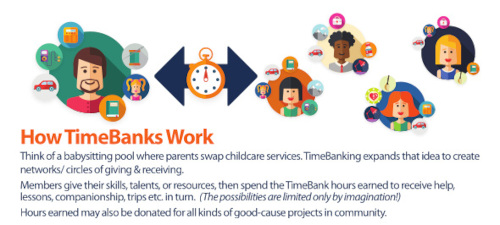
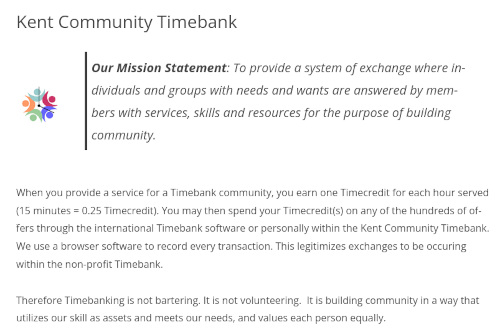
Timebanking is a community development tool and works by facilitating the exchange of skills and experience within a community. It aims to build the 'core economy' of family and community by valuing and rewarding the work done in it. The world's first timebank was started in Japan by Teruko Mizushima in 1973[26] with the idea that participants could earn time credits which they could spend any time during their lives. She based her bank on the simple concept that each hour of time given as services to others could earn reciprocal hours of services for the giver at some stage in the future, particularly in old age when they might need it most. In the 1940s, Mizushima had already foreseen the emerging problems of an ageing society such as seen today. In the 1990s the movement took off in the US, with Dr Edgar Cahn pioneering it there, and in the United Kingdom, with Martin Simon from Timebanking UK and David Boyle, who brought in the London-based New Economics Foundation (Nef).


 6
6


 4
4
Phil Stevens wrote:There are other software platforms that communities use for timebanking.
Aspirations: She seeks wool and flax, considers a field and buys it, girds herself with strength, opens her mouth with wisdom, and does him good all the days of her life. (pieces of Proverbs 31, NKJV)


 5
5
Tradition is not the worship of ashes, but the preservation of fire.


 3
3


 4
4
"Ah, but a man's reach should exceed his grasp,
Or what's a heaven for?"
Andrea del Sarto by Robert Browning
7
Creating edible biodiversity and embracing everlasting abundance.


 5
5
 .
.How Permies works: https://permies.com/wiki/34193/permies-works-links-threads
My projects on Skye: The tree field, Growing and landracing, perennial polycultures, "Don't dream it - be it! "

|
Live ordinary life in an extraordinary way. Details embedded in this tiny ad:
Permaculture Voices 1, 2 and 3 - all 117 hours of video!
https://permies.com/t/voices123
|