
• Post Reply Bookmark Topic Watch Topic
  • New Topic
permaculture forums growies critters building homesteading energy monies kitchen purity ungarbage community wilderness fiber arts art permaculture artisans regional education skip experiences global resources cider press projects digital market permies.com pie forums private forums all forums
this forum made possible by our volunteer staff, including ...
master stewards:
  • Carla Burke
  • John F Dean
  • r ransom
  • Nancy Reading
  • Timothy Norton
  • Jay Angler
stewards:
  • paul wheaton
  • Pearl Sutton
  • Eric Hanson
master gardeners:
  • Christopher Weeks
  • M Ljin
gardeners:
  • thomas rubino
  • Megan Palmer
  • Benjamin Dinkel

Fruitflies destroy my melons. What to do?

 
gardener
Posts: 603
Location: Boudamasa, Chad
228
2
forest garden
  • Likes 3
  • Mark post as helpful
  • send pies
    Number of slices to send:
    Optional 'thank-you' note:
  • Quote
  • Report post to moderator
This country (Chad) grows some gorgeous melons. Delicious, all sorts of colors. The watermelons are also huge and amazing. The climate is perfect.


But they're all grown with insecticide. Without it, little flies lay their eggs in them and they rot from the inside. What are my alternatives? I'd love to grow these things.
 
Nathanael Szobody
gardener
Posts: 603
Location: Boudamasa, Chad
228
2
forest garden
  • Mark post as helpful
  • send pies
    Number of slices to send:
    Optional 'thank-you' note:
  • Quote
  • Report post to moderator
So, now that it's spring, perhaps someone has some ideas...???
 
master pollinator
Posts: 2064
Location: Ashhurst New Zealand (Cfb - oceanic temperate)
675
duck trees chicken cooking wood heat woodworking homestead
  • Likes 1
  • Mark post as helpful
  • send pies
    Number of slices to send:
    Optional 'thank-you' note:
  • Quote
  • Report post to moderator
Fine mesh netting? After the flowers have been pollinated, cover the vines against the flies so that they can't lay their eggs on the developing fruit. I would assume that they wait until it's close to ripe and it's the smell that attracts them.
 
steward
Posts: 18192
Location: USDA Zone 8a
4627
dog hunting food preservation cooking bee greening the desert
  • Likes 1
  • Mark post as helpful
  • send pies
    Number of slices to send:
    Optional 'thank-you' note:
  • Quote
  • Report post to moderator
Hi, Nathanael

Here in the US fruit flies are an indoor species.  Can you give us the genus and family name?

Here they are: "Drosophila (/drəˈsɒfɪlə, drɒ-, droʊ-/) is a genus of flies, belonging to the family Drosophilidae, whose members are often called "small fruit flies" or (less frequently) pomace flies, vinegar flies, or wine flies, a reference to the characteristic of many species to linger around overripe or rotting fruit."

Maybe with the exact name someone can help.
 
steward & manure connoisseur
Posts: 4726
Location: South of Capricorn
2703
dog rabbit urban cooking writing homestead ungarbage
  • Likes 3
  • Mark post as helpful
  • send pies
    Number of slices to send:
    Optional 'thank-you' note:
  • Quote
  • Report post to moderator
Maybe Bactrocera cucurbitae? https://www.cabi.org/isc/datasheet/17683

We have a similar fruit fly here in South America that goes after mangoes (which is why mangoes exported to North America have no taste- they have to be treated in very hot water to kill any potential eggs).

It looks to me like you have two potential routes- decoys (they seem to really go for bitter melon, although that might just encourage them to reproduce and really wreak havoc), or just physical barriers. That page is really long but if you scroll down to cultural controls they talk about wrapping the fruit in newspaper or bags or whatever before the insects lay their eggs.
 
pollinator
Posts: 241
65
  • Likes 4
  • Mark post as helpful
  • send pies
    Number of slices to send:
    Optional 'thank-you' note:
  • Quote
  • Report post to moderator
I have used peppermint iol and water  to spray on melons and that helps some, guess they cant smell them. Now I buy throw away hair nets and hospital shoe covers for smaller melons. Get them cheap online by the 100s.  Just have to wrap around melons when you see them. They will stretch as melons grow.   ( Big watermelons need 2, one from each side).
Good luck, nobody wants to loose a crop after all the hard work.
 
Nathanael Szobody
gardener
Posts: 603
Location: Boudamasa, Chad
228
2
forest garden
  • Likes 4
  • Mark post as helpful
  • send pies
    Number of slices to send:
    Optional 'thank-you' note:
  • Quote
  • Report post to moderator
Thanks for all the suggestions! Guess I'll try wrapping them in mosquito netting. Last year I tried wrapping watermelons in old t-shirts, but they just rotted.

I do not know what species the flies are because I never see them. They just leave a tiny hole, usually on the underside of the fruit.
 
gardener
Posts: 1153
Location: France, Burgundy, parc naturel Morvan
513
forest garden fish fungi trees food preservation cooking solar wood heat woodworking homestead
  • Likes 7
  • Mark post as helpful
  • send pies
    Number of slices to send:
    Optional 'thank-you' note:
  • Quote
  • Report post to moderator
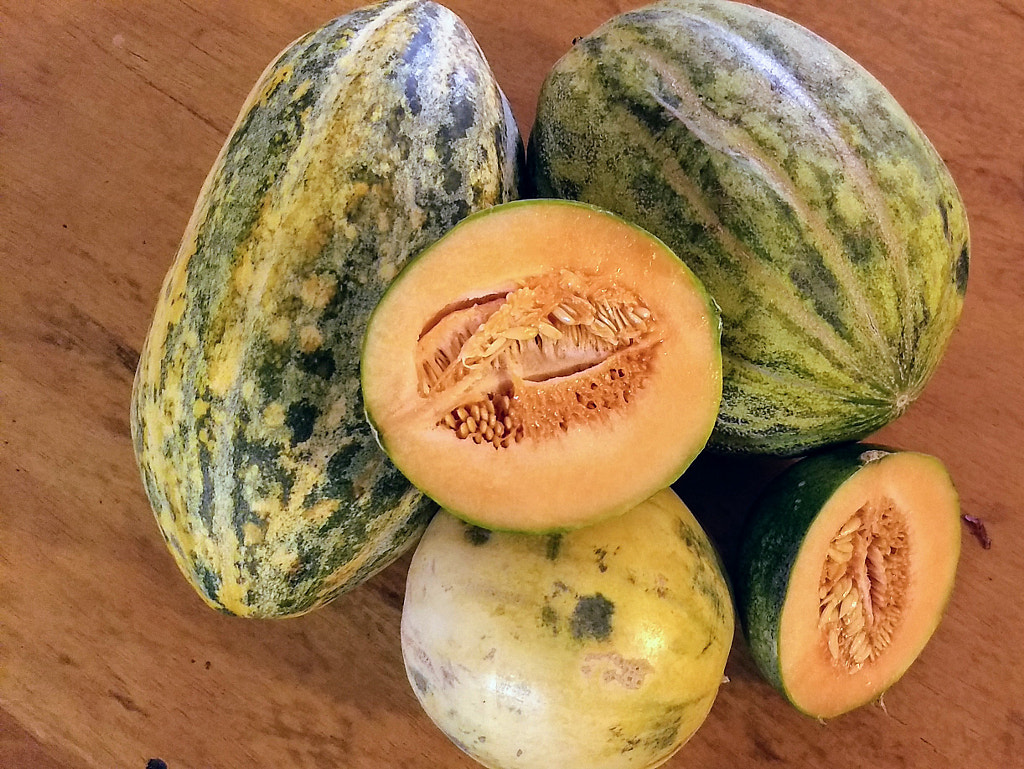
Hi Nathanael, i know this is an old post, maybe you're growing lots of great tasting melons by now. But if not it could be of help to try to grow a mix of diverse varieties. I used to be very bad at growing melons but this year i've had succes by growing out diverse varieites from the GoingToSeed group i'm a member of. Not many in Africa are on board the Adaptation Gardening train yet, which is a great shame, because it's such a great tool to share seeds amongst varying growers at the cost of a few poststamps surpassing the industry mostly interested in scalability and selling chemicals through the backdoor to help their weak plants.
I've had one very tough melon , very yellow, snails couldn't penetrate the skin, so i guess fruit flies couldn't either. Some genetics like that could really be the difference you need. They were very late and didn't become very sweet. I suspect somebody from Mallorca had put this variety in the mix, so i'll be trying it in the greenhouse coming summer. They might have crossed with other melons at this point... Most melons looked more like the ones in your photo though and snails got a hold of them. As well they didn't like the 40+degrees celcius heatwave we had and collapsed quite a bit. Later they bounced back and gave some lovely tasting fruit.
 
master steward
Posts: 14468
Location: Pacific Wet Coast
8742
duck books chicken cooking food preservation ungarbage
  • Likes 8
  • Mark post as helpful
  • send pies
    Number of slices to send:
    Optional 'thank-you' note:
  • Quote
  • Report post to moderator

Nathanael Szobody wrote:I do not know what species the flies are because I never see them. They just leave a tiny hole, usually on the underside of the fruit.


A weird idea to try - where I live, I put my pumpkins up on a pot so they aren't touching the soil as that reduces slug damage. If the bugs are usually entering on the underside, I'm wondering if you put them up on wire pots or similar ideas, would it make a difference?
 
Anne Miller
steward
Posts: 18192
Location: USDA Zone 8a
4627
dog hunting food preservation cooking bee greening the desert
  • Likes 3
  • Mark post as helpful
  • send pies
    Number of slices to send:
    Optional 'thank-you' note:
  • Quote
  • Report post to moderator
Maybe try to attract some lizards to eat the flies?
 
pollinator
Posts: 441
Location: Oz; Centre South
102
trees books cooking fiber arts writing
  • Likes 4
  • Mark post as helpful
  • send pies
    Number of slices to send:
    Optional 'thank-you' note:
  • Quote
  • Report post to moderator
This might get you started:

There are many other "recipes" available.  
 
Nathanael Szobody
gardener
Posts: 603
Location: Boudamasa, Chad
228
2
forest garden
  • Likes 5
  • Mark post as helpful
  • send pies
    Number of slices to send:
    Optional 'thank-you' note:
  • Quote
  • Report post to moderator

Hugo Morvan wrote:Hi Nathanael, i know this is an old post, maybe you're growing lots of great tasting melons by now. But if not it could be of help to try to grow a mix of diverse varieties.


I wish! I did get a few melons, but I pretty much gave up. This year I decided to give it another go with watermelons, and treat them with neem tea. Nope. Every single melon has multiple rotten fruit fly holes in it--within days of pollination! Seriously, tiny little marble sized melons with holes on the underside.

Jay Angler wrote:
A weird idea to try - where I live, I put my pumpkins up on a pot so they aren't touching the soil as that reduces slug damage. If the bugs are usually entering on the underside, I'm wondering if you put them up on wire pots or similar ideas, would it make a difference?


That's a good idea. In fact I have found the same; if I put a melon on a brick it takes the fruit flies longer to find it...but they eventually do.

Anne Miller wrote:Maybe try to attract some lizards to eat the flies?


We've got loads of lizards!!

Jill Dyer wrote:This might get you started:


There are many other "recipes" available.  


Thanks. I'll give it a try.

Currently I'm trying wrapping them in squares of my old turban (because it's the only 100% cotton on the local market). We'll see...But I have to get them tiny or the flies will have already pierced them.
 
Hugo Morvan
gardener
Posts: 1153
Location: France, Burgundy, parc naturel Morvan
513
forest garden fish fungi trees food preservation cooking solar wood heat woodworking homestead
  • Likes 3
  • Mark post as helpful
  • send pies
    Number of slices to send:
    Optional 'thank-you' note:
  • Quote
  • Report post to moderator
I'm looking for fruit fly resistant African varieties with AI. They come up with landraces which are mostly grown for seeds and have bitter flesh. Further looking came up with this which is kind of interesting...

2. Winter Melon (Wax Gourd, Benincasa hispida)
This large Asian cucurbit develops an extremely thick, hard, waxy rind as it matures, providing excellent protection against insect penetration (including fruit flies). The waxy coating adds an extra layer of resistance. It's often stored for months due to this durable skin.

This is a link to the wiki page https://en.wikipedia.org/wiki/Wax_gourd

Also i found that the yellow melon i spoke is the Canary

Grok has this to say about it:

Fruit Fly Resistance in Canary Melon
The melon fruit fly (Bactrocera cucurbitae, now often called Zeugodacus cucurbitae) is a major pest of cucurbits, including various melons. It prefers softer-skinned hosts like cucumbers, muskmelons/cantaloupes, and watermelons, where females can easily pierce the rind with their ovipositor to lay eggs.
Canary melon falls into the moderately susceptible category — not as heavily attacked as softer varieties, but still vulnerable, especially in areas with high fruit fly pressure. Here's why:

Rind characteristics: The rind is relatively thick and hard compared to many muskmelons, which offers some mechanical resistance (antixenosis) by making oviposition more difficult. Research on related Cucumis melo types shows that thicker, harder rinds (along with traits like pubescence or biochemical compounds) correlate with lower infestation rates.
However, it is not considered truly resistant or immune. Standard sweet melons in the inodorus group (like Canary and honeydew) are listed as hosts for B. cucurbitae, and infestation can occur, particularly on ripening or mature fruits. In tropical/subtropical regions, losses can still happen without management.

This is my (Hugo's) conclusion: So wax gourd, not sweet but most fruit fly resistant. Canary Melon, some resistance, but sweet. They're not in the same genus so crossing is very unlikely. Otherwise hybrids could be expected who have more waxy fruit fly resistant skin and sweeter. Not so lucky.

Same goes for the African landraces which are in the Citrullus type, it won't work. They have to be landraces from in the same Melo genus as Canary melon to stand a chance of hybridizing into a good tasting fruit fly resistant variety.
But i wouldn't know where to get those Melo landrace seeds in Africa. Where do you get your seeds from usually Nathanael?
 
Nathanael Szobody
gardener
Posts: 603
Location: Boudamasa, Chad
228
2
forest garden
  • Likes 6
  • Mark post as helpful
  • send pies
    Number of slices to send:
    Optional 'thank-you' note:
  • Quote
  • Report post to moderator
Thanks Hugo. Yes. We have local "wax gourd" types that i grow, as well as luffa gourd. Those are both tasty. They are not melons :-)

The bitter watermelons are native to here. The kind with edible seeds are called egusi melon. The seeds are sublime and we use them in soups and stir-frys.

I get my seeds locally. I have probably tried hundreds of varieties sourced from the US, and the only things that do well here are giant amaranth and watermelon--fruit-flies notwithstanding. Some hot peppers have done alright as well.

So far the watermelons wrapped in turban have done well,  reached grape size without holes in them yet--which is progress, believe me!

Makes for a goofy looking watermelon patch though:
20260101_172609.jpg
[Thumbnail for 20260101_172609.jpg]
 
Hugo Morvan
gardener
Posts: 1153
Location: France, Burgundy, parc naturel Morvan
513
forest garden fish fungi trees food preservation cooking solar wood heat woodworking homestead
  • Likes 2
  • Mark post as helpful
  • send pies
    Number of slices to send:
    Optional 'thank-you' note:
  • Quote
  • Report post to moderator
Good to hear that you make use of what does want to grow locally. Totally sensible. I've heard insect pressure in the tropics can be off the charts. They're like superhappy with all the sun, totally energized to eat whatever and multiply, multiply. Hard to battle and heartwrenching to see them in action i'd think. I mostly have snails to beat, but they come in waves eating weak plants, i just resow in between waves. Saving seeds gives me that luxury to do that for free and bit by bit my plants seem to adapt to them. I saw one on top of a newly salad, he was "sniffing" it out and decided to move on. That was a good day. I don't know if coming year will be similar. Nature can be so eratic and hard to pin down.
That's why i'm grateful to be part of this community where we can freely exchange information and together creep forward at our own pace to hopefully obtain sustainability and a new balance and way of life with the land. A copyable template for future generations to build on where ever we live. It's where my energy lies anyway, sorry to bother you with it. Haha.
I respect you've moved away from growing melons if it's so difficult and you don't want to be part of a system using pesticides. In the adaptation gardening community we're trying to do similar, using as little inputs as possible by trying different genetics and not being afraid of hybridizing siblings. Breeding the fittest/tastiest/most resistant varieties we can in differing settings like mountains, marshes,high up north to islands and forests or the opposite deserts like situations.
Leaving you with some pics of watermelon seeds and what people grew this year.
photo_2025-09-18_22-07-21-(2).jpg
[Thumbnail for photo_2025-09-18_22-07-21-(2).jpg]
photo_2025-09-18_22-07-19.jpg
[Thumbnail for photo_2025-09-18_22-07-19.jpg]
photo_2026-01-02_09-14-48.jpg
[Thumbnail for photo_2026-01-02_09-14-48.jpg]
 
Nathanael Szobody
gardener
Posts: 603
Location: Boudamasa, Chad
228
2
forest garden
  • Likes 2
  • Mark post as helpful
  • send pies
    Number of slices to send:
    Optional 'thank-you' note:
  • Quote
  • Report post to moderator
Beautiful!!

At least snails taste good ;-)
 
snakes are really good at eating slugs. And you wouldn't think it, but so are tiny ads:
Learn Permaculture through a little hard work
https://wheaton-labs.com/bootcamp
reply
    Bookmark Topic Watch Topic
  • New Topic