• Post Reply Bookmark Topic Watch Topic
  • New Topic
permaculture forums growies critters building homesteading energy monies kitchen purity ungarbage community wilderness fiber arts art permaculture artisans regional education skip experiences global resources cider press projects digital market permies.com pie forums private forums all forums
this forum made possible by our volunteer staff, including ...
master stewards:
  • Carla Burke
  • Nancy Reading
  • John F Dean
  • r ransom
  • Jay Angler
  • Timothy Norton
stewards:
  • paul wheaton
  • Pearl Sutton
  • Tereza Okava
master gardeners:
  • Christopher Weeks
  • M Ljin
gardeners:
  • thomas rubino
  • Jeremy VanGelder
  • Megan Palmer

small regenerative, sustainable farm - tree biomass

 
Posts: 1
Location: hillsborough, nj
1
  • Likes 6
  • Mark post as helpful
  • send pies
    Number of slices to send:
    Optional 'thank-you' note:
  • Quote
  • Report post to moderator
greetings, :)

We are a small 50 acres, regenerative, sustainable farm (umrit farm) in Hillsborough, NJ. Our farm is off Millstone river, interestingly flowing from south to north. Our farm is land of https://en.wikipedia.org/wiki/Lenape. We have been farming on this land for 10 years now. The sandy clay loam soils are very depleted.  In order to be successful at being sustainable, regenerative, ecological, to improve the soil fertility we chose to utilize tree biomass (leaves, wood chips, wood logs) in various ways, rather than import compost, so as to have diverse microbial life in soil and know what is going into our soils.

- wood chips as mulch
- logs on hedges to grow mushrooms and serve as habitat for insects
- logs to make lumber for farm use
- logs to build hügelkultur beds, in ground and above ground

We practiced no-till for 8 years, as years went by, the soil compacted further. We did find good structure development. Whenever there is moisture in soil, small life in soil can mobilize and build up soil structure to allow water to percolate through, rather than flooding off.

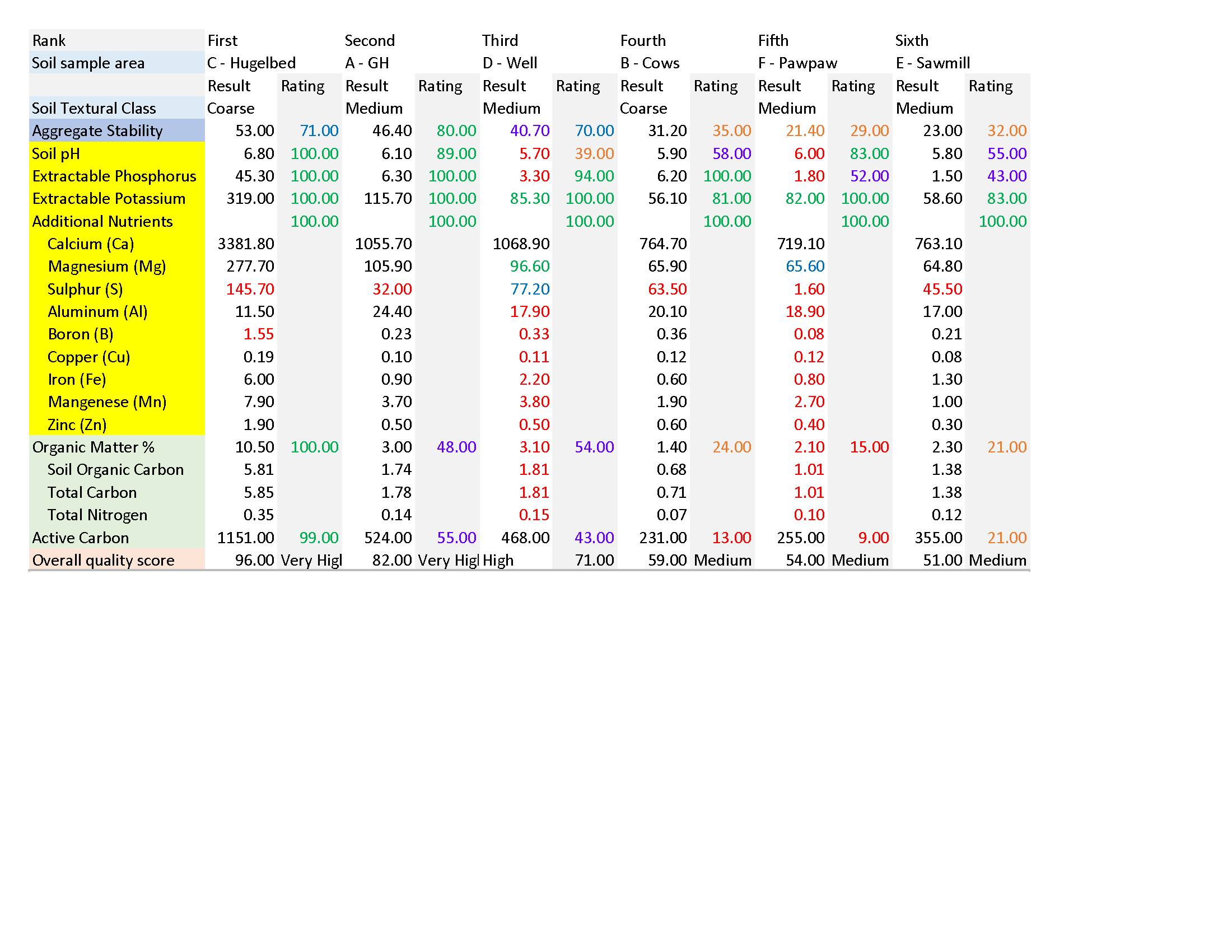
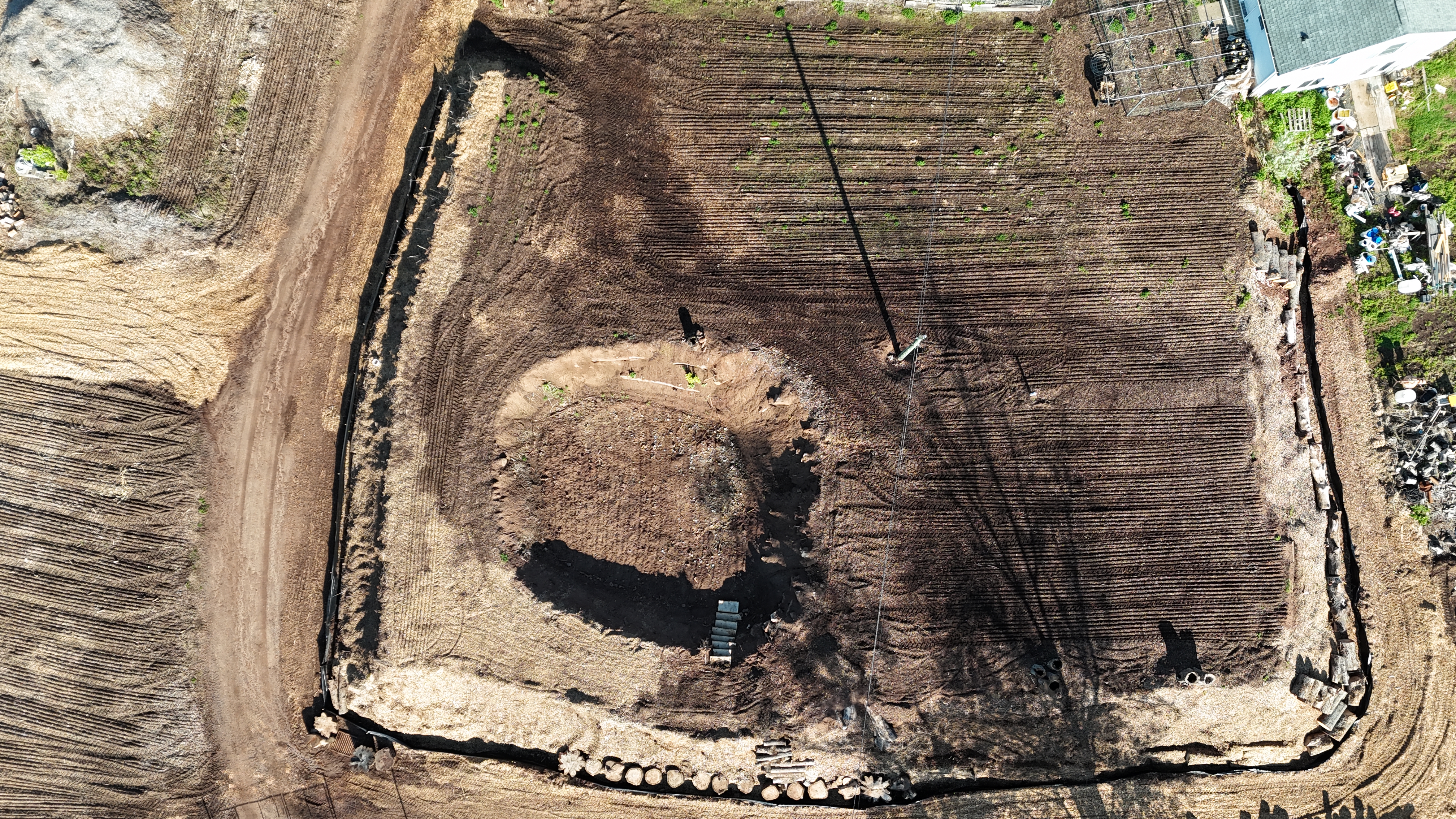
One of our above ground hügel beds is 7 years old and is the most productive, balanced soil at the farm (attached is a soil test report that shows difference between different soils at the farm). Within 2 years of completing it, the soils came to balance without any supplements and are now growing 3 times bigger plants compared to grown in other soils at the farm.

We have about 4 acres of soil under wood chips as mulch and these soils are also productive. Sorghum in wood chips mulched soils, grows to 14 feet tall, compared to non-mulched soil, which is about 5-6 feet tall. The soils under wood chips mulch don't have compaction issue. The bacterial and fungal life is in good balance, promoting plant growth and good vegetable harvest.

The tree biomass is also important to retain moisture in soil and warding off fluctuations in temperatures. It also shields microbial life from solarization.

We have realized many benefits that many of you have experienced and discussed for a good long time. We are fortunate to be able to afford sustainable, regenerative practices.

We have been unable to assure the state agriculture development committee (SADC) and county agriculture development committee (SCADB) that our practices are not new, had been in practice for millenniums, all across the world, and are good for us to grow food as well as for the environment and ecology. The governing agencies have cited that our practices are not well known, established, prevalent and hence we are in violation, as tree biomass is considered to be waste in the state, hence it is dumping.

We have been asked to revert and remediate the areas of our practice. It is a set back to our efforts, of years observing that purer, natural methods and least impactive importation and supplementation, allowing us to grow very good foods as well as enrich the soil with organic matter and carbon, spurring many things soils should have like glomalin, amino acids, soil stable carbon and most importantly carbon sequestration.

Please suggest measures and resources to bring about mediation so as we don't lose out the progress we have made and enable the governing bodies to recognize the practices to be viable agriculture practices as prevalent practice of using urea, pesticides, herbicides, plastic mulching and imports are. Growing foods, no matter the practices, is a demanding and many a times unnoticeable act. Every farmer works very hard to grow foods, no matter the nature of practice. We happen to be fortunate to understand and utilize close to natural methods.

Please find will and resources, allowing us to gain your help. The farm website has good bit of information and we should be able to furnish further, within our reach.

Filename: umrit-soil-test-report.pdf
Description: soil test reports showing difference in soil
File size: 136 Kbytes
umrit-soil-test-report.png
soil test report picture
 
master gardener
Posts: 6221
Location: Carlton County, Minnesota, USA: 3b; Dfb; sandy loam; in the woods
3696
8
forest garden trees books chicken food preservation cooking fiber arts seed woodworking homestead ungarbage
  • Likes 4
  • Mark post as helpful
  • send pies
    Number of slices to send:
    Optional 'thank-you' note:
  • Quote
  • Report post to moderator
Hey Yash, I probably don't have any useful knowledge to pass along, but I'm curious what your interactions with Somerset County have been like so far? I've found that county officials are usually willing to help you figure out a way to make things work when you approach them as a collaborator rather than an enemy, so I hope you've taken that route.

I know for zoning purposes, you can petition the county for a variance. And I know here in Minnesota, if you want to e.g. dispose of human waste in an irregular manner, you can get permission from the county/state if you can convince the sanitation folks that you know what you're doing. What are your similar options? You should assume they have good reasons for the policies, but you also have good reasons for your own actions and want to find some way the county can understand what you're doing so they can help you figure out how to make it legal.

(Honestly, I'm only responding because 25 years ago I lived 10 miles from where you're farming -- just up on Sourland Mountain, so this is a small-world moment for me.)

I do hope that you can work something out with them!
 
steward & author
Posts: 45910
Location: Left Coast Canada
18411
10
art trees books chicken cooking fiber arts
  • Likes 8
  • Mark post as helpful
  • send pies
    Number of slices to send:
    Optional 'thank-you' note:
  • Quote
  • Report post to moderator
Wow, that sounds like a great farm!

When dealing with the government, it helps to answer the three keys before taking action.

1. What did we hear them say?
2. What did they actually say?
3. What is their goal they want to achieve?

Not being there first hand, it's difficult to know for certain what applies in your situation.  The following is based on your description.

1. What did we hear them say?
- you must return to 20th century agriculture and reduce yield while increasing expense.


This is the hardest key to examine because what we hear them say is what we base our actions on.  It's amplified by our prey instincts and emotion.  We feel attacked because authority demands. But if we can see this and put it to one side for a moment, it helps us see what the other two keys might be.  

2. What did they actually say?
- "hence it is dumping"


This is what you mentioned above.   So let's run with this and pretend it's what they said.

Remember how key 1 can be influenced by emotions and history - so can key 2.  The government person is a real human who has a history of frustration and abuse.  Sure, it's their job, but also, it influences how they communicate.  Like any person in authority, they are used to not being listened to.  

Most of the time dealing with the government, I find most of the problem can be solved by showing the government guy that I think of him as a real human and I heard what he has to say (active listening is possibly the worlds most powerful superpower for getting what you want in life - and can be learned by anyone).

If we can find out what they mean by dumping and why it concerns them, then it's possible to solve that problem without destroying all your hard work.  


For that, we need to know what problem they are trying to solve.

I don't know if showing them it's a traditional or useful farming method is going to solve this.  Let's deep dive into what some possibilities are they are wanting to solve.


3. What is their goal they want to achieve?
- here we need to speculate


Based on personal expierence, here is (what turned out to be a long list) of why a government might be against bringing woodchips onto a location from another location.  

- Pest and illness quarantine.

One place I lived has their major income for the region in fruit production.  In that climate, at that time, moving wood chips with juniper from one location to another (even near by) was a really great way to harm the fruit tree harvest as it spread something I was too young to pay attention to what the actual thing was.

Here, we had trouble with chips from a local tree service that cuts down dead and dyeing trees - full of beetles.  Beetles that now are eating and killing our trees.  

Chips need to be heat treated (composted) before used to remove this risk.  Even if you aren't growing whatever XYZ they worry about, it might be vital to your local economy.

- money

Locally we have a family that charges $25-50 to dump a load of branches or chips off at his place.  Then he composts the mulch and sells it for a crazy-expensive price.  The family is making money twice on the same stuff and has to do very little other than turn the pile with a machine once or twice a year.

They also have family members in government.  And if people get chips for free then that family loses income.  Thus the dislike of dumping.

- my neighbour but one charged trucks $10 a load to dump at his place.  They loved it!  However, they weren't um... caring about the contamination of the stuff they dumped and it penetrated the ground water.  This could be a big concern for moving stuff onto a farm.  

- a different house, a different neighbour.  He got a lot of free chips and fill to help reshape his land.  Got in trouble for dumping under the bylaws.

About that time, we were getting a lot of chips and yard waste delivered to our farm, so our neghbour made a fuss and sent the government to visit us too.  

Now, we were getting the exact same stuff from the same people as our neighbour did earlier, but we were paying for the time and gas of the driver.  So we weren't dumping, we were buying a valuable commodity.  

If it was free or we were being paid for it, it would be dumping, like our neighbour got in trouble for.  But, in our case, the exact same thing was considered a purchase.  


Lots of possible reasons.  Probably about 200 more I missed.  

Start with evaluating which branch of the government is kicking up the fuss and see what law they are citing.  It's usually bylaws so give those another read (I assume everyone reads the bylaws when moving to a new home because these are icky to deal with).  Or ask them kindly to point you to the specific law and ask them for more details.  Most government people hate paperwork and are happy to educate rather than enforce.  
 
steward
Posts: 18661
Location: USDA Zone 8a
4731
dog hunting food preservation cooking bee greening the desert
  • Mark post as helpful
  • send pies
    Number of slices to send:
    Optional 'thank-you' note:
  • Quote
  • Report post to moderator
In a simple version what is it they did not like that you were doing?

I can imagine that this involved using human waste?
 
steward & manure connoisseur
Posts: 5033
Location: South of Capricorn
3010
dog rabbit urban cooking writing homestead ungarbage
  • Likes 2
  • Mark post as helpful
  • send pies
    Number of slices to send:
    Optional 'thank-you' note:
  • Quote
  • Report post to moderator
My first call would be to someone at Somerset Cty Rutgers cooperative extension service.
https://somerset.njaes.rutgers.edu/
my second call would be to one of the research/extension offices at Rutgers proper, maybe here https://ifnh.rutgers.edu/centers/agricultural-food-ecosystems/
or here https://ecocomplex.rutgers.edu/
plus there are all the experimental farms
https://sebs.rutgers.edu/research/centers-facilities

it sounds to me, if someone is saying you are in violation and need to remediate, either someone has it out for you (who is reporting a violation of what you do on your own farm?? that seems very strange), youve run afoul of someone, etc. A connection with links to legal resources will be useful.
Good luck.
 
I agree. Here's the link: http://stoves2.com
reply
    Bookmark Topic Watch Topic
  • New Topic