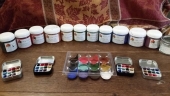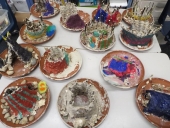

We did one coat of milk paint with really thick curds, along with the pigments yellow ochre and viridian. This is what it looked like:
It looked so pretty
That worked well, but we thought we should do a second coat. So, Wednesday the 3rd (three days ago). The curds on that batch were runnier and just didn't strain right. But, I figured a little extra liquid wouldn't be too bad, especially since the last coat was a bit too thick and didn't really flow into the cracks. We mixed it up, but it was too thin, and we were running low on pigment, so we just went with it. That was a mistake, because the yellow ocher pigment kept rising to the top, while the green viridian pigment settled, meaning that the paint kept changing colors. So, we had to go over some places again the next day. Since the milk paint was still liquid, we just used it. We also noticed that this second coat of paint was taking FOREVER to cure. It stayed tacky for two days.
I noticed chipping today by the door today, and figured it was because we had left the door open to help dry things out. So I scraped off all that. Weirdly enough, the milk paint was SUPER water soluble. Just getting it wet made it roll up and turn into liquid pigment.
Chips of paint flaking off the concrete
I scraped off all the chips and wiped down the area, in case there was dirt the paint was sticking to.
I thought, "Maybe the last coat of paint didn't have enough lime, so I'll add more to this batch to make it stronger!" I added more lime and mixed everything up. The paint was a great consistency, so I gave everything another coat so that it would have a consistent color. That was 2 hours ago. I just went and looked, and now it's ALL cracking. There's chips just popping off the floor, all by themselves!
Fresh chips, and the paint isn't even all dry yet!
It's all just bubbling up like this
What do I do? What caused this? Was it the old milk? How can I even fix this?
I just want this floor done so we can move things out of our spare room so my daughter can finally have her own bedroom before school starts.
If memory serves, there was a thread about cracking caused by the moisture being absorbed from the surface too fast. But darned if I can find that thread again or maybe it was a dream.
It's weird, because the paint seems to have been chemically transformed by this layer of paint. Usually milkpaint is rock solid and not really water soluble. After this coat, it just turns back into liquid when in contact with water. Some of it rolls up, and some is just liquid. I got liquid paint on my arms when I tried cleaning the area that had a few cracks. I thought the cracks were just from the heat.
But, when I repainted the rest of the milkpaint, it started cracking within two hours. It was 7:00pm when I finished the second coat, and the cracks and chips were happening by 8:30.
I just don't understand. I reached out to earthpigments.com, which is where I got the pigments and found the recipe for making milk paint. I've made lots of milk paint, painting wood, cobb, the cement wall, and gypsum. And none of those have ever done this.
My husband says we should just throw in the towel and throw down some rugs and live with cracking, yucky paint and cement that refuses to be swept. I'm out of pigment, and if I order more, it'll be at least a week before it gets here, because there's no way I can afford express shipping!
I just went and looked, and the areas all around the edge (except by the door) are all fine. I wonder if I should just go seal them all with tung oil before they crack?
I applied tung oil to one spot that was really crackly, just to see what would happen (I picked that spot because I know a rug is going there), and the chips were hard and crunchy, and very much still chips.
My house has concrete floor and I like that they are maintenance free.
Sweep or mop ever so often.
My floors have no finish.
If that were my floor, I would scrape it and sand it and leave it like that, especially if it is going to be covered with a rug.
Invasive plants are Earth's way of insisting we notice her medicines. Stephen Herrod Buhner
Everyone learns what works by learning what doesn't work. Stephen Herrod Buhner
It's like they went over the wet concrete with a brush to put fine ridges in it
Those ridges catch dirt and make it REALLY hard to sweep. No matter how many times we sweep, there's more dirt hiding in the cracks. It's always filthy. The paint (before it decided to crack), smoothed out the ridges so that we could sweep.
We have a big rug to put down, but it doesn't go to the edges of the wall, which is where we'll have all our desks...which would be really nice to be able to sweep and vacuum under.
r ranson wrote:Could ph be related? It sounds like a chemical reaction.
The only other thing I can find is greasy surface, but that would show with the first coat?
Sorry, no firm solution. Just speculation.
I'm wondering if that might be it. Maybe the second batch of milk was more acidic because the vinegar wasn't rinsed out, and maybe I didn't put in enough hydrated lime to counteract it? The third coat had a lot more lime, so maybe that caused the reaction?
Polished concrete is lovely, and would take care of the ridges, but I have the sense that it isn't really a DIY project, at least for normal folks. I wonder, even if you don't want to tile or something, could you put a skim of thinset all over to end up with a smooth floor?
(I don't know enough about (milk) painting concrete to be of any real use, so these are the things that occur to me as I'm reading the thread.)
Christopher Weeks wrote:Polished concrete is lovely, and would take care of the ridges, but I have the sense that it isn't really a DIY project, at least for normal folks. I wonder, even if you don't want to tile or something, could you put a skim of thinset all over to end up with a smooth floor?
(I don't know enough about (milk) painting concrete to be of any real use, so these are the things that occur to me as I'm reading the thread.)
My brother had his concrete floor polished, and had to bring in professionals for it.
I'd love to just buy click linoleum tiles and place that down on top (like these made from actual linseed oil). But, it would cost $2000 to cover all 360sqft...and we just don't have that in the budget right now.
Last night, I went around and scraped off some of the chipped paint.
I noticed a few things:
- The top of the paint seems to smooth out, no longer showing the ridge-texture of the concrete below, before it starts to crack and chip up
- The underside of the paint chips shows concrete. It seems to have pulled the concrete up with it!
- The paint is now chipping/cracking even in the area that didn't get a third coat.
We're tempted to try scraping it off and painting it with the clay brown color we still have a lot of. Maybe the clay will stick better than the viridian green pigment? Though, the amount of viridian green is half of the yellow ochre, but maybe it just dries funny?
20240722_094711.jpg
So much paint chipped up! :o
20240722_094738.jpg
Concrete stuck to the underside of the paint chips
20240722_094843.jpg
A bad picture, but it's here to remind me that even in the area oiled with tung oil, the paint is still chipping.
I have been scouring google for ideas why, and the best I can come up with is this artist casein document. Don't know if it’s close enough to milk paint to be useful.
I called Earth Pigments and had a really good chat with Erin. She mentioned that the casein can be very strong, and shrink when it dries. This is usually a problem with people applying purchased milkpaints made with casein powder and applying it to horsehair plaster. It will pull the plaster away from the wall.
We're thinking that maybe since the first layer of milk paint was made with very thick quark (we'd let it hang dry for hours and the curds were DRY), that it was too strong and pulled away from the concrete.
We talked about how the paint on the walls worked, and she thinks that might be because of the high percentage of Kaolin, which acts as a binder and filler, and helps to prevent the shrinkage from the casein paint.
I asked if we painted the floor with just clay brow pigment, if that would work the same as kaolin. She said the kaolin really helps to stretch it, and would be a necessary edition.
She said we should remove what is on there. And that maybe waterglass paint (which is silica based) might work. And maybe painting the floor with a milk paint with a lot of kaolin would work. We also talked about marmoleum linoleum, and she has that on her floors and really likes it. She loves the texture and color selection offered.
She also said that some people like to limewash their floors, but she advises against that as it's a high-contact area and it tends to dust off. (She asked if the milkpaint floor was dusting off, and I said it was not. The paint is very solid, held together by the casein in the quark)
Might have an answer for. Doing commercial paint over etched concrete we found if we did not physically scrub or narrow nozzle pressure wash the sand layer left behind by the etching away, that the sand layer and paint lifted off the surface. But if we got rid of the sand layer from the etching then the paint bonded well and was durable.
Country oriented nerd with primary interests in alternate energy in particular solar. Dabble in gardening, trees, cob, soil building and a host of others.