
• Post Reply Bookmark Topic Watch Topic
  • New Topic
permaculture forums growies critters building homesteading energy monies kitchen purity ungarbage community wilderness fiber arts art permaculture artisans regional education skip experiences global resources cider press projects digital market permies.com pie forums private forums all forums
this forum made possible by our volunteer staff, including ...
master stewards:
  • Carla Burke
  • John F Dean
  • Nancy Reading
  • r ransom
  • Jay Angler
  • Timothy Norton
stewards:
  • paul wheaton
  • Pearl Sutton
  • Anne Miller
master gardeners:
  • Christopher Weeks
  • M Ljin
gardeners:
  • Jim Garlits
  • thomas rubino
  • William Bronson

Giving New Life to Old Cast Iron

 
steward
Posts: 8213
Location: Colombia - Tropical dry forest
3127
6
forest garden fish fungi trees tiny house earthworks bee solar woodworking greening the desert homestead
  • Likes 14
  • Mark post as helpful
  • send pies
    Number of slices to send:
    Optional 'thank-you' note:
  • Quote
  • Report post to moderator
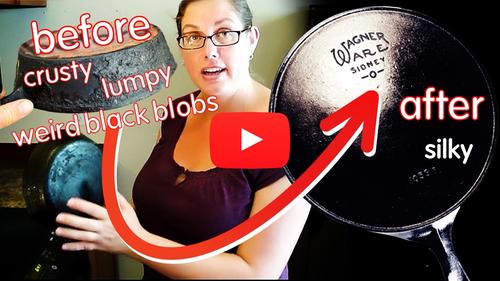
Jocelyn and Paul bring back a cast iron skillet to life using the self cleaning oven technique:

 
steward and tree herder
Posts: 13506
Location: Isle of Skye, Scotland. Nearly 70 inches rain a year
7343
6
transportation dog forest garden foraging trees books food preservation woodworking wood heat rocket stoves ungarbage
  • Likes 7
  • Mark post as helpful
  • send pies
    Number of slices to send:
    Optional 'thank-you' note:
  • Quote
  • Report post to moderator
That's fascinating Andres. So how hot does the self cleaning oven cycle get? Could you just stick the pan in a fire and get the same cleaning effect?
 
Rusticator
Posts: 9825
Location: Missouri Ozarks
5430
7
personal care gear foraging hunting rabbit chicken cooking food preservation fiber arts medical herbs homestead
  • Likes 5
  • Mark post as helpful
  • send pies
    Number of slices to send:
    Optional 'thank-you' note:
  • Quote
  • Report post to moderator
I'll bet the rocket kiln would gitter dun!
 
Nancy Reading
steward and tree herder
Posts: 13506
Location: Isle of Skye, Scotland. Nearly 70 inches rain a year
7343
6
transportation dog forest garden foraging trees books food preservation woodworking wood heat rocket stoves ungarbage
  • Likes 4
  • Mark post as helpful
  • send pies
    Number of slices to send:
    Optional 'thank-you' note:
  • Quote
  • Report post to moderator

Carla Burke wrote:I'll bet the rocket kiln would gitter dun!


That was my thought too! I was pondering how hot my woodstove might get (even in the firebox....)
 
Posts: 46
Location: North-central Pennsylvania
35
  • Likes 10
  • Mark post as helpful
  • send pies
    Number of slices to send:
    Optional 'thank-you' note:
  • Quote
  • Report post to moderator
I’d like to add my two cents to the seemingly endless ideas about salvaging, seasoning, and cleaning cast iron cookware. A bit of chemistry is in order to begin.

The “seasoning” on a cast iron pan, as many have said before me, is hardened oil. This means, for you chem buffs, “polymerized” oil. The oil molecules cross-link, creating a sort of pseudo varnish—a thin but relatively resilient, smooth(ish) surface that if used properly is (relatively) non-stick. All organic oils will polymerize over time, but (again for the chem buffs) it’s all about rate. Heat increases the rate of polymerization. Thus if you don’t want to wait weeks or months for that necessarily very thin layer of oil to harden on your new old Griswold, put the pan in the oven. Personally I’m a devotee of the long and slow oven method—200 degrees F or a little hotter for several hours. Repeat if your surface doesn’t perform well. I’ve used higher heats and thicker coats, and what I get is a surface less smooth than it could be, sometimes to the point of clumped, hard little oil droplets.

To clean a properly seasoned pan, use a bit of soap, lots of water, and if necessary a plastic scraper. While you can damage the surface with harsh soaps (like dishwasher soap) a bit of regular old dish soap won’t hurt a thing. Note that it is very possible to abrade seasoning off. Never use steel wool or stainless wool, and avoid the stiffer plastic scrubbies unless you have a very light touch. Never use salt. Salt is sometimes suggested in seemingly reliable treatises, but salt is a serious abrasive—no good. When finished at the sink, dry the pan thoroughly before putting away. I usually do the drying with a paper towel.

To recondition an old, rusted, crusted pan, burning in a wood stove or a self-cleaning oven are first rate choices. The key there is to not remove the pan from the fire or oven until it has completely cooled. Again, rate is key, but this time it’s crucial at the back end. Fast cooling will crack an iron pan. Once the firebox or oven has fully cooled, remove the pan and scrub lightly with 0000 steel wool or a green scrubbie and soap as necessary. Rinse real well and then season, and re-season, and maybe re-season again if the surface doesn’t look smooth and slick.

The pans in the picture have been in daily use in my kitchen for over 30 years. All started as old wrecks and were put in the woodstove for an initial burn-off, then cleaned and cared for as above. They are stellar kitchen companions.

A last note... Lard is my first choice for seasoning and most cooking because we render it ourselves and have it by the bucketful, but I’ve used other oils as well. So long as I followed the long and slow seasoning method, none have been a problem.
Dave-s-Beloved-Iron-Pans.jpg
[Thumbnail for Dave-s-Beloved-Iron-Pans.jpg]
 
Posts: 187
Location: 55 deg. N. Central B.C. Zone 3a S. Nevada. Hot and dry zone
57
  • Likes 6
  • Mark post as helpful
  • send pies
    Number of slices to send:
    Optional 'thank-you' note:
  • Quote
  • Report post to moderator
That is some really pretty iron.
 
gardener
Posts: 509
Location: The Old Northwest, South of Superior
302
books building wood heat
  • Likes 7
  • Mark post as helpful
  • send pies
    Number of slices to send:
    Optional 'thank-you' note:
  • Quote
  • Report post to moderator
Of late, I have used food grade flax seed oil (raw linseed oil) on my refurbished cast iron - 2 Dutch ovens and a skillet, so far.  I don't know if that's good, bad, or indifferent, compared to bacon grease or similar.

Here's my rationale: linseed oil oxidizes/crosslinks/polymerizes readily, even at room temperature.  That's what makes it a "drying" oil (usually hastened along in one way or another as "boiled" linseed oil - whether chemically with metallic salts or heated as "stand oil" - for a wood finish).

So, I've wiped on a thin coat of food grade flaxseed oil and put the iron in the oven at 350F or so, leaving it until the oil stops smoking.  It will stink up the house a bit.  It will smell like you've been using a heat gun to strip old oil-based paint.  It's better to do it on a day when you can open some windows and get a good cross breeze, but it's still winter-ish here, so that's a no go.  Maybe in a few weeks, but not now.

This is still experimental, so follow at your own risk.
 
Posts: 11
Location: Oregon, USA
1
gear woodworking homestead
  • Likes 7
  • Mark post as helpful
  • send pies
    Number of slices to send:
    Optional 'thank-you' note:
  • Quote
  • Report post to moderator

Kevin Olson wrote:So, I've wiped on a thin coat of food grade flaxseed oil and put the iron in the oven at 350F or so, leaving it until the oil stops smoking.  It will stink up the house a bit.  It will smell like you've been using a heat gun to strip old oil-based paint.  It's better to do it on a day when you can open some windows and get a good cross breeze, but it's still winter-ish here, so that's a no go.  Maybe in a few weeks, but not now.


I've not tried flax seed oil, do let us know how it turns out.

I would definitely avoid oils labeled "linseed oil", as "flax seed oil" is usually meant to be safe to ingest and the other is usually not.

I seasoned my iron with butter after a vigorous bout with steel wool.  It's been about 20 years now, and I haven't had to re-season.  I just cook with whatever is nearby, rotating through bacon grease, butter, and beef tallow.  I rarely put soap in mine.  I gently scrape the bottom with the metal spatula I use for cooking (just enough to get a smooth surface again).  If I put water in it, I dry it by heating it on the stove just until the water evaporates, this saves on paper towels.
 
pollinator
Posts: 860
Location: Clemson, SC ("new" Zone 8a)
211
11
  • Likes 11
  • Mark post as helpful
  • send pies
    Number of slices to send:
    Optional 'thank-you' note:
  • Quote
  • Report post to moderator

David Milano wrote:To recondition an old, rusted, crusted pan, burning in a wood stove or a self-cleaning oven are first rate choices. The key there is to not remove the pan from the fire or oven until it has completely cooled. Again, rate is key, but this time it’s crucial at the back end. Fast cooling will crack an iron pan. Once the firebox or oven has fully cooled, remove the pan and scrub lightly with 0000 steel wool or a green scrubbie and soap as necessary. Rinse real well and then season, and re-season, and maybe re-season again if the surface doesn’t look smooth and slick.

A last note... Lard is my first choice for seasoning and most cooking because we render it ourselves and have it by the bucketful, but I’ve used other oils as well. So long as I followed the long and slow seasoning method, none have been a problem.


Good stuff!  Just a note to the reader inexperienced with cast iron: all of this talk about restoration and seasoning is how you get a piece of cast iron ready for use the first time.  Once in regular kitchen use, if you employ proper procedures for cooking and cleaning, you should never have to season your iron again, as it will continue to build layers of polymerized oils during cooking.  Those layers fill in any divots in the metal to create the smooth, shiny, non-stick surface.

As for cooking, Jocelyn and Paul teach us that the key is using the right spatula.  That's good advice!  Following their advice, I've developed several high-quality old/new iron skillets that only function better and better over the years without ever needing to be re-seasoned.  You want a metal spatula WITH a straight front edge but WITHOUT sharp corners.  No wood, no plastic.  Wood or plastic spatulas will of course get your food cooked, but they won't care for your iron.  As you cook with a proper metal spatula, it scrapes away any tall bits of seasoning that build up, maintaining that flat, smooth cooking surface, but without gouging down into the seasoning layer as might happen with sharp corners.

As for cleaning...

David Milano wrote:To clean a properly seasoned pan, use a bit of soap, lots of water, and if necessary a plastic scraper. While you can damage the surface with harsh soaps (like dishwasher soap) a bit of regular old dish soap won’t hurt a thing. Note that it is very possible to abrade seasoning off. Never use steel wool or stainless wool, and avoid the stiffer plastic scrubbies unless you have a very light touch. Never use salt. Salt is sometimes suggested in seemingly reliable treatises, but salt is a serious abrasive—no good. When finished at the sink, dry the pan thoroughly before putting away. I usually do the drying with a paper towel.


I have to disagree here.  I have absolutely used salt rubbed in with paper towels effectively as a dry abrasive to clean cast iron.  I don't recommend it, however, because it's messy and requires entirely too much elbow grease.  Instead, I DO use stainless steel chainmail AND if necessary steel wool to clean my iron cookware, but I DON'T use soap.  Lots of hot water and 20 seconds of scrubbing with the chainmail gets my skillets clean without excessive wear on the seasoning layer.  If I feel it is required, I sometimes follow up with a light scrub with steel wool.  Dry very thoroughly.  Then I will often rub a few drops of oil across all surfaces of the dry iron with a paper towel before hanging it up.

I've been following this cleaning routine for years and, as I wrote above, my skillets only continue to get better and better.  I can slide eggs from my skillets more cleanly than from commercial non-stick-coated pans!
 
Matthew Nistico
pollinator
Posts: 860
Location: Clemson, SC ("new" Zone 8a)
211
11
  • Likes 7
  • Mark post as helpful
  • send pies
    Number of slices to send:
    Optional 'thank-you' note:
  • Quote
  • Report post to moderator

brian keath wrote:I would definitely avoid oils labeled "linseed oil", as "flax seed oil" is usually meant to be safe to ingest and the other is usually not.


Excellent point!  Linseed oil sold in hardware stores and often used on furniture is not pure.  As I think was mentioned above, it has chemical additives.  Probably labeled as not food safe if you read the small print.

I usually season and rub down my iron with whatever medium- or high-temp cooking oils I already have in my kitchen.  Often lard or duck fat or refined avocado oil.  I do add a few drops of flax seed oil to salad dressings, but I don't cook with it, so it never occurred to me to use it on my cast iron.
 
Posts: 12
Location: Zone 9 & 6b
5
cat gear
  • Likes 7
  • Mark post as helpful
  • send pies
    Number of slices to send:
    Optional 'thank-you' note:
  • Quote
  • Report post to moderator
Wow, wish I would have had all this information way back when.
All I can add is:
To avoid the seasoning smells in my house (referenced in thread) I do seasoning outside on a Coleman stove (usually in spring to check function of stove before camping season).
I generally use olive oil, because that’s what I have.
I used some last year that had an oxidadized smell. Did not carry over to finished product.
Interested in using Lard like someone talked about. I guess I’ll have to learn to render lard first though…
As to cleaning, wile not relevant to restoring cast iron: for day to day I simply fill with water and let soak a bit and all my cooking sins easily wash away.
 
Matthew Nistico
pollinator
Posts: 860
Location: Clemson, SC ("new" Zone 8a)
211
11
  • Likes 4
  • Mark post as helpful
  • send pies
    Number of slices to send:
    Optional 'thank-you' note:
  • Quote
  • Report post to moderator

Ray Schmidt wrote:As to cleaning, wile not relevant to restoring cast iron: for day to day I simply fill with water and let soak a bit and all my cooking sins easily wash away.


I'm not sure I understand... are you saying that you fill your cast iron pots with water and let soak between cleanings?
 
They worship nothing. They say it's because nothing is worth fighting for. Like this tiny ad:
change the world (for the better) with hands on permaculture
https://wheaton-labs.com/bootcamp
reply
    Bookmark Topic Watch Topic
  • New Topic