
• Post Reply Bookmark Topic Watch Topic
  • New Topic
permaculture forums growies critters building homesteading energy monies kitchen purity ungarbage community wilderness fiber arts art permaculture artisans regional education skip experiences global resources cider press projects digital market permies.com pie forums private forums all forums
this forum made possible by our volunteer staff, including ...
master stewards:
  • Carla Burke
  • Nancy Reading
  • paul wheaton
  • John F Dean
  • r ransom
  • Jay Angler
stewards:
  • Timothy Norton
  • Tereza Okava
  • Pearl Sutton
master gardeners:
  • Christopher Weeks
  • M Ljin
gardeners:
  • Jeremy VanGelder
  • Megan Palmer
  • Thekla McDaniels

the best oil/grease to use for seasoning cast iron

 
author and steward
Posts: 79738
Location: missoula, montana (zone 4)
hugelkultur trees chicken wofati bee woodworking
  • Likes 13
  • Mark post as helpful
  • send pies
    Number of slices to send:
    Optional 'thank-you' note:
  • Quote
  • Report post to moderator
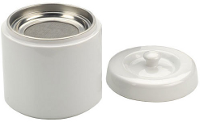
Best:   Bacon squeezins.  Put leftover bacon grease in this sort of screened thing


and then fish it back out.


Tallow/Lard if i am out of bacon squeezins


Coconut oil if i am out of tallow/lard


Awful:  grapeseed oil  the pan gets a weird sort of sticky.

flax seed oil the seasoning flakes off into your food - gross!

olive oil should be used for raw eating only - never heat it

butter   I cook with a little from time-to-time for fun, but i never let the pan get too hot.  I'm not sure, but i think it does not make a proper seasoning layer


What do you use/avoid?

 
pollinator
Posts: 531
Location: Klumbis Oh Hah, Zone 6
239
  • Likes 6
  • Mark post as helpful
  • send pies
    Number of slices to send:
    Optional 'thank-you' note:
  • Quote
  • Report post to moderator
I try to use stuff with a higher smoke point (canola oil and coconut oil have higher smoke points than olive oil or animal fats, I believe; I once learned that flaxseed oil has the highest smoke point? Not sure if I'm remembering correctly) but really I just use whatever type of oil was in it most recently or whatever's at hand.

BTW I don't mind heating olive oil, like if I'm adding it to a sauce, but I try not to use it for sauteing or frying, at least not without mixing it with a different oil that has a higher smoke point. I do sometimes break this rule, like if I saute fresh salmon in a mix of olive oil and butter though, because that's plain delicious.
 
Steward of piddlers
Posts: 7980
Location: Upstate New York, Zone 5b, 43 inch Avg. Rainfall
4619
monies home care dog fungi trees chicken food preservation cooking building composting homestead
  • Likes 8
  • Mark post as helpful
  • send pies
    Number of slices to send:
    Optional 'thank-you' note:
  • Quote
  • Report post to moderator
I primarily utilize animal fats (Tallow) for seasoning my pans but that is because I have it readily available most of the time. I render my own fats from the local butcher to keep on hand periodically.

I've read about some chatter worrying about animal fats going rancid on cast iron but if it is properly polymerized, I don't see that as something that needs to be worried about. I have never had any ill effects utilizing tallow on my cookware for seasoning purposes.
 
master steward
Posts: 8748
Location: southern Illinois, USA
3630
goat cat dog chicken composting toilet food preservation pig solar wood heat homestead composting
  • Likes 4
  • Mark post as helpful
  • send pies
    Number of slices to send:
    Optional 'thank-you' note:
  • Quote
  • Report post to moderator
Bacon tops my list. This is especially true for cast iron seeing regular use.
 
pollinator
Posts: 764
Location: South West France
289
  • Likes 12
  • Mark post as helpful
  • send pies
    Number of slices to send:
    Optional 'thank-you' note:
  • Quote
  • Report post to moderator
Well, living in south west France where geese and ducks reign supreme, you won't be too astonished to find that it is a well used fat for cooking in my house, followed by olive oil and butter.  I also keep all fats from any roasting meat including chickens as well as bacon and sausage fat.  It stays in a jar by the stove to be used when and if needed.  In the Mediterranean basin, olive oil has been used for centuries for frying, salad dressing even baking.  Different variety and grades of olive oils for different purposes.  We have no problems with high smoking point and have quite a few centenarians to prove it !!  Having spent some time in India and Burma, I make my own ghee, which incidentally has a very high smoking point.

I never use coconut oil, it is not indigenous and packs a hell of a food mile.  As for flaxseed oil, that's the stuff my grandmother used to force a spoon of down our gob when we were kids, to improve our liver function and bowel movements!  So no thanks!!

Of course it goes without saying that cast iron cooking pots and skillets have been the norm in my life, for as long as I can remember.  Gran would not have had it any other way.
 
master gardener
Posts: 6609
Location: Carlton County, Minnesota, USA: 3b; Dfb; sandy loam; in the woods
4026
8
forest garden trees books chicken food preservation cooking fiber arts seed woodworking homestead ungarbage
  • Likes 6
  • Mark post as helpful
  • send pies
    Number of slices to send:
    Optional 'thank-you' note:
  • Quote
  • Report post to moderator
Peanut oil seems to work fine in my kitchen. I used something more exotic once twenty years ago when someone suggested it and it left a tacky coating on everything that had to be scratched off with steel wool. I wonder if it was grape seed oil.
 
steward and tree herder
Posts: 13973
Location: Isle of Skye, Scotland. Nearly 70 inches rain a year
7647
6
transportation dog forest garden foraging trees books food preservation woodworking wood heat rocket stoves ungarbage
  • Likes 8
  • Mark post as helpful
  • send pies
    Number of slices to send:
    Optional 'thank-you' note:
  • Quote
  • Report post to moderator
I never used oil for seasoning a cast iron pan - just heat fine salt to smoking point and then wipe out and fry as normal... It was a friend who told me this and it seems to work fairly well (as long as you don't fry wet bacon.)

Would sesame oil be a good choice - that's a high temperature oil used for stir frying?
 
Posts: 10571
Location: a temperate, clay/loam spot on planet earth, the universe
3754
4
  • Likes 10
  • Mark post as helpful
  • send pies
    Number of slices to send:
    Optional 'thank-you' note:
  • Quote
  • Report post to moderator
In the far distant past, definitely bacon grease and beef tallow.

For years now we put the iron away dry and unoiled.  It's not as well seasoned as a good greasy skillet but works for us.

Most of our skillets are used daily for stove top soda breads and stirfries....they are seasoned enough for tomato sauces and fruit jams....bacon, etc is not on the menu anymore.

Heating the dry skillet to temperature and then adding the oil, then food avoids sticking problems.

This method began because we have summer carnivorous ants....tiny tiny things that love meat and meat fats....and also butter, ghee, coconut oil, peanuts....any container is fair game as they are tiny enough to try to get under a lid.  Even with dry skillets they can 'smell' the past use and if it's meat related they gather there waiting🫤

Nancy, I have not tried your salt method but will try soon.
The salt is to absorb any remaining moisture in the pan?
 
Posts: 13
Location: San Francisco, s. Belize, s Louisiana
2
hugelkultur monies forest garden
  • Likes 6
  • Mark post as helpful
  • send pies
    Number of slices to send:
    Optional 'thank-you' note:
  • Quote
  • Report post to moderator
So I have a cherished chrome plated cast iron Griswold 9-in skillet and a Wagner 6-in cast iron skillet which I really love Plus a few other larger ones. And avocado oil and olive oil or what I use mainly for seasoning these cast iron pana. Bacon grease may top my list as well but it has been mainly taken off of the menu. Let those little porkers live. And they say never heat with olive oil. Well I use olive oil. Since I gave up most carbs for breakfast because of my gallbladder and pancreas problems I have switched over to miscellaneous chopped vegetables and one single organic medium egg for breakfast and olive oil works fantastic for that. Some nice salmon? Olive oil fries up great. I have read a lot lately about how people actually do cook with olive oil. One only can eat so many salads. Of course olive oil is great and in dressing along with some vinegar. Now my partner prefers avocado oil for frying and seasoning which I have not seen mentioned here yet. She gave up the corn oil which has a very negative kind of connotation these days with GMOs and bad cholesterol. So we keep only avocado oil and lots of olive oil. Of course if I did have some bacon grease I would cook and season with it. Butter is wonderful as well But probably not for seasoning.But olive oil takes the cake for me for seasoning a pan and cooking.
 
Christopher Weeks
master gardener
Posts: 6609
Location: Carlton County, Minnesota, USA: 3b; Dfb; sandy loam; in the woods
4026
8
forest garden trees books chicken food preservation cooking fiber arts seed woodworking homestead ungarbage
  • Likes 8
  • Mark post as helpful
  • send pies
    Number of slices to send:
    Optional 'thank-you' note:
  • Quote
  • Report post to moderator
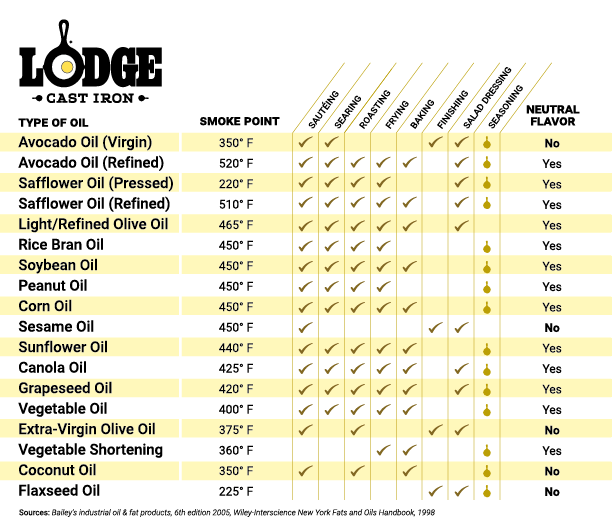
This doesn't have a Permies sensibility behind it, but Lodge cast iron says (see second-to-rightmost column):
LodgeSmokePointChart-2026-WEB-2.webp.png
Lodge opinions
Lodge opinions
 
Nancy Reading
steward and tree herder
Posts: 13973
Location: Isle of Skye, Scotland. Nearly 70 inches rain a year
7647
6
transportation dog forest garden foraging trees books food preservation woodworking wood heat rocket stoves ungarbage
  • Likes 6
  • Mark post as helpful
  • send pies
    Number of slices to send:
    Optional 'thank-you' note:
  • Quote
  • Report post to moderator

Judith Browning wrote:The salt is to absorb any remaining moisture in the pan?


I don't know what the mechanism is Judith, but that would sort of make sense. You'd have thought justheating the pan would do that too.

Christopher Weeks wrote:Lodge cast iron says


So finishing=seasoning edit-doh no - I can see the skillet icon now! No animal fats in that table. Some of those string tastes verdicts are a bit subjective. I find coconut oil quite innocuous for example (certainly compared to sesame oil). I'd have thought if the pan was seasoned properly there would be little taste left.
 
steward & author
Posts: 47660
Location: Left Coast Canada
19599
10
art trees books chicken cooking fiber arts
  • Likes 10
  • Mark post as helpful
  • send pies
    Number of slices to send:
    Optional 'thank-you' note:
  • Quote
  • Report post to moderator
There seem to be two main ways to season cast iron popular on the internet these days.

Grease it.  
This is where the high smoke temp comes in handy. Basically baking on grease.  The finish is sensitive to soap and some acids like tomatoes.  Avoid that, and it's a very practical method, easily renewed by frying more bacon.  It does not have to be a drying oil as we aren't focused on a chemical change to the oil, it just needs to have a high smoke point.

The usual method for this is high temperature seasoning for shorter time to bake or burn the oil onto the metal

Cure it
This is using an oil that polymerizes and the oil absorbs Oxygen to create a hard film.  This is far less sensitive to soaps and acids than the first method, and requies a much lower temperature and longer season time to allow the chemical reaction.  This is where flax oil shines as it crosslinks with Oxygen easily and makes the strongest bond.  But other drying oils like walnut, safflower, sunflower...work.  note, these oils don't need a high smoke point because once the chemistry is completed, they become something different - no longer oil - that can withstand high heat without harming the humans.   Where one needs to be careful is to make sure there is no excess oil after the seasoning part.  

The usual method for this is to heat to 200f or less for about an hour, usually, leaving it in a closed oven overnight to slow cooling.

The cured seasoning can be brittle over time if one is enthusiastic with the cooking.  The cure (pun intended) for that is to combine the two methods and cook more bacon more often.  This one is my preference.


Which is better?  Which is more permie?

I don't know.  

I know what I like from expierence.   That doesn't make it better.

I also know that most discussions on this topic over the life of the internet forget there are two different mechanisms used to season cast iron and a lot of confusion has come from this over the years.
 
steward
Posts: 19301
Location: USDA Zone 8a
4866
dog hunting food preservation cooking bee greening the desert
  • Likes 10
  • Mark post as helpful
  • send pies
    Number of slices to send:
    Optional 'thank-you' note:
  • Quote
  • Report post to moderator

Nancy Reading wrote:I never used oil for seasoning a cast iron pan - just heat fine salt to smoking point and then wipe out and fry as normal... It was a friend who told me this and it seems to work fairly well (as long as you don't fry wet bacon.)

Would sesame oil be a good choice - that's a high temperature oil used for stir frying?


Salt is how my mother taught me to cook non-stick with.

We had a "bag" (piece of cotton material with 1 tablespoon of salt and tied with cotton string or thread).  This salt bag was rubbed inside the pan once the pan was hot. We never had anything stick.  It has been too long to say what we cooked though I am thinking eggs ...
 
Christopher Weeks
master gardener
Posts: 6609
Location: Carlton County, Minnesota, USA: 3b; Dfb; sandy loam; in the woods
4026
8
forest garden trees books chicken food preservation cooking fiber arts seed woodworking homestead ungarbage
  • Likes 7
  • Mark post as helpful
  • send pies
    Number of slices to send:
    Optional 'thank-you' note:
  • Quote
  • Report post to moderator

Nancy Reading wrote:

Christopher Weeks wrote:Lodge cast iron says


I'd have thought if the pan was seasoned properly there would be little taste left.


I think that table is doing multiple service rather than all dedicated to just seasoning the pans. I agree that the flavor shouldn’t matter once it has been polymerized.
 
Posts: 938
Location: Sierra Nevada foothills, 350 m, USDA 8b, sunset zone 7
230
  • Likes 9
  • Mark post as helpful
  • send pies
    Number of slices to send:
    Optional 'thank-you' note:
  • Quote
  • Report post to moderator
The discussion revolves around fats, but sugars in vegetables make wonderful seasoning.
Around 20 years ago, I was unhappy with my Lodge skillet performance, as everything was sticking to it, despite being seasoned several times with fats. For the first time I fried some vegetables and everything stuck badly. When started scratching with metal spatula to remove the charred residue, the skillet became an order of magnitude less sticky and it was improving with more vegetable frying.
Fry various things and be aggressive with scraping.
 
Rusticator
Posts: 9910
Location: Missouri Ozarks
5487
7
personal care gear foraging hunting rabbit chicken cooking food preservation fiber arts medical herbs homestead
  • Likes 11
  • Mark post as helpful
  • send pies
    Number of slices to send:
    Optional 'thank-you' note:
  • Quote
  • Report post to moderator
I use tallow or lard. We used to use peanut oil, but a family friend who occasionally comes to visit is deathly allergic. We switched because it's easier to keep track, if you don't have some pans with one and others with another, and frankly, peanut oil is a lot more expensive. Tallow & lard are interchangeable for this, so we don't have to worry about which to use. The only other oils we typically keep in the house are butter, sesame(for specific cooking methods), olive, & avocado - all also much more expensive. When I can, I also will occasionally make schmaltz, but that is not going to be used for seasoning pans.
 
gardener
Posts: 614
Location: Southern Manitoba...bald(ish) prairie, zone 3ish
341
3
transportation hugelkultur monies forest garden urban books food preservation cooking writing woodworking
  • Likes 6
  • Mark post as helpful
  • send pies
    Number of slices to send:
    Optional 'thank-you' note:
  • Quote
  • Report post to moderator
After starting to read this thread, I queried about walnut oil smoke point and came across this blog chart.  I have walnut oil on hand for oiling woods, so was curious.

From a European / North American perspective, cast iron was in use 150 years ago.  Many of the fats mentioned didn't exist or weren't in widespread use.  Something to consider is how they were used by our ancestors.  I'd expect animal fats were the primary go-to.

For some of us who weren't raised with cast iron, discussions like this can add to the trepidation, especially when sources one expects to be reputable offer conflicting advice.

Another thing that may (or may not) be relevant is a modern electric glass cooktop doesn't heat the same way as the old resistance elements.  In the old days, the switch was a rheostat that varied the resistance of the circuit, so the amount of current flowing through the heating element varied.  This created a stable heating element.  We have a glass cooktop whereby the element beneath turns on and off, depending on where we have the temperature control set.  Thus, I would expect the temperature involved rises and falls as the element is on and off.  I'm not sure whether that would have an impact with respect to seasoning cast iron.
 
We all live in a yellow submarine. Me, this cat and this tiny ad:
Homesteading and Permaculture Bundle - More than 35 Things
https://permies.com/w/235626/Homesteading-Permaculture-Bundle
reply
    Bookmark Topic Watch Topic
  • New Topic