• Post Reply Bookmark Topic Watch Topic
  • New Topic
permaculture forums growies critters building homesteading energy monies kitchen purity ungarbage community wilderness fiber arts art permaculture artisans regional education skip experiences global resources cider press projects digital market permies.com pie forums private forums all forums
this forum made possible by our volunteer staff, including ...
master stewards:
  • Carla Burke
  • John F Dean
  • Nancy Reading
  • r ransom
  • Jay Angler
  • Timothy Norton
stewards:
  • paul wheaton
  • Pearl Sutton
  • Anne Miller
master gardeners:
  • Christopher Weeks
  • M Ljin
gardeners:
  • Jim Garlits
  • thomas rubino
  • William Bronson

I think I've got an alien.

 
steward and tree herder
Posts: 13441
Location: Isle of Skye, Scotland. Nearly 70 inches rain a year
7301
6
transportation dog forest garden foraging trees books food preservation woodworking wood heat rocket stoves ungarbage
  • Likes 13
  • Mark post as helpful
  • send pies
    Number of slices to send:
    Optional 'thank-you' note:
  • Quote
  • Report post to moderator
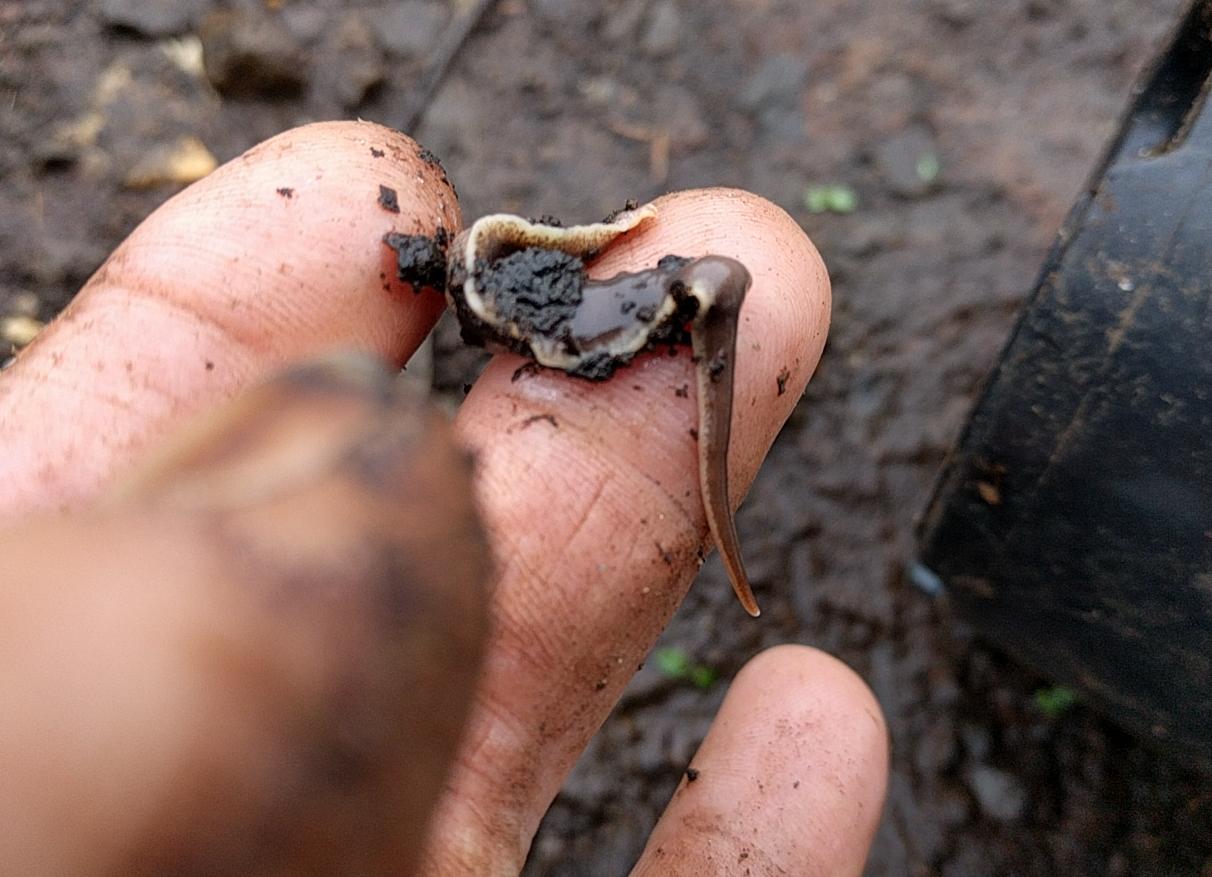
Anyone familiar with this critter? I found it today in between two bags of compost - A bit less than 2 inch when curled up, but stretched out to about 4 when I first found it. It's quite fast moving. No obvious mouth. I'm suspecting New Zealand flatworm, which is a non native to the UK creature that eats earthworms. That's all I know about it.

Can anyone confirm my diagnosis? This is the first I've seen here, but I guess there could be lots more hidden away. I've put this one in a jar until I decide what to do with it.
alien_worm.jpg
flatworm?
flatworm?
 
gardener
Posts: 1233
Location: France, Burgundy, parc naturel Morvan
585
forest garden fish fungi trees food preservation cooking solar wood heat woodworking homestead
  • Likes 17
  • Mark post as helpful
  • send pies
    Number of slices to send:
    Optional 'thank-you' note:
  • Quote
  • Report post to moderator
Definitely. It's the dreaded eater of earthworms. I don't know if this hideousness is capable of eradicating them, but it sure seems to make a dent in populations. They're on the march in France.
 
Nancy Reading
steward and tree herder
Posts: 13441
Location: Isle of Skye, Scotland. Nearly 70 inches rain a year
7301
6
transportation dog forest garden foraging trees books food preservation woodworking wood heat rocket stoves ungarbage
  • Likes 15
  • Mark post as helpful
  • send pies
    Number of slices to send:
    Optional 'thank-you' note:
  • Quote
  • Report post to moderator
Thanks Hugo

I've since done a bit of research, there's a little information about these and several other flatworms on buglife. There are also native flatworms. You're not supposed to release the exotic ones, so this one ended up crushed by my husband's boot. I found and crushed a couple of eggs near where the bags were kept, so I guess I've got at least one more worm somewhere around. The eggs are about 1/4 inch and look like a shiny blackcurrant, so quite distinctive when you see them.
Apparently the flatworm are not all bad news; they also eat slugs and snails as well as earthworms. However they can reduce the earthworm population by about 20% when their population gets going. I'm not sure whether there are any controls as yet. I suspect that birds and other small critters will eat them quite happily, so as well as looking under plant pots more often, I'll keep promoting a diverse environments for my helpful wild critters.
 
Hugo Morvan
gardener
Posts: 1233
Location: France, Burgundy, parc naturel Morvan
585
forest garden fish fungi trees food preservation cooking solar wood heat woodworking homestead
  • Likes 11
  • Mark post as helpful
  • send pies
    Number of slices to send:
    Optional 'thank-you' note:
  • Quote
  • Report post to moderator
I'm pondering and muttering thoughts out loud, spewing nonsensical factoids if you like, here before heading out on an early morning in an early heatwave. I wonder how they get to that 20%... Is that after one infestation of the 5 big species on the move or is that after all 5 have moved in.. But as it's all we've got what would that do i wonder? It will take mulch longer to break down. It will still happen... But slower. Do they eat smaller ones? I think they might hunt smaller ones first. Will the earthworms learn to fight back? How about some earth worm Krav-Maga course this summer.. (joke) Don't the bigger worms eat a bigger percentage of the mulch? Then it makes not such a big dent.
I guess there is nothing we , a few thousand Permie minded folk can do against them. Compost and plants keep on getting imported. And once in, they have up to 3 generations a year, they're hermaphrodites and some can even split themselves. Aliens... The RHS said plant swaps are another cause of the spread.
They'll take their place in the ecosystems i guess whatever we do. Maybe we should look at it this way, preventive plant more pioneer species of trees to up the leaf litter bio mass in anticipation of them arriving. I'm doing an experiment with aspen trees this year. I found a little grove and have gone in in autumn and ripped out some root to propagate. It's sprouting beautifully and i'll incorporate it into edible food hedges/wind blocks i'm installing.
 
master gardener
Posts: 6435
Location: Carlton County, Minnesota, USA: 3b; Dfb; sandy loam; in the woods
3884
8
forest garden trees books chicken food preservation cooking fiber arts seed woodworking homestead ungarbage
  • Likes 9
  • Mark post as helpful
  • send pies
    Number of slices to send:
    Optional 'thank-you' note:
  • Quote
  • Report post to moderator
If that 20% number is reliable, I'm not sure I'd spend much effort fighting them. It sounds like a lot of work for not much gain. And how much will they reduce the slug population? They aren't really bad here yet, but as I keep improving the soil with carbon additions, they keep getting worse. I've lived where slugs were a real problem. (Of course, Hugo makes good points about all the multifaceted details.)
 
master gardener
Posts: 2567
Location: Zone 5
1508
ancestral skills forest garden foraging composting toilet fiber arts bike medical herbs seed writing ungarbage
  • Likes 8
  • Mark post as helpful
  • send pies
    Number of slices to send:
    Optional 'thank-you' note:
  • Quote
  • Report post to moderator
I’ve seen a somewhat similar species, specifically the “hammerhead worm”. There are some “invasive” earthworm species here that don’t really seem like much of a problem, but perhaps they will balance things out. I think those hammerhead worms are very creepy and try not to get too close.
 
pollinator
Posts: 592
95
  • Likes 5
  • Mark post as helpful
  • send pies
    Number of slices to send:
    Optional 'thank-you' note:
  • Quote
  • Report post to moderator
For years I have seen a few here in GA, above the fall line.  Some had that hammer head, some had round heads. Certainly not to be cuddled, as a few have neurotoxin (wear gloves)   My one ray of hope is this advice given, this could reduce jumping earthworms.   They have damaged our garden soil over a decade.

This is from UGA ag science folks:

    "Hammerhead worms (Bipalium spp.) were introduced into the U.S. in the early 1900s and have likely been in Georgia for several decades. The concern that many have with hammerhead worms is that they feed on earthworms. However, most earthworms in Georgia are introduced species as well. Because hammerhead worms feed on the invasive earthworms such as jumping worms, some believe they should be left alone. For more information on worms, please see this video from Penn State (https://www.youtube.com/watch?v=C8m119EmdDQ).

Key Points about Hammerhead Worms

Hammerhead worms are present across Georgia and in neighboring states.
It is not necessary to report sightings to your county extension office, the state extension office or the Georgia Department of Agriculture.
They are an invasive species that prey on earthworms.
There is no consensus if you should kill hammerhead worms or leave them alone.
If you find a hammerhead worm and you choose to kill it, there are several options. These include putting them in soapy water that they can’t crawl out of and crushing them to the point where there are no viable segments. Other remedies, such as salt, vinegar solution, or citrus oil also are effective. However, do not chop their bodies. This does not kill them and each piece becomes a new worm.


Links:

Interview with Dr. Nancy Hinkle (UGA Veterinary Entomologist)
L
 
pollinator
Posts: 55
Location: SW Virginia zone 7a (just moved from DFW, TX)
38
  • Likes 2
  • Mark post as helpful
  • send pies
    Number of slices to send:
    Optional 'thank-you' note:
  • Quote
  • Report post to moderator
Quick question:

Do they make good fishing bait?

If yes, then "...do not chop their bodies. This does not kill them and each piece becomes a new worm"  sounds like a way to make unlimited bait.
 
M Ljin
master gardener
Posts: 2567
Location: Zone 5
1508
ancestral skills forest garden foraging composting toilet fiber arts bike medical herbs seed writing ungarbage
  • Likes 4
  • Mark post as helpful
  • send pies
    Number of slices to send:
    Optional 'thank-you' note:
  • Quote
  • Report post to moderator
They are supposedly rather toxic and unpalatable, so I doubt they would make good fishing bait.
 
Posts: 215
61
kids urban seed
  • Likes 3
  • Mark post as helpful
  • send pies
    Number of slices to send:
    Optional 'thank-you' note:
  • Quote
  • Report post to moderator
That 20% earthworm reduction figure is genuinely worrying if it's accurate. Earthworms do so much of the heavy lifting in soil structure — losing a fifth of them would show up pretty quickly in compaction and drainage. Worth keeping an eye out for the eggs too, sounds like they're easy to spot once you know what you're looking for.
 
steward
Posts: 19013
Location: USDA Zone 8a
4815
dog hunting food preservation cooking bee greening the desert
  • Likes 3
  • Mark post as helpful
  • send pies
    Number of slices to send:
    Optional 'thank-you' note:
  • Quote
  • Report post to moderator
That picture reminded me of a tapeworm.  I would not want to find one.

Vinegar might be your friend.

 
pollinator
Posts: 1616
Location: Zone 6b
232
goat forest garden foraging chicken writing wood heat
  • Likes 2
  • Mark post as helpful
  • send pies
    Number of slices to send:
    Optional 'thank-you' note:
  • Quote
  • Report post to moderator
If they are somewhat toxic, are they safe for things like ducks to eat? (Moot point, as I can't allow my ducks to free range at this point.)
 
Nancy Reading
steward and tree herder
Posts: 13441
Location: Isle of Skye, Scotland. Nearly 70 inches rain a year
7301
6
transportation dog forest garden foraging trees books food preservation woodworking wood heat rocket stoves ungarbage
  • Likes 4
  • Mark post as helpful
  • send pies
    Number of slices to send:
    Optional 'thank-you' note:
  • Quote
  • Report post to moderator

Anne Miller wrote:That picture reminded me of a tapeworm.  I would not want to find one.


Tapeworm are in the same animal family, but are different, as they mostly live inside other animals. There are several different flatworms like these that live in soil detritus, and some that live entirely in water.

No I was not happy!
 
this tiny ad is trying to guide you away from the dark side!
Escape to a permaculture life in Montana
https://wheaton-labs.com/bootcamp
reply
    Bookmark Topic Watch Topic
  • New Topic