• Post Reply Bookmark Topic Watch Topic
  • New Topic
permaculture forums growies critters building homesteading energy monies kitchen purity ungarbage community wilderness fiber arts art permaculture artisans regional education skip experiences global resources cider press projects digital market permies.com pie forums private forums all forums
this forum made possible by our volunteer staff, including ...
master stewards:
  • Carla Burke
  • Nancy Reading
  • John F Dean
  • r ransom
  • Jay Angler
  • Timothy Norton
stewards:
  • paul wheaton
  • Pearl Sutton
  • Tereza Okava
master gardeners:
  • Christopher Weeks
  • M Ljin
gardeners:
  • thomas rubino
  • Jeremy VanGelder
  • Megan Palmer

Are you interested in building a rocket mass heater? What is holding you back?

 
steward
Posts: 18680
Location: USDA Zone 8a
4731
dog hunting food preservation cooking bee greening the desert
  • Likes 6
  • Mark post as helpful
  • send pies
    Number of slices to send:
    Optional 'thank-you' note:
  • Quote
  • Report post to moderator
I have loved learning about RMH and would love to have one.

If only I lived in a bigger house...

I guess I could get some #5 cans and fashion one out in the yard though that would only be a rocket stove.

 
pollinator
Posts: 1071
Location: Inter Michigan-Superior Woodland Forest
208
7
transportation gear foraging trees food preservation bike building solar writing woodworking wood heat
  • Likes 5
  • Mark post as helpful
  • send pies
    Number of slices to send:
    Optional 'thank-you' note:
  • Quote
  • Report post to moderator

Glenn Herbert wrote:Code even says that a masonry heater needs to be supported directly by masonry piers or foundation and not wood


What is the code that covers this?
 
Posts: 11
Location: Dundas ON near Hamilton KG climate Dfa, HZ 6a, 44dN, 320ft asl
3
dog trees wood heat
  • Likes 7
  • Mark post as helpful
  • send pies
    Number of slices to send:
    Optional 'thank-you' note:
  • Quote
  • Report post to moderator

Glenn Herbert wrote:Heating rooms distant from the heater location could be tricky, and we can only advise usefully with a floor plan of some sort and/or good pictures.


I'd like to do that tho it feels like leaning on you'all quite a bit.
As for  no wood floor under a RMH that sets me back, not even with a sheetmetal barrier like I have under my woodstove?
 
Posts: 4
2
  • Likes 6
  • Mark post as helpful
  • send pies
    Number of slices to send:
    Optional 'thank-you' note:
  • Quote
  • Report post to moderator

Glenn Littman wrote:...What is holding you back?


I live in Maryland and I would love to connect with someone who can help me build one. I can't put it in my house but I want to build it outside (maybe build a structure around it) and connect a heat pump to it to heat my house in winter. I have an unlimited wood supply.
 
Posts: 880
Location: Sierra Nevada foothills, 350 m, USDA 8b, sunset zone 7
208
  • Likes 5
  • Mark post as helpful
  • send pies
    Number of slices to send:
    Optional 'thank-you' note:
  • Quote
  • Report post to moderator

Ian Graham wrote:As for  no wood floor under a RMH that sets me back, not even with a sheetmetal barrier like I have under my woodstove?


If the top of masonry foundation walls is close to the floor level, you could place steel rails diagonally in the corner and build a concrete pad. This solution is used in Europe when building a masonry heater in the room corner when the floor is too weak to carry such a load.
 
Posts: 169
Location: Nova Scotia
36
  • Likes 8
  • Mark post as helpful
  • send pies
    Number of slices to send:
    Optional 'thank-you' note:
  • Quote
  • Report post to moderator
Barriers to starting:
-we have a high efficiency woodstove installed;
-good access to hardwood cordwood; less effective access to small stuff
-intimidated by evolving abbreviations & terminology (J-tube, K-tube, riser, bell...);  a pegged glossary/wikidictionary would help
-enjoy view of flames and intimidated by options to install a window
-confusion over naming & accessibility of supplies (refractory brick, clay for cob, insulation etc.)
-until recently, limited time; cob construction looks fun in timelapse youtube, not sure about irl

I may still try something next spring.
 
Posts: 9
Location: Southeastern PA
5
  • Likes 6
  • Mark post as helpful
  • send pies
    Number of slices to send:
    Optional 'thank-you' note:
  • Quote
  • Report post to moderator

John C Daley wrote:In Australia I am held back by lack of concrete information.
I habe been advised by members on this site about what type and size I need to build.
But detailed information about build plans are very hard to find.
I have ascertained from batchheater.eu what dimensions I need but that is all.
I would love detais for a 125mm [ 5 inch] batch rocket  unit.


This is the issue I am facing (here in Pennsylvania USA in 2026). I have purchased several books (some through permies) and watched many videos (some through permies), and I'm still having a hard time finding concrete information laid out for a newbie. I'm a handyman/carpenter by trade, so I know how to use tools and a tape measure. What I need is a detailed set of drawings of how to make one of these things out of fire bricks. It doesn't inspire a lot of confidence in the product to have a bunch of people experimenting on camera saying, "You can build this!".

Half the websites dedicated to rocket stoves are defunct--even ernieanderica.info takes me to some foreign landing page with a soccer ball on it. It seemed Ernie and Erica were the go-to people.

A lot of the permies RMH videos talk about a "shippable core". I'd love to get my hands on one of those, but where? Did the kickstarter lose steam and no one bothered to update the published information on permies?

The only real plans I've seen are the batchrocket.eu plans, and even those have limitations (I have to interpret a Sketchup drawing on a free website).

Am I missing something here in 2026? Please tell me I am!, cuz I'm hoping to build a RMH (batch box style) this summer. But maybe I'm asking too much at this stage--just hoping for it to be less experimental, I guess.
 
Posts: 19
4
forest garden fungi bee
  • Likes 6
  • Mark post as helpful
  • send pies
    Number of slices to send:
    Optional 'thank-you' note:
  • Quote
  • Report post to moderator
Hi, interesting thread and great question.

I have been wanting to build a RMH for a while now,
even though I have a tiny tiny house in a rather hot climate. We do have cold winters (night time moslty).

The thing that holds me back to embark, besides lack of time and all such things
is the materials.

I would love to build one where I do not have to use the special heat resistant whatchamacallit for the core.
I _do_ understand why it's needed, but always end up taking a liiiitle time (which I lack) to try to find alternatives
or find what they used in the mass heaters in central/northish Europe.
They did not have those materials back then, but I did not find any good resources yet on how they build their kachelovens or masonry heaters.

I bet there's tons of info out there, I just always end up looking over it, or again, lacking time to do the research proper.

Another material-related thing is the insulation below the RMH.
The floor is basically a big boulder/rock, and initialy I had not given it any thought to have insulation and build the RMH on top of it.
Now that I know that, I find myself thinking about a thick layer of wool, with all the questions that brings with it.

So not lack of space or time to build, more analysis-paralysis about the materials and being stubborn on the core super tech material...

One day!


Cristobal Cristo
Posts: 880
Location: Sierra Nevada foothills, 350 m, USDA 8b, sunset zone 7
208
  • Likes 7
  • Mark post as helpful
  • send pies
    Number of slices to send:
    Optional 'thank-you' note:
  • Quote
  • Report post to moderator
Dalo,

You just use the firebricks for the core and it will work. If you insulate the riser, it will work better and if you build the upper part of the riser from insulating bricks, it will work even better. It can evolve further into building entire core from insulating material, but it's impractical, due to its fragility and softness, so the compromise is chosen - hard firebox and soft upper part of the riser.
Before the invention of modern firebricks in late XIX century, regular bricks and cob were used for the purpose of building heaters. Even in older times people were aware that some clays are more refractory than others and various bricks were used for various tasks.
And now it's easy to purchase quality and uniform refractory material.
 
dalo franss
Posts: 19
4
forest garden fungi bee
  • Likes 7
  • Mark post as helpful
  • send pies
    Number of slices to send:
    Optional 'thank-you' note:
  • Quote
  • Report post to moderator
Hi Cristobal!

Thanks for your splendid answer, very much appreciated.

I would love to ask some follow up questions (try to keep it short)

- do you just stack the firebricks? or need some goop between them?
- insulating the riser with rock wool or is that too low temp stuff?
- the top insulating bricks that's that funny whatchamacallit white material right?

Yes, evolve, my intention is to build one which can be "easily" disassembled and upgraded,
and builing the first one outside.

Darnit, now i have less excuses, and want to start building :)
Perfect ! I love this forum!
 
Cristobal Cristo
Posts: 880
Location: Sierra Nevada foothills, 350 m, USDA 8b, sunset zone 7
208
  • Likes 7
  • Mark post as helpful
  • send pies
    Number of slices to send:
    Optional 'thank-you' note:
  • Quote
  • Report post to moderator

dalo franss wrote:- do you just stack the firebricks? or need some goop between them?


If you dry stack brick, thermal expansion will quickly move them around and will open the joints. It would work with a well designed tension frame, but would work better if the dry stacked bricks had thin layer of refractory wool in the joints. For testing, dry stacking will work fine, especially if brand new (straight and square dry pressed, not extruded) firebricks are used.
The brick can be mortared with:
-clay/aggregate mortar - air setting; can be reused
-or hydraulic mortar - water setting based on alumina cement; can not be reused
Tension frame is a good addition even if mortars are used.

dalo franss wrote:- insulating the riser with rock wool or is that too low temp stuff?


Outside of the riser the temperatures are much lower than inside. for example a brick that is almost too hot to the touch at 70 C, it will be 450 C on the fire side. i do not know if people use it, but I think it would work.

dalo franss wrote:- the top insulating bricks that's that funny whatchamacallit white material right?


Yes. They are insulating bricks. There exist various kinds and not all of them are designed to work in the flame path (perlite or calcium-silicate).
The most popular insulating firebrick ARE designed to work in the flame path. For riser it's recommended to use IFB-2600, rated to 2600 F. They can be purchased at well stocked refractory supplier for $6 a piece (US made).

dalo franss wrote:Yes, evolve, my intention is to build one which can be "easily" disassembled and upgraded,
and builing the first one outside.


Building a prototype outside is the best approach. You will learn a lot and risk nothing.
 
Posts: 50
9
  • Likes 6
  • Mark post as helpful
  • send pies
    Number of slices to send:
    Optional 'thank-you' note:
  • Quote
  • Report post to moderator
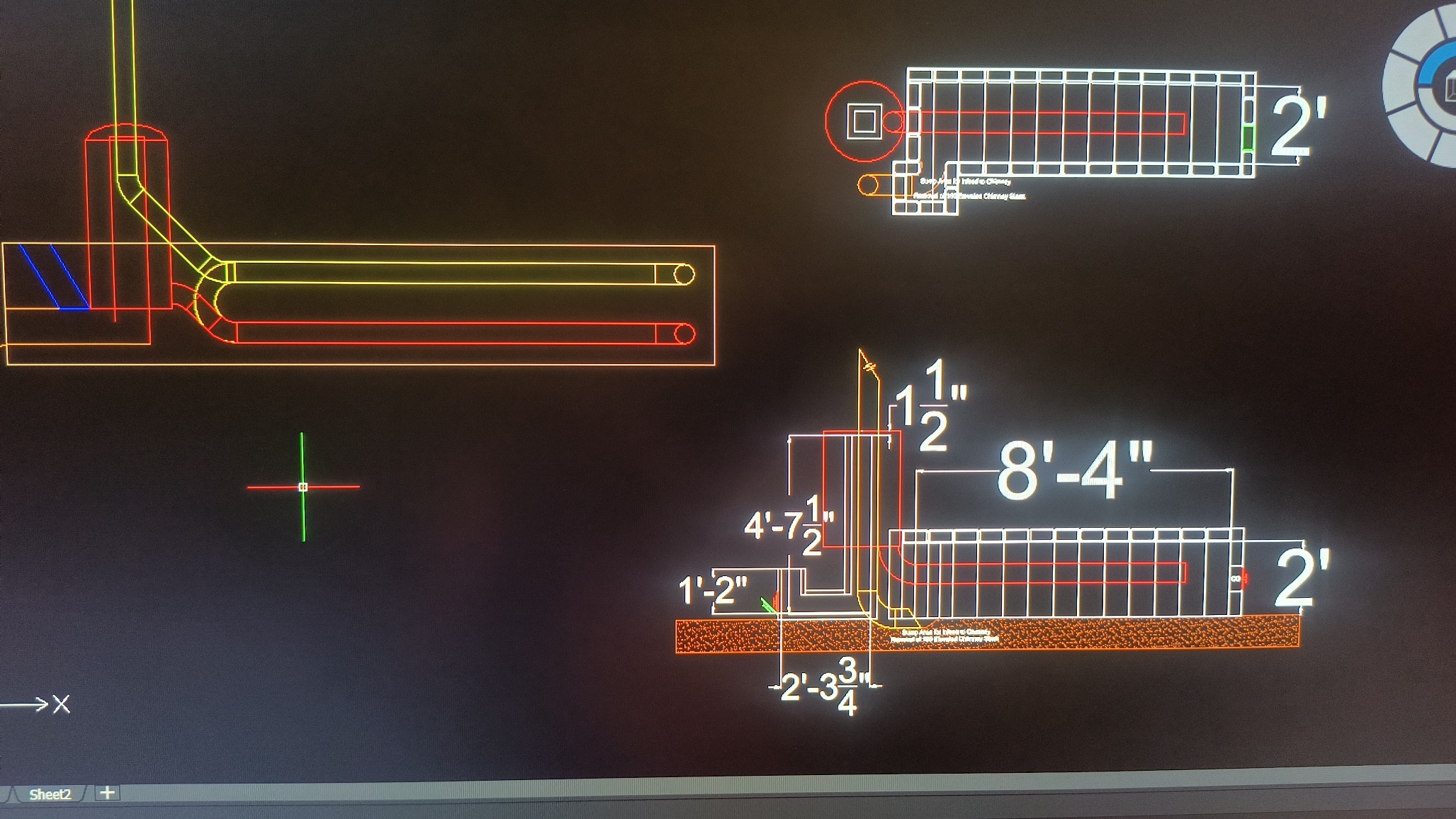
I have drawn up a plan for one for our place in Arkansas Mountains, but have Not begun yet. I have a question about the Mass Heater portion of pipe. Does the pipe have to be perfectly horizontal, as I have it drawn with slight incline for each leg, which brings me to the 2nd question. I have approximately 32 feet before chimney entrance which is approximately 30' but have 3 180 deg turns as I have 4 runs drawn into the bench area, with chimney near combustion chamber barrel to help draw. Is this too much length. Please see illustration. Pipe is 6" w/ 1/8" wall
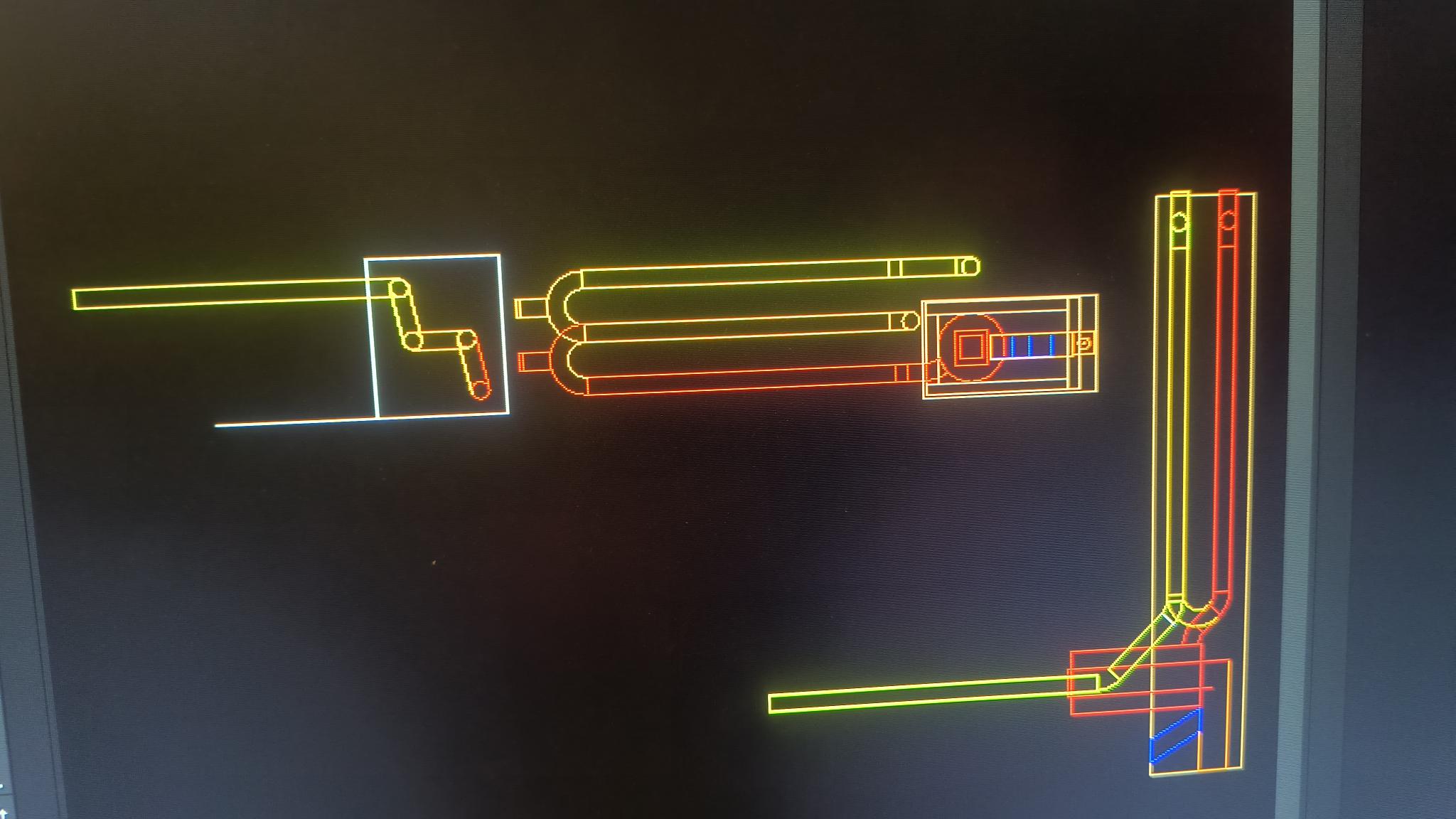
RMH-Pipe-System.png
[Thumbnail for RMH-Pipe-System.png]
 
Rocky Massengale
Posts: 50
9
  • Likes 4
  • Mark post as helpful
  • send pies
    Number of slices to send:
    Optional 'thank-you' note:
  • Quote
  • Report post to moderator

Rocky Massengale wrote:I have drawn up a plan for one for our place in Arkansas Mountains, but have Not begun yet. I have a question about the Mass Heater portion of pipe. Does the pipe have to be perfectly horizontal, as I have it drawn with slight incline for each leg, which brings me to the 2nd question. I have approximately 32 feet before chimney entrance which is approximately 30' but have 3 180 deg turns as I have 4 runs drawn into the bench area, with chimney near combustion chamber barrel to help draw. Is this too much length. Please see illustration. Pipe is 6" w/ 1/8" wall

. I need a little advise for this configuration considered before commencement of construction.
RMH4.jpg
Better depiction showing orientation of Bench/Mass Piping
 
Rocky Massengale
Posts: 50
9
  • Likes 4
  • Mark post as helpful
  • send pies
    Number of slices to send:
    Optional 'thank-you' note:
  • Quote
  • Report post to moderator

Rocky Massengale wrote:

Rocky Massengale wrote:I have drawn up a plan for one for our place in Arkansas Mountains, but have Not begun yet. I have a question about the Mass Heater portion of pipe. Does the pipe have to be perfectly horizontal, as I have it drawn with slight incline for each leg, which brings me to the 2nd question. I have approximately 32 feet before chimney entrance which is approximately 30' but have 3 180 deg turns as I have 4 runs drawn into the bench area, with chimney near combustion chamber barrel to help draw. Is this too much length. Please see illustration. Pipe is 6" w/ 1/8" wall

. I need a little advise for this configuration considered before commencement of construction.

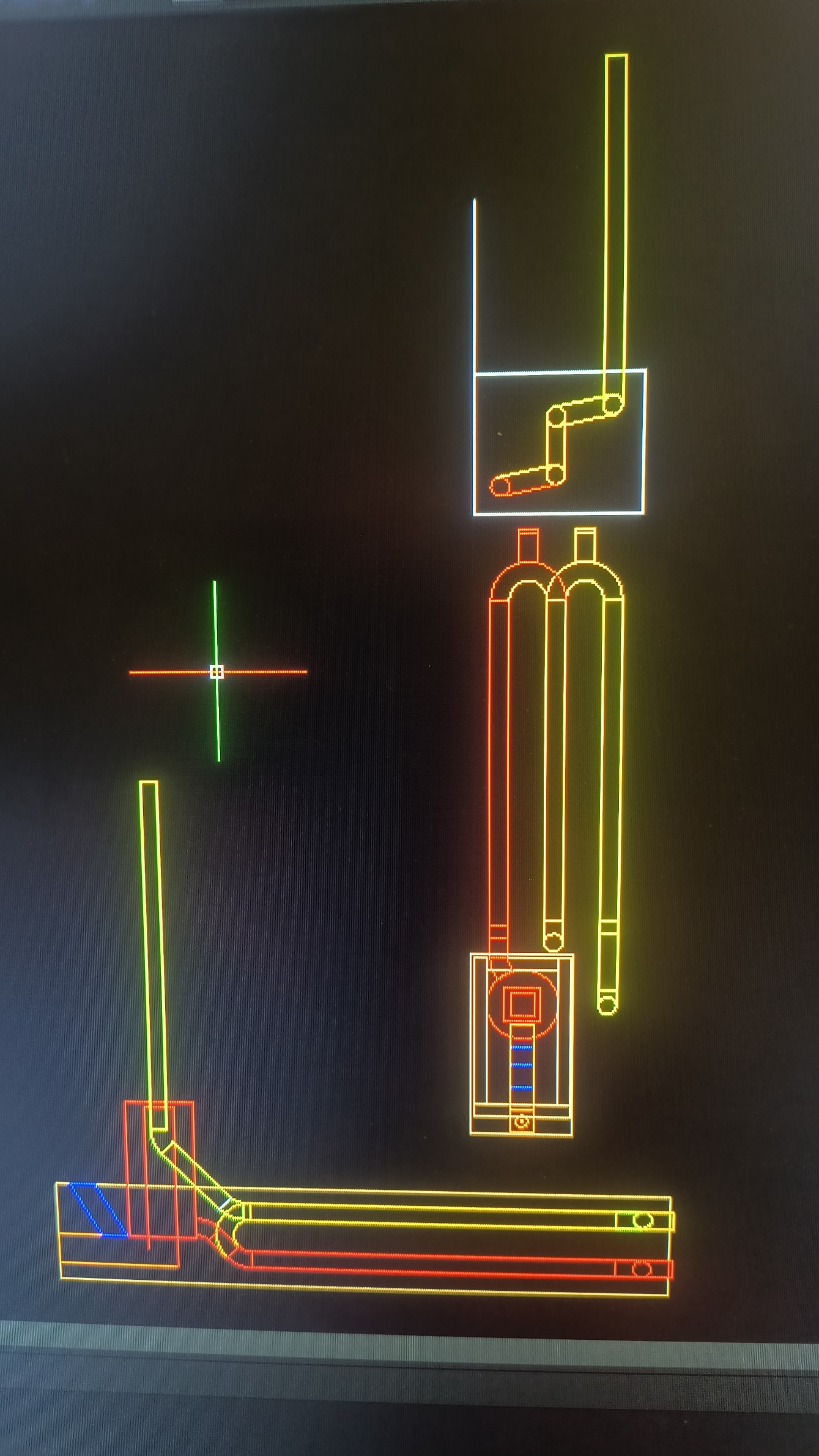
You can see that center section is vertical whereas the feed section from combustion into it is slightly angled and discharge end is slightly angled to provide draw to chimney. Feasible ?

Advise on design would be muchly appreciated
 
Rocky Massengale
Posts: 50
9
  • Likes 6
  • Mark post as helpful
  • send pies
    Number of slices to send:
    Optional 'thank-you' note:
  • Quote
  • Report post to moderator

Rocky Massengale wrote:

Rocky Massengale wrote:

Rocky Massengale wrote:I have drawn up a plan for one for our place in Arkansas Mountains, but have Not begun yet. I have a question about the Mass Heater portion of pipe. Does the pipe have to be perfectly horizontal, as I have it drawn with slight incline for each leg, which brings me to the 2nd question. I have approximately 32 feet before chimney entrance which is approximately 30' but have 3 180 deg turns as I have 4 runs drawn into the bench area, with chimney near combustion chamber barrel to help draw. Is this too much length. Please see illustration. Pipe is 6" w/ 1/8" wall

. I need a little advise for this configuration considered before commencement of construction.

You can see that center section is vertical whereas the feed section from combustion into it is slightly angled and discharge end is slightly angled to provide draw to chimney. Feasible ?

Advise on design would be muchly appreciated

 I forgot to mention that cleanouts have been added at 180's to clean out Horizontal runs, and that Barrel is Schedule 20 SS 24" pipe 36" long will be building manifold as suggested with IFB-2600 Brick and wrapping with perlite to about 2 - 2 1/2" from the barrel cap at top.
RMH5.png
Showing clean outs
Showing clean outs
 
master pollinator
Posts: 2122
Location: Ashhurst New Zealand (Cfb - oceanic temperate)
728
duck forest garden fungi trees chicken cooking solar sheep wood heat woodworking rocket stoves
  • Likes 8
  • Mark post as helpful
  • send pies
    Number of slices to send:
    Optional 'thank-you' note:
  • Quote
  • Report post to moderator
The design looks workable, but most builders are now opting to make a stratification chamber instead of a piped mass. The main advantages are less flow restriction and susceptibility to ash blockage, as well as being easier to clean out when necessary.
 
Rocky Massengale
Posts: 50
9
  • Likes 3
  • Mark post as helpful
  • send pies
    Number of slices to send:
    Optional 'thank-you' note:
  • Quote
  • Report post to moderator
Are you saying that another large chamber like what the one with j firebox n manifold are in? To take the discharge of that into another chamber at say mid level and then allow the heat to stratify and discharge to chimney near bottom ? OR SOMETHING ELSE ? ARE THERE PICTURES OR DRAWINGS AVAILBLE SOMEWHERE ?
 
Rocky Massengale
Posts: 50
9
  • Likes 3
  • Mark post as helpful
  • send pies
    Number of slices to send:
    Optional 'thank-you' note:
  • Quote
  • Report post to moderator
By the way phil,
Thanks for responding ?
 
Rocket Scientist
Posts: 4763
Location: Upstate NY, zone 5
707
5
  • Likes 12
  • Mark post as helpful
  • send pies
    Number of slices to send:
    Optional 'thank-you' note:
  • Quote
  • Report post to moderator
Yes, a stratification chamber or "bell" is just a hollow brick box with the combustion core feeding into it, and the exit to the chimney leaving from near the bottom of the cavity. The new hot air rises, gives its heat to the brick box, and falls as it cools. The coolest air ends up at the bottom where it leaves for the chimney. The internal surface area of the box needs to be sized to extract the right amount of heat for best operation, per instructions at batchrocket.eu.
 
pollinator
Posts: 550
78
  • Likes 8
  • Mark post as helpful
  • send pies
    Number of slices to send:
    Optional 'thank-you' note:
  • Quote
  • Report post to moderator
Rocky, I am a beginner,
but  one thing i  have learned:  the long runs with 180s are not optimum. Too much friction for exit gasses I think.

A bell (or stratification chamber)is superior, and can be cob or brick or even made using earth, in a pinch.  
 
Rocky Massengale
Posts: 50
9
  • Likes 4
  • Mark post as helpful
  • send pies
    Number of slices to send:
    Optional 'thank-you' note:
  • Quote
  • Report post to moderator
Thanks Rico
i have received loud n clear !
 
Posts: 16
3
  • Likes 6
  • Mark post as helpful
  • send pies
    Number of slices to send:
    Optional 'thank-you' note:
  • Quote
  • Report post to moderator
I haven't found the perfect setup and the aesthetics of the current models make me hesitate. I lost the information for the man who has built a system that can be purchased and completed at home. It had the option for an oven. He uses brick for the heating systems. There was a video where he came to a customer's home and helped build it but I lost that link. I think if it was done with brick like some of the Russian/Eastern European videos we see I'd be more willing. Our homestead land has some smaller trees but is not a big forested area so a rocket type stove is ideal but the actual look isn't palatable.

There's a YT channel that has Medieval techniques that I've been watching for ideas. They have some really great models that have been lost through time.

BTW I did buy the rocket series DVDs that Paul Wheaton put out to see if anything new was coming down the pike.
 
Rocky Massengale
Posts: 50
9
  • Likes 2
  • Mark post as helpful
  • send pies
    Number of slices to send:
    Optional 'thank-you' note:
  • Quote
  • Report post to moderator
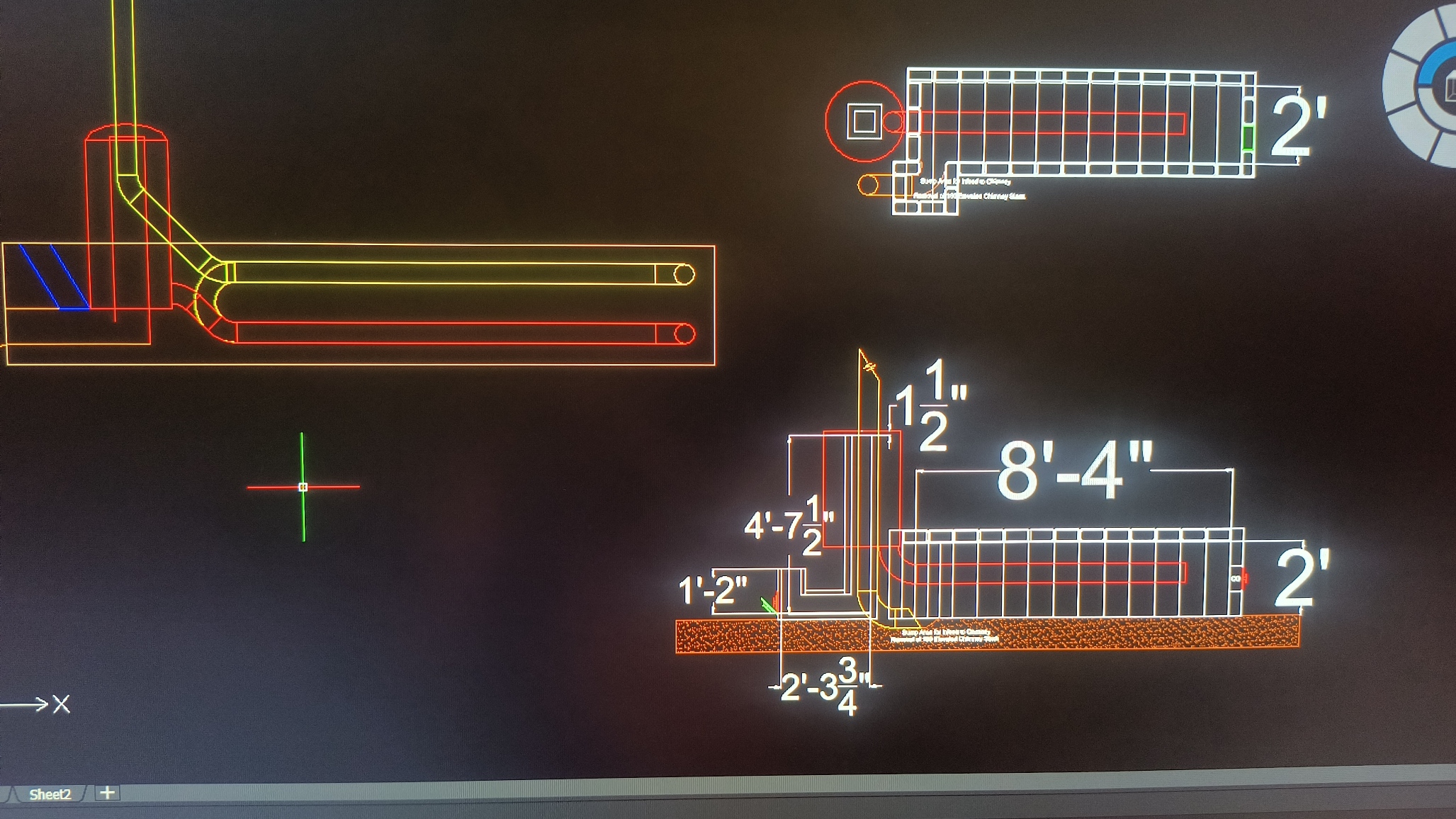
Thanks Sandy, Still working out Details for the Upcoming build !
Revisions-to-Bell.jpg
Have come a long Way from original Design with Pipe run (Left)
 
master rocket scientist
Posts: 7058
Location: latitude 47 N.W. montana zone 6A
4155
cat pig rocket stoves
  • Likes 8
  • Mark post as helpful
  • send pies
    Number of slices to send:
    Optional 'thank-you' note:
  • Quote
  • Report post to moderator
Here is a link to Matt Walker's stoves
https://walkerstoves.com/
He sells brick-by-brick plans for cook stoves, water heaters, BBQ's, and more.

This is probably Sandy's lost link.
Matt used to travel to build but I think he has stopped doing that.
 
Rocky Massengale
Posts: 50
9
  • Likes 7
  • Mark post as helpful
  • send pies
    Number of slices to send:
    Optional 'thank-you' note:
  • Quote
  • Report post to moderator
Thanks Tom,
I hope it helps Sandy, at least my communiques with (Rocket Scientists) about details for a solid build that functions well ! I am a hands-on guy and want to build my RMH myself, I have been in construction most of my life (Residential, Commercial and Industrial), I am not familiar with RMH construction but asking and acquiring all information possible to "get her Done" . I am confident that after all the videos/research/questions asked and answered, that I can create a great RMH at my place that I am in process of building !  
Cabin.png
cabin in Process
cabin in Process
Revisions-to-Bell.jpg
Changed from original Pipe design System to Bell system
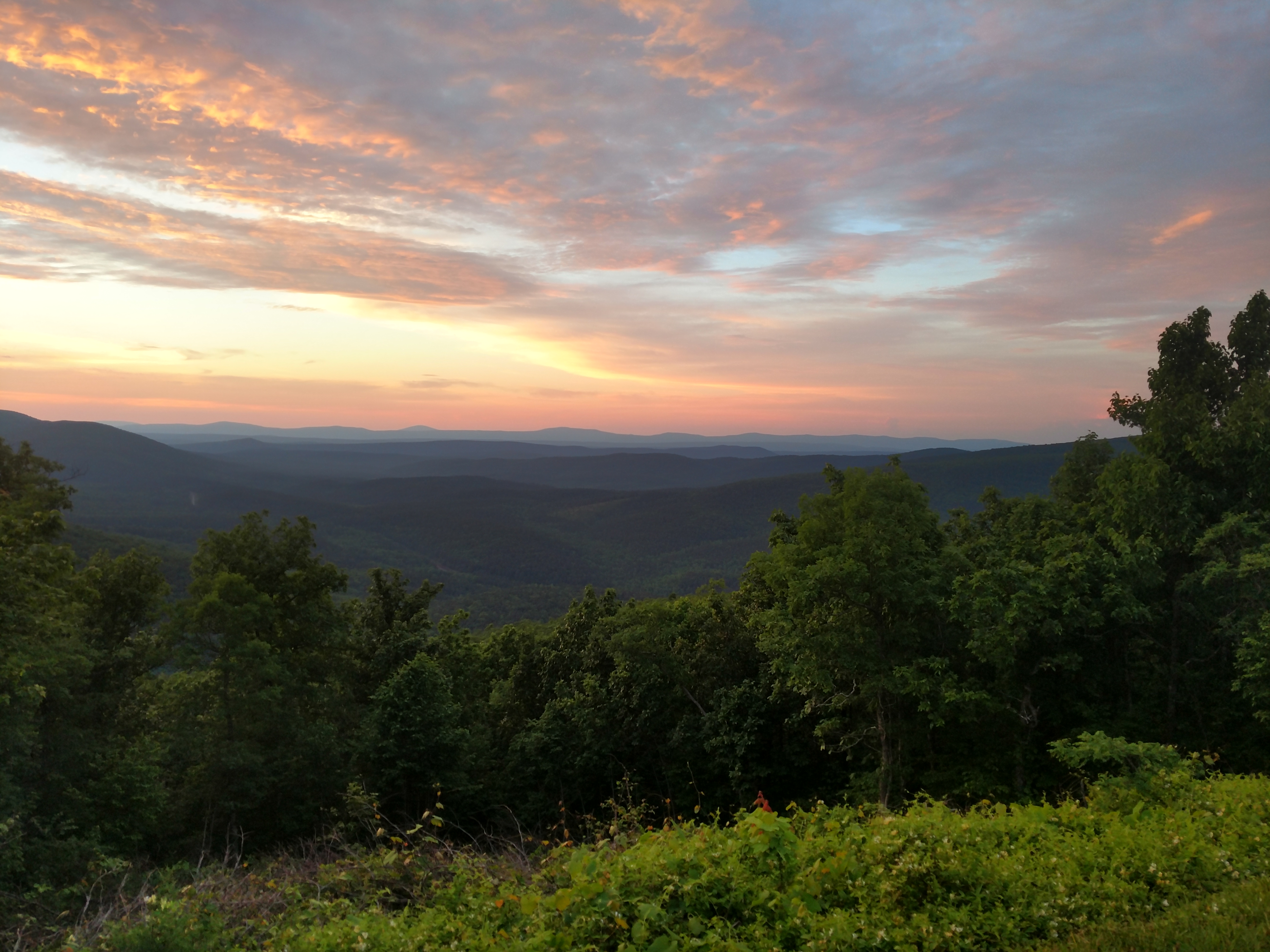
IMG_20180525_202138211_HDR.jpg
Our Area of Arkansas
 
Rocky Massengale
Posts: 50
9
  • Likes 3
  • Mark post as helpful
  • send pies
    Number of slices to send:
    Optional 'thank-you' note:
  • Quote
  • Report post to moderator
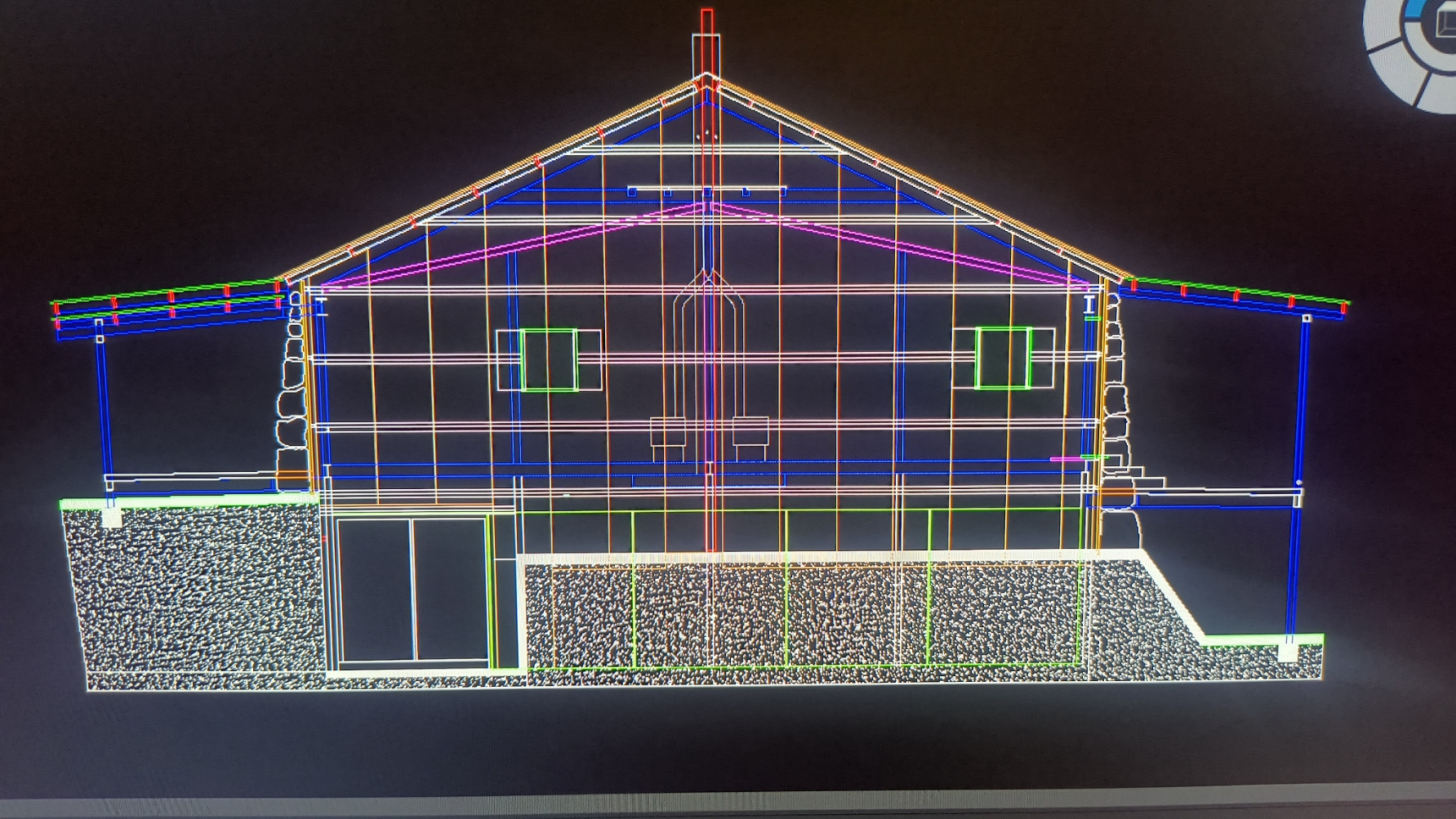
Any issues with this design for a 6" system ?
Rev-5-.png
Please Review and Advise
 
Glenn Herbert
Rocket Scientist
Posts: 4763
Location: Upstate NY, zone 5
707
5
  • Likes 9
  • Mark post as helpful
  • send pies
    Number of slices to send:
    Optional 'thank-you' note:
  • Quote
  • Report post to moderator
An important thing to be aware of is that a J-tube system has much less power for the size than a batch box. It has been found that an 8" J-tube is roughly equivalent to a 6" batch box in rate of heat delivered, so using the bell size for a 6" batch box needs an 8" J-tube to heat it adequately.

My experience is that in a space/chimney with good natural draft, an 8" J-tube is well served with a 6" final chimney leaving the bell.
 
Rocky Massengale
Posts: 50
9
  • Likes 2
  • Mark post as helpful
  • send pies
    Number of slices to send:
    Optional 'thank-you' note:
  • Quote
  • Report post to moderator
Good Info will Redesign for an 8" can I still use a 6" chimney pipe discharge ? i already own it !
Cabin.png
[Thumbnail for Cabin.png]
Container-Configuration.png
[Thumbnail for Container-Configuration.png]
Final-Bell-Dimensions.png
[Thumbnail for Final-Bell-Dimensions.png]
 
Rocky Massengale
Posts: 50
9
  • Likes 2
  • Mark post as helpful
  • send pies
    Number of slices to send:
    Optional 'thank-you' note:
  • Quote
  • Report post to moderator
Apologies, i didn't finish your post until I asked the stupid question about the chimney pipe !

Am Good to go then ! the J tube was gonna be a fabrication from ceramic fiberboard and fire bricks anyway so that is Great to know BEFOREHAND !
 
Glenn Herbert
Rocket Scientist
Posts: 4763
Location: Upstate NY, zone 5
707
5
  • Likes 7
  • Mark post as helpful
  • send pies
    Number of slices to send:
    Optional 'thank-you' note:
  • Quote
  • Report post to moderator
From the look of your plan, with the chimney rising straight through the central peak of the roof, I would expect a 6" chimney to work. This assumes that you don't have weird atmospheric or environmental conditions.
 
Rocky Massengale
Posts: 50
9
  • Likes 3
  • Mark post as helpful
  • send pies
    Number of slices to send:
    Optional 'thank-you' note:
  • Quote
  • Report post to moderator
Thanks Glenn
 
Rocky Massengale
Posts: 50
9
  • Likes 7
  • Mark post as helpful
  • send pies
    Number of slices to send:
    Optional 'thank-you' note:
  • Quote
  • Report post to moderator
it will be right out The Peak, I will be living in the Mountains of Arkansas, and the wind does do some whipping around, but the stacks will be well above the ridge !
 
Rico Loma
pollinator
Posts: 550
78
  • Likes 7
  • Mark post as helpful
  • send pies
    Number of slices to send:
    Optional 'thank-you' note:
  • Quote
  • Report post to moderator
Rocky, nice sunset photo, looks like southern Ozarks. Had one trip there....my dad took me along for a 6 day paddle on the Buffalo and white rivers , i was 12.  Serene camping spots and fresh trout for supper. Good idea to build there, sir
 
Rocky Massengale
Posts: 50
9
  • Likes 7
  • Mark post as helpful
  • send pies
    Number of slices to send:
    Optional 'thank-you' note:
  • Quote
  • Report post to moderator
Thanks Rico, We Love it there, peace, quiet n solitude ! Lots of Critters, All kinds from Bear, Deer, Elk, Mountain Lions n all the rest !
 
Posts: 5
Location: Arkansas
1
dog writing ungarbage
  • Likes 9
  • Mark post as helpful
  • send pies
    Number of slices to send:
    Optional 'thank-you' note:
  • Quote
  • Report post to moderator
Researching about RMH is how I found this site!  I bought raw land, have cleared a small bit of it, and am working on house design now. Due to the terrain, I've been advised to build with a walk-out basement. My challenges re RMH include: if i put it on the main floor (the living area), what do I need to do to make sure the floor can support the weight? If I put it in the basement, how do i use the heat to heat the main floor? Is there a way to use that heat to make the main level floor like a radiant heat floor? Could i put one on both levels and have the basement chimney meet the main floor chimney to go outside?

I was planning to do the RMH that's the bench style, but after reading this thread and some other posts on here, I'm not committed to that style (the warm seating would be very nice, though).

A new-in-the-box traditional wood stove came into my life before I knew about RMH. Is there a way to utilize that as a component of a RMH?

I'm in no hurry to build this, but I need to decide what I'm going to do asap so I can incorporate it into the house plans (chimney placement re roof, support under main floor, etc). I'd like heat by winter 2026 but I've managed this past winter with wearing/sleeping under layers and heating my immediate space with candles/terracotta pots, so I'm sure I'll survive if i don't get it built before it gets cold. I want to KNOW what I'm doing before i get started on it, so i still have a lot of reading and video watching to do! And suggestions/guidance are VERY welcome!!!
 
Posts: 404
Location: North East Iowa, USA
123
  • Likes 9
  • Mark post as helpful
  • send pies
    Number of slices to send:
    Optional 'thank-you' note:
  • Quote
  • Report post to moderator

Sophie Hatter wrote:Researching about RMH is how I found this site!  I bought raw land, have cleared a small bit of it, and am working on house design now. Due to the terrain, I've been advised to build with a walk-out basement. My challenges re RMH include: if i put it on the main floor (the living area), what do I need to do to make sure the floor can support the weight? If I put it in the basement, how do i use the heat to heat the main floor? Is there a way to use that heat to make the main level floor like a radiant heat floor? Could i put one on both levels and have the basement chimney meet the main floor chimney to go outside?

I was planning to do the RMH that's the bench style, but after reading this thread and some other posts on here, I'm not committed to that style (the warm seating would be very nice, though).

A new-in-the-box traditional wood stove came into my life before I knew about RMH. Is there a way to utilize that as a component of a RMH?

I'm in no hurry to build this, but I need to decide what I'm going to do asap so I can incorporate it into the house plans (chimney placement re roof, support under main floor, etc). I'd like heat by winter 2026 but I've managed this past winter with wearing/sleeping under layers and heating my immediate space with candles/terracotta pots, so I'm sure I'll survive if i don't get it built before it gets cold. I want to KNOW what I'm doing before i get started on it, so i still have a lot of reading and video watching to do! And suggestions/guidance are VERY welcome!!!


At first it sounds like you have a clean slate design in front of you, meaning nothing is built?  So like any house, the square feet of your living space would be most helpful,  and of
course how well you plan to insulate.   But at the end you tell of staying warm enough with candles/terracotta pots.  Where is this?

Tying two stoves to one chimney is never a good idea, RMH's are generally sized to the size of your chimney. but again, if starting from scratch is your plans vs redoing something, the range is huge for what you can do.   if you have read much at all about RMH's the thought of selling your "new in the box traditional stove" but that also is just a guess, as these "stoves" could range from tiny to big, we have no idea.  It sounds like you may be shooting for total house heat? not relying on any backup, but it is not clear.   I am guessing when the group has more information, you'll get back better suggestions in kind.

Best of success.
Scott
 
Cristobal Cristo
Posts: 880
Location: Sierra Nevada foothills, 350 m, USDA 8b, sunset zone 7
208
  • Likes 12
  • Mark post as helpful
  • send pies
    Number of slices to send:
    Optional 'thank-you' note:
  • Quote
  • Report post to moderator

Sophie Hatter wrote:Researching about RMH is how I found this site!  I bought raw land, have cleared a small bit of it, and am working on house design now...


Hi Sophie,

If you have not built the house yet, this is the right moment to think about chimney and heater placement.
My recommendations:
-if you are going to build some form of gabled roof and the chimney will be masonry then it's good to place it centrally so it will exit through the ridge - you will avoid more complicated roof flashing behind the chimney
-masonry chimney can have several ducts for different heaters; the ducts can be clay flues insulated with perlite/vermiculite or double walled stainless
-it makes sense to place the heater in the central spot of the house
-if you also want to build a kitchen stove, please consider placing it on the kitchen/bathroom wall, so some small bell will also heat your bathroom
-place the heater in the room where you want the heat - basement placement, floor channels. etc. is some theory that is being discussed but I never see examples of such builds; they would be possible but much more complex and more difficult to build especially for a first time builder
-if the heater will be placed on the ground floor then prepare a properly reinforced concrete slab
-if it will be placed on an upper floor you can put it in the corner of the room (with additional diagonal floor reinforcement in that spot) or in any place if the heater pad will be supported on some columns placed on the ground level
 
Sophie Hatter
Posts: 5
Location: Arkansas
1
dog writing ungarbage
  • Likes 13
  • Mark post as helpful
  • send pies
    Number of slices to send:
    Optional 'thank-you' note:
  • Quote
  • Report post to moderator
I'm trying to figure out how to respond to individual posts. Until I do, this is it.  lol

Scott:
Nothing is built, yet, correct. No amenities...nothing. i'm in Central Arkansas in a 20-foot camper suitable for deer camp. Candles/terracotta did fine for me this winter until we had actual snow. Arkansas isn't prepared for weather like that, so it shut down the state for a week. With no way in or out, my daughter made me stay with her that week, so i don't know how well that set up would have performed with those ridiculously low temperatures. As long as the outside temperature didn't go below 20*, i could keep my immediate space at about 40*  When it was in the 40s, I could keep it as warm as 50*. (I moved to Arkansas from Ontario, Canada 5 yrs ago. I don't like cold, but I can live with it.)

The house will be ICF since i'm in tornado alley. I'm looking RMH for whole house, as I want to be as self-reliant as possible. I'm also looking at other natural sources of heat to supplement the RMH, such as capturing the heat on the south wall, though I'm still researching that, so i can't speak intelligently about it, yet. Walk-out basement will mean part of the basement will be underground and somewhat insulated that way. The square footage is 2400 on the main level, and that's what i'm most concerned about having heated. In a pinch/really nasty cold, I have electric space heaters we can use.

Cristobal:
That is VERY helpful info!! I plan a simple gabled roof, so I like hearing that!

I was planning the heater to be centrally located and on the main floor (unless it made sense to put it elsewhere), as I expect that is where we will spend most of our time. I'm glad to hear you say that about the columns. That's what I was imagining, but I've not seen it done anywhere...haven't seen pics or read of one being used on an upper floor. Good to know it can be done! Any suggestions on how to build those columns? The high-rises in Toronto are build with poured concrete with huge rebar cages inside. This is what I've imagined I would need...something similar but on a smaller scale.

I wasn't sure about masonry, but after more perusing and with what you have to say, I'm thinking that's the way i'm going to go. Good idea about kitchen stove placement.
 
Cristobal Cristo
Posts: 880
Location: Sierra Nevada foothills, 350 m, USDA 8b, sunset zone 7
208
  • Likes 10
  • Mark post as helpful
  • send pies
    Number of slices to send:
    Optional 'thank-you' note:
  • Quote
  • Report post to moderator
Masonry stoves on the upper floor were traditionally placed in the corners of the rooms, so it would be easy to reinforce that corner with double T-bars. I have provided an image from some old masonry building book before and can share again if you wish.

I think concrete block could be used to build 4 columns, with 1/2 or 5/8" rebar, grouted. Solid concrete columns with more rebars and stirrups will be much stronger - it would make sense in a seismic zone. They would not be exposed directly to a tornado, but I would opt for solid concrete in this case. I have not seen it done, because of tradition of corner placement, but it would be logical to do so. If the floor will be reinforced concrete then I would talk to an engineer so he could incorporate the pillar into entire structure and it would actually help to distribute the loads of a heavy upper floor slab, especially if the room has large dimensions.
The column reinforcement would be between 1-10% of the column cross section area, so for a column fi=12"/300 mm, and minimum 1% it would be 4 rebars 5/8", for 2% it would be 7 such rebars, etc. Stirrups would be placed every 6".

Will all your walls be masonry? If yes then heating entire house with one heater will be difficult. Masonry houses had traditionally one heater per room or one heater shared by 2 rooms.

Have you selected what type of ICF you are going to use? I recommend Faswall - no plastic and breathing walls that can be beautifully finished with natural plasters.

After edit
Actually it would be better to build a rectangular structure (like an elevator shaft) for the heater support. It will be more stable than columns. If you plan for central location then you will also have to think about the chimney in that location and its foundation. My chimney weight is around 6 tons and has 3 flues. Yours would be probably smaller, but taller, so similar weight. Probably the best solution would be to place the heater and the chimney close to the center of a wall and part of that wall would be the chimney itself. In this case the heater would be resting on a pilaster being part of the same wall. If the other side of that wall would be kitchen, the kitchen stove would exit to another flue of the chimney. If you share your sketch of the plans we will think about the most optimal location.
 
Posts: 50
8
gear fiber arts building
  • Likes 11
  • Mark post as helpful
  • send pies
    Number of slices to send:
    Optional 'thank-you' note:
  • Quote
  • Report post to moderator
I'm also in the category of people who have thought about building an RMH and been turned off.  I'll cite two reasons, but insurance and materials are not them.

1) Design - I haven't seen a clear way to copy a safe design without first understanding why it needs to be done each way, and that leads to a rabbit hole of stove design expertise that I don't have the time to study.  Specifically, I want to be able to put in something like the square footage to be heated, the outer temperature, and the R value of the walls...and have something spit out a set of size constraints for the various chambers that will work.  I worry that by copying what others have built i'll end up with something either massively too big or (worse) too small for heating my space.  Then there's all the variations in the design. Such as do I go with a self-feeding design or not? I don't know and i lack the time to study enough to find out.

2) Time - Related to #1, but even if I had a turnkey design, I doubt I would have the time to spend building one, and I would be willing to pay to have it pre-built as much as possible.  Building an RMH while in the process of also building a roof and walls leads to a conflict in priorities. The roof and walls and foundation are going to win just about every time you have a moment to build something, so the RMH won't get built but a store-bought stove might go in during an hour or three, letting you go back to keeping dry.

Reduced time spent chopping wood is great, but I'm still at the point of designing the roof of my house, and I feel like I'll have to put off becoming efficient until after I can handle the basics.
 
I agree. Here's the link: http://stoves2.com
reply
    Bookmark Topic Watch Topic
  • New Topic