Greetings!
I'm planning a tiny "forest garden" to my backyard and in need of a short windbreak hedge. It would be also thin (about 1 m wide). So my question is so basic that I cannot find an answer anywhere. If I choose a fruiting shrub which would grow about 2.5 m wide, but I cut/prune/trim it to be 1 m wide, would that shrub still bear fruits?
Thanks
Georgina
Hi Georgina,
That should be fine, as long as you don't cut off the extra 1.5m all at once :). If you cut off more than 30% of many plants, it will not have enough energy to regrow well. Some other plants are crazy and will regrow from almost anything.
If you are simply maintaining the plant at 1m wide, you will be fine. Depending on the fruiting shrub, you may need to thin out the branches once in a while.
"When the whole world is running towards a cliff, he who is running in the opposite direction appears to have lost his mind." C.S. Lewis
Visit https://themaineingredient.com for organic, premium dried culinary herbs that are grown, processed, and packaged in the USA.
I suspect that most fruiting shrubs will not like to be closely pruned. They also won't tolerate wind that well. You don't say what climate area you live in which may enable people to make more useful suggestions for you.
My suggestion would be a sideways one: Instead of fruit had you considered edible leaves? The act of harvesting will cut your hedge for you and most will respond with fresh leaves again. I really like Lime (Linden, Tillia cordata) leaves as a salad leaf. Saltbush (Halimus halimus) is also very tasty in my opinion. Mulberry (probably not good in a windbreak?) is supposed to be good as a cooked vegetable.
There are other suggestions on Permies:
https://permies.com/t/168562/perennial-vegetables/Coppice-Block-Linden-Chinese-Toon https://permies.com/t/58645/favourite-vegetable-trees#497669 are two threads which may be useful depending on your climate.
Invasive plants are Earth's way of insisting we notice her medicines. Stephen Herrod Buhner
Everyone learns what works by learning what doesn't work. Stephen Herrod Buhner
Thank you for the suggestions!
I'm in USDA zone 7a. I'm considering these plants in a mixed hedge: Amelanchier alnifolia, Atriplex halimus, Caragana arborescens, Poncirus trifoliata, Ribes nigrum.
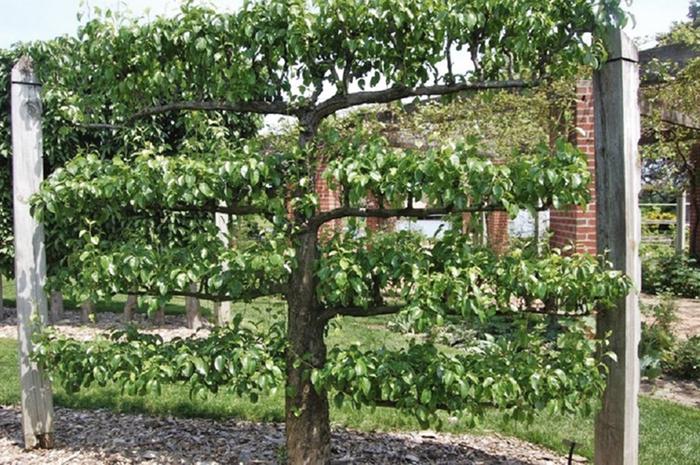
I planned Limes to another location but it is all on paper for now. Espailered trees look really impressive! However, I want something shorter in height than a tree (though recently I realised that trees can be shrubs and shrubs can be trees).
Honestly if you are doing this as a windbreak you probably will need more than one meter wide. Most windbreaks are five to ten meters wide, with at least two rows of trees offset from one another, and growing together with various shrubs mixed in between. That is my experience anyway.
Trifoliate Orange (also called Flying Dragon Bitter Orange) should grow in your climate, and it grows extremely thick and gnarly, possibly thick enough to slow down the wind. But it is less than two meters high. It is gnarly looking in an attractive kind of way, in my opinion. If you need your hedge to stop trespassers, it will definitely do that for you as well because it is full of thorns. The oranges are technically edible but I have never heard of anyone taking more than one bite.
"windbreak" and "1m wide" aren't really compatible design objectives. Especially if you also want edible fruit or nuts from the hedge. Must fruiting trees require open canopies with good air circulation which is the opposite of what you want for an effective windbreak.
Moderator, Treatment Free Beekeepers group on Facebook.
https://www.facebook.com/groups/treatmentfreebeekeepers/
I think there are quite a few things you can grow as a hedge that would give fruit even while being kept to one meter wide.
Cane fruits like raspberries and blackberries. I grow mine in a row just 1' wide along a fence and they are very dense and provide shade and wind protection, though limited during the winter months. If you get fall bearing varieties, you can leave the canes through the winter.
Grapes
Currants, josta berries
Autumn olive
Seaberry
Blueberries
Figs. These would probably die back each winter in your climate but the right variety will grow back quickly each spring and summer. Prune them to grow many stems from the base to get a dense seasonal hedge.
Pineapple guava pruned to a hedge size (some varieties will grow in zone 7)
Invasive plants are Earth's way of insisting we notice her medicines. Stephen Herrod Buhner
Everyone learns what works by learning what doesn't work. Stephen Herrod Buhner