• Post Reply Bookmark Topic Watch Topic
  • New Topic
permaculture forums growies critters building homesteading energy monies kitchen purity ungarbage community wilderness fiber arts art permaculture artisans regional education skip experiences global resources cider press projects digital market permies.com pie forums private forums all forums
this forum made possible by our volunteer staff, including ...
master stewards:
  • Carla Burke
  • Nancy Reading
  • r ransom
  • John F Dean
  • paul wheaton
  • Jay Angler
stewards:
  • Timothy Norton
  • Pearl Sutton
  • Tereza Okava
master gardeners:
  • Christopher Weeks
  • M Ljin
gardeners:
  • Jeremy VanGelder
  • Matt McSpadden
  • thomas rubino

How do you deal with moldy foods?

 
master gardener
Posts: 5960
Location: Carlton County, Minnesota, USA: 3b; Dfb; sandy loam; in the woods
3486
8
forest garden trees books chicken food preservation cooking fiber arts seed woodworking homestead ungarbage
  • Likes 4
  • Mark post as helpful
  • send pies
    Number of slices to send:
    Optional 'thank-you' note:
  • Quote
  • Report post to moderator
Foods grow mold colonies. It's one of the primary ways that our foods spoil. When that happens, what do you do about it?

I grew up being taught that when a block of cheese grows mold, you cut it off -- careful to get it all and you eat the rest. But if an orange in the fruit bowl has a patch of green mold, you toss it. If there's a small amount of mold on top of a batch of yogurt, I spoon it into the compost and as long as there's no off flavor, I eat the rest.

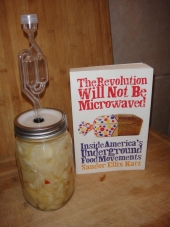
When I read Sandor Katz' Wild Fermentation, over twenty years ago, he talked about the tradition of lifting the mat of mold from the top of the kraut barrel and serving the good stuff underneath. But in the online fermentation groups I've been part of, it's pretty common for people to declaim that if there's a speck of mold, it has riddled the kraut (or whatever) with invisible mold roots that will kill you. I don't really know the microbiological truth, but guessing it's somewhere in the middle seems safe.

Among permies, it seems like there would be two impulses in tension: Thrift drives us not to waste. And food purity drives us to seek wellness.

So, where do you land?
 
pollinator
Posts: 4245
Location: Tennessee 7b
353
  • Likes 5
  • Mark post as helpful
  • send pies
    Number of slices to send:
    Optional 'thank-you' note:
  • Quote
  • Report post to moderator
It kind of depends on you. Roughly 20% of people are basically immune to mold and mycotoxins, 20% are extremely sensitive, and the rest are somewhere in between. I am in the extremely sensitive group, so I have to throw out anything with a trace of mold.
 
Posts: 110
Location: Colorado Springs, CO [Zone: 5B/6A]
27
hugelkultur goat fungi gear fish hunting building writing woodworking composting
  • Likes 5
  • Mark post as helpful
  • send pies
    Number of slices to send:
    Optional 'thank-you' note:
  • Quote
  • Report post to moderator
I usually cut off the mold on fermented dairy because it's localized.

With veggies it usually depends. Sometimes I get rot/mold on onions that appears to be only exterior but I cut it open and it goes into the core. In that case I just toss the whole thing.
 
Christopher Weeks
master gardener
Posts: 5960
Location: Carlton County, Minnesota, USA: 3b; Dfb; sandy loam; in the woods
3486
8
forest garden trees books chicken food preservation cooking fiber arts seed woodworking homestead ungarbage
  • Likes 3
  • Mark post as helpful
  • send pies
    Number of slices to send:
    Optional 'thank-you' note:
  • Quote
  • Report post to moderator
Oh, onions are a good weird case! I often will find mold between two layers of the onion and I'm comfortable peeling those two out and tossing them but eating the rest.
 
Tyler Grace
Posts: 110
Location: Colorado Springs, CO [Zone: 5B/6A]
27
hugelkultur goat fungi gear fish hunting building writing woodworking composting
  • Likes 4
  • Mark post as helpful
  • send pies
    Number of slices to send:
    Optional 'thank-you' note:
  • Quote
  • Report post to moderator

Christopher Weeks wrote:I'm comfortable peeling those two out and tossing them but eating the rest.


I do that sometimes but usually when I am dealing with onions, I am slicing them up on the fly as I'm cooking, because I don't prep beforehand. So it's mostly just laziness and being unprepared.
 
steward & manure connoisseur
Posts: 4898
Location: South of Capricorn
2860
dog rabbit urban cooking writing homestead ungarbage
  • Likes 4
  • Mark post as helpful
  • send pies
    Number of slices to send:
    Optional 'thank-you' note:
  • Quote
  • Report post to moderator
I had the privilege (?) of living with a microbiologist in college, who gleefully informed us every time we cut off the moldy parts of a block of cheese and ate the rest that MOLD PENETRATES and we were still eating mold that we couldn't see.

I was poor as heck and was going to eat anything that didn't eat me first.

I think there is mold and there is mold. Kraut I think is a different story (there is a clear division between the mat on top and the kraut below); mold on cheese bothers me a lot less. And I am a lot more concerned about botulism or salmonella in food that has been sitting out or crappy kitchen/bathroom hygiene giving me rotavirus/norovirus/hepatitis/etc.

I personally still cut the mold off of things and eat any salvageable parts (fruit, bread, cheese; I try to give a good margin for the 'roots'. if a sauce or something in the fridge has mold I will sometimes scrape it out or sometimes throw the whole thing away, occasionally mold is evidence that the whole thing is bad). I depend heavily on how things look and smell.
I've gotten much better at storing cheese (wrapped in wax or butcher paper and then put in a bag in fridge). And that moldy orange (although sometimes half can be saved....) gets saved to make ant repellant (that mold can be brought back to the nest, where it outcompetes the fungus the ants grow on the vegetation they cut).
 
steward
Posts: 18463
Location: USDA Zone 8a
4687
dog hunting food preservation cooking bee greening the desert
  • Likes 4
  • Mark post as helpful
  • send pies
    Number of slices to send:
    Optional 'thank-you' note:
  • Quote
  • Report post to moderator
Like Christopher, if it is cheese I cut if off.

And like Tyler said with onions.

Preserves I pick out the mold.

Everything else goes into my rear fridge to freeze dry then into the trash when it no longer smell bad.
 
Tereza Okava
steward & manure connoisseur
Posts: 4898
Location: South of Capricorn
2860
dog rabbit urban cooking writing homestead ungarbage
  • Likes 8
  • Mark post as helpful
  • send pies
    Number of slices to send:
    Optional 'thank-you' note:
  • Quote
  • Report post to moderator

Christopher Weeks wrote:Thrift drives us not to waste.


Animals/compost/bokashi make me feel about 90% better about throwing away food. It gets a second chance at life!
 
gardener
Posts: 3138
Location: Central Maine (Zone 5a)
1685
homeschooling kids trees chicken food preservation building woodworking homestead
  • Likes 4
  • Mark post as helpful
  • send pies
    Number of slices to send:
    Optional 'thank-you' note:
  • Quote
  • Report post to moderator
I admit to being one of those people who gets rid of it, if there is even a little mold. As my journey progresses, however, I have moved away from simply throwing it away... to feeding it to the chickens or the compost pile instead.
 
master steward
Posts: 8342
Location: southern Illinois, USA
3259
goat cat dog chicken composting toilet food preservation pig solar wood heat homestead composting
  • Likes 2
  • Mark post as helpful
  • send pies
    Number of slices to send:
    Optional 'thank-you' note:
  • Quote
  • Report post to moderator
Depends upon how much mold.  Usually I just remove the mold. In severe cases it goes to the compost.  In the rare case of making kraut, I remove the mold.
 
Posts: 69
56
forest garden fungi homestead
  • Likes 6
  • Mark post as helpful
  • send pies
    Number of slices to send:
    Optional 'thank-you' note:
  • Quote
  • Report post to moderator
I have always had a very sensitive sniffer, and as a child I caused no small amount of distress to my parents by refusing to eat foods that were deemed ‘off’.  I can still hear my dad’s anxious groan as he watched me perform the act of olfactory judgement that would doom another hard won meal.

Fast forward to today, about eight years into a pretty intense fermentation journey. These days I cackle with delight at recipes like those found in Pascal Baudar’s book Wildcrafted Fermentation. Fermented forest floor? Oh heck yes, let me at it!

The child whose brow crinkled in consternation at the slightest whiff of moldy or funky notes, is blown away by the things I will happily put in my mouth today. For every new flavor that has a galaxy of wonder exploding on my tongue, there are others that have me wondering, ‘Am I going to regret this later???’

Mold and I have become very close. I am extremely sensitive to moldy notes and can taste it even when it is not visible or others can’t. In my experimenting I’ve ingested plenty. Staggeringly, I am still here. I have regretted very few of my tastings, and those were all mild gastro distress, nothing earth shattering.

Here’s my personal stance on moldy food, no science or data to back it up, just my own experience:

I don’t mess around with colored molds. Pink, blue, black - nope.  I toss those items.

White or grey molds though, I am happy to remove the layer and eat what’s underneath. If the flavor is unaffected I don’t give it another thought.
 
They weren't very bright, but they were very, very big. Ad contrast:
Promoting Your Stuff on Permies for FREE!
https://permies.com/wiki/20020/Promoting-Stuff-Permies-FREE
reply
    Bookmark Topic Watch Topic
  • New Topic