• Post Reply Bookmark Topic Watch Topic
  • New Topic
permaculture forums growies critters building homesteading energy monies kitchen purity ungarbage community wilderness fiber arts art permaculture artisans regional education skip experiences global resources cider press projects digital market permies.com pie forums private forums all forums
this forum made possible by our volunteer staff, including ...
master stewards:
  • Carla Burke
  • Nancy Reading
  • r ransom
  • John F Dean
  • paul wheaton
  • Jay Angler
stewards:
  • Timothy Norton
  • Pearl Sutton
  • Tereza Okava
master gardeners:
  • Christopher Weeks
  • M Ljin
gardeners:
  • Jeremy VanGelder
  • Matt McSpadden
  • thomas rubino

Has anyone used the gravel trench foundation but with piers instead of perimeter? 4 ft deep?

 
Posts: 20
6
  • Likes 5
  • Mark post as helpful
  • send pies
    Number of slices to send:
    Optional 'thank-you' note:
  • Quote
  • Report post to moderator
I live in WI. I'm planning on building a simple one-story (shed roof) timber frame addition (12' by 26') this summer to our small old farmhouse. The addition will attach to the long side of our house (26'). I am not an experienced builder or timber framer. I've completed two workshops, and read a lot of books, but no more experience than that.

We are on a tight budget and also prefer to not use manufactured components whenever possible.

We are using red pine timbers we've cut and milled ourselves. 8x8 posts and 8x10 beams.

I am wondering about using four foot deep holes with compacted gravel and either stone or cement block on top, with the piers located underneath the house posts. We would use anchor bolts to attach to black locust 8x8 sills on the perimeter (2x8 block locust joists). We'd then attach the posts to the black locust. Does this work? Is it stable enough? Will it hold the load of the addition? Or do we really need posts going into the ground for stability or other reasons?

Thanks for your thoughts on this.
 
Posts: 793
183
  • Likes 7
  • Mark post as helpful
  • send pies
    Number of slices to send:
    Optional 'thank-you' note:
  • Quote
  • Report post to moderator
I can't picture it I guess because to me, if you are going to dig down 4 feet anyway, why not just put a post in and backfill that with gravel? Why would you build a trench, backfill with gravel, then put a beam on top of that and still have some posts?

Your posts will rot at the ground line, or six inches above and below it and not deep down so you are not gaining anything by having better post drainage. But you can use post sleeves to cure the ground contact rot issue.

It seems to me you are trying to use two different foundation systems for one addition. But maybe I am not fully understanding what you are trying to accomplish.
 
pollinator
Posts: 4245
Location: Tennessee 7b
353
  • Likes 7
  • Mark post as helpful
  • send pies
    Number of slices to send:
    Optional 'thank-you' note:
  • Quote
  • Report post to moderator
It depends. A rubble pier may work to hold the addition up, it really depends on your soil type. Posts/piers/foundation walls in the ground anchor the building from lifting in the wind.

What is the foundation of the original house? I’d try and match it functionally as close as you can. It will need to behave the same in freeze thaw cycles or your addition will shift differently that the main house and that’s not good.
 
master rocket scientist
Posts: 7010
Location: latitude 47 N.W. montana zone 6A
4058
cat pig rocket stoves
  • Likes 8
  • Mark post as helpful
  • send pies
    Number of slices to send:
    Optional 'thank-you' note:
  • Quote
  • Report post to moderator
Hi May
I also am not quite sure what you are describing.
If you are attaching the new room to the existing house, then the original foundation will be providing support on that side.
Your new room will be 12' deep.
If it were me, I would use soni-tube forms and pour concrete piers every eight feet 3' in the ground along the outside edge.
Set your black locust on them.
For a solid floor, depending on your floor joists, I would also add a support beam and piers at six foot.
This  beam could be supported with piers of black locust in the ground
If using concrete is not to your liking then using your black locust posts on the outside edge would work.
I have heard of B.L. posts over 100 years old still supporting buildings.

 
Posts: 395
Location: North East Iowa, USA
119
  • Likes 6
  • Mark post as helpful
  • send pies
    Number of slices to send:
    Optional 'thank-you' note:
  • Quote
  • Report post to moderator

May Maglock wrote:I live in WI. I'm planning on building a simple one-story (shed roof) timber frame addition (12' by 26') this summer to our small old farmhouse. The addition will attach to the long side of our house (26'). I am not an experienced builder or timber framer. I've completed two workshops, and read a lot of books, but no more experience than that.


With all of your reading, certainly the foundations for your location or soil types have been covered? Something as important as this, now would not be the time to decide that there must be a better way, most but not all, books cover what works for your area. But certainly what is good for your area, may not work for southern latitudes and so on.

May Maglock wrote:We are on a tight budget and also prefer to not use manufactured components whenever possible.

We are using red pine timbers we've cut and milled ourselves. 8x8 posts and 8x10 beams.


If I am reading this correctly, you are getting things lined up pretty well for the above ground supports? Just need to nail the below ground stuff?

I

May Maglock wrote: am wondering about using four foot deep holes with compacted gravel and either stone or cement block on top, with the piers located underneath the house posts. We would use anchor bolts to attach to black locust 8x8 sills on the perimeter (2x8 block locust joists). We'd then attach the posts to the black locust. Does this work? Is it stable enough? Will it hold the load of the addition? Or do we really need posts going into the ground for stability or other reasons?

Thanks for your thoughts on this.


By digging down as you describe with stone or cement block built up to make a level based top, what is your proposed method to have every pier level?  As Tom mentioned, the sannen tubes really can help tremendously in this reguard, Set them as perfectly as possible, then decide where the level line is, cut to this line and fill the tubes. If this goes against your desire to not use commercial products, your cement blocks fall into that catergory. Stone will never get to a perfect level without concrete,  so I am just proposing cutting to the chase.   Much of this has to do with your longevity plans, if your shooting for 10 years vs 100, makes a big difference.   Knowing if your in silt, sand or extra rocky country makes a big difference as well.  

Best of success.
 
gardener
Posts: 342
Location: Austin, Texas
166
9
tiny house building homestead
  • Likes 8
  • Mark post as helpful
  • send pies
    Number of slices to send:
    Optional 'thank-you' note:
  • Quote
  • Report post to moderator
I think it will work. If you calculate the total weight of the building and get a rough idea of your soil class you can figure how big your piers need to be. Just make sure you get below frost depth.

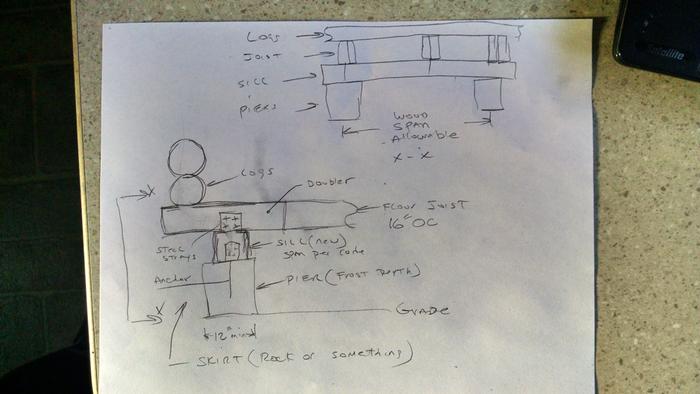
We built a 16'x24' timber frame cabin on piers. Here's our pier detail(note there is about six inches of compacted gravel below the pier that's not in the detail):


I used this table for the determining soil class.

I agree with R Scott that you need to think about the foundation of your existing building. I've seen a house with a slab and grade foundation pull away from it's porch built on piers.

Here are the calculations I made for our our cabin for reference.

Loading-Calculation(2).png
Pier Load Calculation
Loading-Calculation(3).png
Soil Class Load Bearing Capacity
Loading-Calculation.png
Cabin Loading Calculation
 
pollinator
Posts: 5975
Location: Bendigo , Australia
544
plumbing earthworks bee building homestead greening the desert
  • Mark post as helpful
  • send pies
    Number of slices to send:
    Optional 'thank-you' note:
  • Quote
  • Report post to moderator
All the suggestions above are worthwhile.
From Google
Red pine timber, when used in-ground, requries pressure treatment (typically H4 or H5 rating) to last 15–30 years,
as untreated, it is only moderately durable and susceptible to decay.
- Will you treat the timber?

I have a few questions and comment though:
- What is the issue with manufactured items, there are many great ideas around?
- The old ways are not always the best, compared with modern fixtures etc.
- Metal brackets set into the concrete as suggested above may be a faster method, thought about it?
- Will you insulate the walls and roof?
- How deep is your frost zone?
- Posts in the ground will improve stability if cross bracing is not used.
- In Australia I would use steel posts, set into the ground at each corner to start, then use timber above the ground for intermediate columns, on piers.
 
Steve Zoma
Posts: 793
183
  • Likes 3
  • Mark post as helpful
  • send pies
    Number of slices to send:
    Optional 'thank-you' note:
  • Quote
  • Report post to moderator
The biggest issue with living over anything with piers is not the strength of the foundation as all of Venice has been built on piers 600 years ago. The problem is how cold they get underneath. You can insulate them but the area of exposed earth is not high enough to overcome the cold migrating in so the floors of the living area is cold. Overtime that makes paying for heat or cooling far more expensive than what a better foundation would have cost. The further north you live in the northern hemisphere, the shorter the return on investment.

I live on a pier foundation. There is no reason to explain it here as bedrock is scant inches down. It’s rock solid but my floors are cold and that causes higher heating costs. It also causes drain lines and plumbing to freeze.

Piers: cheaper upfront costs but are higher long term due to higher heating and cooling costs and are often not bank financeable or able to be insured.

Traditional foundations cost more upfront but allow for warmer floors with no issues in financing and insuring.
 
pollinator
Posts: 496
60
  • Likes 1
  • Mark post as helpful
  • send pies
    Number of slices to send:
    Optional 'thank-you' note:
  • Quote
  • Report post to moderator
That is great prep work, you are on a good path to success.  Props for milling your own lumber, red pine and locust are great choices.  
 
John C Daley
pollinator
Posts: 5975
Location: Bendigo , Australia
544
plumbing earthworks bee building homestead greening the desert
  • Mark post as helpful
  • send pies
    Number of slices to send:
    Optional 'thank-you' note:
  • Quote
  • Report post to moderator
Steve, what are you describing as a traditional foundation?
 
Steve Zoma
Posts: 793
183
  • Likes 4
  • Mark post as helpful
  • send pies
    Number of slices to send:
    Optional 'thank-you' note:
  • Quote
  • Report post to moderator

John C Daley wrote:Steve, what are you describing as a traditional foundation?


Concrete Slab
Concrete Block
Concrete poured walls

I am not saying there are no other types of foundations, they are, but they are harder to get if there are building codes, or if financing or insurance is required. That is important, maybe not to the Permie now, but it may be harder to resell the house in the future.

It is not without reason. Drive around the New England countryside and it is everywhere. The main house on these old buildings is sound, but when they put on additions, they used cheaper foundations and they have failed over the years. It's in human nature, build on as cheap as possible, but it shows long term and banks and insurance companies have seen and endured the effects of it.

I live in a town where there are no building codes and I was able to get my pier foundation house insured, but it took going through 19 different insurance companies before one accepted us. It would never be able to be financed by a traditional home loan. I fully expect in order to sell my house at some point in the future, I am going to have to have a block foundation put in. It is no big deal, but something I fully expect I will have to do in order to sell it.
 
Posts: 12
  • Likes 3
  • Mark post as helpful
  • send pies
    Number of slices to send:
    Optional 'thank-you' note:
  • Quote
  • Report post to moderator
It sounds feasible for a small timber frame, but make sure your piers are properly sized, well-compacted, and anchored—otherwise posts set into the ground may be safer for long-term stability and load-bearing.
 
Posts: 159
Location: Nova Scotia
35
  • Likes 3
  • Mark post as helpful
  • send pies
    Number of slices to send:
    Optional 'thank-you' note:
  • Quote
  • Report post to moderator
Steve:
'The main house on these old buildings is sound, but when they put on additions, they used cheaper foundations and they have failed over the years. '

This is everywhere in New Brunswick & Nova Scotia; original house fairly solid, with 1-3 progressively more decrepit add ons.  They fall down in reverse order of age.
Around here, I suspect it partly reflects economic decline when the land was logged, sailing ships were no more and the marginal agriculture dwindled back.
That might apply in rural New England as well.
In some cases the add ons were for winter access to wood or animals, so lower grade for that reason.
 
John C Daley
pollinator
Posts: 5975
Location: Bendigo , Australia
544
plumbing earthworks bee building homestead greening the desert
  • Mark post as helpful
  • send pies
    Number of slices to send:
    Optional 'thank-you' note:
  • Quote
  • Report post to moderator
Steve, I am amazed to read what your wrote about the issue of foundations in USA.
 
Steve Zoma
Posts: 793
183
  • Mark post as helpful
  • send pies
    Number of slices to send:
    Optional 'thank-you' note:
  • Quote
  • Report post to moderator

Douglas Campbell wrote:Steve:
'The main house on these old buildings is sound, but when they put on additions, they used cheaper foundations and they have failed over the years. '

This is everywhere in New Brunswick & Nova Scotia; original house fairly solid, with 1-3 progressively more decrepit add ons.  They fall down in reverse order of age.
Around here, I suspect it partly reflects economic decline when the land was logged, sailing ships were no more and the marginal agriculture dwindled back.
That might apply in rural New England as well.
In some cases the add ons were for winter access to wood or animals, so lower grade for that reason.


I think when a person starts an original building they view the foundation as being integral to the whole structure, but with an addition the main focus is on what is being done within the walls. It is in the words when a neighbor asks, "hey, what are you building?" With a house the person states as such and maybe the number of bedrooms and bathrooms, but they are stating what the building is. With an addition the person often states, "oh the kitchen is not really big enough, so we need more room", or "we never expected to have twins so we are building a master bedroom". The difference is, up front what the building is, is stated, and for the latter; the reason for the addition is stated. It is a whole different mind-set because with additions people want the function but want to do it as cheaply as possible.

Not that I am against rubble filled foundations at all. In fact, I LOVE, LOVE, LOVE them and think they have longevity and low price: a rarity when speaking of foundation types. I do think they are site-dependent though and that a person should dig the trenches but also run the trenches to daylight and then wait before filling them with rubble. Wait until a good rain storm or snowmelt and if no water remains in the trenches, THEN and only then, backfill them with rubble. That will ensure the trenches never freeze since they continuously drain water.

I would certainly do that type of foundation on a forever home I was building. The problem is, I have built and sold three-forever homes.

I get it, banks and insurance companies dislike other types of foundations because they silly-think, "when the last hurricane blew through, we had plenty of homes that now need new foundations because they fell off their piers. Therefore pier foundations are bad". That is not always the case. My house was not only built in 1890, but was built on another island and barged to this one when electricity came to this island in the 1930's. I have never lived in an old house with such levels floors. But this house sits on bedrock. But banks and insurance companies don't consider individual house situations, they lump everything into go or no-go situations. It is too bad...
 
Douglas Campbell
Posts: 159
Location: Nova Scotia
35
  • Likes 2
  • Mark post as helpful
  • send pies
    Number of slices to send:
    Optional 'thank-you' note:
  • Quote
  • Report post to moderator

John C Daley wrote:Steve, I am amazed to read what your wrote about the issue of foundations in USA.



>50 freeze thaw cycles/y, often > 20C change in < 24h; 1500 mm precip/y... in Nova Scotia
Keeping things standing is hard.
I used to live in a village settled on land stolen from Acadians after ethnic cleansing.
Some of the incoming New Englanders & Brits built imposing stone houses within 25-50 y (1775-1825 or so).
They are all falling over because of frost heave; one pathetic museum example had amateur flying buttresses installed to keep the walls up.
 
All of the following truths are shameless lies. But what about this tiny ad:
Learn Permaculture through a little hard work
https://wheaton-labs.com/bootcamp
reply
    Bookmark Topic Watch Topic
  • New Topic