• Post Reply Bookmark Topic Watch Topic
  • New Topic
permaculture forums growies critters building homesteading energy monies kitchen purity ungarbage community wilderness fiber arts art permaculture artisans regional education skip experiences global resources cider press projects digital market permies.com pie forums private forums all forums
this forum made possible by our volunteer staff, including ...
master stewards:
  • Carla Burke
  • John F Dean
  • Nancy Reading
  • r ransom
  • Jay Angler
  • Timothy Norton
stewards:
  • paul wheaton
  • Pearl Sutton
  • Anne Miller
master gardeners:
  • Christopher Weeks
  • M Ljin
gardeners:
  • Jim Garlits
  • thomas rubino
  • William Bronson

Best cookware for perpetual stews?

 
Posts: 3
  • Likes 8
  • Mark post as helpful
  • send pies
    Number of slices to send:
    Optional 'thank-you' note:
  • Quote
  • Report post to moderator
Hi everyone! First post here, if there’s another thread that might solve my problem let me know.

I’m looking to start a perpetual stew, but from what I found lots of crock pots don’t end up maintaining user-set temperatures, usually cooking higher than you set (even read someone who’s crock pot went up to 165F and it made them have to change everything out!)

What are some reliable affordable crock pot brands/models that can keep the temps low? Also largest capacity possible is best, but only when the temp problem is solved!

Specifically for me, I live in Canada, so models that can be found in-stores up here (or ordered online) would be ideal. I’ve been making stews for a bit and storing them, but the idea of a perpetual stew sounds like just what I need to know that when I come home I’ll have a warm meal waiting for me no matter what.

Let me know what you all think, and thanks in advance!
 
steward
Posts: 19058
Location: USDA Zone 8a
4820
dog hunting food preservation cooking bee greening the desert
  • Likes 9
  • Mark post as helpful
  • send pies
    Number of slices to send:
    Optional 'thank-you' note:
  • Quote
  • Report post to moderator
Cast iron is not good for perpetual stews so my suggestion would be stainless steel.
 
master gardener
Posts: 6435
Location: Carlton County, Minnesota, USA: 3b; Dfb; sandy loam; in the woods
3884
8
forest garden trees books chicken food preservation cooking fiber arts seed woodworking homestead ungarbage
  • Likes 8
  • Mark post as helpful
  • send pies
    Number of slices to send:
    Optional 'thank-you' note:
  • Quote
  • Report post to moderator
I've done it in steel, enameled cast iron, and earthenware, but it's on the stovetop and we don't leave it hot all the time, I just bring it back to a simmer each day to prevent microbial colonization.
 
May Quinn
Posts: 3
  • Likes 6
  • Mark post as helpful
  • send pies
    Number of slices to send:
    Optional 'thank-you' note:
  • Quote
  • Report post to moderator
I've been looking into heat sources and the best kind I can find are induction cookers. Which ones draw really low power? The main circuit in our unit is.... not the best lol. If I wanna keep the heat going for weeks, what are some of the lowest power-needing induction cookers?
 
master pollinator
Posts: 5411
Location: Due to winter mortality, I stubbornly state, zone 7a Tennessee
2376
7
forest garden foraging books food preservation cooking fiber arts bee medical herbs
  • Likes 8
  • Mark post as helpful
  • send pies
    Number of slices to send:
    Optional 'thank-you' note:
  • Quote
  • Report post to moderator
Welcome to Permies May!

We're oddballs here, and answer questions with different alternatives to the original question. I do make perpetual stew. But not in a crock pot. Mine is in a heavy bottomed stainless steel pot. I add ingredients, bring it to boil for 15 minutes, then put it in a "hay box". 8 to 24 hours later every thing is cooked, and still piping HOT. Note: I do now cook my meats before adding them, but only because sometimes it is needed to bulk up the current meal. We serve that up before placing the soup in the hay box.

Some relevant threads:
How to make a hay box.
Hay box cooker, thermal cooking...
Perpetual stew and friends.

My hay box is a styrofoam cooler. I wrap my pot in a wool blanket and put it inside.
 
Joylynn Hardesty
master pollinator
Posts: 5411
Location: Due to winter mortality, I stubbornly state, zone 7a Tennessee
2376
7
forest garden foraging books food preservation cooking fiber arts bee medical herbs
  • Likes 8
  • Mark post as helpful
  • send pies
    Number of slices to send:
    Optional 'thank-you' note:
  • Quote
  • Report post to moderator
My pot is similar to this one on Amazon.

I do cook with a new wave induction burner. I do not know the model, it is simply what I could afford at the time. I have only used it for 3 hours of continuous use at a time. But it has continued to work with daily use for... three years? (NOT three hours each day)
 
Anne Miller
steward
Posts: 19058
Location: USDA Zone 8a
4820
dog hunting food preservation cooking bee greening the desert
  • Likes 9
  • Mark post as helpful
  • send pies
    Number of slices to send:
    Optional 'thank-you' note:
  • Quote
  • Report post to moderator
The problem in trying to find a low power something is that they don't meet food safety requirements ... 200 degree F.
 
gardener
Posts: 5692
Location: Cincinnati, Ohio,Price Hill 45205
1306
forest garden trees urban
  • Likes 10
  • Mark post as helpful
  • send pies
    Number of slices to send:
    Optional 'thank-you' note:
  • Quote
  • Report post to moderator
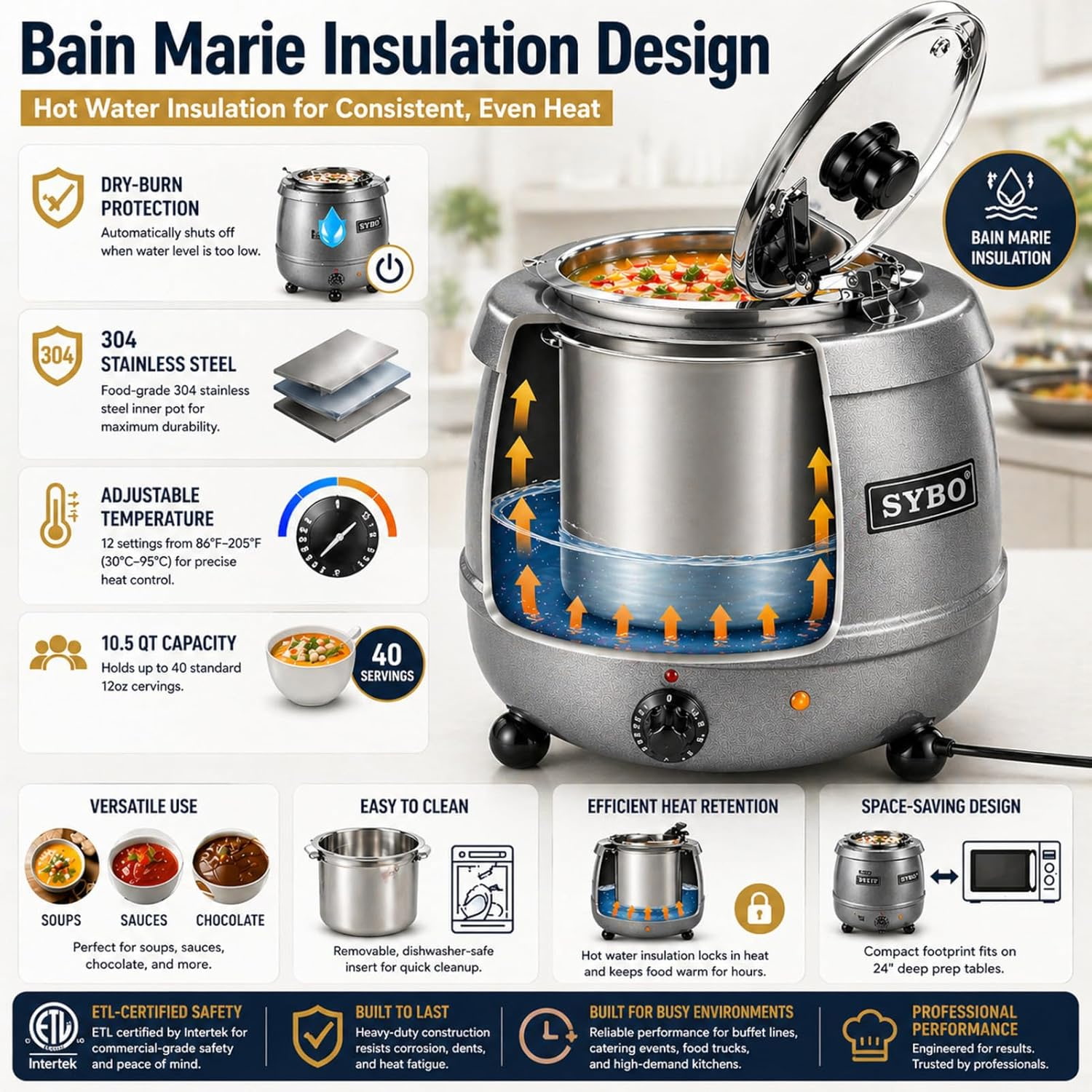
Here's a purpose built device:
IMG_20260531_120534.jpg
Expensive but built for the task
 
William Bronson
gardener
Posts: 5692
Location: Cincinnati, Ohio,Price Hill 45205
1306
forest garden trees urban
  • Likes 8
  • Mark post as helpful
  • send pies
    Number of slices to send:
    Optional 'thank-you' note:
  • Quote
  • Report post to moderator
Since I'm cheap, and I like screw around, my ideal solution would involve an derelict electric water heater, insulation intact, cut down to about 36".
Cap that with ridged insulation, then cut a hole for a giant stockpot to fit down into.
Make a ridged insulation lid to go over the stockpot lid.
Wire a 120v plug appliance cord to the 120v hearing coil.
This would be highly insulated, and gigantic double boiler.
To moderate the temperature, plug the cord into an  thermostatically controlled outlet adapter and insert the temp probe between the insulation and the stock pot, then set the desired temperature on the thermostatic outlet adapter to 205 degrees.
 
May Quinn
Posts: 3
  • Likes 6
  • Mark post as helpful
  • send pies
    Number of slices to send:
    Optional 'thank-you' note:
  • Quote
  • Report post to moderator
No worries Joylynn, With my current living space my current stainless steel pot does everything I need it to lol. Right now I'm just looking into cheap heating equipment that maintains low power, since stovetop is too risky to leave on all day. I'll look into old low-power heat sources that can maintain ~155F that I can keep plugged in for about 10 hours at a time tops instead of the horrible fire risk of my current stovetop. That water heater idea sounds perfect, as well as the purpose built device. I'll see what I can do for next week! Thanks for the help everyone.
 
pollinator
Posts: 4288
Location: Tennessee 7b
362
  • Likes 9
  • Mark post as helpful
  • send pies
    Number of slices to send:
    Optional 'thank-you' note:
  • Quote
  • Report post to moderator
Have you looked at sous vide cookers? Fairly low power, extremely accurate temperature control, and will hold temp like a hay box if you insulate it well.
 
William Bronson
gardener
Posts: 5692
Location: Cincinnati, Ohio,Price Hill 45205
1306
forest garden trees urban
  • Likes 9
  • Mark post as helpful
  • send pies
    Number of slices to send:
    Optional 'thank-you' note:
  • Quote
  • Report post to moderator

R Scott wrote:Have you looked at sous vide cookers? Fairly low power, extremely accurate temperature control, and will hold temp like a hay box if you insulate it well.


I'm curious about this.

Most  sous vide cookers are built like a "stick" with an immersion heater and something that circulates the water.
Would it work directly in soup, or would the food particles foul the mechanism?
Even with pot style sous vide cookers,the circulation mechanism could be compromised.
The Insta pot style pressure cookers usually have a sous vide setting, but I don't think you can set the temperature precisely.


If a  sous vide cooker won't work directly, it could be used in a cooler full of water.
Cut  holes in the lid of the cooler, one for the sous vide stick, one for a stock pot.
Much simpler and cleaner than my industrial level diy double boiler, much cheaper than a commercial one.

 
William Bronson
gardener
Posts: 5692
Location: Cincinnati, Ohio,Price Hill 45205
1306
forest garden trees urban
  • Likes 6
  • Mark post as helpful
  • send pies
    Number of slices to send:
    Optional 'thank-you' note:
  • Quote
  • Report post to moderator
I looked into the pressure cookers with souse vide options
At least one  Cosori pressure cooker,offers precision control.
What the range is, I don't know.
Even the manual was unclear on that.

I found a permies post on fermentation that suggested plugging a crock pot into a thermostat controlled outlet.
There's no insulation in that setup, but you could just place it in a cooler.

By expanding my search to skillets I found this:

Presto Precise® 16-inch
Tuxedo™
digital precision skillet multi-cooker

It goes from 100 to 400 degrees and has a digital display.
No insulation.
 
R Scott
pollinator
Posts: 4288
Location: Tennessee 7b
362
  • Likes 8
  • Mark post as helpful
  • send pies
    Number of slices to send:
    Optional 'thank-you' note:
  • Quote
  • Report post to moderator
William, that was my idea—set the pot inside a cooler and use the immersion heater in clean water.
 
Posts: 24
8
purity urban homestead
  • Likes 8
  • Mark post as helpful
  • send pies
    Number of slices to send:
    Optional 'thank-you' note:
  • Quote
  • Report post to moderator
I can't really answer your question, but i feel i should give my input on material choices. I did a deep dive into materials when swapping out all my teflon poison in my kitchen and it turns out it is a minefield!
I am seeing stainless steel suggested, but you should be aware that acidic foods will corrode stainless steel, which then gets into your food. As far as my research showed me, stainless steel corrodes below pH 6, which many stews will fall below. Stainless steel contains nickle and chromium, both of which are toxic, particularly chromium. This is usually okay (i think) if you are cleaning your cookware quickly after using it, but with a perpetual stew you are soaking the pot all the time, slowly corroding the material.

I never did complete my research fully, but as per usual the best bet seemed to be the natural and surface materials such as clay and ceramic (not accounting for coatings, of course). Certain glasses also turned out to be safe, depending on the composition, but generally they won't be very good for perpetual stews. This is not really the answer you were looking for, but definitely something worth keeping in mind.
 
gardener
Posts: 3728
Location: Western Slope Colorado.
900
5
goat dog food preservation medical herbs solar greening the desert
  • Likes 8
  • Mark post as helpful
  • send pies
    Number of slices to send:
    Optional 'thank-you' note:
  • Quote
  • Report post to moderator
About stainless steel, there are different grades of it.  Some, magnets will stick to, and some not.  I think there is such a thing as food grade, but so is aluminum, so is teflon….

I use stainless steel, cast iron, glass, wood and pottery in my kitchen.  If the stainless steel does corrode it is very little, as the appearance of my pans hasn’t changed over my 50+ years of cooking.

I used to make my lye solution (for soap) in a stainless steel pot. I noticed tiny flakes (less than a millimeter and no depth) of something or other at the bottom corner of the pot when I poured the lye into the fats.  

I thought it could be an impurity in the lye, but I did a little messing around, and these tiny “flakes” only appeared in the stainless steel.  My conclusion was that it was the stainless steel.  

It’s a little late for me to start worrying about stainless steel now.  

About perpetual stew or soup, I don’t know anyone who keeps it hot all the time.  If you keep it covered, and after adding new ingredients, bring it to the boil, simmer 20-30 minutes once a day, that’s enough to keep it from spoiling.  If you have a way to heat it once a day, you don’t have to worry about being gone from home.  

I wouldn’t want to use a crockpot because if I add cold water and cold vegetables to the hot stew, it may crack the crock.
 
My, my, aren't you a big fella. Here, have a tiny ad:
earth skills program
https://wheaton-labs.com/bootcamp
reply
    Bookmark Topic Watch Topic
  • New Topic