
• Post Reply Bookmark Topic Watch Topic
  • New Topic
permaculture forums growies critters building homesteading energy monies kitchen purity ungarbage community wilderness fiber arts art permaculture artisans regional education skip experiences global resources cider press projects digital market permies.com pie forums private forums all forums
this forum made possible by our volunteer staff, including ...
master stewards:
  • Carla Burke
  • Nancy Reading
  • John F Dean
  • r ransom
  • paul wheaton
  • Jay Angler
  • Timothy Norton
stewards:
  • Pearl Sutton
  • Tereza Okava
  • Nicole Alderman
master gardeners:
  • Christopher Weeks
gardeners:
  • M Ljin
  • Megan Palmer
  • Pete Podurgiel

What makes a trail (pathway) good?

 
Steward of piddlers
Posts: 8196
Location: Upstate New York, Zone 5b, 43 inch Avg. Rainfall
4821
monies home care dog fungi trees chicken food preservation cooking building composting homestead
  • Likes 8
  • Mark post as helpful
  • send pies
    Number of slices to send:
    Optional 'thank-you' note:
  • Quote
  • Report post to moderator
I was watching a recent video that Paul where he was showing off how he Builds a Mountain Pathway Six to Twelve Feet per day.

What makes a good trail? Is it more than a compacted pathway? How could a person improve their trails and pathways?
 
gardener
Posts: 2966
Location: Zone 4b/5a
1740
ancestral skills forest garden foraging composting toilet fiber arts bike medical herbs seed writing ungarbage
  • Likes 6
  • Mark post as helpful
  • send pies
    Number of slices to send:
    Optional 'thank-you' note:
  • Quote
  • Report post to moderator
A good trail in my mind is one that you can walk on barefoot easily and comfortably. That means sweeping sticks and thorns out of it and keeping it clear of sharp stones, as well as having boardwalks over muddy areas or avoiding them altogether.

In my book, smooth stones and brook crossings are okay in summer, as the feet stay clean, but some sort of bridge might be welcome in winter.

Ideally, it should not be too steep, especially if there is risk of slipping.

This is different from paths for vehicles, that may go over stones, sticks and so on, and need a wider area. Often they cause ruts that collect water and become muddy, leaving a single strip of grassy, easily walkable pathway in the middle. But oftentimes they are also fine for walking.

Sections of the Appalachian Trail near here are a good example, and also a certain path up a local mountain that is worn by use.
 
gardener
Posts: 422
Location: S. New England
289
fungi foraging trees chicken bee wood heat homestead
  • Likes 11
  • Mark post as helpful
  • send pies
    Number of slices to send:
    Optional 'thank-you' note:
  • Quote
  • Report post to moderator
My favorite trails/paths have twists and turns that make me wonder what's around the next corner.  
 
master steward
Posts: 8873
Location: southern Illinois, USA
3756
goat cat dog chicken composting toilet food preservation pig solar wood heat homestead composting
  • Likes 10
  • Mark post as helpful
  • send pies
    Number of slices to send:
    Optional 'thank-you' note:
  • Quote
  • Report post to moderator
My immediate first thought was “improve for who or what?”  To use an example, the Grand Canyon is full of trails.  Some seem to be more like an interstate….such as the Bright Angel”.  I saw a woman using it wearing fashion boots with heels. Others, I wonder how a mountain goat could navigate them.

On a similar level, on my homestead I stay aware my wife often uses a cane. I am also aware that some day she may use a wheel chair.  Do all paths have to be available to her …. No. But I do know she likes to visit the goats and chickens….so those paths are better maintained. I am providing the chickens a larger home closer to the house.  I am also putting in a container garden closer to the house.

Now, for me, I want a trail that has some visual interests and some challenges. …hiking wise.   Around the homestead, I want pathways that don’t get muddy in the rain.

 
steward
Posts: 19514
Location: USDA Zone 8a
4915
dog hunting food preservation cooking bee greening the desert
  • Likes 6
  • Mark post as helpful
  • send pies
    Number of slices to send:
    Optional 'thank-you' note:
  • Quote
  • Report post to moderator
My property has a lot of trails though they are mostly used by deer.

In spring, I had patches of wildflowers that come back every year though they are isolated deep in the woods.

I would be nice if I had walking trails back to those flowers.

My walking trails would need to be flat and smooth.

So that the trail is not lots over time it would need wood chips thickly laid.

The way my property is 30 to 45 minutes would be enough to get to those flowers.

Other times of year the trails could be used to pick prickly pear cactus tunas.
 
steward and tree herder
Posts: 14346
Location: Isle of Skye, Scotland. Nearly 70 inches rain a year
7997
6
transportation dog forest garden foraging trees books food preservation woodworking wood heat rocket stoves ungarbage
  • Likes 10
  • Mark post as helpful
  • send pies
    Number of slices to send:
    Optional 'thank-you' note:
  • Quote
  • Report post to moderator
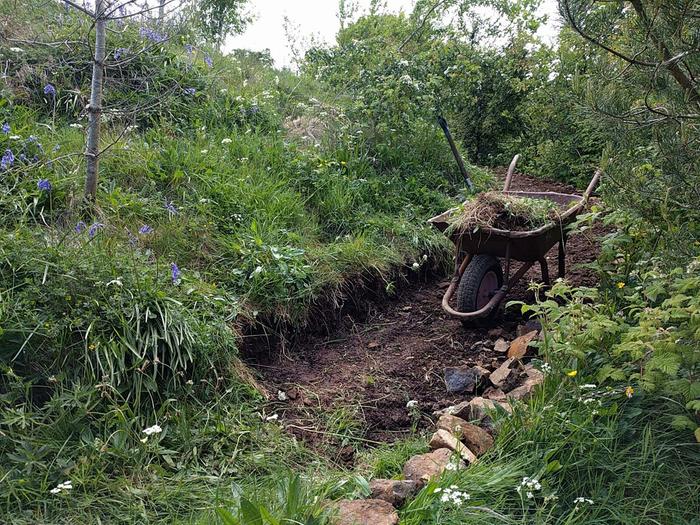
I like my tracks
- Wide enough and level enough for a wheelbarrow.
- Without overhanging branches that catch at me and get me wet.
- Not getting too muddy when it rains.
- Taking me where I want to go without sharp bends or excessive distance.
- With useful and edible plants to the side of them.

I've improved some of my pedestrian paths to make them wide enough for our little invalid scooter

pathway under improvement

 
master steward
Posts: 16154
Location: Pacific Wet Coast
10618
duck books chicken cooking food preservation ungarbage
  • Mark post as helpful
  • send pies
    Number of slices to send:
    Optional 'thank-you' note:
  • Quote
  • Report post to moderator
To me, the most important thing to control is water. If a trail gets muddy, it's more likely to deteriorate and erode.

It's nice to use all local material, but one area of our farm trail gets water sheeting over it in heavy storms. Using a pipe would concentrate that water. So we got some "road base" fine gravel which we spread and compacted in that area. Now the water sheets over it in a wide enough area, that it doesn't erode either the trail, or the forest down from the trail. This likely wouldn't work if the area wasn't just very gently sloped.
 
master pollinator
Posts: 423
Location: UK
157
kids urban seed
  • Mark post as helpful
  • send pies
    Number of slices to send:
    Optional 'thank-you' note:
  • Quote
  • Report post to moderator
The wheelbarrow width test is the one I always come back to. If it can't take a loaded barrow it's more of a stroll path than a working garden path. And water is everything, a perfectly graded path turns into a mud pit by November if you haven't thought about drainage.
gift
 
Native Bee Guide by Crown Bees
will be released to subscribers in: soon!
reply
    Bookmark Topic Watch Topic
  • New Topic