
• Post Reply Bookmark Topic Watch Topic
  • New Topic
permaculture forums growies critters building homesteading energy monies kitchen purity ungarbage community wilderness fiber arts art permaculture artisans regional education skip experiences global resources cider press projects digital market permies.com pie forums private forums all forums
this forum made possible by our volunteer staff, including ...
master stewards:
  • Devaka Cooray
  • Carla Burke
  • John F Dean
  • Nancy Reading
  • Timothy Norton
  • r ranson
stewards:
  • Jay Angler
  • Pearl Sutton
  • paul wheaton
master gardeners:
  • Christopher Weeks
  • M Ljin
gardeners:
  • thomas rubino
  • Eino Kenttä
  • Jeremy VanGelder

Can You Help Identify This Log?

 
Posts: 6
  • Likes 8
  • Mark post as helpful
  • send pies
    Number of slices to send:
    Optional 'thank-you' note:
  • Quote
  • Report post to moderator
Hi all,

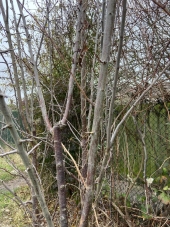
My father and I collected some logs after the recent storm and are trying to identify what type of tree they came from. We’d greatly appreciate any help! I find it quite challenging to identify trees without their leaves. Thanks in advance! Logs were collected in Dublin, Ireland.

Log_3.jpg
[Thumbnail for Log_3.jpg]
Log_2.jpg
[Thumbnail for Log_2.jpg]
Log_1.jpg
[Thumbnail for Log_1.jpg]
 
Posts: 59
8
cattle kids foraging
  • Likes 6
  • Mark post as helpful
  • send pies
    Number of slices to send:
    Optional 'thank-you' note:
  • Quote
  • Report post to moderator
Truly the wrong continent for me, let alone the country. However, in looking at the bark, that is giving me some ideas. It is smooth, gray, relatively thin (especially for the diameter). Also note the horizontal lenticels on the bark.

Add to your description any smell that may be present on the bark and/or the freshly split wood.

There are some indications to me that the tree may have been some kind of Prunus species, or a cherry/peach/apricot/almond in other words.

https://www.bing.com/ck/a?!&&p=0a179fb36889e67d66b3a164290b2c02e331bce6985c1b5f9f4093b8b0e433b1JmltdHM9MTczNTYwMzIwMA&ptn=3&ver=2&hsh=4&fclid=35303032-f811-6b77-0999-2568f99f6ae1&u=a1L2ltYWdlcy9zZWFyY2g_cT10cmVlK2JhcmslMmMrY2hlcnJ5JmlkPUQ5MkQ4QjhDM0RGREM1NjIwNTBGNjhGOUM2MTEwRjM1MEUwOEE2NTAmRk9STT1JUUZSQkE&ntb=1
 
gardener
Posts: 1813
Location: the mountains of katuah, southern appalachia
584
forest garden trees foraging chicken food preservation wood heat
  • Likes 5
  • Mark post as helpful
  • send pies
    Number of slices to send:
    Optional 'thank-you' note:
  • Quote
  • Report post to moderator
smooth, gray, relatively thin bark could say beech around here. do you have european beech in your area?
 
Mark Reynolds
Posts: 59
8
cattle kids foraging
  • Likes 6
  • Mark post as helpful
  • send pies
    Number of slices to send:
    Optional 'thank-you' note:
  • Quote
  • Report post to moderator

greg mosser wrote:smooth, gray, relatively thin bark could say beech around here. do you have european beech in your area?


I get what you are saying about beech. This bark is smooth and unfurrowed, I don't think its quite smooth enough for a beech, although I honestly wouldn't put money on my guess.
 
greg mosser
gardener
Posts: 1813
Location: the mountains of katuah, southern appalachia
584
forest garden trees foraging chicken food preservation wood heat
  • Likes 7
  • Mark post as helpful
  • send pies
    Number of slices to send:
    Optional 'thank-you' note:
  • Quote
  • Report post to moderator
you may be right! to my eye, there aren’t strong enough horizontal ‘dotted lines’ to be a prunus, and they will frequently have clearly darker heartwood, which i’m not seeing in the pics. in my area, sweet birch could also look like that without different colored heartwood, but they’re not native, so probably not common in ireland.
 
pollinator
Posts: 282
Location: Oregon Coast Range Zone 8A
74
art purity forest garden fungi foraging trees books cooking bee medical herbs seed
  • Likes 8
  • Mark post as helpful
  • send pies
    Number of slices to send:
    Optional 'thank-you' note:
  • Quote
  • Report post to moderator
Identifying dormant tree logs by bark alone is difficult.  But assuming these logs were from dormant, leafless hardwoods, identifying them by the winter buds and twigs is usually the way to go, at least that's the way I learned how to do it in my college taxonomy class. In case you might have access to some dormant buds on some branches from trees adjacent to the logs where you picked them up,  here is a quick winter bud ID guide for Ireland:

https://www.ucd.ie/plantmat/treeidentification/winterbudsandtwigs/

Hope this helps!

 
steward and tree herder
Posts: 11622
Location: Isle of Skye, Scotland. Nearly 70 inches rain a year
5699
5
transportation dog forest garden foraging trees books food preservation woodworking wood heat rocket stoves ungarbage
  • Likes 8
  • Mark post as helpful
  • send pies
    Number of slices to send:
    Optional 'thank-you' note:
  • Quote
  • Report post to moderator
Beech has a lovely cross grain to it and a slightly pinky colouration. The pictures aren't quite defined enough to tell, but it could be.
Another suggestion is sycamore. Younger branches, even up to quite a large daimeter, have quite thin bark. The grain tends to be wider and more defined rings than beech though.
 
David Regan
Posts: 6
  • Likes 6
  • Mark post as helpful
  • send pies
    Number of slices to send:
    Optional 'thank-you' note:
  • Quote
  • Report post to moderator
I smelled the log today but couldn't quite identify it. I was told that in the area where I collected the logs, there are beech and cherry blossom trees.
 
Mark Reynolds
Posts: 59
8
cattle kids foraging
  • Likes 6
  • Mark post as helpful
  • send pies
    Number of slices to send:
    Optional 'thank-you' note:
  • Quote
  • Report post to moderator
It did have a smell though? In my experience, the prunus is going to have a stronger smell than the beech. Maybe a bit 'pungent'? Someone give me a hand here with what the prunus/cherry smells like...... possibly somewhat like bitter almonds. That would be the cyanide within the tree. (It's not going to harm you unless you are going to eat the bark, which I don't imagine you have any intentions of doing).
 
gardener
Posts: 1956
863
13
homeschooling hugelkultur trees medical herbs sheep horse homestead
  • Likes 7
  • Mark post as helpful
  • send pies
    Number of slices to send:
    Optional 'thank-you' note:
  • Quote
  • Report post to moderator
Hello David!

I live in the pacific northwest, the rainy side of the states of Washington and Oregon, USA. The way the bark breaks, the grain of the wood and the lichen on the bark, makes me think of a tree a we have here called a Red Alder (Alnus rubra).

It is often dead standing and will come down in storms.
 

Maybe you have something similar in your region.


Posts: 8
3
  • Likes 2
  • Mark post as helpful
  • send pies
    Number of slices to send:
    Optional 'thank-you' note:
  • Quote
  • Report post to moderator
I have a book, small and covered in vinyl, that I use to ID the trees I do not already know. I can ID the usual, red and white oak because I make acorn flour, pines, sweet gum, American chestnut and most fruit trees. Everything else I must look up. The pictures you show make it hard for a novice to be certain. If you are using it for heat, ID would be important for it's heat generating properties. IDing for growing mushrooms would be important.
 
gardener
Posts: 707
Location: Semi-nomadic, main place coastal mid-Norway, latitude 64 north
401
  • Likes 4
  • Mark post as helpful
  • send pies
    Number of slices to send:
    Optional 'thank-you' note:
  • Quote
  • Report post to moderator
Looks like rowan (Sorbus aucuparia) to me. Could be wrong.
 
Posts: 23
Location: Sukhbaatar,Selenge, Mongolia
14
4
forest garden trees greening the desert
  • Likes 4
  • Mark post as helpful
  • send pies
    Number of slices to send:
    Optional 'thank-you' note:
  • Quote
  • Report post to moderator
I would go with something in the alder family.
 
Posts: 15
Location: CT
2
hunting books food preservation
  • Likes 1
  • Mark post as helpful
  • send pies
    Number of slices to send:
    Optional 'thank-you' note:
  • Quote
  • Report post to moderator
Pine, going w/ pine
 
Steward of piddlers
Posts: 6745
Location: Upstate New York, Zone 5b, 43 inch Avg. Rainfall
3432
monies home care dog fungi trees chicken food preservation cooking building composting homestead
  • Likes 2
  • Mark post as helpful
  • send pies
    Number of slices to send:
    Optional 'thank-you' note:
  • Quote
  • Report post to moderator
Congrats on your thread being put in the Dailyish!

I'm excited to see what the Permies hivemind comes up with for identification.

I'm not much help when it comes to identifying species of trees, but I remember a fella from highschool who could tell something like twenty different woods by smell alone. Our school woodshop made a 'sampler' of woods to test him and he didn't miss one. It was amazing.
 
Posts: 69
Location: Nova Scotia, Canada
16
8
  • Likes 1
  • Mark post as helpful
  • send pies
    Number of slices to send:
    Optional 'thank-you' note:
  • Quote
  • Report post to moderator
Could definitely be beech. Beech can have even rougher bark in some cases. Is it relatively light or heavy? Alders would be lighter in weight and have a much looser grain than beech. Is the wood reddish? Can we see a close-up of the grain?
 
Hey, sticks and stones baby. And maybe a wee mention of my stuff:
The new permaculture playing cards kickstarter is now live!
https://www.kickstarter.com/projects/paulwheaton/garden-cards
reply
    Bookmark Topic Watch Topic
  • New Topic