• Post Reply Bookmark Topic Watch Topic
  • New Topic
permaculture forums growies critters building homesteading energy monies kitchen purity ungarbage community wilderness fiber arts art permaculture artisans regional education skip experiences global resources cider press projects digital market permies.com pie forums private forums all forums
this forum made possible by our volunteer staff, including ...
master stewards:
  • Carla Burke
  • Nancy Reading
  • John F Dean
  • r ransom
  • Jay Angler
  • Timothy Norton
stewards:
  • paul wheaton
  • Pearl Sutton
  • Tereza Okava
master gardeners:
  • Christopher Weeks
  • M Ljin
gardeners:
  • thomas rubino
  • Jeremy VanGelder
  • Megan Palmer

Whole-diet Garden Plan Feedback

 
Posts: 36
31
  • Likes 13
  • Mark post as helpful
  • send pies
    Number of slices to send:
    Optional 'thank-you' note:
  • Quote
  • Report post to moderator
I am working on my garden plan for this year, and would welcome friendly feedback on parts of my plan I could improve to make the work easier and/or care for my local landscape better.

Assumptions and goals:

Since about 2019 I've been on a journey toward growing a complete diet using:
  • renewable energy in the form of human labour and biofuels - as opposed to fossil fuels or electricity; preferably not using animal traction either
  • tools that can be built and maintained locally using non-industrial technologies
  • local nutrients - not importing fertilizers or organic matter from off this patch of land land (the local complexity is using hay mulch from the land beside the garden, a practice I want to keep modifying so I can be confident in the long-tern health of that soil)
  • genetics that can be maintained locally - seed and other propagules

  • For me, aiming for a complete diet means, breadth, quantity, and length. Breadth: enough variety in all the "food groups" for my health, resilience against specific crop failures, and culinary interest. Quantity: sufficient volume of food to support my body in the work I ask of it (not obtaining other food to supplement). To the point of "enough," for now I'm imagining a 1:1 worker to eater ratio, although I'd like to become more efficient to the point that its practical and not drudgerous for one person to support several. Length: this breadth and quantity spread over the full year, with no seasons of deficiency.

    This means techniques have to be efficient so I can grow enough and have time and energy left over to do everything else in my life. I don't have a paid job, but do have plenty of other things to do. And I like to rest sometimes!

    I've come a long way on this journey already and have a long way to go.

    Specifics of my context:

    My focus for now is on an annual garden, soft fruits like currants and raspberries, and apples and black walnuts (since they're already established and bearing). And oyster mushrooms, sun-dried for vitamin D. Those tree crops are significant, but still less than 10% of my total food, so this post is focused on the garden, since that's where the vast majority of my food comes from for now.
    I've worked with others on planting a lot more fruit and nut trees; hopefully in years to come they will be a significant food source which could displace some (most?) of the annuals.
    I am leaning away from including animals in my agriculture, although I may do some hunting for small game like groundhogs and rabbits that eat my crops.*

    I lean toward foods that are easy to store under the above assumptions, since more than half the year I'm mostly eating stored food. This means passive storage (grains, pulses, squash, aliums), root cellaring (roots/tubers/kohlrabi), lacto-fermented veggies (can just go in the root cellar), and drying (over the woodstove, in the sun, or maybe a solar dehydrator). I want to avoid canning and freezing since they use technologies that I'd rather avoid and are energy-intensive.

    The land I'm working on is in SW Ontario, Canada. Edge of zone 4/5. Frost around the end of May and end of September, give or take a few weeks. Usually plenty of rain; patterns are shifting, so I can't tell you when for sure.
    I took last year away from gardening, so I don't have an established garden spot. There's a mix of soil types around, but I'm hoping to garden on a patch that's loamish with stones. Well-drained. Okay organic matter. It's flat enough that I'm really worried about following contour or terracing. Currently hay field with a mix of grasses, alfalfa, and clover.

    Here's my garden plan so far for this year.
    In the map tab, each cell represents a bed 3'x25'. In theory there's an 18" path between each bed. Beds are grouped into blocks of four beds side-by-side, which I call a block. A lot of staple crops like dry peas or amaranth are just planted right across the block, not really leaving paths. This covers more soil and increases yield for crops that don't need to be accessed much between planting and harvest.
    Th colours represent rotation slots. The idea is that each row of colour moves up one slot (and the top row goes to the bottom) each year. (And the split part in yellow/green flips back and forth so each bit of garden sees both).
    Areas are based on a couple years of data on yields in these conditions (or worse), and my estimate of my dietary preferences and needs for all these foods. See the crop chart tab. I'm pretty sure it's a varied enough diet to cover all the vitamins, except perhaps B12. I'm using standard dietary data (mostly USDA) to calculate if I'm roughly on the right track in terms of enough calories and protein (see the staple comparisons tab). With my current plan, both are a little low for my estimation of needs (late-20s male, 165lbs, quite active). But I haven't put in data for a lot of the vegetables and fruits and any small game I hunt, and these estimates are probably conservative anyhow, so I think it's about right. I realize that many people believe good gardening practices make more nutrient-dense food. Could be. In that case, hopefully I'll have plenty. If it's not enough, I can increase scale a bit in future years.

    Question #1:
    How to convert the hay field into garden?
    I'm looking at about 1/4 acre. Remember, I don't want to import a tonne of compost or cardboard or anything else. I can use mulch, but only as much as I can practically cut with a scythe. I can flip sod with a shovel, but as I recall from other years it's about 6 hours/block (=144 hours), and I don't like that much tillage if it can be avoided anyhow.
    My best idea for now is discouraging the sod with a combination of eye-hoe and stirrup wheelhoe - basically shallow tillage. Then plant, and mulch what I can as the season progresses. Still more tillage than I'd prefer. Other ideas?
    Based on a few others years in this spot, if I keep after the weeds and mulching, this soil seems to be pretty manageable with relatively little tillage the year after breaking sod.

    Question #2:
    What opportunities do you see for intercropping?
    I haven't done a whole lot of intercropping in the past. Things which I know have work for me that I want to do again are:
  • dry beans on dry corn (low yield, but it's a bonus)
  • dry beans on amaranth
  • dry peas on dry favas (maybe, sometimes)
  • basil under tomatoes

  • Looking at what I hope to grow and the constraints of my rotation, what other intercrops could I do? I want suggestions with some evidence that they are beneficial (your experience or someone else's documentation).

    Question #3:
    What opportunities do you see for cover cropping? Remember, I want to be able to produce any cover crop seed myself. I prefer cover crops that don't compete with my food supply if possible. For example, if I use rye or buckwheat and don't harvest it, that's basically more food I need to grow. Whereas extra radish seed doesn't "cost" too much to grow.

    Question #4:
    Do you have ideas for rearranging my layout that you think would be beneficial? Or are you curious why I'm putting things where I am?

    Question #5:
    Are there other crops that I'm not planning to grow that you really like growing and eating and would recommend?

    *Non-ruminants tend to eat enough human-quality food that it doesn't seem worthwhile to keep them. I'm not interested in importing feed. Exceptions I haven't explored that I'm curious about are rabbits, insect larvae, and fish. I'd welcome links to resources on how to raise these within the assumptions described above.
    Ruminants certainly have a potential role in filling a niche in the landscape different from humans and providing many benefits. I've worked with goats and cattle, and have helped others a bit with sheep. I have experience with butchering, milking and dairy processing, and a bit of experience with making hay by hand for winter feed. The work is fine, but it's not my preferred way to live if I don't have to. Gardening foods to take the role of staples from animals seems easier and more flexible overall to me at this point. I'm still wondering about fibre for clothing, particularly winter, though.
    19-garden6.JPG
    [Thumbnail for 19-garden6.JPG]
    64-Sunrise-in-Long-Field-Garden.JPG
    [Thumbnail for 64-Sunrise-in-Long-Field-Garden.JPG]
    DSC09690.JPG
    [Thumbnail for DSC09690.JPG]
     
    steward
    Posts: 18617
    Location: USDA Zone 8a
    4719
    dog hunting food preservation cooking bee greening the desert
    • Likes 3
    • Mark post as helpful
    • send pies
      Number of slices to send:
      Optional 'thank-you' note:
    • Quote
    • Report post to moderator
    When do you plan to start planting this 1/4 acre?

    If not soon, why not find some organic straw to use to smother the grass?

    I am think square bales to cover the area then when you are ready to plant, just plant right into the bales?

    https://permies.com/t/271467/Straw-Bale-Garden-Tips

    https://permies.com/t/223604/Straw-bale-gardening-organic
     
    Andre Wiederkehr
    Posts: 36
    31
    • Likes 7
    • Mark post as helpful
    • send pies
      Number of slices to send:
      Optional 'thank-you' note:
    • Quote
    • Report post to moderator
    Thanks for engaging, Anne!

    Anne Miller wrote:When do you plan to start planting this 1/4 acre?


    This spring.
    Peas and favas are usually early to mid-April. Oilseed poppies toward the end of the month. Assorted greens can go in pretty early.
    A lot more planting through May and about to 2/3 of the way through June.

    Anne Miller wrote:
    If not soon, why not find some organic straw to use to smother the grass?

    I am think square bales to cover the area then when you are ready to plant, just plant right into the bales?


    There are a few reasons I don't want to do this, which all come out of my guidelines for how I want to live/work (described in the first post):
  • Transport - moving enough straw to deep-mulch a quarter acre from someone else's land to mine would be a big job doing it with human labour instead of machines
  • Importing nutrients - I think the land the straw came from probably wants it back. That's a lot of organic matter to be taking away. And a fair bit of potassium.
  • System coherence - I'm trying to build a system that covers a full diet. In other words, I want to be a gardener who is also the grain farmer. I plan to grow some small grain, but the quantity I eat will not provide nearly enough straw to do mulch this way. So a world of farmers like me could not supply this quantity of straw. If I understand the method, I think I'd also need a bunch of nitrogen to grow in the bales? I don't want my systems of gardening to require others to do large-scale mechanized animal farming or monoculture fields of grain to provide me with materials.


  • Hopefully this example helps make those ideas a bit more concrete.

    One way I might kind of use this idea longer-term is to slowly move the garden through the hay field by adding a narrow strip with deep mulch on one edge and planting the other edge back to grass, so as to give the soil some rest time out of annuals.
     
    steward and tree herder
    Posts: 12862
    Location: Isle of Skye, Scotland. Nearly 70 inches rain a year
    6727
    6
    transportation dog forest garden foraging trees books food preservation woodworking wood heat rocket stoves ungarbage
    • Likes 7
    • Mark post as helpful
    • send pies
      Number of slices to send:
      Optional 'thank-you' note:
    • Quote
    • Report post to moderator
    Wow! It looks like you've put loads of thought into your plans Andre - I hope you get a great growing season.

    starting with

    Question #1:How to convert the hay field into garden?


    The standard answet to a question like this is like eating the elephant - a bite at a time... Looking at your calender not everything is going in the ground at once, so that spreads out the work. Some of your crops will cope better with grass competition than others as well - probably anything that you transplant, will do reasonably OK with just local cultivation and surrounding mulch.
    The normal 'permie' way to start no-till is through thick mulch - wood chip, or lasagne-style. I wonder whether solarising might be an option for you? It's not something that would work here, as I don't get enough sunshine/heat. You may not like to consider it as it would involve plastic sheeting, or possibly windows. But some people have reported good results in killing turf that way here for example. Another downside is that I think it would result in carnage of the soil biota, but I guess that would grow back pretty quickly once the plants got established.
    There are more options for clearing land for next year, I'm having some success growing Angelica for example, that grows quite big and smothers the grass out and is relatively easy to remove after a season. but thick mulch, or tillage (lazy beds, hugel, double digging, rotovating, ploughing...) are probably still your best bet for vegetables started direct from seed. When I tried sowing into scalped turf I got little success with green manures (rye grass and vetch), but others have found that cutting a furrow in gives enough space for grain to get started. That might be worth a try - turning a furrow and using what mulch you can find thickly between the rows.

     
    Andre Wiederkehr
    Posts: 36
    31
    • Likes 6
    • Mark post as helpful
    • send pies
      Number of slices to send:
      Optional 'thank-you' note:
    • Quote
    • Report post to moderator
    Thanks, Nancy.

    Yes, I think your suggestion of a bit at a time is a good one. Spreading the soil preparation over a couple of months will certainly be key for this season.

    I agree that it'd be preferably to work farther ahead, either trying to prepare the whole area for next year or, even better, nibbling away at adding area over several years.

    At the end of the day, if I can't come up with something I feel great about for this year, I'm okay with somewhat sub-optimal methods (including some tillage) based on the thinking that otherwise this year I'll be eating food someone else grew in a way that I feel less good about than what I can manage. I get that for some people, similar reasoning would lead them to buy stuff in rather than till. This is where I'm at.

    I do appreciate your suggestions for ways to add no-till garden area gradually, for when I have opportunities to work farther ahead in future years. So while I'd welcome more thoughts on what to do for this year, I'd like to add that as a focus of this thread:

    What are ways to prepare garden space more gradually (either a smaller section each year, or in a process that takes several years), but still within all the above assumptions?

    On your specific suggestions:

    Can you tell me more about your work with Angelica? Which species, how do you establish it, how densely, how do you remove it the next season, and some idea of how much it suppresses sod and weeds?

    Do you know of ways to make wood chips (in quantity - say, enough to mulch 500 sqft) without fossil fuels or electricity? Will Bonsall is/was a fan of this "forest-source fertility" in a similar context of veganic, relatively whole-diet gardening, but in the book I read by him, he doesn't address this issue of how to make them.

    If I don't want to import materials, is there an advantage to lasagna-style application of materials vs. using the same materials to make compost and mulching with that, Charles Dowding-style? Do you think either of these has an advantage over deep mulching with hay, leaves, or straw?

    You're right, I'm not a fan of plastic mulch because of the systems needed to produce it and the waste problem afterwards. From what little I know of the biodegradable ones, I'm not convinced they address either issue. If people want to use it in a salvage context, I don't see that it does any additional damage, but it's not what I'm working toward. I am trying to embody a way of living that doesn't depend on salvage from systems that I want to see changed. It's too bad, because it clearly is handy stuff, and some people claim that it actually increases soil microbiome health by some measures (according to this meta-study, "plastic mulch increases microbial α-diversity, abundance, and functionality, while decreasing β-diversity").
     
    Nancy Reading
    steward and tree herder
    Posts: 12862
    Location: Isle of Skye, Scotland. Nearly 70 inches rain a year
    6727
    6
    transportation dog forest garden foraging trees books food preservation woodworking wood heat rocket stoves ungarbage
    • Likes 6
    • Mark post as helpful
    • send pies
      Number of slices to send:
      Optional 'thank-you' note:
    • Quote
    • Report post to moderator
    I had another thought, which again is suboptimal for you, but using animals temporarily is also supposed to be a good way of clearing vegetation for growing crops. Pigs in particular often like to root in the soil and will turn a patch over quite quickly I believe. Obviously animal husbandry is a whole other responsibility and it sound like that isn'twhat you want to get into, but a) could give your garden a boost in it's first year and b) could be anoher source of nutrients during it or at the end. Chickens or lactating mammals also have the potential to suppliment your diet through the year. An alternative to having your own animals, could be lending the site (or part of it) to a neighbour for the early part of the year.

    Angelica:
    I didn't set out to use this as a ground clearing crop. In my location (always cool and damp with compacted shallow acid soil) I have been struggling to get much established (have a look at my signature links for my main project threads if you have some spare time) However I noticed Angeica archangelica seems to thrive, even in my polycultures area which I have been so far treating as a no dig area. I sowed into the weedy surface and it grows in the first year big enough to shade out the grasses. So far it is not achieving much in the way of decompacting the soil, but it can be a saleable crop as a medicinal. Unfortunately my husband doesn't like it so I can't use it as much as I might myself.
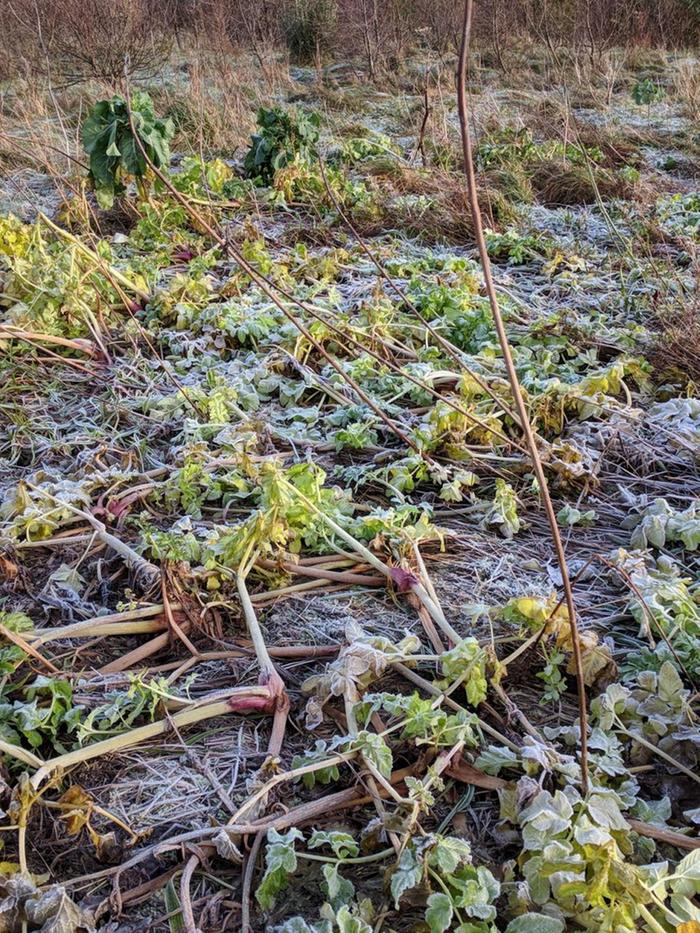
    The foreground in this image gives an indication of the effect I am finding:

    Angelica at end of first season

    You can see from the undergrowth behind that the grass is normally still green, if not growing overwinter, yet the angelica canopy succeeded in shading it out.
    It may be with you that another herbacious plant would be better - Angelica is a biannual, so for me will regrow the following year. Something like fodder radish (that may winter kill for you?) or a bulky annual like a squash plant might be better suited to your conditions.

    I started writing more answer, but lost a whole paragraph, so will make a separate post....
     
    Nancy Reading
    steward and tree herder
    Posts: 12862
    Location: Isle of Skye, Scotland. Nearly 70 inches rain a year
    6727
    6
    transportation dog forest garden foraging trees books food preservation woodworking wood heat rocket stoves ungarbage
    • Likes 7
    • Mark post as helpful
    • send pies
      Number of slices to send:
      Optional 'thank-you' note:
    • Quote
    • Report post to moderator

    Andre Wiederkehr wrote:Do you know of ways to make wood chips (in quantity - say, enough to mulch 500 sqft) without fossil fuels or electricity? Will Bonsall is/was a fan of this "forest-source fertility" in a similar context of veganic, relatively whole-diet gardening, but in the book I read by him, he doesn't address this issue of how to make them.


    It is possible to cut sticks up by hand, or build/buy a human powered shredder/chipper. Many people who practise 'veganic' type market gardening like Helen Atthowe and Ian Tollhurst do use machinery such as lawnmowers and mini tractors. If you are intending to practise no-dig on this bit of land for several years you will probably need to find a source of nutrients to keep it in good heart - I gather getting the balance is the tricky bit.

    One way I have found that potentially would work towards preparing a bed for next year is to pile up twiggy prunings in a heap and let them sit over the summer. Like the Angelica, the sticks shade out the new growth and leave a bare patch. The remaining sticks can be removed in the following spring, or maybe in a fire risk area in late summer they could be burnt for biochar perhaps. Under the patch you are left with small bits and clear soil. I tend to just break the sticks up for kindling - not every wood becomes this brittle so quickly, but they should all be able to provide the mulching effect of shading out the undergrowth if laid on thickly enough.
     
    pollinator
    Posts: 1291
    Location: Chicago
    443
    dog forest garden fish foraging urban cooking food preservation bike
    • Likes 8
    • Mark post as helpful
    • send pies
      Number of slices to send:
      Optional 'thank-you' note:
    • Quote
    • Report post to moderator

    Nancy Reading wrote:

    Andre Wiederkehr wrote:Do you know of ways to make wood chips (in quantity - say, enough to mulch 500 sqft) without fossil fuels or electricity? Will Bonsall is/was a fan of this "forest-source fertility" in a similar context of veganic, relatively whole-diet gardening, but in the book I read by him, he doesn't address this issue of how to make them.


    It is possible to cut sticks up by hand, or build/buy a human powered shredder/chipper. Many people who practise 'veganic' type market gardening like Helen Atthowe and Ian Tollhurst do use machinery such as lawnmowers and mini tractors. If you are intending to practise no-dig on this bit of land for several years you will probably need to find a source of nutrients to keep it in good heart - I gather getting the balance is the tricky bit.

    One way I have found that potentially would work towards preparing a bed for next year is to pile up twiggy prunings in a heap and let them sit over the summer. Like the Angelica, the sticks shade out the new growth and leave a bare patch. The remaining sticks can be removed in the following spring, or maybe in a fire risk area in late summer they could be burnt for biochar perhaps. Under the patch you are left with small bits and clear soil. I tend to just break the sticks up for kindling - not every wood becomes this brittle so quickly, but they should all be able to provide the mulching effect of shading out the undergrowth if laid on thickly enough.


    This basically describes my practice for using my tree trimmings as garden mulch.

    Regarding how to clear land; controlled burns were the technique used by North American gardeners working without steel or draft animals. See Buffalo Bird Woman’s account of Hidatsa method of starting a garden: https://digital.library.upenn.edu/women/buffalo/garden/garden.html

     
    master steward
    Posts: 15066
    Location: Pacific Wet Coast
    9405
    duck books chicken cooking food preservation ungarbage
    • Likes 8
    • Mark post as helpful
    • send pies
      Number of slices to send:
      Optional 'thank-you' note:
    • Quote
    • Report post to moderator
    I would look up the standards for land management for organic gardeners.  An old gardening book I have talks about adding 2 inches of quality compost to every bed each year to maintain fertility. I have *no* idea how that fellow managed to get that much compost without importing from outside the garden. But my shaky memory tells me that an Organic Market farmer in Ontario claimed that he had to let a bed have at least 3 cover crops between each planting. (I don't think he was no-till and minimal tillage tends to have higher microbes, insects, and

    I recall Joel Salatin had a chart in one of his books that mentioned how much of each vital nutrient leaves the farm every time you sell produce or meat off the farm. This leads me to remind you to check out the forum about humanure and responsible use of urine!  I'm pretty sure part of the issue is that some nutrients are harder for plants to access than others. Once you prepare land, the more minimal the tillage, the more mushrooms you can encourage, the more plants will have access to mycorrhizae and microbes to play that important role.

    That said, some soils *may* be low in some nutrients. My Island is known to be low in selenium. Local farmers will likely know if your area has anything critical that's low.

    I would be careful in the short term (until you get more nuts planted) that you do have enough and the right kind of fats planned for harvest. There are "essential" fats, just like essential vitamins. Some of the research I did a long time ago, suggested the fat side of the equation was a much bigger issuer than the protein side.

     
    Andre Wiederkehr
    Posts: 36
    31
    • Likes 8
    • Mark post as helpful
    • send pies
      Number of slices to send:
      Optional 'thank-you' note:
    • Quote
    • Report post to moderator

    Jay Angler wrote:I would look up the standards for land management for organic gardeners.  An old gardening book I have talks about adding 2 inches of quality compost to every bed each year to maintain fertility. I have *no* idea how that fellow managed to get that much compost without importing from outside the garden.


    This is a very important topic to me, and the source of my "local nutrients" value.
    I've read the same recommendation recently in Charles Dowding's book Compost . I don't have it by me, but I think the recommendation was to start a garden with a 6-8" layer of compost (imagine the wealth!) and then 2" every subsequent year. I think if you do this, you must end up importing from outside the garden.

    John Seymour, from The New Self-Sufficient Gardener wrote:
    ...no-diggers do use an awful lot of compost. In fact, they put so much on their soil that it is almost pure compost. All the no-diggers I know bring in organic material, in large quantities, from outside their property, because no matter what crops they grow, they cannot obtain enough organic material from their own lands to make the necessary compost....
    I am not decrying these practices; I think they are marvelous. All gardeners should be constantly on the lookout for organic material and seize it whenever they can. But obviously not every gardener in the world can do it; and you can be sure that if one plot of land is using this technique, it is robbing another plot of land that is either being doused with chemicals or left unproductive.


    I have actually seen a few cases of no-till gardeners not importing  from off "their own lands," but as far as I could see, they were probably still depleting the source land, so his point stands. I'm not interested in human concepts of property ownership nearly as much as ecological health.

    Importation from outside the garden is okay with me as long as it comes into a fairly healthy equilibrium eventually - basically, that the land it's coming from is not becoming continuously less fertile over time. My fairly basic understanding is this can happen in two ways: either you rotate where you're gardening around the whole area you work with (e.g. compost materials come from 1/2 of the plot of land and are applied to the other 1/2, and every few years you move where that 1/2 over to the other side) or you are taking them from an ecosystem that contains enough critters that are good at 1) producing enough bonus organic matter that you can take some and still leave more than they started the season with and 2) breaking mineral constituents of soil down into nutrient forms available to plants at least as fast as you're taking away minerals.
    The former is only practical transport-wise if the areas are pretty near each other. I'm wary of the latter option, because it seems a lot of people assume the source ecosystem can cope with what you're taking away without really knowing that it can. And it might take a while to see if you're doing damage. This is why I'm pretty committed to not importing material from land others are managing to feed the soil I'm working with. And that's where these systems usually run into trouble, because it seems like it's just pretty hard for most people to gather that much material without importing.

    Jay Angler wrote:I recall Joel Salatin had a chart in one of his books that mentioned how much of each vital nutrient leaves the farm every time you sell produce or meat off the farm. This leads me to remind you to check out the forum about humanure and responsible use of urine!  I'm pretty sure part of the issue is that some nutrients are harder for plants to access than others. Once you prepare land, the more minimal the tillage, the more mushrooms you can encourage, the more plants will have access to mycorrhizae and microbes to play that important role.


    Yup, I love using humanure/urine compost on gardens for this very reason! Cycle the nutrients back to where we received them from (or uphill/upstream/upwind from there...), like many other animals do (perhaps in a less calculating way). I've used Joe Jenkins' methods for doing this in the past, although I'd like to keep exploring if that exact system makes the most sense for me.

    I've actually done a calculation of this potential for nutrient loss for the example of maize (using standard nutritional data, which again might not represent the nutrient content of one's particular variety).
    So, for example, in the past Arkhipov Dent has yielded 26.3 cups in a bed (which, including the paths, is ~122sqft). This comes to 63 bushels/acre (not that I've ever grown anything near an acre of corn). That's a very poor yield by conventional monoculture standards, but I'm okay with that. I choose to not use all the tricks they do to bump up yield.
    The nutrients in this hypothetical harvest would be:
    nutrientlb/ton dry matter maizelb/acre
    C7951220
    N2436.8
    P(P2O5)1218.4
    K(K2O)812.3
    Ca23.1
    Mg23.1
    S23.1

    So, if I were to grow an acre of this corn and send it away from the land, the soil would be losing 1200lbs of carbon, 37lbs of nitrogen and 40lbs of mineral nutrients. This is why I don't want to sell food!

    If others are entertained by such calculations, I put the table in my spreadsheet at the bottom of the "crop chart" page, so you can sub in your own yield data or that of a conventional field of corn (might be 100-200 bu/ac).

    Jay Angler wrote:I would be careful in the short term (until you get more nuts planted) that you do have enough and the right kind of fats planned for harvest. There are "essential" fats, just like essential vitamins. Some of the research I did a long time ago, suggested the fat side of the equation was a much bigger issuer than the protein side.


    I've tried to read about this in the past and gotten kind of bogged down in debates about not only getting enough of essential fatty acids, but also the right ratio between omega-3 and omega-6. I think I might be okay, between soybeans, poppy seeds, squash seeds (I eat them from any species, with more less processing depending on the thickness of hull) and black walnuts. As a byproduct of fibre-flax growing, I find I get relatively little seed beyond what I need to replant the next time. I'm reluctant to try to maintain both a fibre flax and a seed flax variety. But maybe I should try to grow more flax seed, as it is higher in omega-3 and would pull the ratio that way a bit along with the walnuts.
    Anyone know some pretty straightforward sources on how to get this essential fatty acid amount and balance about right? Maybe I need to add another section to my spreadsheet....
     
    Andre Wiederkehr
    Posts: 36
    31
    • Likes 4
    • Mark post as helpful
    • send pies
      Number of slices to send:
      Optional 'thank-you' note:
    • Quote
    • Report post to moderator

    Nancy Reading wrote:
    You can see from the undergrowth behind that the grass is normally still green, if not growing overwinter, yet the angelica canopy succeeded in shading it out.


    That's pretty cool! I will tuck the idea away to try.
     
    Jay Angler
    master steward
    Posts: 15066
    Location: Pacific Wet Coast
    9405
    duck books chicken cooking food preservation ungarbage
    • Likes 7
    • Mark post as helpful
    • send pies
      Number of slices to send:
      Optional 'thank-you' note:
    • Quote
    • Report post to moderator

    Andre Wiederkehr wrote: I'm reluctant to try to maintain both a fibre flax and a seed flax variety. But maybe I should try to grow more flax seed, as it is higher in omega-3 and would pull the ratio that way a bit along with the walnuts.


    R Ransom here on permies has done a *lot* of work on growing flax. If I recall correctly, the most important issues were:
    1. Flax seed grown for fiber has to be planted close so competition encourages height with few side branches. Best fiber is harvested before seed is viable.
    2. Flax seed grown for seed is planted further apart and side branches are promoted for better seed production. Harvesting is after seed is mature.  

    I'm going on memory here, but she's got info in the fiber arts forums.
     
    pioneer
    Posts: 373
    94
    cat trees urban
    • Likes 6
    • Mark post as helpful
    • send pies
      Number of slices to send:
      Optional 'thank-you' note:
    • Quote
    • Report post to moderator

    Andre Wiederkehr wrote:
    Anyone know some pretty straightforward sources on how to get this essential fatty acid amount and balance about right?


    I did look at this a number of years back, and I seem to recall: Brassica seed crops bred for oil came up as another option;  Omega-3 family fatty acids were the limiting factor in seed oils. Growing micro-algae may be a viable way to get enough Omega-3.

    "Walnuts, canola [rapeseed] oil, flaxseeds and flaxseed oil, chia seeds, hemp seeds, and perilla oil are high in the omega-3, alpha-linolenic acid (ALA). There are two other omega-3s, EPA and DHA .. " [which we can get from algae.]

    Adults need up to 1.5 g ALA daily, which would be about a dozen cups of kale leaf! or about four cups of common purslane leaf.

    Source: Omega 3s, by Jack Norris, Registered Dietitian https://veganhealth.org/omega-3s-part-2/#dri-ala


    Ac Baker
    pioneer
    Posts: 373
    94
    cat trees urban
    • Likes 7
    • Mark post as helpful
    • send pies
      Number of slices to send:
      Optional 'thank-you' note:
    • Quote
    • Report post to moderator
    "Brassica oilseed species are the third most important in the world, providing approximately 15 % of the total vegetable oils. Three species (Brassica rapa, B. juncea, B. napus) dominate ..

    "The term ‘canola’ is used to describe varieties with <2 % erucic acid in their oil and < 30μmoles glucosinolates per g of meal. ... [also called] low erucic acid rapeseed (LEAR)"

    Source: Randall et al. 2024, Increasing oil content in Brassica oilseed species, Prog. Lipid R.
    https://www.sciencedirect.com/science/article/pii/S0163782724000390
     
    Ac Baker
    pioneer
    Posts: 373
    94
    cat trees urban
    • Likes 6
    • Mark post as helpful
    • send pies
      Number of slices to send:
      Optional 'thank-you' note:
    • Quote
    • Report post to moderator
    I don't know of anyone growing "oilseed rape" or commercial LEAR rapeseed on a non-commercial basis. But there are named varieties optimised for Europe if we wanted to try e.g. https://mspagriculture.co.uk/our-products/cereal-seed/oilseed-rape/
     
    Ac Baker
    pioneer
    Posts: 373
    94
    cat trees urban
    • Likes 7
    • Mark post as helpful
    • send pies
      Number of slices to send:
      Optional 'thank-you' note:
    • Quote
    • Report post to moderator
    In terms of sustainably organic matter and soil nutrients in the land we steward, I recall Iain "Tolly" Tolhurst suggesting 25% of the land needs to be under green manure crops.  These days, Tolhurst Organic makes vast quantities of branch wood compost from sustainably managing their woody perennials on-site.

    Here's a nice readable introduction by Tolly about using composted branch wood in tandem with green manures in-situ in veg fields: https://veganorganic.net/composting-woodchips/
     
    Nancy Reading
    steward and tree herder
    Posts: 12862
    Location: Isle of Skye, Scotland. Nearly 70 inches rain a year
    6727
    6
    transportation dog forest garden foraging trees books food preservation woodworking wood heat rocket stoves ungarbage
    • Likes 4
    • Mark post as helpful
    • send pies
      Number of slices to send:
      Optional 'thank-you' note:
    • Quote
    • Report post to moderator

    Andre Wiederkehr wrote:So, if I were to grow an acre of this corn and send it away from the land, the soil would be losing 1200lbs of carbon, 37lbs of nitrogen and 40lbs of mineral nutrients.


    I always say my produce is too precious to sell!
    I wouldn't worry about the carbon at least - that will almost entirely have come from the air. Nitrogen as well comes from the air (via soil dwelling organisms) so both of these should be replenished with a system that returns the surplus. However, yes most of the minerals would be from the soil.
     
    I agree. Here's the link: http://stoves2.com
    reply
      Bookmark Topic Watch Topic
    • New Topic