
• Post Reply Bookmark Topic Watch Topic
  • New Topic
permaculture forums growies critters building homesteading energy monies kitchen purity ungarbage community wilderness fiber arts art permaculture artisans regional education skip experiences global resources cider press projects digital market permies.com pie forums private forums all forums
this forum made possible by our volunteer staff, including ...
master stewards:
  • Carla Burke
  • Nancy Reading
  • John F Dean
  • r ransom
  • Jay Angler
  • Timothy Norton
stewards:
  • paul wheaton
  • Tereza Okava
  • Nicole Alderman
master gardeners:
  • M Ljin
  • Christopher Weeks
gardeners:
  • Jeremy VanGelder
  • thomas rubino
  • Megan Palmer

neighborhood bamboo patch

 
Posts: 10315
Location: a temperate, clay/loam spot on planet earth, the universe
3552
4
  • Likes 16
  • Mark post as helpful
  • send pies
    Number of slices to send:
    Optional 'thank-you' note:
  • Quote
  • Report post to moderator
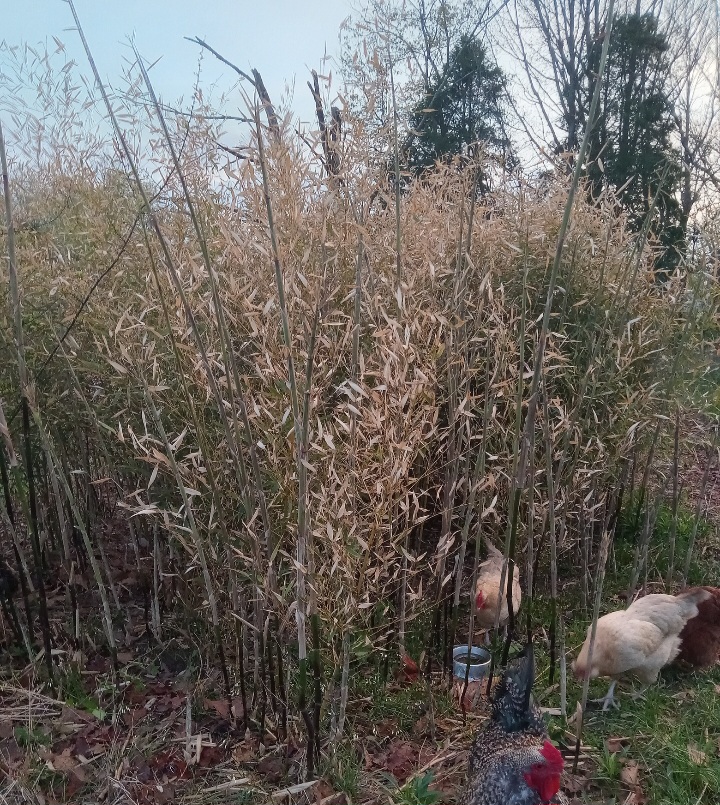
This bamboo is a short walking distance from our house.
It was planted years ago when the lot had a large garden.  The bamboo has taken over the garden, storage buildings, trees, rolls of wire, etc and is always encroaching on the immediate neighbors yards.

We, and others here in town are encouraged to harvest all we like with no end in sight.
One year some folks hauled big trailer loads off to sell for crawfish traps.

When Stephen T. was here over the winter he cleared a corridor for us back into the center where it was so overgrown canes were dieing.
These pictures are of that 'corridor'today....the bamboo began sending up new shoots only a week or so ago...some are already leafing out at the top....some are just small shoots.

I've read that canes should be three years old before cutting and have wondered how to keep track ..now I think cutting swaths through the grove and marking with stakes or flagging for age would make it easy.

There's a limit to what we can use and time we feel like devoting to the task although as a thought exercise it's been interesting.
IMG_20260416_124332_300.jpg
[Thumbnail for IMG_20260416_124332_300.jpg]
IMG_20260416_124456_844-2.jpg
[Thumbnail for IMG_20260416_124456_844-2.jpg]
IMG_20260416_124344_592-2.jpg
[Thumbnail for IMG_20260416_124344_592-2.jpg]
IMG_20260416_124350_974-2.jpg
[Thumbnail for IMG_20260416_124350_974-2.jpg]
IMG_20260416_124338_967-2.jpg
[Thumbnail for IMG_20260416_124338_967-2.jpg]
 
Judith Browning
Posts: 10315
Location: a temperate, clay/loam spot on planet earth, the universe
3552
4
  • Likes 6
  • Mark post as helpful
  • send pies
    Number of slices to send:
    Optional 'thank-you' note:
  • Quote
  • Report post to moderator
Here's a link to Stephen's post with pictures of the clearing...
https://permies.com/t/365095/volunteering/experiences/Stephen-Snowbirding-Sustainability-Sojourn-February#3742789
 
master steward
Posts: 15274
Location: Pacific Wet Coast
9612
duck books chicken cooking food preservation ungarbage
  • Likes 13
  • Mark post as helpful
  • send pies
    Number of slices to send:
    Optional 'thank-you' note:
  • Quote
  • Report post to moderator
That's a very happy bamboo patch!

If you cut a shoot (many are edible if cut young, but you need to know what type), it won't grow, so one way to keep it under control is to cut lots of shoots in the spring and only leave shoots where you want them.

If you let them grow in groups, that might make it easier to tag a whole group for harvesting purposes. I have actually heard that for longevity, 5 year old culms are even better. That said, clearly you have so much of it, that longevity isn't the biggest issue. However, it is likely to be stronger at 3-5 years of age, so if what you're doing requires strength, it would be nice to have some sections that are marked.

I have heard of it being used for firewood, but I've never tried it. I think it would be on the bulky side to store.
 
master gardener
Posts: 2347
Location: Zone 5
1326
ancestral skills forest garden foraging composting toilet fiber arts bike medical herbs seed writing ungarbage
  • Likes 9
  • Mark post as helpful
  • send pies
    Number of slices to send:
    Optional 'thank-you' note:
  • Quote
  • Report post to moderator
What sort of bamboo is that I wonder? I’m relatively sure not river cane.
 
Judith Browning
Posts: 10315
Location: a temperate, clay/loam spot on planet earth, the universe
3552
4
  • Likes 12
  • Mark post as helpful
  • send pies
    Number of slices to send:
    Optional 'thank-you' note:
  • Quote
  • Report post to moderator
If it was the variety we thought it was, definitely edible shoots...not so sure after looking at 'The Big Book of Bamboo' from the library!

Definitely not river cane although we have some on the creek nearby and it's fairly common here....we used to harvest it and bring home truckloads to our cabin...the goats cleaned the tops for us.

This has a double ring, a groove up one side, grows over 20' tall, and a couple other things that we thought indicated it was
phyllostachys bambusoide
Some that has died out is over 2" but most is so crowded it's coming up small.
https://en.wikipedia.org/wiki/Phyllostachys_bambusoides
We hear from someone who knew that Aunt Tilly planted it and it would have been long enough ago that we thought it was the type the USDA was promoting as a useful thing to plant and maybe not explaining how to keep it in check?

We use a lot for woven garden trellises...and curtain rods and plant stakes and a few other things.
The attic of the garden shed is full of curing bamboo.


steward & manure connoisseur
Posts: 5075
Location: South of Capricorn
3044
dog rabbit urban cooking writing homestead ungarbage
  • Likes 11
  • Mark post as helpful
  • send pies
    Number of slices to send:
    Optional 'thank-you' note:
  • Quote
  • Report post to moderator

Jay Angler wrote:If you cut a shoot (many are edible if cut young, but you need to know what type), it won't grow, so one way to keep it under control is to cut lots of shoots in the spring and only leave shoots where you want them.


if they're small enough you should be able to just break them off with your hand, don't even need to cut. this is the time to do it, before the sprouts get too fibrous to break.
 
Tereza Okava
steward & manure connoisseur
Posts: 5075
Location: South of Capricorn
3044
dog rabbit urban cooking writing homestead ungarbage
  • Likes 12
  • Mark post as helpful
  • send pies
    Number of slices to send:
    Optional 'thank-you' note:
  • Quote
  • Report post to moderator
(we eat pretty much every kind of bamboo we can find. we never eat any of it raw, only after significant boiling, and anything that is still bitter after a good boil gets tossed out. there are ongoing debates in my family about what kinds are good and what kinds are bad, even though everyone grew up eating it... we basically just don't worry about it and if we find bamboo sprouting, we harvest it. your mileage may vary!)
 
gardener
Posts: 2201
Location: Zone 6b
1389
forest garden fungi books chicken fiber arts ungarbage
  • Likes 14
  • Mark post as helpful
  • send pies
    Number of slices to send:
    Optional 'thank-you' note:
  • Quote
  • Report post to moderator
So wonderful you have as many bamboo canes as you need. I have difficulty growing bamboo and at one point it was on the brink of dying. https://permies.com/t/242089/bamboo-grow-faster-bigger

Following Jay's advice, I encouraged chickens in that area to add fertility, and gave the groove same mineral treatments as in my garden. The culms have grown thicker and have less winter die back in the last two years. I pluck young shoots in undesirable spot to control the spread. Those shoots are edible and chickens love them too if I help breaking them up. I also dig up long underground rhizomes and use them for basket handles.
20260411.jpg
Bamboo
Bamboo
 
Judith Browning
Posts: 10315
Location: a temperate, clay/loam spot on planet earth, the universe
3552
4
  • Likes 11
  • Mark post as helpful
  • send pies
    Number of slices to send:
    Optional 'thank-you' note:
  • Quote
  • Report post to moderator
We did break off a few new sprouts and peeled and nibbled a bit.

How fo we cook them?
peeled or not?

30 years ago this would have been a serious pursuit, harvesting the canes and also food!

Now, it's gathering info to share with anyone who might want to harvest some.

There is a cottage industry in waiting over there for someone younger than us.

One of the first for sale items Steve ever made was cane flutes...river cane cures out just as beautifully as larger bamboo....he sold a lot of flutes and pan whistles.
 
Tereza Okava
steward & manure connoisseur
Posts: 5075
Location: South of Capricorn
3044
dog rabbit urban cooking writing homestead ungarbage
  • Likes 11
  • Mark post as helpful
  • send pies
    Number of slices to send:
    Optional 'thank-you' note:
  • Quote
  • Report post to moderator
we make a point of never ever eating raw shoots. i don't think we have what the poisonous one is but it still never is going to taste good raw.
After harvesting we peel (knife slit down the side, shuck off the leafy part) and the remaining part goes into salted water. you'll see a gradient in softness- anything a knife won't slide through like butter (any resistance) isn't something we eat and gets tossed for the animals. We usually do it in a big group.
There have been times when we've sliced them and cooked them in slices, but generally we keep the tips whole, cook them whole, and then slice and cook in the final application later.
I don't remember how long we cook them, but it's a while. I have seen my mother in law taste, drain and replace the water and declare it needed another go. Basically til the bitter is boiled out.
 
Judith Browning
Posts: 10315
Location: a temperate, clay/loam spot on planet earth, the universe
3552
4
  • Likes 4
  • Mark post as helpful
  • send pies
    Number of slices to send:
    Optional 'thank-you' note:
  • Quote
  • Report post to moderator
I don't know enough about bamboo to know that there are some poisonous ones!

Cooking resolves that possibility?


Judith Browning
Posts: 10315
Location: a temperate, clay/loam spot on planet earth, the universe
3552
4
  • Likes 4
  • Mark post as helpful
  • send pies
    Number of slices to send:
    Optional 'thank-you' note:
  • Quote
  • Report post to moderator
...or is poisonous bamboo like poisonous mushrooms, still toxic after cooking?
 
Tereza Okava
steward & manure connoisseur
Posts: 5075
Location: South of Capricorn
3044
dog rabbit urban cooking writing homestead ungarbage
  • Likes 11
  • Mark post as helpful
  • send pies
    Number of slices to send:
    Optional 'thank-you' note:
  • Quote
  • Report post to moderator
i am not an expert. i understand the toxin is like cassava (which we eat without any issues), degrades upon cooking (like half an hour of boiling). That cooking will remove most of the bitterness, and sometimes multiple boilings remove the bitterness and sometimes it can't be helped and they're still too bitter to eat.
But i've seen somewhere conversation about some poisonous type and I haven't seen every type of bamboo so I truly don't know. worth a search.
 
Judith Browning
Posts: 10315
Location: a temperate, clay/loam spot on planet earth, the universe
3552
4
  • Likes 8
  • Mark post as helpful
  • send pies
    Number of slices to send:
    Optional 'thank-you' note:
  • Quote
  • Report post to moderator
https://en.wikipedia.org/wiki/Bamboo_shoot

 Raw bamboo shoots contain cyanogenic glycosides, natural toxins also contained in cassava.[3] The toxins must be destroyed by thorough cooking, and for this reason, fresh bamboo shoots are boiled before being used in other ways. The toxins are also destroyed in the canning process.  


  Plants that make cyanogenic glycosides store them in the vacuole, but, if the plant is attacked, they are released and become activated by enzymes in the cytoplasm. These remove the sugar part of the molecule, allowing the cyanohydrin structure to collapse and release toxic hydrogen cyanide.
Storing them in inactive forms in the vacuole prevents them from damaging the plant under normal conditions.[6]
Along with playing a role in deterring herbivores, in some plants they control germination, bud formation, carbon and nitrogen transport, and possibly act as antioxidants.[6] The production of cyanogenic glycosides is an evolutionarily conserved function, appearing in species as old as ferns and as recent as angiosperms.[6] These compounds are made by around 3,000 species.
In screens they are found in about 11% of cultivated plants but only 5% of plants overall; humans seem to have selected for them.[6]Examples include amygdalin and prunasin which are made by the bitter almond tree; other species that produce cyanogenic glycosides are sorghum (from which dhurrin, the first cyanogenic glycoside to be identified, was first isolated), barley, flax, white clover, and cassava, which produces linamarin and lotaustralin.

[6]Amygdalin and a synthetic derivative, laetrile, were investigated as potential drugs to treat cancer and were heavily promoted as alternative medicine; they are ineffective and dangerous.[7]

Some butterfly species, such as the Dryas iulia and Parnassius smintheus, have evolved to use the cyanogenic glycosides found in their host plants as a form of protection against predators through their unpalatability.[8][9]l


Jay Angler
master steward
Posts: 15274
Location: Pacific Wet Coast
9612
duck books chicken cooking food preservation ungarbage
  • Likes 12
  • Mark post as helpful
  • send pies
    Number of slices to send:
    Optional 'thank-you' note:
  • Quote
  • Report post to moderator

In screens they are found in about 11% of cultivated plants but only 5% of plants overall; humans seem to have selected for them.


That makes sense to me. Humans know how to cook food. Animals don't. So if Humans want to discourage grazing animals from eating our crops, make them toxic without cooking first.

Unfortunately, the deer where I live haven't read this article...

However, this does also mean that it's important not to follow fads which have people eating foods raw that are probably not that good for them. I have a friend who eats raw rhubarb stalks in the spring. Rhubarb contains oxalic acid and I quick search suggests it's not destroyed by cooking - but dissolves in hot water, so similar to bamboo, cooking it in changes of water would be necessary if you've got kidney issues or are low in Calcium intake.

Knowing how foods were prepared traditionally is really useful.
 
May Lotito
gardener
Posts: 2201
Location: Zone 6b
1389
forest garden fungi books chicken fiber arts ungarbage
  • Likes 11
  • Mark post as helpful
  • send pies
    Number of slices to send:
    Optional 'thank-you' note:
  • Quote
  • Report post to moderator
Varieties and growing stages matter a lot. The most tasty ones are from dormant shoots of some large bamboo species harvested in winter. Many toxins are secondary metabolites that accumulate when the plants get older so young ones are safer to eat. Bitterness is the sign and humans naturally avoid bitter foods.
Given the small size of my bamboo, if I want to eat some, I need to pluck when they just emerge no more than a few inches tall and they broke off underground.  It makes walking in the area easier, than cutting with a pruner later and leaving short stubbles here and there.
20260417_214545.jpg
Earing bamboo shoots
 
Judith Browning
Posts: 10315
Location: a temperate, clay/loam spot on planet earth, the universe
3552
4
  • Likes 6
  • Mark post as helpful
  • send pies
    Number of slices to send:
    Optional 'thank-you' note:
  • Quote
  • Report post to moderator
thanks for the inspiration and encouragement!
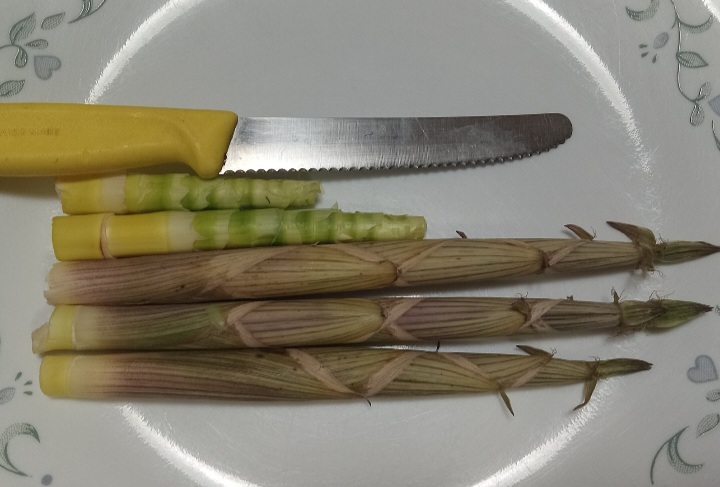
We walked over to the grove and found a few still small enough from the area we had cleared.
Have them on to boil now...

Is there a minimum length of time to boil?
all determined by the level of bitter?
IMG_20260418_103641_147-2.jpg
[Thumbnail for IMG_20260418_103641_147-2.jpg]
IMG_20260418_104200_995-2.jpg
[Thumbnail for IMG_20260418_104200_995-2.jpg]
 
Judith Browning
Posts: 10315
Location: a temperate, clay/loam spot on planet earth, the universe
3552
4
  • Likes 5
  • Mark post as helpful
  • send pies
    Number of slices to send:
    Optional 'thank-you' note:
  • Quote
  • Report post to moderator
just had a tiny taste....No bitter taste at all but astringent even after one change of water and a 45 minutes boiling.
...putting back on to boil.
 
May Lotito
gardener
Posts: 2201
Location: Zone 6b
1389
forest garden fungi books chicken fiber arts ungarbage
  • Likes 7
  • Mark post as helpful
  • send pies
    Number of slices to send:
    Optional 'thank-you' note:
  • Quote
  • Report post to moderator
I put them in the slow cooker with meat stew. So that's hours of cooking. It's better to harvest just after spring rain as they grow so fast and haven't had time to get fibrous. I don't taste anything astringent, just umami.

Also I see a pile of junk canes. They will take forever to breakdown due to high silica level but they make great biochar. Is there a way you can haul them somewhere safe to burn?
 
Judith Browning
Posts: 10315
Location: a temperate, clay/loam spot on planet earth, the universe
3552
4
  • Likes 8
  • Mark post as helpful
  • send pies
    Number of slices to send:
    Optional 'thank-you' note:
  • Quote
  • Report post to moderator
hours of cooking!
we gave up too soon ...just ate a small amount and composted the rest.
We thought the flavor similar to asparagus...and lovely texture but definitely a lasting astringency in my mouth.

Will look forward to next winters new growth!

There are piles of dead canes and standing dead but no where we would be comfortable burning for biochar....will try to suggest to anyone who can put more effort in the clean up.
 
pollinator
Posts: 124
45
  • Likes 9
  • Mark post as helpful
  • send pies
    Number of slices to send:
    Optional 'thank-you' note:
  • Quote
  • Report post to moderator
The oxalic acid in rhubarb tends to concentrate in the leaves.  Pretty logical, if a plant has to expend energy to make poison, concentrate said poison in the most likely portion of the plant to be eaten - the leaves!  Oxalic acid is not the only toxin found in rhubarb, many of those produce digestive issues and some crystal formations may damage the kidneys.  It is suggested to not exceed moderate ingestion to reduce potential negative effects.
 
May Lotito
gardener
Posts: 2201
Location: Zone 6b
1389
forest garden fungi books chicken fiber arts ungarbage
  • Likes 8
  • Mark post as helpful
  • send pies
    Number of slices to send:
    Optional 'thank-you' note:
  • Quote
  • Report post to moderator
Since Arkansas is severe drought, that may cause the astringent taste because plants are stressed. You don't have to cook that long, it's just my lazy cooking. Besides, I didn't bother to harvest many to make an entire dish. I grew up eating the giant type, maybe a kind of moso, that one shoot was more than enough to serve a whole family. Short ones that look like traffic cones were younger and tastier. We only ate modestly each time as people said too much would cause indigestion.  The peeled shoots was cut into fine threads similar to those of potato hashbrowns and blanched in boiling water. Then drained and sautéed with some meat.

Do you know what variety it is? I am still trying to figure out what I have.
 
Judith Browning
Posts: 10315
Location: a temperate, clay/loam spot on planet earth, the universe
3552
4
  • Likes 4
  • Mark post as helpful
  • send pies
    Number of slices to send:
    Optional 'thank-you' note:
  • Quote
  • Report post to moderator
May,
this is what we think it is
https://en.wikipedia.org/wiki/Phyllostachys_bambusoides

https://permies.com/t/371552/neighborhood-bamboo-patch#3763472
 
Steward and Man of Many Mushrooms
Posts: 6108
Location: Southern Illinois
1893
transportation cat dog fungi trees building writing rocket stoves woodworking
  • Likes 5
  • Mark post as helpful
  • send pies
    Number of slices to send:
    Optional 'thank-you' note:
  • Quote
  • Report post to moderator
If you just want to just contain the bamboo, you could mow a path right up to the bamboo patch--going as close to as to the "forest" as you can.  The idea is to snap off the shoots as they come up.  

This probably needs to be a wide row--I would say 8 feet wide at the minimum.  Hopefully, you can outrun the Bamboo's ability to to spread it runners.


Just my 2 cents.


Eric
 
Jay Angler
master steward
Posts: 15274
Location: Pacific Wet Coast
9612
duck books chicken cooking food preservation ungarbage
  • Likes 4
  • Mark post as helpful
  • send pies
    Number of slices to send:
    Optional 'thank-you' note:
  • Quote
  • Report post to moderator
Judith, I've seen P bambusoides twice in my ecosystem ( and coveted it both times...) and unless your ecosystem is much harsher on the plant in some way, it seems to me that the culms are too narrow for it to be that one. Even my P dulcis ( https://en.wikipedia.org/wiki/Phyllostachys_dulcis ) grows 2" culms around the outside of the patch on good years, and its culms are supposed to be smaller in diameter than P bambusoides.

From  https://bamboosourcery.com/?s=bambusoides
"Also known as ‘Giant Japanese Timber Bamboo’, this plant has bright green smooth canes and medium size leaves. One of the largest, reliable, easy-to-grow, temperate climate, giant bamboo, it can grow 72′ tall and 6″ in diameter"

There are a few bamboos that are distinct and easier to identify, but I admit that most are darn difficult! I tried getting a picture of the young shoots, and the web showed me closer to what I expected, but a totally different genus!  

Then again, this patch isn't being managed and proper, regular, thinning could make all the difference.
 
The airline is called "Virgin"? Don't you want a plane to go all the way? This tiny ad will go all the way:
Permaculture Adventure Bundle - 43 digital goods for freaky cheap!
https://permies.com/w/permaculture-adventure
reply
    Bookmark Topic Watch Topic
  • New Topic