• Post Reply Bookmark Topic Watch Topic
  • New Topic
permaculture forums growies critters building homesteading energy monies kitchen purity ungarbage community wilderness fiber arts art permaculture artisans regional education skip experiences global resources cider press projects digital market permies.com pie forums private forums all forums
this forum made possible by our volunteer staff, including ...
master stewards:
  • Devaka Cooray
  • Carla Burke
  • John F Dean
  • Nancy Reading
  • Timothy Norton
  • r ranson
stewards:
  • Jay Angler
  • Pearl Sutton
  • paul wheaton
master gardeners:
  • Christopher Weeks
  • M Ljin
gardeners:
  • thomas rubino
  • Eino Kenttä
  • Jeremy VanGelder

Why the duck cant I grow carrots!!!

 
Posts: 65
16
personal care foraging urban chicken bike bee
  • Likes 15
  • Mark post as helpful
  • send pies
    Number of slices to send:
    Optional 'thank-you' note:
  • Quote
  • Report post to moderator
I have been gardening on my own now for 10 years. My mother for 20 years and my Grandma for longer then time. I had realized a few years back that none of us grow carrots. I thought well why are we buying them from the store when we grow everything else? Mom says there just cheaper to buy then to grow for her and that's valid. Grandma just grows daisy's these days.  But I still want to grow rather then buy so I add them to the list for seeds and stuff to plant thinking nothing much of it.
For the FORTH year in a row now I have tried and failed to grow the little buggers. I just harvested 4 carrots from LAST years bed!!! Apparently the seeds decided to finally germinate. I will mention just to sooth my own ego they were picture perfect carrots but a year to late and only 4. Iv grown tomatoes, squash, potatoes, dragon fruit, beets, radishes, onions and so on no problem!!! They seem to be the only thing I cant grow and now we really want carrots cause they were really good!!! I've tried presprouting them, seeding them under burlap to keep them moist, changing locations, seed and soil. But They normally never even germinate!  We live in zone 4 of Iowa with good soil and I dont think its the garden or seeds at this point I think its me lol. Please tell me your carrot growing ways!
 
Posts: 26
Location: Zone 7b, 600', Sandy-Loam, Cascadian Maritime Temperate
15
  • Likes 13
  • Mark post as helpful
  • send pies
    Number of slices to send:
    Optional 'thank-you' note:
  • Quote
  • Report post to moderator
I feel your pain.
I love Carrots, but they have always been a very difficult crop for me - for more than a decade.

I've tried making a corn starch gel to mix the seeds into - to keep the seeds even spaced and hydrated.
I've tried mixing the seed with fine soil and sprinkling that in the planting furrows - to keep good spacing.
I've tried keeping a board over the planted row until they emerge- to keep the bed from drying out.
I've tried germinating them in a plastic bag, on rolled up strips of paper towels...
I understand that these methods work very well for many people, yet I rarely get very many full-grown carrots.

The best results I have is by replanting the top portion of store-bought carrots.
One thing I've learned is that their seeds often take a long time to germinate - two weeks sometimes.
Keeping the rows moist during that time seems to be essential, from what I've read.

I get a mental block about fiddling around with tiny seeds though, and that probably doesn't help.
I won't give up though, and I hope you don't either - good luck!
 
Posts: 776
Location: Sierra Nevada foothills, 350 m, USDA 8b, sunset zone 7
165
  • Likes 3
  • Mark post as helpful
  • send pies
    Number of slices to send:
    Optional 'thank-you' note:
  • Quote
  • Report post to moderator
You are not alone Sam. I never ever managed to grow a single carrot. I have planted thousands of seeds of various  types and at various times of the year and in various locations on my land.
 
gardener
Posts: 912
Location: Ontario - Zone 6a, 4b, or 3b, depending on the day
607
dog foraging trees tiny house books bike bee
  • Likes 11
  • Mark post as helpful
  • send pies
    Number of slices to send:
    Optional 'thank-you' note:
  • Quote
  • Report post to moderator
Carrots need me to water every day, maybe every other day, and I put boards on top of them to germinate them. They are planted super shallowly can't can't be allowed to dry out at all.  They also germinate better before last frost, when the ground is warming but not yet hot. I find sowing carrots in summer for fall harvests much more challenging.

My procedure is to scrape a furrow with a stick, maybe 1/2" deep, plant the carrot seed, then sprinkle lightly with dry crumbled soil just until I came no longer see the seeds, so the carrots are still in a bit of a depression to hold water, cover with a board, and wait. The burlap trick isn't enough for reliable germination with how often I water.

I now get good germination... Until I deviate even slightly from that procedure.

Oh, and fork the soil before you plant them, too, if you can. My new garden was rototilled this spring so I didn't fork the ground. The carrots all grew to the depth of the tiller and stopped.
 
Posts: 678
235
  • Likes 10
  • Mark post as helpful
  • send pies
    Number of slices to send:
    Optional 'thank-you' note:
  • Quote
  • Report post to moderator
The only thing I've not seen posted is the addition of creek sand to the carrot growing beds.  I also would place the seeds as thin as possible and use the edge of the board to lightly press in the tiny seeds into contact with the soil.  Water well and then cover with the rough cut board and wait!!!  Some years it would take weeks for any to appear.

I did not save seed from the carrots, I bought fresh seed for each year, Danvers or Nantes and from bio-dynamic growers.  And always had fair to good results, except for the spacing thing.  Some years here in zone 7 we did not pull our carrots, just covered them with leaves and straw for the winter.

I hope you will keep trying, as there is nothing in the stores like home grown carrots!!!

Heddwch
 
pollinator
Posts: 426
Location: Oz; Centre South
101
trees books cooking fiber arts writing
  • Likes 9
  • Mark post as helpful
  • send pies
    Number of slices to send:
    Optional 'thank-you' note:
  • Quote
  • Report post to moderator
Just maybe the problem is soil that is "too heavy"  Seems that carrots like a sandy soil to grow properly.  I've finally cracked it - bought in some garden soil from the local landscape centre, which had a fair proportion on sand in it.  I planted a whole packet of a variety that had round carrots - a bit like the shape of radishes - and what do you know, the little marvels have ALL grown, and I'd sown them thickly in anticipation of minimal germination.  So, anyone who has success with carrots, can I thin out and transplant them?  Please. . .
 
gardener & author
Posts: 3569
Location: Tasmania
2131
8
homeschooling goat forest garden fungi foraging trees cooking food preservation pig wood heat homestead
  • Likes 12
  • Mark post as helpful
  • send pies
    Number of slices to send:
    Optional 'thank-you' note:
  • Quote
  • Report post to moderator
I used to really struggle with growing carrots, now they are one of our staple crops. Here’s what I do to make them grow more reliably:

• Plant them deeper than everyone says. I plant at around 3/4” deep. I use an earthway seeder, but you can just carefully sow them by hand if you don’t have one.

• Water them every day if it’s not raining until they come up. It can take up to 3 weeks sometimes.

• Around a week or two after they’re up, start thinning them so they are around 4” apart in the row. It’s important to be absolutely ruthless with this, if they are crowded then you won’t get more carrots, you’ll just get heaps of tiny things that are too small to eat.

• If weeds are taking over the bed, do some hoeing. I usually only need to weed once or twice early on.

• Mine take around 5 months to grow to a decent size. In my zone 8 or 9 climate, they can stay in the soil all winter without problems.

• Kuroda is my favourite variety, Koral has grown well here too.
 
pollinator
Posts: 1124
Location: Greybull WY north central WY zone 4 bordering on 3
340
hugelkultur trees solar woodworking composting homestead
  • Likes 3
  • Mark post as helpful
  • send pies
    Number of slices to send:
    Optional 'thank-you' note:
  • Quote
  • Report post to moderator
sandy soil, way over seed, thin like crazy.

If doing heavier soils expect way lower success rates and choose short fat varieties.
 
Sam Potter
Posts: 65
16
personal care foraging urban chicken bike bee
  • Likes 5
  • Mark post as helpful
  • send pies
    Number of slices to send:
    Optional 'thank-you' note:
  • Quote
  • Report post to moderator
Its nice to hear that Im not the only one that has troubles with carrots. From what I see I'm planting them a little to late in the spring and they are most likely drying out in our clay soil. I think Il try three beds this year in different styles and see if I cant crack the code. Can you sow them in winter like I do with spinach and lettuce seeds? The melting snow keeps them moist and happy so around February on a relatively warm day I plant them on the north side of the house and get a good crop that way come spring. It wouldn't be to hard to prep a bed in fall and throw in the seeds then. Or maybe around the same time I get potatoes in...  
 
gardener
Posts: 1974
874
13
homeschooling hugelkultur trees medical herbs sheep horse homestead
  • Likes 4
  • Mark post as helpful
  • send pies
    Number of slices to send:
    Optional 'thank-you' note:
  • Quote
  • Report post to moderator
Hello Sam!


One easy way is to replant the top of another carrot.  That seems to work pretty well.  

If you do want to grow from seed, the way that works for me is to not burry the seed at all.  I just press the seed into the moist, rich soil and cover with fresh grass clippings.  I water the seeds a couple times per day.   This technique woks well for me even in heavy clay soil.    If you can get them to germinate, the rest of the growing should be easy.
 
gardener
Posts: 628
Location: Suffolk County, Long Island NY, Zone: 7b (new 2023 map)
328
6
forest garden foraging food preservation cooking writing seed ungarbage
  • Likes 14
  • Mark post as helpful
  • send pies
    Number of slices to send:
    Optional 'thank-you' note:
  • Quote
  • Report post to moderator
  This is the first year I tried carrots.  What do you all use for companion planting with carrots?
  From what I've read here, I need to plant in sandier soil, which will be easy to do here on Long Island.  I'll seed more heavily too.
   I harvested one carrot this year, and it was somewhat embarrassing!  Keep in mind my husband is a urologist, so it it quite appropriate.
thumbnail-20.jpg
[Thumbnail for thumbnail-20.jpg]
 
C. Letellier
pollinator
Posts: 1124
Location: Greybull WY north central WY zone 4 bordering on 3
340
hugelkultur trees solar woodworking composting homestead
  • Likes 2
  • Mark post as helpful
  • send pies
    Number of slices to send:
    Optional 'thank-you' note:
  • Quote
  • Report post to moderator
Clay soil makes it difficult.  You want a coarser well drained sand ideally.
 
Kate Downham
gardener & author
Posts: 3569
Location: Tasmania
2131
8
homeschooling goat forest garden fungi foraging trees cooking food preservation pig wood heat homestead
  • Likes 2
  • Mark post as helpful
  • send pies
    Number of slices to send:
    Optional 'thank-you' note:
  • Quote
  • Report post to moderator
I have clay soil and find that it is possible to grow carrots, if the right variety is selected, and some organic matter is added.
 
Samantha Lewis
gardener
Posts: 1974
874
13
homeschooling hugelkultur trees medical herbs sheep horse homestead
  • Likes 5
  • Mark post as helpful
  • send pies
    Number of slices to send:
    Optional 'thank-you' note:
  • Quote
  • Report post to moderator
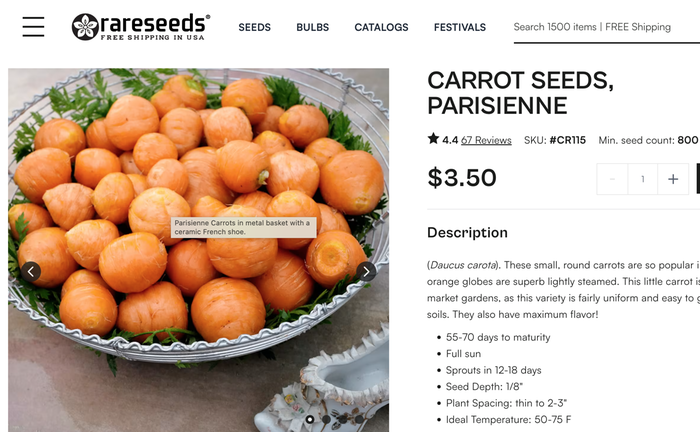
I like growing these.    They will be fine in heavy soil.
https://www.rareseeds.com/carrot-parisienne

 
master gardener
Posts: 1414
Location: Zone 5
735
ancestral skills forest garden foraging composting toilet fiber arts bike medical herbs seed writing ungarbage
  • Likes 8
  • Mark post as helpful
  • send pies
    Number of slices to send:
    Optional 'thank-you' note:
  • Quote
  • Report post to moderator
I seem to have no trouble growing Queen Anne’s Lace (wild carrot), nor parsnips and marshmallow. Cultivated carrots always turn out small, but they are better the more I ignore them, grow them in natural soils, and treat them as wild. Probably, this increases their soil moisture.

I have tried wild carrots for the first time and love the richness of flavor and aroma. They are abundant in my low nitrogen, high carbon soils. I also like the seeds as a nibble and sometimes as flavoring. But they are nowhere near as big and substantial as the cultivated kind can get, and of course in my soil they don’t get very big either (though decent if I treat them right). Parsnips (wild) therefore form the staple root.

On another note, Paul Stamets has grown king oyster parasitically on carrots. They grow natively on the roots of wild Apiaceae, he writes, especially Eryngium.
 
Posts: 203
Location: Southwest Washington 98612
44
2
  • Likes 7
  • Mark post as helpful
  • send pies
    Number of slices to send:
    Optional 'thank-you' note:
  • Quote
  • Report post to moderator
This repeats Kate and Catie's posts, but for me it was the changer: I needed to WATER every day, and sometimes 2x, to keep the seeds and seedlings moist enough. And this is not my typical gardening style by any stretch. Once I did that, and made sure the seedlings were protected from slugs and pill bugs, I had success, after years and years of trying.

I did try covering with a board; that did not work for me; maybe because it made it easier for the slugs to eat the fresh starts?
 
Posts: 3
Location: Bedford, IN, USDA zone 6a, Sunset 35
1
rabbit food preservation seed
  • Likes 3
  • Mark post as helpful
  • send pies
    Number of slices to send:
    Optional 'thank-you' note:
  • Quote
  • Report post to moderator
I also agree with the sand plan. I till the upper few inches of soil with a hoe (small garden) and I also break with a turning fork so the roots will grow deeper. Seeds go about a half inch deep and every couple of inches, I put a radish seed. Daily water (or more often during hot dry days) until everything's established. The radishes germinate quickly so I know exactly where the row is.
I recommend starting with 'Little Finger' carrots. They are delicious and don't need deeper breaking. 'Parisienne' as suggested above is even a better idea. they also mature more quickly.
 
pollinator
Posts: 252
Location: Middlebury, Vermont zone 5a
77
  • Likes 5
  • Mark post as helpful
  • send pies
    Number of slices to send:
    Optional 'thank-you' note:
  • Quote
  • Report post to moderator
This was the first year that I tried planting carrots.  For the first while, they didn't seem to do much at all.  I harvested them at the end of the season, and while they had grown somewhat, they still were deformed a little and shorter than they should have been.  For the last number of years, because of not wanting to disturb the microbial life, I have not tilled the garden, but instead, added a lot of natural mulch in the form of compost and chopped leaves and this past year, wood chips in the pathways.  I think though, that it might be beneficial to use a pitchfork to loosen up the soil and aerate it, at least where root crops are involved.  Next year that is my plan, because I think over the years, even though I have pretty sandy soil, I would suspect that it is quite compacted.  That doesn't help you now, but it's another thought to think about.  
 
Posts: 62
Location: Sterling, OH
14
dog chicken food preservation bike seed homestead
  • Likes 7
  • Mark post as helpful
  • send pies
    Number of slices to send:
    Optional 'thank-you' note:
  • Quote
  • Report post to moderator
What works for me is to plant early, follow all the directions people have mentioned. Barely cover and press down. I then cover the rows with white agriculture cloth, propped up by sticks like a tent. Water often. I think the cloth helps retain moisture and facilitates germination. I leave it for at least a month or even more. Check weekly. When the carrot tops are 4-6 inches tall I uncover and carefully weed. I usually plant again in August for another crop. Dragon carrots from Seed Savers Exchange are my favorite. I haven't been able to grow parsnips, though.
 
Posts: 130
Location: Australia, Tasmania, Coastal, sandy, windy and temperate.
24
goat dog fish trees books chicken food preservation cooking bee seed wood heat
  • Likes 4
  • Mark post as helpful
  • send pies
    Number of slices to send:
    Optional 'thank-you' note:
  • Quote
  • Report post to moderator
I do also have problems growing carrots. I have Sandy soil and I water regularly so how come farmers can grow carrots without covering them and grow them on mass, and the birds don’t eat all the seeds, and I’m sure that they don’t water the carrots every day. I’m in zone 9.
 
Posts: 109
Location: Meriden, NH
28
4
chicken homestead
  • Likes 2
  • Mark post as helpful
  • send pies
    Number of slices to send:
    Optional 'thank-you' note:
  • Quote
  • Report post to moderator
I had the worst luck with carrots when I moved here.  Poor small deformed things.  My success has been planting the longest carrot types possible in my rather dense soil.  The carrots never get as long as advertised, but over the years the length has gotten longer and longer. I plant very shallowly and cover with a fine dusting of peat moss or fine compost, otherwise they only germinate near the chunky stuff in a rougher covering.  They like to be cool to germinate and they like it moist.  I'd try it with the lettuce and spinach.  I put a radish seed in every 4-6 inches in the row of carrots just to remind myself where the carrot row is so I don't get impatient.  Radish comes up a week or so before the carrots.  If its too cool it'll just take longer.  I can't seem to get them to germinate in the summer either, too hot?  I mulch them after weeding and thinning (ruthless thinning).  Keep them watered if you get dry and hot like we do in July and August.  The only things that take longer to germinate are parsley and parnips.  Don't give up until its been at least 4 weeks.
 
pollinator
Posts: 1542
Location: zone 4b, sandy, Continental D
426
  • Likes 2
  • Mark post as helpful
  • send pies
    Number of slices to send:
    Optional 'thank-you' note:
  • Quote
  • Report post to moderator
Well, just like your mom, I have given up growing carrots: They are pretty cheap, and if my time has any value at all, I'd rather nurse some fish in a pond, feed chickens, plant sweet potatoes or sunchokes or fruit trees than spend my time plucking weeds from my carrot patch.
There is, however a way to grow them, and when you said pre-sprouting, I thought you had it.
Their most dangerous moment is when they are very young. They like it sandy and sunshiny.
I put the seeds in warm water and in 2 days, they are all sprouted. Now, the very delicate work of detangling them if I didn't separate them (Those buggers are so small!) It will help to use 2 boards that you plant vertically [on their edge]. Plant one board, then very carefully, add some seed starting mix alongside, where you want the carrots to grow and on top of that, place these naked little buggers all along that one board. Now plant the second board with the carrot seeds and the seed starting soil in between the 2 boards. If you first lay them almost flat and then stand them up, you should be able to cover your babies. If you can, gently tilt the board so as to form a V. Mist or water gently several times a week. Once they are up and going, you can lay the boards almost flat, still keeping a little V but maybe 90 degrees: this way, the water will collect in this trough and feed your babies. with barely 1.5 " in between the 2 boards, you may be better able to prevent weeds, but frankly, that's a heck of a lot of work... I mound the soil behind he boards so they stay put... alternately, you could lay a board flat on top of your little sprouted seeds, and checking on them every other day, when they beg to come out from under, stand the board and maybe add a trace of sand over them.
 
pollinator
Posts: 277
Location: North FL, in the high sandhills
109
  • Mark post as helpful
  • send pies
    Number of slices to send:
    Optional 'thank-you' note:
  • Quote
  • Report post to moderator
This may help. He gets to the carrots at 1:47:


https://www.youtube.com/watch?v=6SiXLSevXiw
 
Posts: 362
Location: rural West Virginia
78
  • Likes 4
  • Mark post as helpful
  • send pies
    Number of slices to send:
    Optional 'thank-you' note:
  • Quote
  • Report post to moderator
I had trouble for years--usually they did germinate, but weren't fit to harvest till fall and then would mostly be very small. Often pale as well. Here's what I do now: first of all I once read that if you plant your onions and carrots in alternating rows, each inhibits the fly that bothers the other. I tried it and it seemed to work so I keep doing it. The downside is that this means I don't plant the carrots till April, when the onions are up so the carrot rows are well marked. No wait--that's not first, first is soil prep, which I mostly do in the fall prior to planting in spring. I have clay soil, and I too have found that adding sand--I have added it to ALL my beds but especially for sure those that will have carrots. I add that after turning the soil with a shovel--I don't agree with the "tilling is a crime" idea, though I think it best to keep it to once a year. Then I add compost or preferably, leafmold, and probably sand. Then I work it with my hands till it's soft and smooth, no sizable lumps (I do this also for lettuce and spinach--other crops don't need a fine seedbed). Next, I grow Danvers or Red Cored Chantenay, two varieties that do well in clay. Then I have to water a lot because as others have said, it typically takes two or even three weeks for the dang things to emerge (yes I put a radish seed every foot or two to mark the rows) and they're planted shallowly. For me, they grow very slowly even after emergence--but when I yank the onions the first week of July and put down mulch between the now one-foot-apart rows, they seem to take off and grow faster. By then I've thinned them at least once.Mty best crop was last year, and I think it was because of the longest drought we ever had, from the beginning of June till the first frost in mid November. I watered them a thousand times or so, so they got ENOUGH water--but it was only in the rows, and probably didn't last long. So the worms or flies or whatever it is that makes those black tunnels in the top part of the carrot, barely hit at all--and therefore I was able to leave the carrots past early August, and they got bigger.
 
Posts: 2
  • Likes 2
  • Mark post as helpful
  • send pies
    Number of slices to send:
    Optional 'thank-you' note:
  • Quote
  • Report post to moderator
Are you are planting in spring? Zone 4? If its too cold, and seeds sit too long in wet soil, they may be rotting. I find that it's easier to grow good carrots in fall anyway. Germination is quick, temperatures are more stable, and less rain to mess things up. They grow for longer, get bigger, and best of all, the late season cold makes them taste extra sweet. Spring carrots are annoying - weeds, weather, and by the time they're almost ready they get hit with a heatwave and lose their taste.

Other than that here are my techniques:
Timing - DO NOT trust the days to harvest on the seed packet. It's going to take longer. Maybe way longer. Start as early as possible in spring, or like 90-120 days before the fall frost

Seed selection - Try "Bolero" carrot seeds - They are normal Nantes type carrots, but the seeds are literally almost twice as big as a normal carrot seed, and they seem to grow way faster, stronger, and bigger than any type I've tried. They will bust right through obstacles that will mess up other carrot types. It is a hybrid, though - no seed saving.

Bed prep - Dig deep and flip the soil over with a shovel all around the bed before planting. If the soil is too dense, Add leaf compost or sand on top first. This is really where 90% of the work in growing carrots should go. The result is big, easy to use carrots.

Planting - Scoop out a hand-sized trench, fill it with leaf compost or potting mix, and plant in that. You can, for example, fill it some, sprinkle a line of seeds, and add the last another half inch on top.
I do this, not just for better germination, but because of weeds. Doing it this way prevents any weeds from coming up around the carrots. If you add some kind of weed block between trenches, you have no weeding to do at all.

Never let the soil dry out especially around germination time, and up to few weeks after. They'll be traumatized for life.

Thinning - Remember to thin to 1.5 inches. Crowding causes stress. I don't use scissors but you have to be careful about disturbing roots.

Mulch - Cardboard, paper, straw etc between the carrot rows have a quadruple benefit - weed supression, temperature stability, maintaining soil moisture, and preventing greening of carrot tops if they poke out. EZ straw (chopped straw from home depot) can be added earlier than regular straw, when the plants are very small. Regular straw can be added a bit later. You can combine these with paper underneath to really snuff weeds.
 
pollinator
Posts: 3374
Location: Meppel (Drenthe, the Netherlands)
1128
dog forest garden urban cooking bike fiber arts
  • Likes 4
  • Mark post as helpful
  • send pies
    Number of slices to send:
    Optional 'thank-you' note:
  • Quote
  • Report post to moderator
It's good to see I'm not te only one who has problems growing carrots.
It isn't that they don't grow at all in my garden, but it's never certain if they do. One year they don't even germinate, other year they germinate and grow but after some time they all die (of something looking like a fungus). Most often part of the seeds germinate and part of the carrots grow well, and part of them do grow but don't produce any substantial 'carrot'.

This year I was very lucky to have a handful of nice carrots at the end of Summer (but the ones I tried to grow earlier did not do well).
And there are still nice looking plants of the Winter carrots (they can go on growing as long as it isn't freezing. In my climate 'first frost date' can vary from September to December and this year it looks like it's late).

I think the most important with carrots is patience. They are slow to germinate, slow to grow plants and then slow to grow real carrots. It's probably true to say it's cheaper to buy them then to grow them yourself ... But I'll go on trying, best-tasting carrots are the ones from your own garden!
 
Mary Cook
Posts: 362
Location: rural West Virginia
78
  • Likes 2
  • Mark post as helpful
  • send pies
    Number of slices to send:
    Optional 'thank-you' note:
  • Quote
  • Report post to moderator
Just gotta say--I disagree with a number of things in the last couple posts. I think it's a matter of geography (climate) and likely soil type as well. My carrots have done a lot better since I started planting them in rows--I used to just scatter seed in a block, which made thinning way more tedious. And planting them here and there among other things would make it far more difficult to keep them watered in the first weeks, which they need more than anything else. I've tried growing carrots in fall and got a good crop once, little or no germination the other two times--probably because in MY climate, it tends to be dry in late summer and early fall, wetter in spring and early summer. I forgot to mention in my earlier post that one key is to choose planting time with an eye on the long-range forecast; ideally you plant before a week of cloudy, rainy weather. And carrots can tolerate very cold temperatures, often surviving the winter, but a really hard prolonged freeze may cause the upper part, more exposed to the cold, to rot. A little mulch may prevent this. But you can't expect plants to actually GROW in winter--if they've gotten enough growth before hard winter sets in, some protection can allow you to harvest hardy crops all winter, or dig up root crops in spring.
What I'd like to know is why my carrots are often pale. I might try that Bolero someone recommended.
 
Posts: 12
1
5
  • Likes 2
  • Mark post as helpful
  • send pies
    Number of slices to send:
    Optional 'thank-you' note:
  • Quote
  • Report post to moderator
My carrot problems here in the PNW has been slugs eating the young plants.  I've found seeding carrots during time periods of lesser slug activity helps.  And adding bonemeal helps solve the not filing out problem.  I can have lovely greens that don't have much underground.
 
pollinator
Posts: 74
Location: SE France
23
fungi trees food preservation medical herbs wood heat composting
  • Likes 2
  • Mark post as helpful
  • send pies
    Number of slices to send:
    Optional 'thank-you' note:
  • Quote
  • Report post to moderator
Hello,
Thank you all for the carrot info.
One day,I too might have a carroty harvest.
Clay soil, very heavy, drought, mulch, flood. It gets a little biblical.

ADVICE:My neighbour, when she was active, mixed carrot seed with radish and sand.
It solves the thinning challenge as radish is harvested way before carrot and the radish leaves provide early shade.
It worked for her.
Perhaps I should give it a go, finally.

Blessings to us all
M-H
and, grated carrot steeped in olive oil, left for a bit, then filtered, makes a fab non toxic sun screen.
Perhaps some presidents with an orangey complexion use it for protection, who knows?
 
pollinator
Posts: 833
Location: Illinois
183
  • Likes 2
  • Mark post as helpful
  • send pies
    Number of slices to send:
    Optional 'thank-you' note:
  • Quote
  • Report post to moderator
Carrots confound me. I plant most years, and every now and then get good ones. No pattern.
One several occasions I got excellent carrots sowing into hard red clay. But I have had total failures in soft 'good' soil.

One year I sowed them in February, during a brief warm period, after which it snowed and the ground froze solid again. After things warmed up in March both carrots and lettuce grew very well. This was in soft sandy soil.

Weeds don't seem to bother carrots much.

But most years I get few or none.
 
Posts: 10
2
  • Likes 4
  • Mark post as helpful
  • send pies
    Number of slices to send:
    Optional 'thank-you' note:
  • Quote
  • Report post to moderator
In ground, I heavily overseed carrots and thin them later.  Consistent watering is essential, use drip or carefully hand water to avoid compacting the soil. I sow very early in the season, and then again mid-season, well after most cool season spring weeds have emerged. After many years of trial and error, I only grow two varieties. Danvers and main-season Nantes.  I've found these types to be very hardy in virtually any soil type and are great storage types.  Don't give up!

gift
 
Diego Footer on Permaculture Based Homesteads - from the Eat Your Dirt Summit
will be released to subscribers in: soon!
reply
    Bookmark Topic Watch Topic
  • New Topic