• Post Reply Bookmark Topic Watch Topic
  • New Topic
permaculture forums growies critters building homesteading energy monies kitchen purity ungarbage community wilderness fiber arts art permaculture artisans regional education skip experiences global resources cider press projects digital market permies.com pie forums private forums all forums
this forum made possible by our volunteer staff, including ...
master stewards:
  • Devaka Cooray
  • Carla Burke
  • John F Dean
  • Nancy Reading
  • Timothy Norton
  • r ranson
stewards:
  • Jay Angler
  • Pearl Sutton
  • paul wheaton
master gardeners:
  • Christopher Weeks
  • M Ljin
gardeners:
  • thomas rubino
  • Eino Kenttä
  • Jeremy VanGelder

What is potash?

 
steward & author
Posts: 43857
Location: Left Coast Canada
16785
9
art trees books chicken cooking fiber arts
  • Likes 14
  • Mark post as helpful
  • send pies
    Number of slices to send:
    Optional 'thank-you' note:
  • Quote
  • Report post to moderator
I was thinking about potash the other day and is seems like a really weird word for something that comes out of the ground.  I bet there's an interesting history here and I suspect I'm not the only one to idly muse on this topic.  Time to start a thread about: what is potash, anyway?

My memory gives me this story from pre 1950.

In the english village next to where my family is from, was a massive pit where they dug since late tudor times and used the richly coloured rocks to dust the feilds and help the soil.  This is something more than what crop rotation and animal rotation could do for the land.  It gave the soil extra "fizz" as the old timers caled it.  An old timer born before science learned about potash.  To the locals, it was just dinosaur poo rocks or fossil.  

Today we call this coprolite and it seems to be related to potash, but contained other useful minerals.

As to why dinosaurs pooped in a latrine like alpacas instead of everywhere like geese, I have no idea.  But it makes for fun imagination.


What's your potash story?
 
gardener
Posts: 3054
Location: Central Maine (Zone 5a)
1594
homeschooling kids trees chicken food preservation building woodworking homestead
  • Likes 11
  • Mark post as helpful
  • send pies
    Number of slices to send:
    Optional 'thank-you' note:
  • Quote
  • Report post to moderator
I think it is interesting how words change. Back in the 1600's and 1700's, potash was a product produced from wood ash (hence the name) and was synonymous with lye. This material was potassium hydroxide and was used to manufacture all sorts of things, such as alum, saltpeter, soap, glass, tanned leather, gunpowder, paper, bleached cotton textiles, and various woolen goods.

Later in history, potash began to be used more frequently as a source of potassium for fertilizing gardens and fields.

In modern times, lye and potash are usually separated as sodium hydroxide (lye) and potassium hydroxide (potash) for making liquid soap and hard soap respectively.

Today, many people use the word potash to simply refer to any potassium rich mineral.

If you are making soap, using this material makes sense. If you are fertilizing a garden today, there are many options that are easier and more effective to get potassium into your garden. I always like to start by focusing on making the soil as alive as possible with microbes. These microbes interact with roots and help make the minerals in the soil available to plants.
 
Steward of piddlers
Posts: 6786
Location: Upstate New York, Zone 5b, 43 inch Avg. Rainfall
3482
monies home care dog fungi trees chicken food preservation cooking building composting homestead
  • Likes 11
  • Mark post as helpful
  • send pies
    Number of slices to send:
    Optional 'thank-you' note:
  • Quote
  • Report post to moderator
In the current sense of the words, I use both Potash and Potassium (K) interchangeably.

Potassium is an important macronutrient to plants, so much so that it is a part of the commonly paired with the BIG THREE Nitrogen/Phosphorus/Potassium (NPK) when analyzing soil nutrients.

I'm lucky enough in my gardening biome that a liberal coating of compost on my soils yearly keeps my soil potassium levels rather happy. Veggies like tomatoes and potatoes especially enjoy their share of potassium so I have amended responsibly with Wood Ash when the need arises.

I do not live near the shore but I have heard that kelp may be a good source of potassium. Has anyone had experience with harvesting from a beach to use it for soil health?
 
r ranson
steward & author
Posts: 43857
Location: Left Coast Canada
16785
9
art trees books chicken cooking fiber arts
  • Likes 9
  • Mark post as helpful
  • send pies
    Number of slices to send:
    Optional 'thank-you' note:
  • Quote
  • Report post to moderator
Kelp is usually very salty so we tend not to harvest for personal use in the garden.  There are a few companies that wash and ferment it.  Sea soil is the main one where i live.  Very good potting soil.
 
Steward and Man of Many Mushrooms
Posts: 5945
Location: Southern Illinois
1807
transportation cat dog fungi trees building writing rocket stoves woodworking
  • Likes 12
  • Mark post as helpful
  • send pies
    Number of slices to send:
    Optional 'thank-you' note:
  • Quote
  • Report post to moderator
OK, history lesson.....


What we call Potash is specifically the element Potassium/K.  But we call it "Potash" due to an early chemical process.

As long as humans have had fire, we have known that wood ash has some fertilizer value.  The main fertilizer component of wood ash is potassium.  In fact, wood ash itself is a pretty good, fast acting form of potassium.

But in the 1400's, wood ash was a resource from which K2CO3 or Potassium Hydroxide was made.  K2CO3 is a chemical which has all sorts of uses which include making soap and glass, but also extends to welding and all sorts of things in between  K2CO3 was made by mixing up a bowl of wood ash with water and a leaching agent and then boiling in an iron bowel.  The result was a white residue--The Pot Ash--later shortened to Potash.

While wood ash is a fine source for Potash, it is a long, laborious process that uses a LOT of wood for a trivial amount of finished product.  The good news is that plants don't need all that much Potash to go from sickly to healthy--nothing at all like a nitrogen deficiency.  Therefore, that little white residue would actually go a fairly long ways.

But K2CO3 can also be mined from places that were old evaporated sea beds--and this is a whole lot easier to do at a large scale and cheaper to boot (and you don't cut down forests to get it either!).

Food for thought!!!
 
master gardener
Posts: 5411
Location: Carlton County, Minnesota, USA: 3b; Dfb; sandy loam; in the woods
2990
7
forest garden trees books chicken food preservation cooking fiber arts seed woodworking homestead ungarbage
  • Likes 8
  • Mark post as helpful
  • send pies
    Number of slices to send:
    Optional 'thank-you' note:
  • Quote
  • Report post to moderator
This is great -- I had no idea! The posts above here and then reading the Wikipedia article really expanded my understanding. I thought it was just wood ash heated in an iron pot!
 
Eric Hanson
Steward and Man of Many Mushrooms
Posts: 5945
Location: Southern Illinois
1807
transportation cat dog fungi trees building writing rocket stoves woodworking
  • Likes 11
  • Mark post as helpful
  • send pies
    Number of slices to send:
    Optional 'thank-you' note:
  • Quote
  • Report post to moderator
Christopher,

You were definitely on the right track.  Potash used as a fertilizer was initially secondary to potash used as an industrial chemical.  A lot of times the potash was just thrown on the ground which then became much more fertile--yet another accidental discovery.


Eric
 
steward and tree herder
Posts: 11683
Location: Isle of Skye, Scotland. Nearly 70 inches rain a year
5786
5
transportation dog forest garden foraging trees books food preservation woodworking wood heat rocket stoves ungarbage
  • Likes 18
  • Mark post as helpful
  • send pies
    Number of slices to send:
    Optional 'thank-you' note:
  • Quote
  • Report post to moderator

Timothy Norton wrote:I do not live near the shore but I have heard that kelp may be a good source of potassium. Has anyone had experience with harvesting from a beach to use it for soil health?


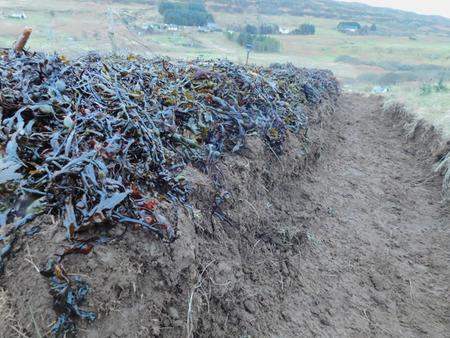
I use locally collected seaweed on my garden beds - a thick layer as a mulch to protect them through the winter. This decomposes and adds Nitrogen and Potassium as well as a wide range of other minerals and organic compounds that (hopefully) improve my silty soil.

seaweed mulch on 'lazy bed'


Although r ranson worries about salt build up - I get a lot of salt spray anyway from the wind, so as long as I take the seaweed from above the high water mark after it has been washed in the rain, I'm not too worried about more salt. They sell sea salt as a soil improver I believe also!
Kelp is definitely high in Potassium. There used to be a thriving industry locally where the people would collect and burn the seaweed for potash to be used in various industries including glass making. (Discovery of mineral sources killed that industry but that's another story)
I like the fact that seaweed contains more than just potassium, but there are other natural materials that are rich in potassium that may be easier and cheaper to source if you're far from the ocean.
 
Eric Hanson
Steward and Man of Many Mushrooms
Posts: 5945
Location: Southern Illinois
1807
transportation cat dog fungi trees building writing rocket stoves woodworking
  • Likes 13
  • Mark post as helpful
  • send pies
    Number of slices to send:
    Optional 'thank-you' note:
  • Quote
  • Report post to moderator
Nancy,

I wish I had as easy access to kelp and seaweed as you do!  But being in the middle of a continent, I will have to make due without.  As for the salt, my thoughts are that any salination from the kelp is likely to be miner to nonexistent.  And I have even heard of people watering with sea water to intentionally bring in some of the rare elements that are freely available in seawater (of course, watering is done once or twice, not as an actual means of irrigation).
 
steward
Posts: 18094
Location: USDA Zone 8a
4612
dog hunting food preservation cooking bee greening the desert
  • Likes 7
  • Mark post as helpful
  • send pies
    Number of slices to send:
    Optional 'thank-you' note:
  • Quote
  • Report post to moderator
When I hear potash, I think of wood ash.  Wood ash has potassium and so does biochar.

I know they are not the same though I wonder if wood ashes can be substituted for potash and can biochar also be substituted for potash?
 
gardener
Posts: 3386
Location: Cascades of Oregon
880
  • Likes 6
  • Mark post as helpful
  • send pies
    Number of slices to send:
    Optional 'thank-you' note:
  • Quote
  • Report post to moderator
When I was in S.C. potash was what the old timers called lye. it wasn't uncommon for me to see an enamel pan with potash set aside as a defensive deterrent in some of the older, poorer folks kitchens.
 
steward
Posts: 14301
Location: Pacific Wet Coast
8586
duck books chicken cooking food preservation ungarbage
  • Likes 9
  • Mark post as helpful
  • send pies
    Number of slices to send:
    Optional 'thank-you' note:
  • Quote
  • Report post to moderator
Just to add another really good reason to improve your garden naturally, Mycorrhiza are extremely helpful with getting whatever Potassium is in your soil, into your plant roots. ( The role of mycorrhizal associations in plant potassium nutrition  )

Potassium is apparently not an easy chemical for plants to absorb. It doesn't move around easily in the soil on its own. However, healthy soil with mycorrhiza working with the plants, will swap potassium for sugar in a natural, mutually supportive exchange.

People talk about "fungal dominated soils", but from what I've read, any soil that's not been repeatedly dug or turned, and especially soil that hasn't been given drugs, will have fungi, even if in a lower amount than bacteria. It's not a 'one or the other' situation. So if you want your small amount of potash rich kelp compost to really help your plants, make sure you don't disturb your fungi!
 
Eric Hanson
Steward and Man of Many Mushrooms
Posts: 5945
Location: Southern Illinois
1807
transportation cat dog fungi trees building writing rocket stoves woodworking
  • Likes 3
  • Mark post as helpful
  • send pies
    Number of slices to send:
    Optional 'thank-you' note:
  • Quote
  • Report post to moderator
Jay, everyone,

My understanding is that most soils are unlikely to be deficient in K, but they might have a problem getting it into a usable form to the plants.  Fungi and other microbes are essential to that goal.


Eric
 
I love a good mentalist. And so does this tiny ad:
Support permies and give beautiful gifts to gardeners: permaculture playing cards.
https://gardener-gift.com/
reply
    Bookmark Topic Watch Topic
  • New Topic