
• Post Reply Bookmark Topic Watch Topic
  • New Topic
permaculture forums growies critters building homesteading energy monies kitchen purity ungarbage community wilderness fiber arts art permaculture artisans regional education skip experiences global resources cider press projects digital market permies.com pie forums private forums all forums
this forum made possible by our volunteer staff, including ...
master stewards:
  • Nancy Reading
  • Carla Burke
  • John F Dean
  • Timothy Norton
  • r ransom
  • Jay Angler
  • Pearl Sutton
stewards:
  • Devaka Cooray
  • Leigh Tate
  • paul wheaton
master gardeners:
  • Christopher Weeks
gardeners:
  • M Ljin
  • thomas rubino
  • Megan Palmer

Bells: masonry to the bottom, metal chimney attaches to the top?

 
Posts: 571
Location: Southern Michigan, USA
46
duck trees hunting food preservation wood heat rocket stoves
  • Likes 5
  • Mark post as helpful
  • send pies
    Number of slices to send:
    Optional 'thank-you' note:
  • Quote
  • Report post to moderator
Good morning! Long time, no see!

There's a possibility I'm building a heater this summer, so I'm reading up. It's been a few years, Peter's invented the Shorty, and life is grand. Exciting!


I haven't encountered an answer to this specific question. I see that generally-accepted practice is to attach the metal chimney to the side of the bell.

I understand why we wouldn't run the metal chimney down into the bell- maintenance would be difficult.
I also understand why would wouldn't just attach the chimney to the top of the bell... then it wouldn't be a bell! We've got to exhaust the gases from the cooler bottom, that's the entire point!

But I don't understand why not have a masonry chimney inside the bell and attach the metal chimney to the top of that. Diagram attached; imagine that this is a cutaway view.

Is this fine? Or am I overlooking a problem?


Thanks!
Mike

bell-chimney-at-top.jpeg
[Thumbnail for bell-chimney-at-top.jpeg]
 
Posts: 847
Location: Sierra Nevada foothills, 350 m, USDA 8b, sunset zone 7
187
  • Likes 6
  • Mark post as helpful
  • send pies
    Number of slices to send:
    Optional 'thank-you' note:
  • Quote
  • Report post to moderator
It is being done - for example in some Russian heaters or in case when the chimney entry is higher than desired and for some reason can not be moved lower within the chimney wall.
 
gardener
Posts: 1187
Location: +52° 1' 47.40", +4° 22' 57.80"
631
woodworking rocket stoves wood heat
  • Likes 9
  • Mark post as helpful
  • send pies
    Number of slices to send:
    Optional 'thank-you' note:
  • Quote
  • Report post to moderator
Yes, it's been done quite some time ago, and it worked. It would be best to do the masonry in such a way that the chimney is firmly connected to the bell's wall. Failing that, the chimney would crack apart from the wall.
The calculation of the ISA would be the same as compared to a bell without this built-in chimney. And it would be wise to incorporate a cleaning hatch close to the foot of the chimney.
 
out to pasture
Posts: 13076
Location: Portugal
4116
goat dog duck forest garden books wofati bee solar rocket stoves greening the desert
  • Likes 7
  • Mark post as helpful
  • send pies
    Number of slices to send:
    Optional 'thank-you' note:
  • Quote
  • Report post to moderator
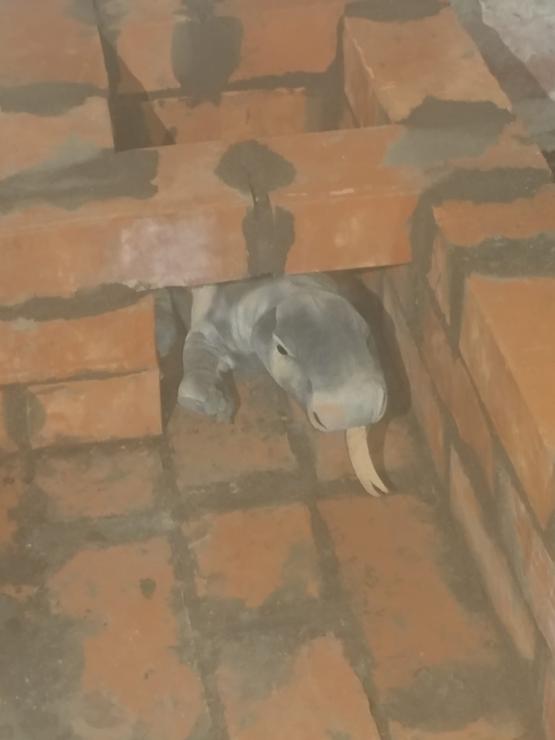
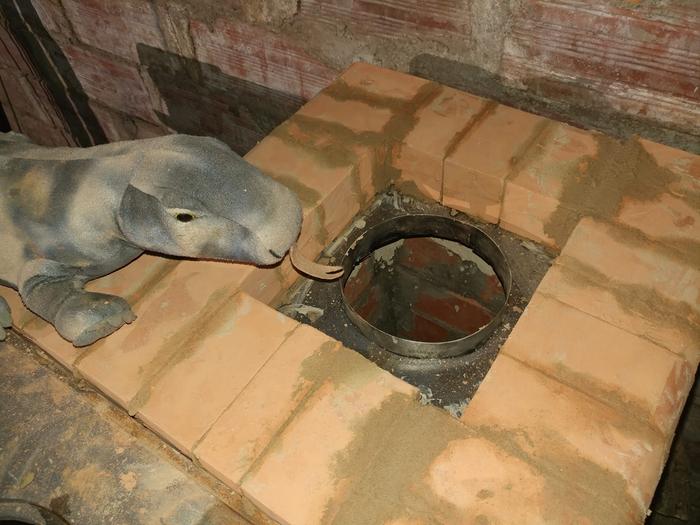
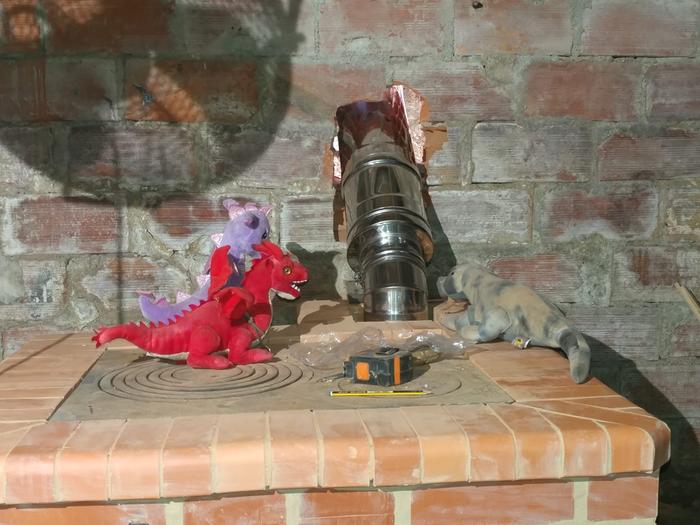
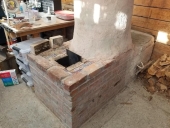
The walker cookstove works like that. I'll share some photos of our build...

In this, the heat first comes up to the top, heats the cooktop, then sinks down the gap on the left and heats the bell (and bench when we finally fit it) then there's a gap at the bottom right which the coolest air can pass out of and rise up the brick 'chimney'.  There's a sliding brick there to act as a bypass for ease of starting, too.


This is an earlier stage of the build showing the base and the gap (occupied by a dragon) where the coolest gas escapes up the chimney.


Detail of 'chimney' and bypass.


Then we built in a flange.


And fitted the metal chimney.

 
Posts: 27
Location: Güéjar Sierra, Granada, Spain
15
kids purity chicken rocket stoves homestead
  • Likes 5
  • Mark post as helpful
  • send pies
    Number of slices to send:
    Optional 'thank-you' note:
  • Quote
  • Report post to moderator

Mike Cantrell wrote:
I understand why we wouldn't run the metal chimney down into the bell- maintenance would be difficult.


Could you elaborate on why? I'm working on my design in a different thread and was just informed that a metal chimney in the bell should be insulated for it to work. There was no mention that it might not/would not work.
And what maintenance are you thinking about?
 
gardener
Posts: 5563
Location: Cincinnati, Ohio,Price Hill 45205
1194
forest garden trees urban
  • Likes 4
  • Mark post as helpful
  • send pies
    Number of slices to send:
    Optional 'thank-you' note:
  • Quote
  • Report post to moderator
I'm pretty sure the "juice box straw" design is a metal chimney in a bell.
I'm not sure if it has ever left the design stage.
I'm not sure why the part of a metal chimney inside the bell would need to be insulated.
Usually we insulate a chimney to keep it hot and thus maintain draw, but would that be a problem inside of a bell?
The top of a bell gets hella hot and is often made of special materials to deal with the heat.
Maybe we need to protect the metal chimney from   the high temperatures at the top of the bell?


Depending on the material, poking a hole for the the metal chimney to exit might be very difficult.
For example, the walker cookstoves often use the glass top from an electric stove as the top for their bell, and you can see above the masonry part of the chimney rises outside of that footprint.
That design preserves cooktop area and it means no need to cut the extremely tough Glass-Ceramic material.

So,even if if you use a metal chimney inside the bell,it might be better to have it rise to the ceiling of the bell,turn 90 °and exit the side.
A tee fitting inverted at the bottom of the chimney,with one arm poking out the side of the bell could offer the perfect place to put a clean out cap.

EDIT: A better name for this design might be a "plunger tube"
Glenn explains it in this thread: https://permies.com/t/367651/tube-RMH-barrel-stratification-bench#3733843

The insulation is there to"reduce heat leakage from the top of the bell."


Mike Cantrell
Posts: 571
Location: Southern Michigan, USA
46
duck trees hunting food preservation wood heat rocket stoves
  • Likes 4
  • Mark post as helpful
  • send pies
    Number of slices to send:
    Optional 'thank-you' note:
  • Quote
  • Report post to moderator

Peter van den Berg wrote:Yes, it's been done quite some time ago, and it worked.


Excellent! Thank you!

Peter van den Berg wrote:And it would be wise to incorporate a cleaning hatch close to the foot of the chimney.


That's exactly what I intend. 👍

Burra Maluca wrote:This is an earlier stage of the build showing the base and the gap (occupied by a dragon) where the coolest gas escapes up the chimney.


Just like that! That's what I was thinking: with the bricks interweaving with the wall itself.
 
Burra Maluca
out to pasture
Posts: 13076
Location: Portugal
4116
goat dog duck forest garden books wofati bee solar rocket stoves greening the desert
  • Likes 6
  • Mark post as helpful
  • send pies
    Number of slices to send:
    Optional 'thank-you' note:
  • Quote
  • Report post to moderator

Mike Cantrell wrote:Just like that! That's what I was thinking: with the bricks interweaving with the wall itself.


We find the bypass pretty much essential on 'shoulder days' to get it started. It's just too long and convoluted a route to expect the first few puffs of hot gas to find their way along otherwise.


In ours, this means that the gasses come up under cooktop but then instead of snaking their way under the whole thing, then going down into the bell and eventually finding the gap at the bottom of the bell, they can shoot along under the right half of the cooktop and find the chimney. This also means that if we have a power outage and run out of gas during the summer, we can light a quick fire and have half the hotplate to cook on without overheating the house by warming the bell up.
 
Mark Roelofs
Posts: 27
Location: Güéjar Sierra, Granada, Spain
15
kids purity chicken rocket stoves homestead
  • Likes 5
  • Mark post as helpful
  • send pies
    Number of slices to send:
    Optional 'thank-you' note:
  • Quote
  • Report post to moderator

William Bronson wrote: I'm pretty sure the "juice box straw" design is a metal chimney in a bell.
I'm not sure if it has ever left the design stage.


I think I have seen videos of the "juice box straw" design working nicely. It is also in the pebble style RMH free pdf design.

William Bronson wrote:
The top of a bell gets hella hot and is often made of special materials to deal with the heat.


What is the temperature range inside the bell?  During and right after firing would be about 900C right?

William Bronson wrote:
EDIT: A better name for this design might be a "plunger tube"
Glenn explains it in this thread: https://permies.com/t/367651/tube-RMH-barrel-stratification-bench#3733843


Thanks for the link, Benjamin also mentioned this in my thread, that the system would be easy to tweek with the p'lunger tube'. I will be insulating the top of my bell anyway, So heat leakage will be minor, but will also protect the plunger tube anyway. Better save then having a molten tube after a cold day. For me exiting the tube in a different way then 'plunger tube' would be a hassle with the space the bell will be in.
 
Rocket Scientist
Posts: 982
Location: Province of Granada, Andalucía, Spain
719
6
cooking rocket stoves woodworking wood heat
  • Likes 5
  • Mark post as helpful
  • send pies
    Number of slices to send:
    Optional 'thank-you' note:
  • Quote
  • Report post to moderator

William Bronson wrote: I'm pretty sure the "juice box straw" design is a metal chimney in a bell.
I'm not sure if it has ever left the design stage.


Yes, it technically is a metal pipe in a bell. But the ones I saw were situated in a bench, following a barrel. In those setups the barrel would shed a significant amount of heat and thus the exhaust pipe can survive the temperatures.
In a bell, above the height of the riser, it might be too hot for normal steel pipe.
But as Peter mentioned, stainless steel pipe should be able to deal with it.
 
Rocket Scientist
Posts: 4744
Location: Upstate NY, zone 5
685
5
  • Likes 6
  • Mark post as helpful
  • send pies
    Number of slices to send:
    Optional 'thank-you' note:
  • Quote
  • Report post to moderator
I believe the principal reason for insulating the plunger tube in a bell is to avoid wasting heat out the chimney - a bare metal tube would get as hot as the top of the bell. Depending on details of layout and design, it might be helpful in protecting the tube also.
 
Mark Roelofs
Posts: 27
Location: Güéjar Sierra, Granada, Spain
15
kids purity chicken rocket stoves homestead
  • Likes 3
  • Mark post as helpful
  • send pies
    Number of slices to send:
    Optional 'thank-you' note:
  • Quote
  • Report post to moderator
That makes sense. And the tube would be even warming up the bottom of your bell, messing with the normal bell function.
 
pioneer
Posts: 1040
Location: Inter Michigan-Superior Woodland Forest
192
7
transportation gear foraging trees food preservation bike building solar writing woodworking wood heat
  • Likes 4
  • Mark post as helpful
  • send pies
    Number of slices to send:
    Optional 'thank-you' note:
  • Quote
  • Report post to moderator
I left the internal part of the "plunger tube" uninsulated, figuring a fast heat-up there would be similar to the 'kissing the barrel' effect. It is at the far end of the stratification bench though.

I also built up the cob around the pipe on the top side of the bench. Mostly to reinforce it against, and discourage, being bumped, but also thought that conductive heat transfer up the pipe could be moderated that way. Seems to me this is a good balance between convective and conductive transfers, but no proof from comparisons...
 
I child proofed my house but they still get in. Distract them with this tiny ad:
Learn Permaculture through a little hard work
https://wheaton-labs.com/bootcamp
reply
    Bookmark Topic Watch Topic
  • New Topic