|

|

|

|

|

|
|
|
|
|
|
|
|

|

|
|

|

|
 13
13


![[Thumbnail for 19-garden6.JPG]](/t/369788/a/285330/19-garden6.JPG "Filename: 19-garden6.JPG
Description:")
![[Thumbnail for 64-Sunrise-in-Long-Field-Garden.JPG]](/t/369788/a/285331/64-Sunrise-in-Long-Field-Garden.JPG "Filename: 64-Sunrise-in-Long-Field-Garden.JPG
Description:")
![[Thumbnail for DSC09690.JPG]](/t/369788/a/285332/DSC09690.JPG "Filename: DSC09690.JPG
Description:") 3
3
Invasive plants are Earth's way of insisting we notice her medicines. Stephen Herrod Buhner
Everyone learns what works by learning what doesn't work. Stephen Herrod Buhner
7
Anne Miller wrote:When do you plan to start planting this 1/4 acre?
Anne Miller wrote:
If not soon, why not find some organic straw to use to smother the grass?
I am think square bales to cover the area then when you are ready to plant, just plant right into the bales?


 7
7
Question #1:How to convert the hay field into garden?
How Permies works: https://permies.com/wiki/34193/permies-works-links-threads
My projects on Skye: The tree field, Growing and landracing, perennial polycultures, "Don't dream it - be it! "
6
6
How Permies works: https://permies.com/wiki/34193/permies-works-links-threads
My projects on Skye: The tree field, Growing and landracing, perennial polycultures, "Don't dream it - be it! "
7
Andre Wiederkehr wrote:Do you know of ways to make wood chips (in quantity - say, enough to mulch 500 sqft) without fossil fuels or electricity? Will Bonsall is/was a fan of this "forest-source fertility" in a similar context of veganic, relatively whole-diet gardening, but in the book I read by him, he doesn't address this issue of how to make them.
How Permies works: https://permies.com/wiki/34193/permies-works-links-threads
My projects on Skye: The tree field, Growing and landracing, perennial polycultures, "Don't dream it - be it! "
8
Nancy Reading wrote:
Andre Wiederkehr wrote:Do you know of ways to make wood chips (in quantity - say, enough to mulch 500 sqft) without fossil fuels or electricity? Will Bonsall is/was a fan of this "forest-source fertility" in a similar context of veganic, relatively whole-diet gardening, but in the book I read by him, he doesn't address this issue of how to make them.
It is possible to cut sticks up by hand, or build/buy a human powered shredder/chipper. Many people who practise 'veganic' type market gardening like Helen Atthowe and Ian Tollhurst do use machinery such as lawnmowers and mini tractors. If you are intending to practise no-dig on this bit of land for several years you will probably need to find a source of nutrients to keep it in good heart - I gather getting the balance is the tricky bit.
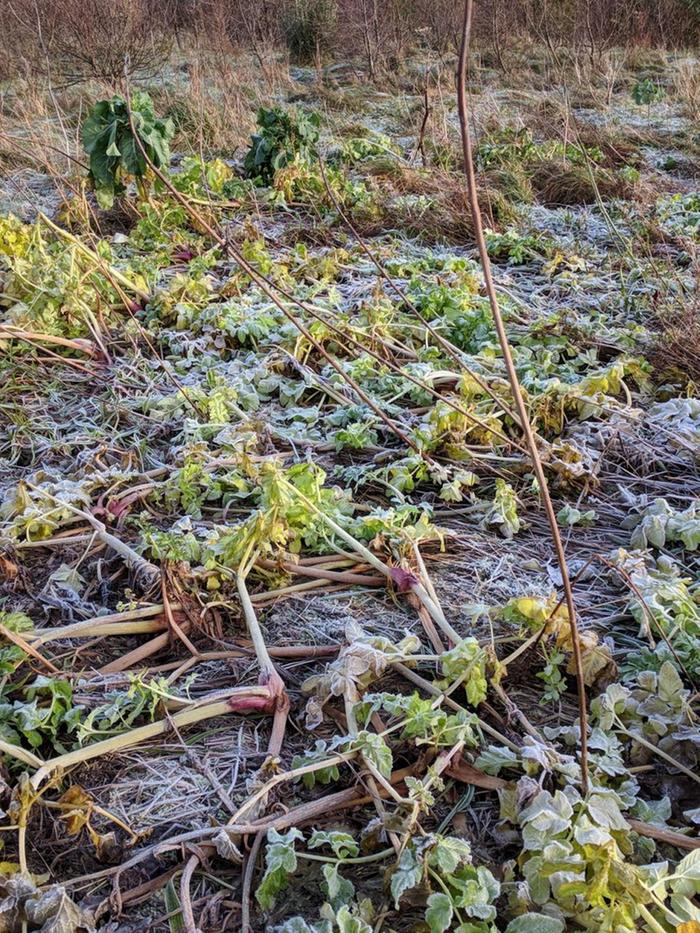
One way I have found that potentially would work towards preparing a bed for next year is to pile up twiggy prunings in a heap and let them sit over the summer. Like the Angelica, the sticks shade out the new growth and leave a bare patch. The remaining sticks can be removed in the following spring, or maybe in a fire risk area in late summer they could be burnt for biochar perhaps. Under the patch you are left with small bits and clear soil. I tend to just break the sticks up for kindling - not every wood becomes this brittle so quickly, but they should all be able to provide the mulching effect of shading out the undergrowth if laid on thickly enough.
Weeds are just plants with enough surplus will to live to withstand normal levels of gardening!--Alexandra Petri


 8
8
Visit Redhawk's soil series: https://permies.com/wiki/redhawk-soil
How permies.com works: https://permies.com/wiki/34193/permies-works-links-threads


 8
8
Jay Angler wrote:I would look up the standards for land management for organic gardeners. An old gardening book I have talks about adding 2 inches of quality compost to every bed each year to maintain fertility. I have *no* idea how that fellow managed to get that much compost without importing from outside the garden.
John Seymour, from The New Self-Sufficient Gardener wrote:
...no-diggers do use an awful lot of compost. In fact, they put so much on their soil that it is almost pure compost. All the no-diggers I know bring in organic material, in large quantities, from outside their property, because no matter what crops they grow, they cannot obtain enough organic material from their own lands to make the necessary compost....
I am not decrying these practices; I think they are marvelous. All gardeners should be constantly on the lookout for organic material and seize it whenever they can. But obviously not every gardener in the world can do it; and you can be sure that if one plot of land is using this technique, it is robbing another plot of land that is either being doused with chemicals or left unproductive.
Jay Angler wrote:I recall Joel Salatin had a chart in one of his books that mentioned how much of each vital nutrient leaves the farm every time you sell produce or meat off the farm. This leads me to remind you to check out the forum about humanure and responsible use of urine! I'm pretty sure part of the issue is that some nutrients are harder for plants to access than others. Once you prepare land, the more minimal the tillage, the more mushrooms you can encourage, the more plants will have access to mycorrhizae and microbes to play that important role.
| nutrient | lb/ton dry matter maize | lb/acre |
|---|---|---|
| C | 795 | 1220 |
| N | 24 | 36.8 |
| P(P2O5) | 12 | 18.4 |
| K(K2O) | 8 | 12.3 |
| Ca | 2 | 3.1 |
| Mg | 2 | 3.1 |
| S | 2 | 3.1 |
Jay Angler wrote:I would be careful in the short term (until you get more nuts planted) that you do have enough and the right kind of fats planned for harvest. There are "essential" fats, just like essential vitamins. Some of the research I did a long time ago, suggested the fat side of the equation was a much bigger issuer than the protein side.
4
Nancy Reading wrote:
You can see from the undergrowth behind that the grass is normally still green, if not growing overwinter, yet the angelica canopy succeeded in shading it out.
7
Andre Wiederkehr wrote: I'm reluctant to try to maintain both a fibre flax and a seed flax variety. But maybe I should try to grow more flax seed, as it is higher in omega-3 and would pull the ratio that way a bit along with the walnuts.
Visit Redhawk's soil series: https://permies.com/wiki/redhawk-soil
How permies.com works: https://permies.com/wiki/34193/permies-works-links-threads
6
Andre Wiederkehr wrote:
Anyone know some pretty straightforward sources on how to get this essential fatty acid amount and balance about right?
--
"Whitewashed Hope: A Message from 10+ Indigenous Leaders and Organizations"
https://www.culturalsurvival.org/news/whitewashed-hope-message-10-indigenous-leaders-and-organizations
7
--
"Whitewashed Hope: A Message from 10+ Indigenous Leaders and Organizations"
https://www.culturalsurvival.org/news/whitewashed-hope-message-10-indigenous-leaders-and-organizations
6
--
"Whitewashed Hope: A Message from 10+ Indigenous Leaders and Organizations"
https://www.culturalsurvival.org/news/whitewashed-hope-message-10-indigenous-leaders-and-organizations
7
--
"Whitewashed Hope: A Message from 10+ Indigenous Leaders and Organizations"
https://www.culturalsurvival.org/news/whitewashed-hope-message-10-indigenous-leaders-and-organizations
4
Andre Wiederkehr wrote:So, if I were to grow an acre of this corn and send it away from the land, the soil would be losing 1200lbs of carbon, 37lbs of nitrogen and 40lbs of mineral nutrients.
How Permies works: https://permies.com/wiki/34193/permies-works-links-threads
My projects on Skye: The tree field, Growing and landracing, perennial polycultures, "Don't dream it - be it! "

|
I FEEL suave and debonair. Why can't you be as supportive as this tiny ad?
A rocket mass heater heats your home with one tenth the wood of a conventional wood stove
http://woodheat.net
|