• Post Reply Bookmark Topic Watch Topic
  • New Topic
permaculture forums growies critters building homesteading energy monies kitchen purity ungarbage community wilderness fiber arts art permaculture artisans regional education skip experiences global resources cider press projects digital market permies.com pie forums private forums all forums
this forum made possible by our volunteer staff, including ...
master stewards:
  • Carla Burke
  • Nancy Reading
  • John F Dean
  • r ransom
  • Jay Angler
  • Timothy Norton
stewards:
  • paul wheaton
  • Tereza Okava
  • Nicole Alderman
master gardeners:
  • M Ljin
  • Christopher Weeks
gardeners:
  • Jeremy VanGelder
  • thomas rubino
  • Megan Palmer

Stairs and ladders inspiration

 
pollinator
Posts: 609
Location: Mid-Atlantic, USDA zone 7
478
3
forest garden trees books building
  • Likes 8
  • Mark post as helpful
  • send pies
    Number of slices to send:
    Optional 'thank-you' note:
  • Quote
  • Report post to moderator
I built a two story farm shack and am looking for some design inspiration regarding stairs/ladders/other means of getting up and down levels.

Right now I use a home built rope ladder indoors, and an aluminum ladder outside. Eventually I'd like more permanent and multifunctional builds in place, such that I can carry loads up and down.

Have you come across any really cool, funky, or multifunctional stairs and ladders builds lately?
 
master steward
Posts: 15453
Location: Pacific Wet Coast
9836
duck books chicken cooking food preservation ungarbage
  • Likes 8
  • Mark post as helpful
  • send pies
    Number of slices to send:
    Optional 'thank-you' note:
  • Quote
  • Report post to moderator
I've seen plenty in videos from the Tiny House Movement. I do think that stairs with integral storage appeal to me. Stairs without tend to take up too much real-estate compared to ladders, but are much safer.

Similarly, spiral staircases are much more dangerous statistically than stairs with regular rectangular treads and rise height and a proper landing when the direction changes.

If you end up sticking with a ladder, consider a pully system for hauling things up and down along the lines of a dumb waiter.
 
Jay Angler
master steward
Posts: 15453
Location: Pacific Wet Coast
9836
duck books chicken cooking food preservation ungarbage
  • Likes 10
  • Mark post as helpful
  • send pies
    Number of slices to send:
    Optional 'thank-you' note:
  • Quote
  • Report post to moderator
Catch is, I've seen some neat stuff, but not used it. I've bought things in the past that got lots of publicity that made them sound wonderful, only to determine they were a waste of money and not worth the materials they were made of.

However, beyond what I said above, 2 ideas have caught my interest:
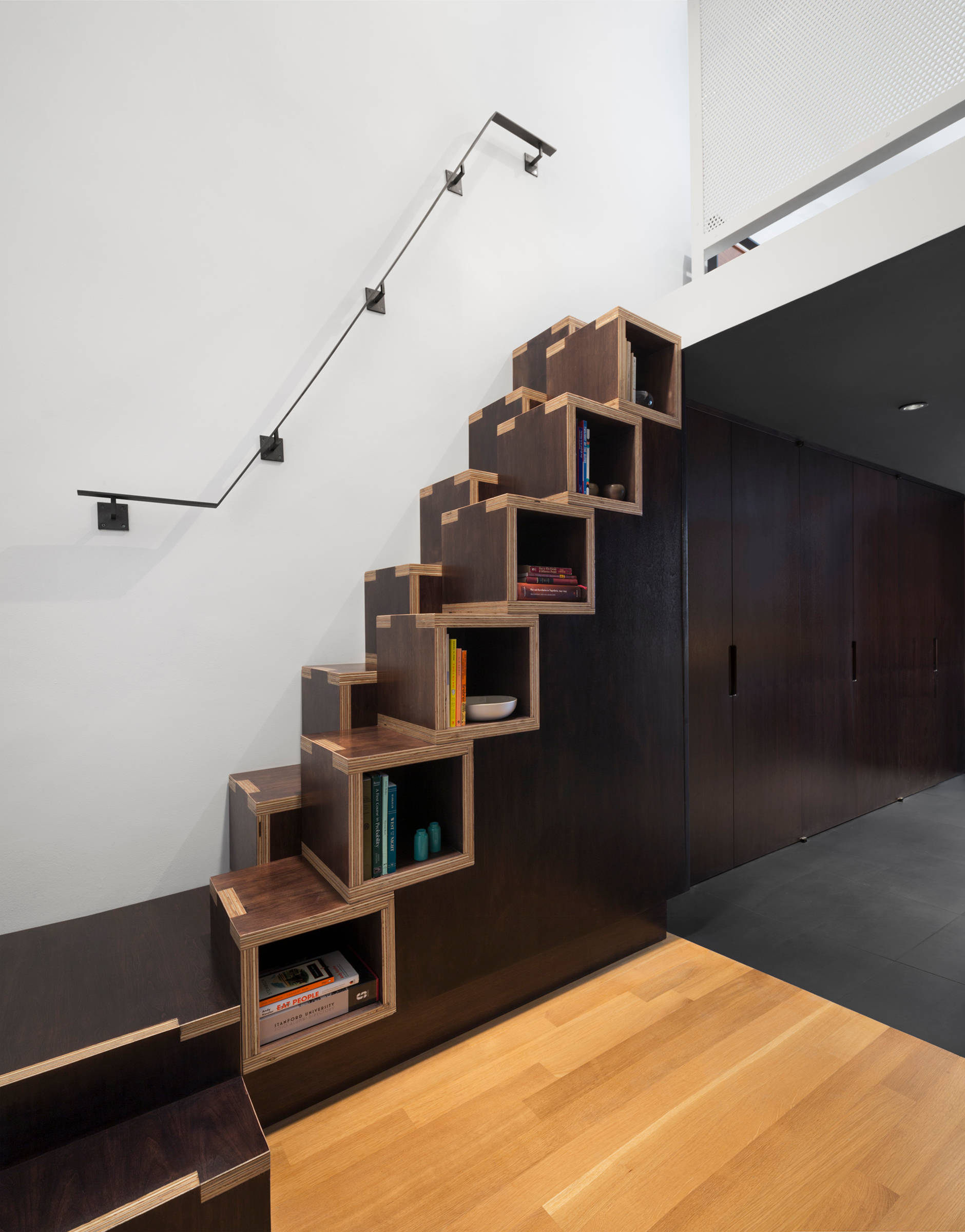
1. I would absolutely not have this in a situation where it couldn't be left in its "stairs" form when people required it for safe egress.


source

2.
source

I've seen various versions of this, but this one at least is using some sections as storage. This could be scary for emergency egress, but if the railing was sturdy enough to take a significant amount of a person's weight, I think many could manage it. I would prefer to find someone who had actively used this sort of design (I recall it's been used on commercial boats) for at least a year and then asking them if they'd want one in their home.

Personally, rope ladders may look cool, but they're a pita to use (pita - pain in the ass feet).

 
Rocket Scientist
Posts: 4777
Location: Upstate NY, zone 5
735
5
  • Likes 13
  • Mark post as helpful
  • send pies
    Number of slices to send:
    Optional 'thank-you' note:
  • Quote
  • Report post to moderator
I built an alternating-tread stair to a small loft 30 years ago, and for several years recently we used the loft as a bedroom. Used regularly, it becomes easy, though you would want a good handrail to hold (we used a hanging knotted rope because the stairwell was so tight). A shed stair with no-slip treads that are deep enough for good footing should work for a shed used mostly by one person.
 
master steward
Posts: 8578
Location: southern Illinois, USA
3470
goat cat dog chicken composting toilet food preservation pig solar wood heat homestead composting
  • Likes 8
  • Mark post as helpful
  • send pies
    Number of slices to send:
    Optional 'thank-you' note:
  • Quote
  • Report post to moderator
In my cabin in MN we used a spiral staircase with a rope handrail.  We moved all the furniture in before we built the stairs.
 
steward
Posts: 18935
Location: USDA Zone 8a
4792
dog hunting food preservation cooking bee greening the desert
  • Likes 7
  • Mark post as helpful
  • send pies
    Number of slices to send:
    Optional 'thank-you' note:
  • Quote
  • Report post to moderator
Our daughter is a tiny person as in slim, and the spiral stairs they used is too narrow ... Food for thought.
 
Posts: 44
Location: North-central Pennsylvania
32
  • Likes 10
  • Mark post as helpful
  • send pies
    Number of slices to send:
    Optional 'thank-you' note:
  • Quote
  • Report post to moderator
Two situations at our place called for a stair that had a very short run but didn’t prevent carrying stuff in our arms. The two pictures show my solution, both of which have been in place for decades and have worked very well. They’re versions of one of the stairs Jay pictured above.

The common name for these is “ladder stairs” because they blend the two—a shortened run that approaches that of a ladder, but with steps like a staircase. A ladder stair cuts the length of the stair run in half (compared to a standard staircase) without affecting the rise of each step taken.

As you can see in my pictures and Jay’s picture, these things can be plain or fancy. I did the “fancy” design for our greenhouse, which is attached to our house and therefore needed a higher level of fit and finish. The barn stair is all about function. Basically it’s two narrow staircases that I built using plywood for stringers. The pattern is evident in the picture. The rise of each step on each side of the stairs is twice normal, which gives a normal rise for each step taken when the two are juxtaposed properly. One must always start with the proper foot, but other than that, they’re very comfortable, and unlike a ladder, they leave the arms free for carrying.

For anyone used to a standard staircase (i.e. everyone) there’s an odd sense of not making much forward progress when ascending or descending. Also, notably, brand new users tend to think for a second and watch their feet!
GreenhouseStair.jpg
[Thumbnail for GreenhouseStair.jpg]
BarnStair.jpg
[Thumbnail for BarnStair.jpg]
 
gardener
Posts: 500
Location: The Old Northwest, South of Superior
296
books building wood heat
  • Likes 11
  • Mark post as helpful
  • send pies
    Number of slices to send:
    Optional 'thank-you' note:
  • Quote
  • Report post to moderator
I would second John Dean's comment, noting that most spiral stairs are rather treacherous, in my experience.  Last summer, we visited the Astoria Column in our peregrinations, and my wife refused the climb; I made the trip to the top (and back to terra firma) without event, but it didn't improve my opinion of spiral stairs, though your mileage may of course vary.

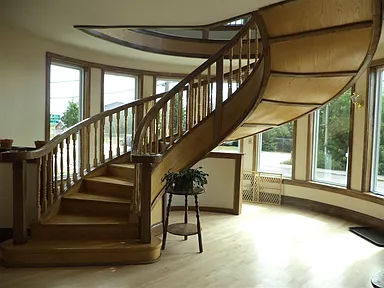
After having seen an article on the Loretto Chapel staircase as a child, my father, in his later years, built a large, free-standing, helical staircase - a much bigger inner radius than most lighthouse-inspired spiral stairs, with a hand rail on both sides - and it was still rather disconcerting to carry furniture or even a full laundry basket up and down.

https://photos.zillowstatic.com/fp/67f4c80eb57023f37d083b39a035f6be-cc_ft_384.webp


Eventually, I did become more accustomed to it, but I never felt truly comfortable on it.

I'm opting for alternating-tread paddle stairs as shown elsewhere in this thread, maybe with library style hardware, to access the loft space of our little shed at our lake property.  Though the fold-flat wall-mounted type with a bazillion hinges are pretty darn cool!  For wrangling awkward objects into the loft space - kayaks, Adirondack chairs and so forth - I'm setting up a gable end hatch and block-and-tackle, hay loft style, so the ladder will really only be for unladen people.

Hermann Phleps in "The Craft of Log Building" and Sven-Gunnar Hakansson in "From Log to Log House" both show several tradition styles of stairs for accessing lofts, upper stories of granaries, etc., some of which are quite ladder-like, if I recall correctly.  I'll try to remember to bring the books in to work to throw them on the flatbed scanner and post up what I find.
 
Posts: 337
21
9
  • Likes 3
  • Mark post as helpful
  • send pies
    Number of slices to send:
    Optional 'thank-you' note:
  • Quote
  • Report post to moderator
Your cat will enjoy this too.


WTC could have saved many lives with this.

Not the Moonwalk.

You can meet this half-way by landing on a table.


I like this because it shows you the wrong way too.


And in case you have an external system:

rope saver

3 unique stairs.
 
Rusticator
Posts: 9777
Location: Missouri Ozarks
5391
7
personal care gear foraging hunting rabbit chicken cooking food preservation fiber arts medical herbs homestead
  • Likes 5
  • Mark post as helpful
  • send pies
    Number of slices to send:
    Optional 'thank-you' note:
  • Quote
  • Report post to moderator
These stairs are all very interesting - but I couldn't count on being able to use any of them, on any given day, because of an old (as in when I was 11) injury to my knees. We have fairly decent, wide stairs that aren't very steep - but, even with the risers open, they're probably the easiest full stairs I've had to climb on a regular basis. That said, there are days when I can't manage them, at all. Some days, I have to 'two-step' my way up and down then. So, my question about the alternative step concept - particularly the type with no common back half of the tread, is how do you manage them, if you have an injury or as you age? Is there a feasible 'plan b' that doesn't require just staying put?
 
Kevin Olson
gardener
Posts: 500
Location: The Old Northwest, South of Superior
296
books building wood heat
  • Likes 7
  • Mark post as helpful
  • send pies
    Number of slices to send:
    Optional 'thank-you' note:
  • Quote
  • Report post to moderator

Carla Burke wrote:So, my question about the alternative step concept - particularly the type with no common back half of the tread, is how do you manage them, if you have an injury or as you age? Is there a feasible 'plan b' that doesn't require just staying put?


When we thought my mother-in-law would be coming to live with us, I investigated used stair lifts.  Turns out there is a regular market in such things.  In the end, she passed on to her eternal reward before it was needed, but it's still in the back of my mind, should that be needed.  The other thing we have discussed is rejiggering our ground floor bathroom, replacing the laundry sink with a walk-in tub/shower, then installing a small corner wash basin (the laundry sink will find another location, probably in the basement).  That would allow someone to use our front room as a bed room, which can be separated from the living room by closing the still-functional 5-foot wide 1890s-vintage pocket door, with an almost directly adjacent full bathroom.  That arrangement would obviate the need for someone - at least in the short term - to go to the upper floor.  Just in case I were to blow out a knee, or something.  Obviously, both of these modifications would be better done before they're needed, though the stair lift would be a bit more obtrusive.  But, I think the rail could be mounted and the electrics run in preparation, and the actual chair carriage stashed somewhere out of the way, held in reserve until called upon.

A small mechanical freight elevator might be an option, if one could be found.  When I was a kid, my dad briefly worked for a motorcycle helmet factory, before it burned down.  But, the only thing I really remember clearly of my tour of the place was the ride on the old hand-operated elevator.  It used some sort of capstan or Chinese windlass arrangement - I'm a bit fuzzy at 40-odd years remove from the event, but there was a big hand wheel and a lot of rope involved.  I don't know if the rope was actually used for the suspension, or just to transfer the mechanical motion from the hand wheel.  Anyway, such things exist, or once did, and might also be helpful.

Ramps are probably only useful for interior stairs if there are just a few treads.  For outside steps, it's quite common in these parts for people to install ramps - and sometimes just to facilitate snow removal.  This used to be a very common thing, but I suspect that mechanical snow removal, especially snow blowers, has made that less necessary.  When finding room for the last couple of feet of snow, after the previous 300 inches of Mother Superior's finest, every advantage helps, included an elevated walkway - even if you are hale and fully mobile.

Not sure if any of these ideas are helpful in you particular circumstances, however.
 
pollinator
Posts: 1090
Location: Inter Michigan-Superior Woodland Forest
215
7
transportation gear foraging trees food preservation bike building solar writing woodworking wood heat
  • Likes 6
  • Mark post as helpful
  • send pies
    Number of slices to send:
    Optional 'thank-you' note:
  • Quote
  • Report post to moderator
Paddle stairs for the win. Not much more space taken than a ladder, but I walk up and down mine carrying stuff both ways all of the time.
 
Kevin Olson
gardener
Posts: 500
Location: The Old Northwest, South of Superior
296
books building wood heat
  • Likes 4
  • Mark post as helpful
  • send pies
    Number of slices to send:
    Optional 'thank-you' note:
  • Quote
  • Report post to moderator
Here's an example dimensioned drawing of a ladder type of stair, taken from Gennady Fedotov's 2001 book "Russian Stoves" ("Русская печь"), as are the other two attached images.

It could pretty easily be made with alternating paddles treads, by cutting away about half the depth of each tread, assembled with half of the treads relieved on the right, the other cut away of the left.  I plan to use this as a general layout for my shed loft ladder, though longer (i.e. taller) than illustrated here to reach the loft floor about 7-1/2 feet (~230cm) from the main floor.  As drawn, it was only intended to reach the loft bed on the top of a Russia teplushka stove (a sort of Swiss army knife combination heating and cooking implement thermal mass heater, see attached images) - probably about 140cm or 4-1/2 feet above the floor.

No fasteners are shown in the stair drawing, but a threaded rod skewered through the stringers under every step, like an old wooden step ladder, might make it more robust.  Alternatively, the braces and treads could be laid out slightly differently to extend either tread or brace tenons through mortises in the stringers, retained with wedges.  Or, screws or nails could fasten the stringers to the braces.

I'll get some of the Phleps and Hakansson examples of ladder style stairs scanned and posted, too.
Stove_ladder.JPG
[Thumbnail for Stove_ladder.JPG]
Teplushka.JPG
[Thumbnail for Teplushka.JPG]
Teplushka2.JPG
[Thumbnail for Teplushka2.JPG]
 
Jay Angler
master steward
Posts: 15453
Location: Pacific Wet Coast
9836
duck books chicken cooking food preservation ungarbage
  • Likes 4
  • Mark post as helpful
  • send pies
    Number of slices to send:
    Optional 'thank-you' note:
  • Quote
  • Report post to moderator

Kevin Olson wrote:Here's an example dimensioned drawing of a ladder type of stair...


Ladder stairs are definitely comfier on bare/sock feet than regular ladders, and slope makes them much easier to climb than vertical ladders such is on my friend's bunkbed.

I will mention that people may need to be told to treat it like a ladder and always climb down facing the ladder rather than facing away from it.
 
Coydon Wallham
pollinator
Posts: 1090
Location: Inter Michigan-Superior Woodland Forest
215
7
transportation gear foraging trees food preservation bike building solar writing woodworking wood heat
  • Likes 2
  • Mark post as helpful
  • send pies
    Number of slices to send:
    Optional 'thank-you' note:
  • Quote
  • Report post to moderator

Edward Lye wrote:Your cat will enjoy this too.


Ahem, the title of this thread is "Stairs and Ladders". I believe 'Chutes and Ladders' would fall into another forum (although it might have to be Snakes and Ladders to translate the joke into some cultures ;-)...
 
Kevin Olson
gardener
Posts: 500
Location: The Old Northwest, South of Superior
296
books building wood heat
  • Likes 4
  • Mark post as helpful
  • send pies
    Number of slices to send:
    Optional 'thank-you' note:
  • Quote
  • Report post to moderator

Coydon Wallham wrote:
Ahem, the title of this thread is "Stairs and Ladders". I believe 'Chutes and Ladders' would fall into another forum (although it might have to be Snakes and Ladders to translate the joke into some cultures ...


Well, that got a chuckle out of me!

The steepest commercially available alternating tread stair I could spot was 68 degrees, though the OSHA spec allows for up to 70 degrees:
https://www.osha.gov/laws-regs/regulations/standardnumber/1910/1910.25
 
Kevin Olson
gardener
Posts: 500
Location: The Old Northwest, South of Superior
296
books building wood heat
  • Likes 3
  • Mark post as helpful
  • send pies
    Number of slices to send:
    Optional 'thank-you' note:
  • Quote
  • Report post to moderator

Kevin Olson wrote:I'll get some of the Phleps and Hakansson examples of ladder style stairs scanned and posted, too.


The attached is a PDF of scans taken from (in order): Hermann Phleps's "The Craft of Log Building", and from his "Deutsche Fachwerkbauten" (German Timberframe Construction); Sven Gunnar Hakansson's "From Log to Log House"; and from Pauls Kundzin's "Latvju Seta" (The Latvian Farmstead).

None of these are alternating tread stairs, but most are quite steep and ladder-like.  The spiral stair on page 4 is the exception, but since I ran across it, I thought I'd include it in the file since there was discussion of spiral stairs in this thread.

Two of the stairs (Figure 327 on the second page, and Figure 96 on page 6) are made from a single log, and are reminiscent of cliff dwelling and pueblo stairs from the American Southwest.  Presumably, similar to the technology of conical tents or beehive masonry domes, this style of stair has historically had broad geographic distribution.

Of all of them, Figure 388 on page 3 is the most picturesque building, to me.  Though my scan isn't the best, is does appear that there are some sort of tenons through the stringers on this example, but they don't exactly line up with the treads.  The original photo is scarcely clearer regarding this technical detail - I really can't determine which part of the treads (or, perhaps, braces) could be poking through mortises in the stringers in the visible locations; they just don't seem to align with the treads, but I can't really see any braces on the inside surface of the opposite stringer, either.  Though Phleps offers many carefully made technical drawings to illustrate various construction details of many facets of log and stave construction in "The Craft of Log Building", he does not show any detail drawings for stairs, that I could see.

I'll have a look in "Woodworking in Estonia" by Viires, but I don't think there were many architectural details in there, and I don't remember any stairs, though it's possible that there are some which appear incidentally in the background of some photos.

I could recommend any of these books, if you can find them.  There is a wealth of information to be gleaned from each of them.

On edit:  I dug out my copy of Ants Viires's "Woodworking in Estonia" and thumbed through it twice.  I couldn't spot any stairs in the photos, steep and ladder-like or otherwise.
Filename: loft_stairs.pdf
File size: 5 megabytes
 
They kept fire breathing monkeys as pets! This tiny ad told me so!
grow your own garden and build your own home in the gardening gardeners program
https://wheaton-labs.com/bootcamp
reply
    Bookmark Topic Watch Topic
  • New Topic