• Post Reply Bookmark Topic Watch Topic
  • New Topic
permaculture forums growies critters building homesteading energy monies kitchen purity ungarbage community wilderness fiber arts art permaculture artisans regional education skip experiences global resources cider press projects digital market permies.com pie forums private forums all forums
this forum made possible by our volunteer staff, including ...
master stewards:
  • Carla Burke
  • John F Dean
  • Nancy Reading
  • r ransom
  • Jay Angler
  • Timothy Norton
stewards:
  • paul wheaton
  • Pearl Sutton
  • Anne Miller
master gardeners:
  • Christopher Weeks
  • M Ljin
gardeners:
  • Jim Garlits
  • thomas rubino
  • William Bronson

Series of water containers in the garden

 
Posts: 5
Location: France
  • Likes 3
  • Mark post as helpful
  • send pies
    Number of slices to send:
    Optional 'thank-you' note:
  • Quote
  • Report post to moderator
Hiya folks,
Interested in people's experience implementing above-ground water containers in a garden and in particular the plumbing parts I need to find.
To explain: I have a garden with some slopes and different levels (terraces) and the roof has a good gutter system but the downpipes currently go below ground. I also have compost toilets so all the kitchen and bathroom water that currently goes into a sub-standard septic tank could be diverted and the septic tank removed/filled.
My idea is to install at least 8 above ground water containers (400l to 1,000l are sizes of galvanized/plastic containers it's relatively easy to source as I get money) as I can afford them and divert both my house waste water and gutter water into them - setting them up using poubellarium principles (plants for cleaning and fish for mosquito control). I love the idea of dipping tanks to be able to water different spots int he garden when it gets really hot and the extra habitat/environment created.
I really want the tanks to be connected, allowing to gravity feed and top up the tanks as I use water in the house or it rains.
My question lies in what to use to connect the tanks when there are maybe 10 or 20 metres between them - what kind of seals/connectors and what kind of tubes. I look at the plumbing stuff in the DIY shops and feel pretty lost tbh. I don't like the idea of kits because they are for very specific applications plus all plumbing stuff now costs a fortune so it feels like a waste of money (I'm on a very tight budget).
Have you done a series of connected containers and how have you set it up? I'm in Europe/France not USA - I think products here are very different.
Thanks very much!!
bac-de-paturage-la-gee-750-l.jpg
[Thumbnail for bac-de-paturage-la-gee-750-l.jpg]
45565152_1736848051_759.jpg
[Thumbnail for 45565152_1736848051_759.jpg]
 
Apprentice Rocket Scientist
Posts: 175
Location: Portugal
122
3
transportation gear earthworks solar rocket stoves
  • Likes 7
  • Mark post as helpful
  • send pies
    Number of slices to send:
    Optional 'thank-you' note:
  • Quote
  • Report post to moderator
It's not generally recommended to store grey water, but if you can render it clean so it doesn't become black water I guess you can.  (I have no knowledge of that part).  Rain water should be less prone to problems but will still potentially breed mozzies if left open.

What we use here is ordinary PVC drain pipe on the sink/shower/washing machine which connects (outside) via a suitable adapter to a length of (IIRC) 1¼" suction hose (it's tougher and doesn't kink).  That gets moved around on the terrace beside the house to water various fruit trees.  We don't generate black water as we have a version of the willow feeder toilet.

For connecting up multiple tanks (and pumps, if on different levels?) I would use 1" bore LDPE or HDPE pipes.  They're readily available in most building or gardening supply places, together with suitable fittings.  Can be left on the surface although the water gets hot in direct sun.  Or you can bury them without any special measures.  They're plenty tough enough to walk on etc. and HDPE will even stand up to being driven over by normal sized vehicles, provided there's not anything very sharp directly under it.  HDPE is generally used for higher pressure which you may not need but that does also make it tougher and unless you're running it a LONG distance the price difference is not extreme.
 
pollinator
Posts: 6174
Location: Bendigo , Australia
582
plumbing earthworks bee building homestead greening the desert
  • Likes 5
  • Mark post as helpful
  • send pies
    Number of slices to send:
    Optional 'thank-you' note:
  • Quote
  • Report post to moderator
Perhaps look at the link in my signature where I talk about catching rainwater.
It is similar, but as someone said, dont store grey water more than 24 hours.
Pipe sizes depend on volume of water being moved, speed of the water and how far it is to be moved.
Too small a pipe will cause big delays in time to move water.
Read about water reuse, water recycling, rainwater catchment to get a better understanding.What you are propsing may not work as well as it can.
 
steward & manure connoisseur
Posts: 5226
Location: South of Capricorn
3186
dog rabbit urban cooking writing homestead ungarbage
  • Likes 8
  • Mark post as helpful
  • send pies
    Number of slices to send:
    Optional 'thank-you' note:
  • Quote
  • Report post to moderator

Austin Shackles wrote:It's not generally recommended to store grey water


Yes, we store rainwater in barrels around the garden (with mosquito netting along the top where rainwater enters from the gutters) but if we need to use graywater in the garden we hook it up directly (usually from the washing machine outflow) and use it at the time it's produced. I do low-tech: the water out of the machine goes into a large trash can, and I put my normal hose for gardening in there, create suction and position the hose out in the garden where I need it.

For my barrels in the garden, I have a few large food-safe barrels I got from an olive curing operation, I drilled a hole in the bottom and put a tap in with a fast connector that can clip to a garden hose, so I can use them to fill buckets or wash my hands (without the hose) or attach the hose and use that water elsewhere. Under each bucket is a "washing station" with gravel (my garden is on a slope, so these stations are level so I can set a watering can or bucket down to fill) that drains into a nearby bed, so any water I use for washing produce/boots/hands/etc gets diverted and used as irrigation too.
 
pollinator
Posts: 135
Location: Central Iowa, Zone 5b
58
personal care foraging urban chicken bike bee
  • Likes 6
  • Mark post as helpful
  • send pies
    Number of slices to send:
    Optional 'thank-you' note:
  • Quote
  • Report post to moderator
We have several open water storage containers for rain water, thou they are not connected yet I want to add onto them for added storage. Mosquitoes were originally a problem but we added some bettas in need of a home to each tank. They are easy to bring in for the winter so they don't die and dont multiply like goldfish or guppies so I don't end up with to many.

My plan for connecting them is to add a hose or pipe at the overflow port Iv put in mine and let it overflow into the next lower one. Then wash and repeat as many times as wanted. Mine will be much closer together so Im not sure if that's a viable plan for your situation. But I cant see why adding flexible hose to bury or let lie on the ground between each one would be a issue. Long as the overflow port is higher then the outflow of the pipe.

As for the grey water we dont keep it in a storage tank because it was to expensive for us to clean it before holding it for any amount of time. It wasnt in the plans to use grey water originally but our septic tank is pretty small and the drain plumbing under the house was disconnected in several places causing flooding that the previous owners thought was from rain. So from each sink and the tub theres a pipe that goes straight out the house to the nearest garden with a hose attachment on it and I currently have just used garden hoses for the last 2 years with no issues. Lets me move it around easily so all that water isnt just in one place. It was a emergency "I have no idea what Im doing repair" that cost us 40$ and is still going strong AND code legal in our area. With a good DIY bog filter and alot of plants thou I bet a simple water filter for the grey water wouldn't be to hard if you are short on rain..... Id do a test run for a few months before connecting it to the whole system first personally. But a fun idea if you have the time to fine tune it!
 
out to pasture
Posts: 13334
Location: Portugal
4489
goat dog duck forest garden books wofati bee solar rocket stoves greening the desert
  • Likes 9
  • Mark post as helpful
  • send pies
    Number of slices to send:
    Optional 'thank-you' note:
  • Quote
  • Report post to moderator

Tereza Okava wrote: ...if we need to use graywater in the garden we hook it up directly (usually from the washing machine outflow) and use it at the time it's produced. I do low-tech: the water out of the machine goes into a large trash can, and I put my normal hose for gardening in there, create suction and position the hose out in the garden where I need it.


Ours is even more low-tech - all the greywater downstairs (washbasin, shower and washing machine) feeds straight into a pipe which has a heavy-duty hosepipe attached to it. One of my daily chores is to move the end of the pipe to the most deserving fruit tree in front of the house.

The water tanks we have are fed from the water-mine on the terrace above the house. One tank supplies this house and is buried underground. Then there is an IBC tank which sends water next door to supply my son, then there is another IBC tank next to it and the overflow from my son's one goes into that. The idea being that his house-water tank fills up before my irrigation tank does as his drinking water is more urgent than my irrigation water. Any overflow from that feeds back into the gulley that the water mine itself overflows into. As though we're just 'taking what we need and letting the rest flow by'. There's also another IBC tank on the next terrace up which is emergency fire-fighting water which we fill from our neighbours' water system as it sits above our water-mine.

One thing to note in the EU is that the system of measuring water-pipe is odd.

One inch water pipe in the minds of most people older than about 40 refers to the internal bore of the pipe. In Portugal an inch is a polegada, related to the word for thumb. An inch is around 25 mm, but one inch water pipe is usually sold as something like 32 mm as these days they measure the external diameter of the pipe, not the internal. So if you go into a store that knows their stuff and ask for one 'polegar' they'll sell you something like 32mm, depending on the thickness of the pipe walls. The translate app tells me that the word for both 'thumb' and 'inch' is pouce in French so it's likely that something similar will happen in France.

We have one wonderful shop called Regacentro near here and there is one guy in there who I swear is autistic and you can ask him the most complex and confusing questions and he'll go quiet for a minute and they give you a simple 'yes' or 'no' answer and go off and fetch the bits you need. And he's always, always right. Just don't expect chit-chat from him. A man after my own heart...
 
steward
Posts: 19213
Location: USDA Zone 8a
4844
dog hunting food preservation cooking bee greening the desert
  • Likes 3
  • Mark post as helpful
  • send pies
    Number of slices to send:
    Optional 'thank-you' note:
  • Quote
  • Report post to moderator
You might look into doing a Holzer-Style Crater Gardens using containers.

This thread also has some YouTubes that you might find helpful:

https://permies.com/t/217628/Small-water-garden-inspiration
 
John C Daley
pollinator
Posts: 6174
Location: Bendigo , Australia
582
plumbing earthworks bee building homestead greening the desert
  • Likes 3
  • Mark post as helpful
  • send pies
    Number of slices to send:
    Optional 'thank-you' note:
  • Quote
  • Report post to moderator
Bettas, also known as Siamese fighting fish, are popular, vibrant freshwater fish native to Southeast Asia.
Renowned for their brilliant colors and flowing fins, they require specific care to thrive, including a heated 20-40L tank, a balanced diet, and solitary housing to prevent aggressive territorial clashes
 
Connie Graham
Posts: 5
Location: France
  • Likes 4
  • Mark post as helpful
  • send pies
    Number of slices to send:
    Optional 'thank-you' note:
  • Quote
  • Report post to moderator
Thanks for the different replies. Lots of focus on the fact I'm diverting sink water - I do know lots about this already I have a plan for pre-treatment and it will go on to get used very quickly for the fruit trees and their guilds so that is not an issue. I plan to divert the cleaned grey water to just 2 or 3 containers at the different levels of the garden for daily watering. The gutter water will go into its own series of containers for low-tech poubellarium habitat (with overflow going into a 'wetland' area). Mosquitoes aren't an issue with such systems thanks to the fish.

What I'm stuck on is connecting the tanks so I can gravity feed them for topping up, as the water will get used regularly. As in the type of fittings that will allow me to connect pipes/hoses between them - I don't know what to look for or what kind of seals etc. Also, in an ideal world the containers are full to the top but how close to the top can you really drill a hole and have a good seal? I was considering whether one could just cut a V-shape in the top of the container and position guttering or similar below it to allow the water to flow out that way. I just haven't seen what I'm hoping to do in real life so it's a bit hard for me to picture it exactly. Really you want some kind of spout as part of the container but that's not how they come!

(Also, it's a nightmare to dig here - just endless stone and barely any soil - which is why I'm going for above ground containers. Interconnected ponds with little gullies would be amazing but I cannot implement that.)
 
pollinator
Posts: 302
Location: UK
96
kids urban seed
  • Likes 7
  • Mark post as helpful
  • send pies
    Number of slices to send:
    Optional 'thank-you' note:
  • Quote
  • Report post to moderator
The overflow cascade idea is solid, gravity does all the work for you. One thing I found when setting up something similar is that the pipe diameter between containers matters more than you'd think. I started with half inch connections and they couldn't keep up during heavy rain, so the upper containers overflowed before the lower ones filled. Went up to one inch and the whole system balanced out much better. Also worth putting a mesh screen where the water enters each container, keeps debris from clogging the connections between them.
 
Connie Graham
Posts: 5
Location: France
  • Likes 3
  • Mark post as helpful
  • send pies
    Number of slices to send:
    Optional 'thank-you' note:
  • Quote
  • Report post to moderator

Joao Winckler wrote:The overflow cascade idea is solid, gravity does all the work for you. One thing I found when setting up something similar is that the pipe diameter between containers matters more than you'd think. I started with half inch connections and they couldn't keep up during heavy rain, so the upper containers overflowed before the lower ones filled. Went up to one inch and the whole system balanced out much better. Also worth putting a mesh screen where the water enters each container, keeps debris from clogging the connections between them.


Yes, it's hard to believe how much water is actually coming down a gutter downpipe in even 'light' rainfall! Thanks for the feedback.
 
Burra Maluca
out to pasture
Posts: 13334
Location: Portugal
4489
goat dog duck forest garden books wofati bee solar rocket stoves greening the desert
  • Likes 7
  • Mark post as helpful
  • send pies
    Number of slices to send:
    Optional 'thank-you' note:
  • Quote
  • Report post to moderator

Connie Graham wrote:What I'm stuck on is connecting the tanks so I can gravity feed them for topping up ... As in the type of fittings that will allow me to connect pipes/hoses between them - I don't know what to look for or what kind of seals etc.
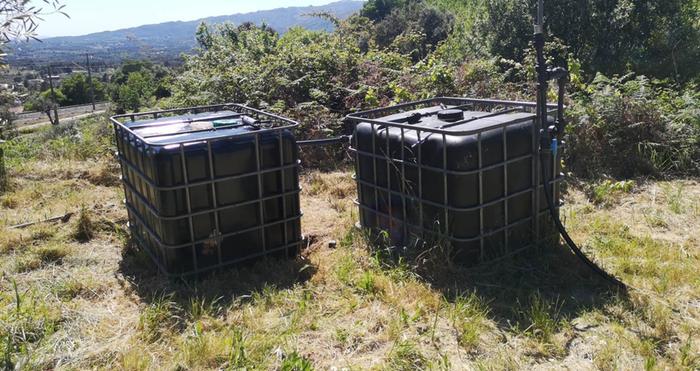
I just went up to the terrace above the house to take some photos in case they help.

If you need more technical info I'll have to twist Austin's arm to reply when he gets home but I'm hoping the photos will help you a bit.

These are two interconnected tanks we have fed from the water mine dug at the back of the upper terrace. There is just enough drop to fill the tank on the right, which supplies my son's house next door. When it's full it overflows into the tank on the left, which supplies the drip irrigation to my garden. There is also another buried tank which supplies our house. I got completely lost on which tanks supply which hose-pipes for use in the garden as I think they've been changed around a few times, but the basic idea is that the irrigation tank fills up last and if ever it stops flowing it will hopefully give us enough advance warning to be able to go and sort out whatever the problem is before both houses run out of drinking water.

You can see the pipe connecting the two tanks - nothing will flow into my irrigation tank on the left until my son's house-supply tank on the right is full.

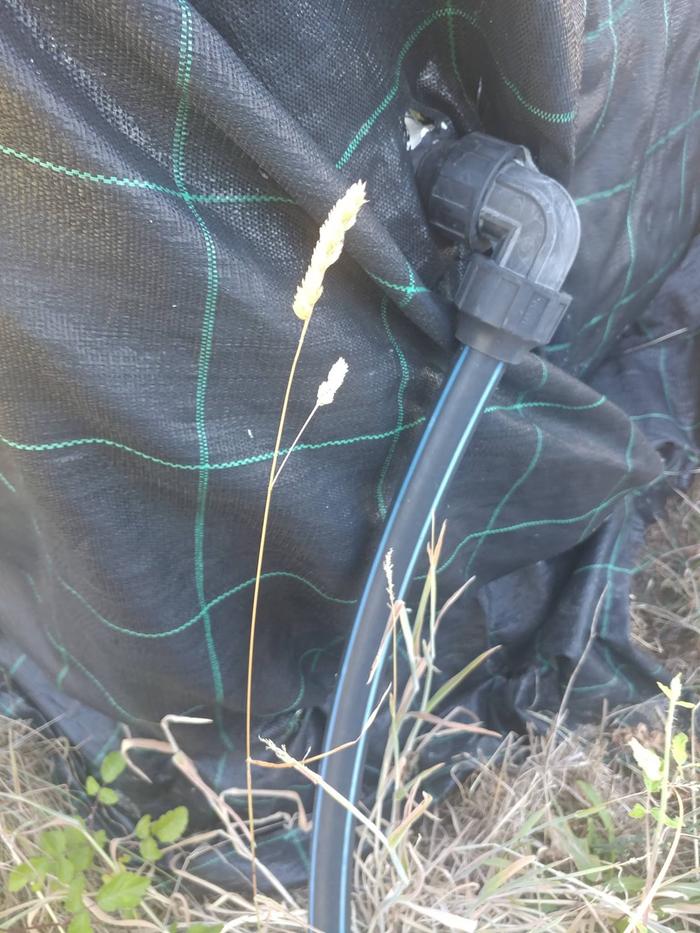
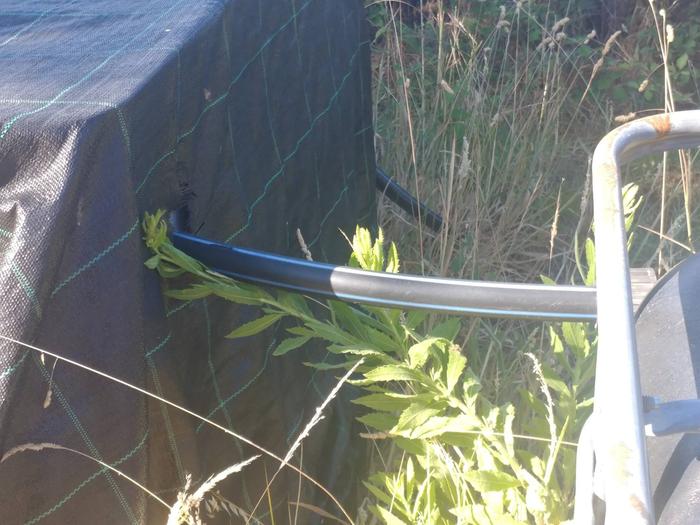
One tank is made of black plastic which stops green algae forming in the water, which is a constant problem if you get the usual white tanks. The other one is painted black because it was difficult to source black ones but the paint tends to come off and we ended up covering it with landscape fabric when we had problems with the drip irrigation clogging with algae.


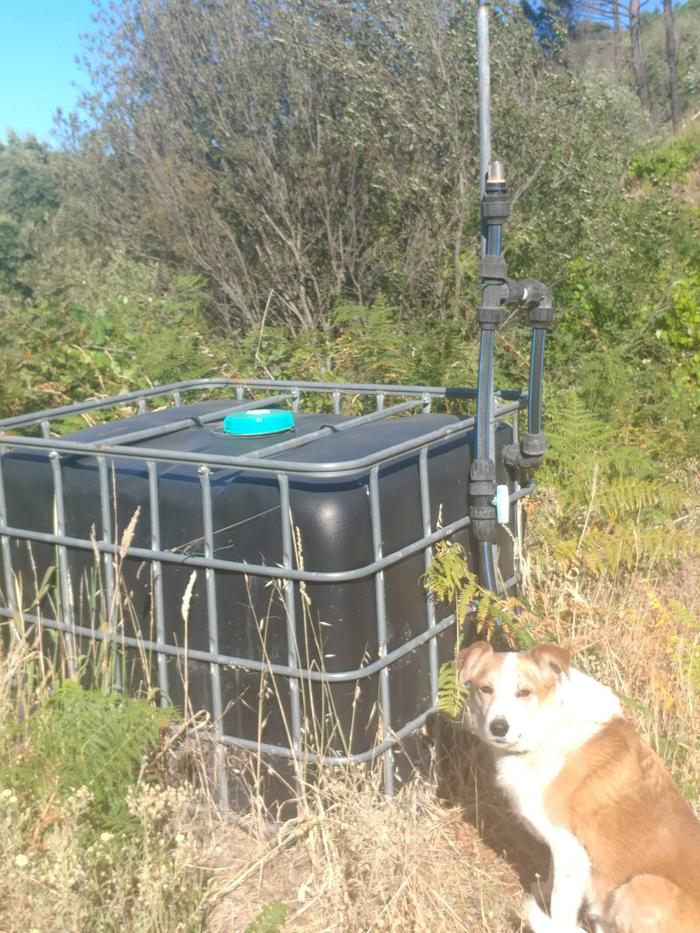
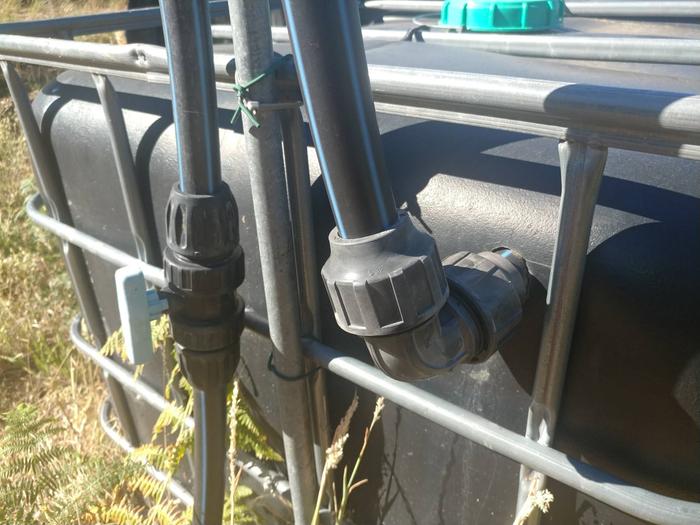
Closer up shot of the pipework on the tank supplying my son's house. I don't pretend to understand it...

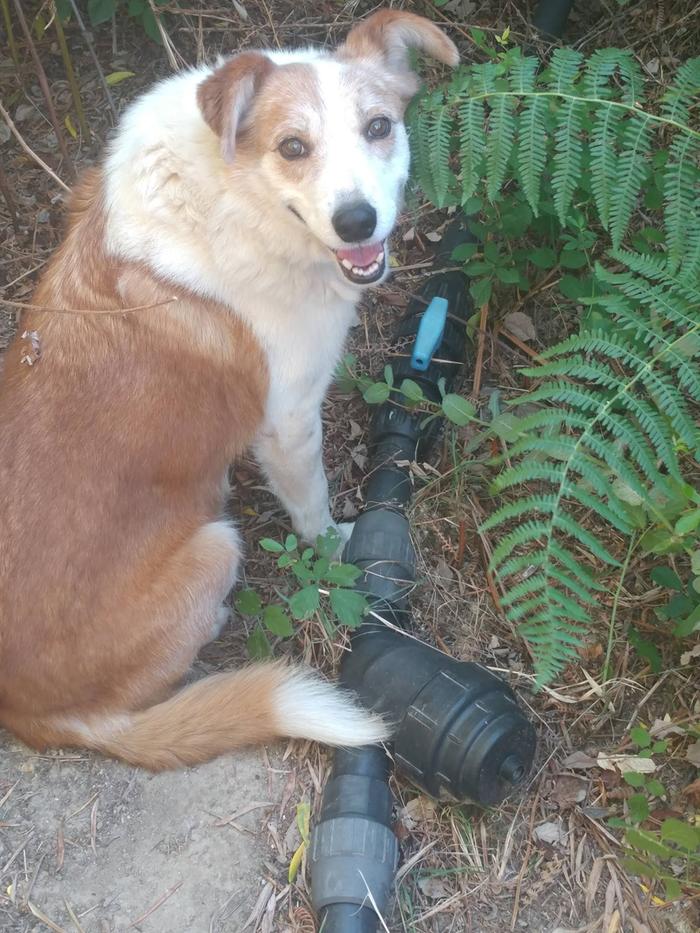
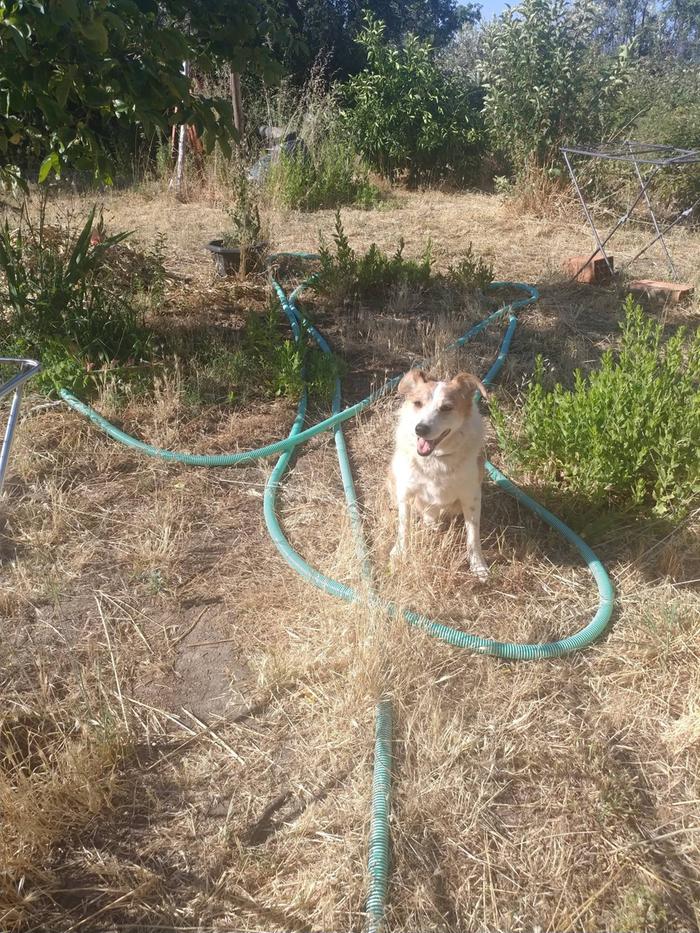
Rock the welsh sheepdog for scale...


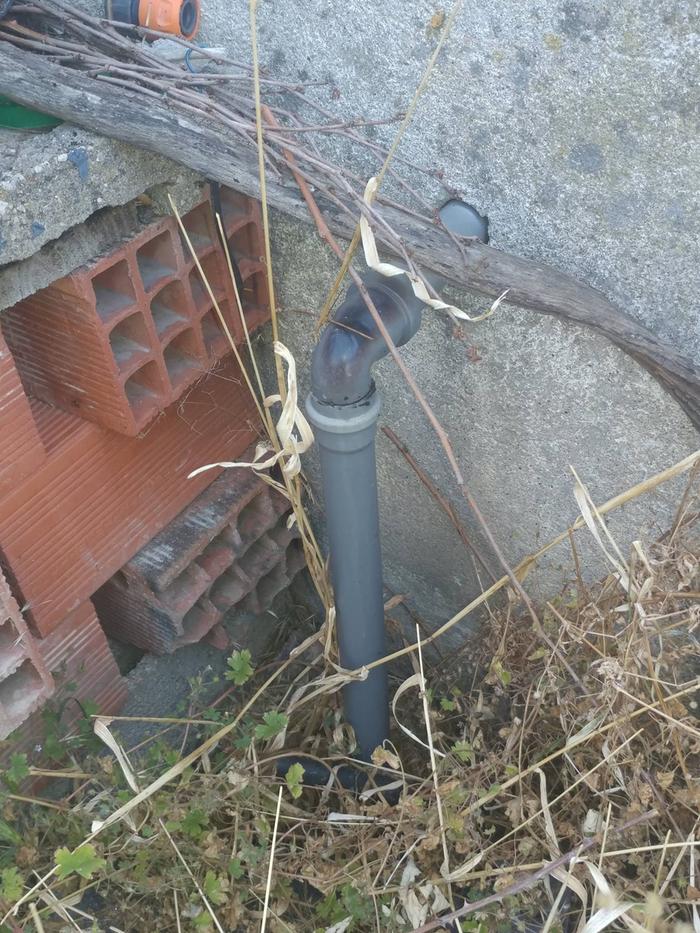
An even closer-up view of where the water from the mine enters the first tank. It seems to basically just be shoved through a hole cut in the side at a suitable height, ie as high up as possible but not so high that the water won't flow into it.


This is the pipe connecting the two tanks. Again positioned as high as possible so that each tank can stay as full as possible. Obviously it can't be higher than the intake pipe on the first tank!


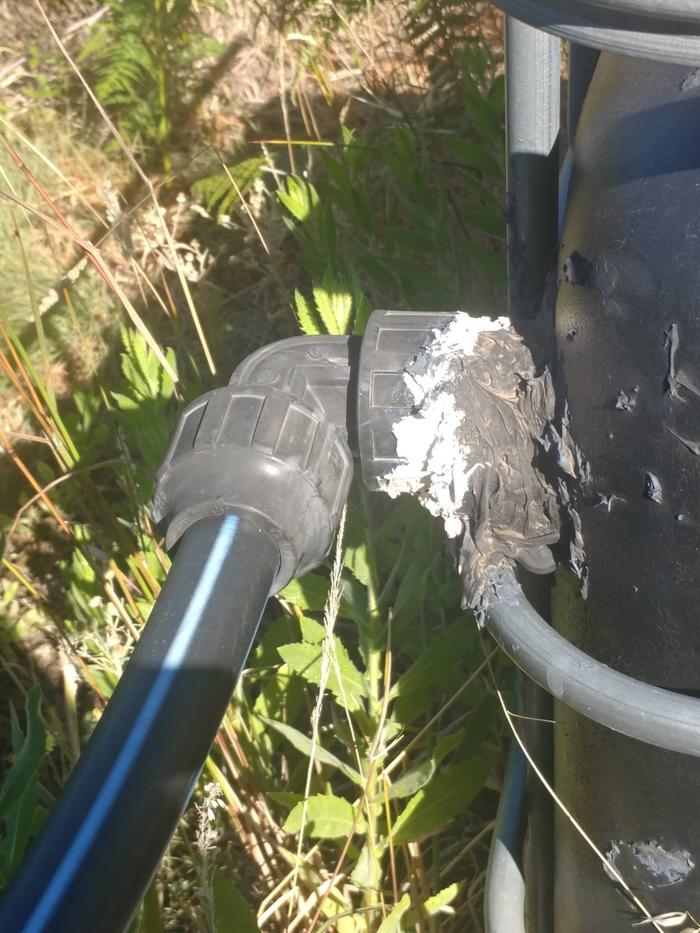
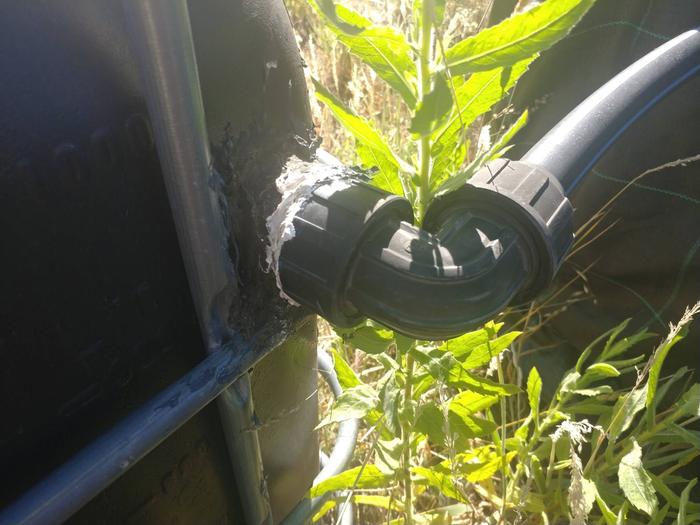
This is the outlet of the connecting pipe - it needed a lot of extra sealer to stop it leaking!


And the same connection taken from the other side...


This is the overflow from the irrigation tank, which just feeds down the gulley where the water mine itself overflows to so that we only take what we actually need, letting the rest go back to where it wanted to be in the first place.


These tanks have fittings near the bottom that you can screw pipes to but they were a bit overgrown and might not be relevant to you. I can go and attempt to take photos if you really want me to.

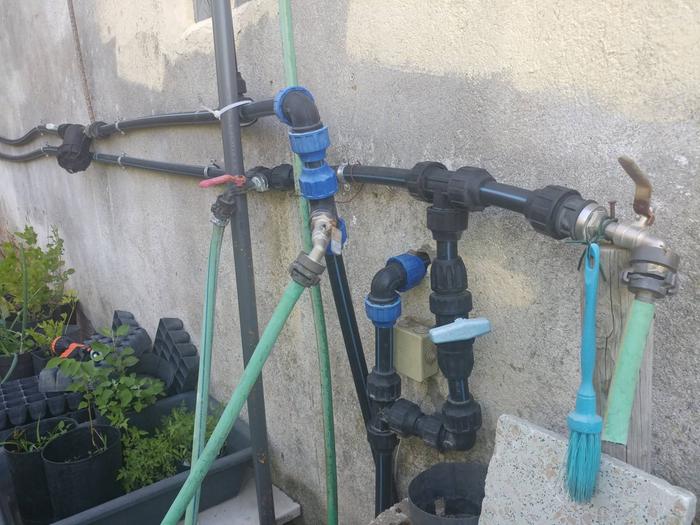
And this is the mess of pipes and fittings we have on the wall of the house, supplied from at least two tanks. With some extra grey-water pipes thrown in for good measure. It's confusing and we're still renovating so it might all change yet...


This is the main tap for my irrigation system. The pipe from the tank goes straight down the terrace wall (somewhat overgrown with brambles...). I switch it on and off with that big blue tap and there is a filter fitted AFTER the tap so we can clean the filter without having to climb to the upper terrace to switch it off and then again to switch it back on.


And just for interest this is the pipe that carries the grey water from the washing machine and wash basin. It feeds in to one connected to the shower and they both feed into a reinforced pipe which is quite wide diameter. I can check, but we recently upgraded it because the original one stopped the shower draining freely if I had the hose pipe on a tree that didn't have much of a drop from the start of the pipe. That's the problem with terraces - there's not much drop from the shower to where you might want the grey water to drain to!


And one final shot of Rock doing the for-scale thing by the pipe that carries the grey-water to the trees. It ends up looped all the place as I move it to a different tree every day.


I can take more photos or measure things or get my other half to give more technical answers if you have any other questions.
 
Connie Graham
Posts: 5
Location: France
  • Likes 3
  • Mark post as helpful
  • send pies
    Number of slices to send:
    Optional 'thank-you' note:
  • Quote
  • Report post to moderator

Burra Maluca wrote:I just went up to the terrace above the house to take some photos in case they help.


This is VERY helpful, thank you so much for taking the time this is really useful and I can picture my setup much better now. Also, your dog is beautiful!
 
gardener
Posts: 1255
Location: France, Burgundy, parc naturel Morvan
610
forest garden fish fungi trees food preservation cooking solar wood heat woodworking homestead
  • Likes 6
  • Mark post as helpful
  • send pies
    Number of slices to send:
    Optional 'thank-you' note:
  • Quote
  • Report post to moderator
I'm in France too. I used this kind of drill bit to get through the IBC. This flows out to my little natural pond and the second photo shows how i empty into the y shaped funnel so if times are lean rainwise i can still keep the pond filled without having to pump. The IBC is sitting on an underground reservoir the farmers made coming from the stables. water and manure to feed the tomatoes in summer. You might have one of those handy..
These kits do not really stick for long on these food grade IBC's as is visible on the photo, but i am a bit sorry i put it on, when rainwater comes it's so abundant a bit of loss is no problem whatsoever. I have other ones, they fit tightly. The drill bit is a few mill smaller than the pipe, i managed to push it in, it sealed well. But with these black cattle drinking bassins you have that might be more difficult, because they are made of a sturdier plastic. Some balm or grease might be necessary then, but it might tear your bassin. So that would be a big shame. Then better some leakage.
I don't think making a V shape and then catch it into a gutter will do. You can but it will leak a lot i dare predict.
My friends have a greywater system with yellowflags and reeds which works great, two bassins lower it's very very clean. I have these black bassins as well and they are so much better than IBC's. They are small ponds with snails and waterbugs and floating green plants for most of the year. Don't let a dog that is chemicxally treated for fleas swim in it. My ex gf did that two years ago and cried because every bug snail and plant died and floated to the top. The black bassins are very handy, because you just plunk a watering can in there instead of waiting for a slow tab endlessly like with IBC.
Hugo-Zelve-2026-07-02-16.35.30.jpg
[Thumbnail for Hugo-Zelve-2026-07-02-16.35.30.jpg]
Hugo-Zelve-2026-07-02-16.35.35.jpg
[Thumbnail for Hugo-Zelve-2026-07-02-16.35.35.jpg]
 
Austin Shackles
Apprentice Rocket Scientist
Posts: 175
Location: Portugal
122
3
transportation gear earthworks solar rocket stoves
  • Likes 4
  • Mark post as helpful
  • send pies
    Number of slices to send:
    Optional 'thank-you' note:
  • Quote
  • Report post to moderator

Burra Maluca wrote:

Connie Graham wrote:What I'm stuck on is connecting the tanks so I can gravity feed them for topping up ... As in the type of fittings that will allow me to connect pipes/hoses between them - I don't know what to look for or what kind of seals etc.


I just went up to the terrace above the house to take some photos in case they help.

If you need more technical info I'll have to twist Austin's arm to reply when he gets home but I'm hoping the photos will help you a bit.


Just a couple of points.  You can get a proper fitting for attaching the pipe to the tank, but I didn't have one handy so the ones with all the sealant are just a short stub of HDPE pipe pushed into a hole and sealed up with some "especial nautico" sealer - this one is made by Fischer but the key term is "MS polymer" and the particular thing about it is it can be used on wet surfaces.

The proper fitting has to be inserted from inside the tank which can be tricky, and has a big nut to hold it in place.  But it may overall be better/easier.  Those overflow pipes have no pressure on them, being overflows.  It wouldn't work with just sealer if there was any pressure on it.


For the curious: The complicated-looking device on the feed into the tanks is in fact a level control.  The water mine has a wall and fills up about 2ft/60cm deep with water and since it's supposedly about 30m long (think mine adit) into the hillside it holds quite a bit of water.  There's an outlet pipe from the mine which is about 8"/20cm above the floor inside so it's above the sediment level.   That runs to the tanks.  It splits part way and one leg goes to our house tank which is underground and fed through a float valve.  The other leg goes to the 2 IBCs.  The feed goes up above tank level and then back down into the tank - the level where it turns back down is the water level in the mine; by moving the whole thing up and down I can vary the level in the mine.  On top is a vent so it can't air lock, with a small filter so bugs can't go in.   The tanks sit in the sun but that's not an issue as there's a constant flow of water through them which keeps them cool.  

The pipes by the house:  one runs direct from the mine and is used for watering and other such uses, the upper one with the filter part way along is from the tank behind the house and goes inside.  There's also a pump to make the shower work and a cross connection (the blue in-line tap) which allows me to use the pump to reverse flow water from the tank back to the mine to flush the pipe if needed.  As the flow is quite slow from the mine especially in summer it can sometimes get sediment in the pipe which restricts the flow.  It also gets gas trapped in it by some means which defies logic as that should escape from the vent.  I've no idea where the gas is from, the whole pipe from the mine to the tank is below water level normally, it can't draw air in.  
 
Connie Graham
Posts: 5
Location: France
  • Likes 4
  • Mark post as helpful
  • send pies
    Number of slices to send:
    Optional 'thank-you' note:
  • Quote
  • Report post to moderator
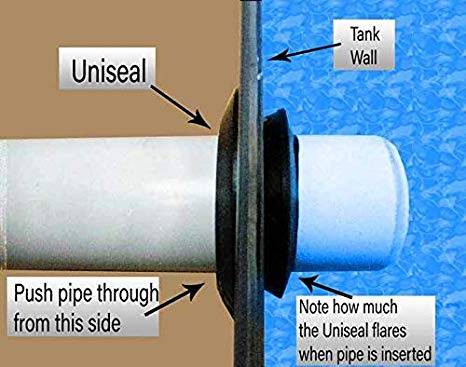
Thanks for the photos. I think the issue was I have been looking in DIY shops (like last year I found a nice - but v small gauge - brass fitting for a water butt, but it was over €20)  and the gear I need is irrigation stuff. Checking online I can see all kinds of fittings are available and a good range of sizes plus the prices aren't too crazy. I will invest in some black pipe and a few connectors. The terms to search (in English anyway) seem to be 'bulkhead connectors' or 'tank wall fittings'. Fingers crossed.
traversee-de-paroi-qdfuick-joints-montage-rapide.jpg
[Thumbnail for traversee-de-paroi-qdfuick-joints-montage-rapide.jpg]
traversee-de-paroi-quick-joints-montage-rapide.jpg
[Thumbnail for traversee-de-paroi-quick-joints-montage-rapide.jpg]
 
Spare the rod, spoil the child. Here, use this tiny ad named Rod:
try homesteading without buying a homestead
https://wheaton-labs.com/bootcamp
reply
    Bookmark Topic Watch Topic
  • New Topic