

• Post Reply Bookmark Topic Watch Topic
  • New Topic
permaculture forums growies critters building homesteading energy monies kitchen purity ungarbage community wilderness fiber arts art permaculture artisans regional education skip experiences global resources cider press projects digital market permies.com pie forums private forums all forums
this forum made possible by our volunteer staff, including ...
master stewards:
  • Carla Burke
  • Anne Miller
  • Nancy Reading
  • John F Dean
  • r ransom
  • paul wheaton
  • Timothy Norton
stewards:
  • Jay Angler
  • Pearl Sutton
  • Andrés Bernal
master gardeners:
  • Christopher Weeks
gardeners:
  • M Ljin
  • Thekla McDaniels
  • May Lotito

Can we decrease inulin (and flatulence) in sunchokes through cultivation practices?

 
master gardener
Posts: 7116
Location: Carlton County, Minnesota, USA: 3b; Dfb; sandy loam; in the woods
4562
8
forest garden trees books chicken food preservation cooking fiber arts seed woodworking homestead ungarbage
  • Likes 19
  • Mark post as helpful
  • send pies
    Number of slices to send:
    Optional 'thank-you' note:
  • Quote
  • Report post to moderator
I was wondering what we can do to grow sunchokes that don't cause as much gas in those who eat them. So I spent some time reading. It's a little weird trying to research this because most the papers come from the point of wanting to -maximize- inulin production. So you have to read things backwards a little sometimes.

Genetics seems like it plays the greatest role, which isn't exactly cultivation -- but since we can choose what to grow, I'm including it. This paper and others show that different varieties produce higher or lower levels of inulin: https://www.isasunflower.org/fileadmin/documents/HELIA_issues/Helia000/Quantification_of_Inulin_Content_in_Selected_Accessions_of_Jerusalem_Artichoke.pdf

I was really wondering about feeding, watering, harvest window, companion plants, planting density -- the sort of things we can do as home or market gardeners to tweak the resulting produce.

This paper where they stored the tubers for five months at 5C, testing inulin over time shows that it drops slowly. It sort of sounds like it's not enough to both with, but it does corroborate the idea that if you leave them in the ground until after a few frosts have hit, they'll be less farty: https://cropj.com/sennoi_15_12_2021_1395_1398.pdf That maps well to our common wisdom about harvesting from late fall through early spring.

There's a paper that suggests different varieties alter inulin production in response to drought in different ways: https://journals.tubitak.gov.tr/agriculture/vol40/iss3/5/ So you could target genetics that more dramatically restrict inulin production as a result of drought when planning to grow them without irrigation. But I think it's also saying that yield suffers, so that's not as awesome.

The presence of phosphorus and potassium both seem to increase inulin production, so it might be that growing them on depleted soil decreases inulin production a little bit. https://www.academia.edu/59703045/Moderation_of_Inulin_and_Polyphenolics_Contents_in_Three_Cultivars_of_Helianthus_tuberosus_L_by_Potassium_Fertilization and https://www.ijat-aatsea.com/pdf/v17_n2_2021_March/Pinmongkhonkul,%20S.%20.pdf

Overall, it seems like our ability as gardeners to moderate the inulin production is pretty minimal, or at least no one has hit on it yet.

Does anyone know anything else about this? Anything these studies miss? Or experiences that you've had making sunchokes less farty in the garden?
 
gardener
Posts: 881
Location: Semi-nomadic, main place coastal mid-Norway, latitude 64 north
638
  • Likes 18
  • Mark post as helpful
  • send pies
    Number of slices to send:
    Optional 'thank-you' note:
  • Quote
  • Report post to moderator
Did you see this study? It sounds a bit promising.

The geographical location of the places where JA was grown determined most of the chemical composition of the tubers. Significantly higher amounts of inulin, crude fiber, crude protein, endogenous amino acids, and magnesium were produced by the cultivars tested in Poland. On the other hand, tubers grown in Lithuania were characterized by a higher content of crude fat, true protein, total amino acids, essential amino acids, and nitrogen, phosphorus, potassium, calcium, and sodium.


Otherwise, I was thinking that since inulin is a polysaccharide built mainly from fructose, it might be worthwhile to try and find (or select for) varieties with sweeter tubers. Sweet taste might mean that less of the fructose produced is bound up in inulin, and therefore less inulin produced.
 
Christopher Weeks
master gardener
Posts: 7116
Location: Carlton County, Minnesota, USA: 3b; Dfb; sandy loam; in the woods
4562
8
forest garden trees books chicken food preservation cooking fiber arts seed woodworking homestead ungarbage
  • Likes 10
  • Mark post as helpful
  • send pies
    Number of slices to send:
    Optional 'thank-you' note:
  • Quote
  • Report post to moderator
Oh, thanks for the pointer -- that's great! It seems like they're attributing it to soil differences, but with 400km north-south difference, there's a lot of environment/light/temperature/etc differences that could be at work as well. I'd love it to be soil though, because then it's pretty likely we could modify things by tuning microbiota and polyculture.
 
pollinator
Posts: 586
Location: UK
196
kids urban seed
  • Likes 13
  • Mark post as helpful
  • send pies
    Number of slices to send:
    Optional 'thank-you' note:
  • Quote
  • Report post to moderator
Ha, I've kind of made peace with it honestly. Eat them in small amounts, cook them low and slow, and accept there are consequences. The variety angle is interesting though, hadn't thought about sourcing different cultivars. Might be worth trying something different next year and seeing if there's actually a noticeable difference.
 
steward
Posts: 16536
Location: Pacific Wet Coast
11100
duck books chicken cooking food preservation ungarbage
  • Likes 14
  • Mark post as helpful
  • send pies
    Number of slices to send:
    Optional 'thank-you' note:
  • Quote
  • Report post to moderator

Eino Kenttä wrote: Sweet taste might mean that less of the fructose produced is bound up in inulin, and therefore less inulin produced.


That's a big "might". A friend tells me that fructose is broken down by the liver, and tends to get turned into stored fat, unlike glucose, which feeds the brain. Even if "sweeter" isn't bound in the inulin, it may have other effects which are less than ideal.

It would take much more research, which hopefully permies out there in the right growing ecosystem will do! (My land (read - Mother Nature's Deer) kill sunchokes - I have to choose my battles!)
 
Eino Kenttä
gardener
Posts: 881
Location: Semi-nomadic, main place coastal mid-Norway, latitude 64 north
638
  • Likes 10
  • Mark post as helpful
  • send pies
    Number of slices to send:
    Optional 'thank-you' note:
  • Quote
  • Report post to moderator

Jay Angler wrote:That's a big "might". A friend tells me that fructose is broken down by the liver, and tends to get turned into stored fat, unlike glucose, which feeds the brain. Even if "sweeter" isn't bound in the inulin, it may have other effects which are less than ideal.

It would take much more research, which hopefully permies out there in the right growing ecosystem will do! (My land (read - Mother Nature's Deer) kill sunchokes - I have to choose my battles!)


Yeah, fructose isn't ideal human food, especially not in refined form. On the other hand, many fruits do contain lots of it, and people have always eaten fruit. From what I've understood, the bad effects of fructose are somewhat mitigated in whole foods by it being mixed up with dietary fibre, which slows absorption in the digestive system so the liver doesn't get too overwhelmed. This is a bit off topic though, I was just thinking of sweet taste as a potential easily spotted marker for less-farty sunroots, although I do agree that they'd probably be somewhat less healthy.

Does anyone know if sunroots store any starch at all, or is it exclusively inulin? If they do have the ability to make starch, that might be the basis for an extremely interesting breeding project...
 
Christopher Weeks
master gardener
Posts: 7116
Location: Carlton County, Minnesota, USA: 3b; Dfb; sandy loam; in the woods
4562
8
forest garden trees books chicken food preservation cooking fiber arts seed woodworking homestead ungarbage
  • Likes 9
  • Mark post as helpful
  • send pies
    Number of slices to send:
    Optional 'thank-you' note:
  • Quote
  • Report post to moderator

Eino Kenttä wrote:Does anyone know if sunroots store any starch at all, or is it exclusively inulin?


One of the sources I read yesterday said something like the tubers contain no starch, but and AI just cited a paper demonstrating that one variety's tuber is 0.02% starch. :)

Sounds like a rough breeding program.
 
Posts: 134
Location: West-central Pennsylvania
73
  • Likes 12
  • Mark post as helpful
  • send pies
    Number of slices to send:
    Optional 'thank-you' note:
  • Quote
  • Report post to moderator
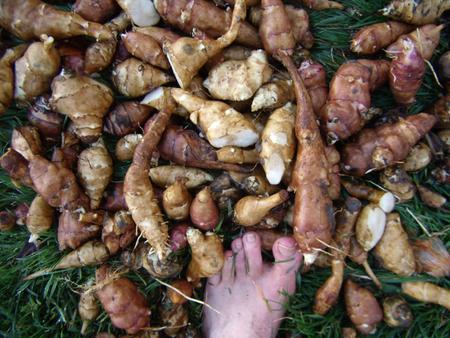
I grow two varieties, both sourced locally from flower gardens and near road sides. The one resembles Stampede or Supernova, white/tan very knobby. The other resembles a Red Fuseau, reddish smooth skin. They look like small red sweet potatoes.
The Stampedes(?) behave nicely. After a long zone 5 winter freeze they have zero to very mild fart production when eaten raw. Harvested in the fall, they do well with a 20+ minute cooking time. The reds ... even after a long winter freeze and cooking for over an hour can still blow your bloomers into the next county.
How my wife and I deal with the red ones and the fall harvested knobbies is, first off, we take a daily supplement of Inulin for gut health so we're tolerant of the Sunchoke Inulin, and we make sure not to serve any reds to visitors. Both are grown on our 1 1/2 in-town lot, so they both have the same soil and sunny growing conditions. The knobby patch is 20 years old, the reds are 15 years old. We like the taste of the reds better than the knobbies, they're nuttier.
There is one item I just found out about; Dextrin. It's also a soluble prebiotic fiber like Inulin. If Inulin and Dextrin are taken together they have a much more pronounced effect on the gut microbiome than either alone, and the Dextrin suppresses the gas production of Inulin according to several articles I found. We're very tolerant of Inulin so we can't experiment on ourselves, but for others it could be worthwhile to mix Dextrin into your Sunchoke recipes or take Dextrin otherwise at the same time and see what the results are. If you eat Sunchokes raw, taking some Dextrin in tea or something else at the same time should work too. Benefiber is one source of Dextrin for example.
 
gardener
Posts: 5826
Location: Cincinnati, Ohio,Price Hill 45205
1460
forest garden trees urban
  • Likes 8
  • Mark post as helpful
  • send pies
    Number of slices to send:
    Optional 'thank-you' note:
  • Quote
  • Report post to moderator
It sounds like processing rather than cultivation and breeding might be the way to go.
Humans use cooking, fermenting and pickling to make many plants nutritious and  platable verse poisonous and disgusting.

Aside from heat, koji seems like the simplest way to turn inulin into something more digestible for humans.
Of course not everyone can tolerate koji based products.
Most of the animals we use as livestock can digest inulin, by a number of different means.
 
pollinator
Posts: 358
Location: Middlebury, Vermont zone 5a
129
forest garden books food preservation fiber arts medical herbs homestead
  • Likes 12
  • Mark post as helpful
  • send pies
    Number of slices to send:
    Optional 'thank-you' note:
  • Quote
  • Report post to moderator
Inulin is really good for us; I don't want things like that messed with.  Nature has a way of knowing better than we do.


Key Health Benefits

• Boosts Gut Health: Acts as a prebiotic that selectively feeds good bacteria like Bifidobacteria and Lactobacilli.
• Improves Digestion: Adds bulk to stool and helps ease constipation when taken regularly.
• Supports Blood Sugar Control: Slows down the digestion of carbohydrates, which helps prevent rapid blood sugar and insulin spikes.
• Aids Satiety and Weight Management: Helps you feel full longer and has a low calorie count.
• Enhances Mineral Absorption: Can improve how well your body absorbs essential minerals like calcium and magnesium
 
steward and tree herder
Posts: 15085
Location: Isle of Skye, Scotland. Nearly 70 inches rain a year
8683
6
transportation dog forest garden foraging trees books food preservation woodworking wood heat rocket stoves ungarbage
  • Likes 8
  • Mark post as helpful
  • send pies
    Number of slices to send:
    Optional 'thank-you' note:
  • Quote
  • Report post to moderator
It sounds like there is already quite a diversity of inulin content in different, so the trick maybe to select those that have a reduced amount, and then plant those in a poor dry spot so as to reduce the inulin further and then harvest later in the season.
Joseph Lofthouse has a diverse range of tubers available seasonally, so if I were in the USA I'd be trying to get hold of some of these and see what suits:

selecting jerusalem artichokes with less inulin for reduced flatulence
a diversity of tubers

source

I think the problem would be in choosing the ones with less inulin in them. If our gut bacteria adapt to eating the tubers over time, we can't just eat them and see which have the worse/better effect! I wonder whether a brix metre may indicate inulin content, or wether there is another easy test one could do at home?
 
gardener
Posts: 2008
Location: Longbranch, WA Mild wet winter dry climate change now hot summer
528
3
goat tiny house rabbit wofati chicken solar
  • Likes 8
  • Mark post as helpful
  • send pies
    Number of slices to send:
    Optional 'thank-you' note:
  • Quote
  • Report post to moderator
My understanding is sunchokes are mostly digested by fermentation. Fermentation that produces lactic acid avoids the gas production.  So the cultivation starts with lactobacillus micro biome. Lacto Fermentation of sunchokes to introduce them into the diet is one way. Lactobacillus rich. Compost my support the availability when eaten raw.
  the more achievable goal then is to cultivate the benefits of the inulin rather the reduction of it.  
 
I agree. Here's the link: https://woodheat.net
reply
    Bookmark Topic Watch Topic
  • New Topic