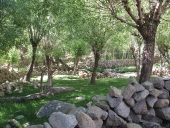
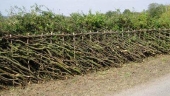
There are scarce resources that I've found about traditional hedgelaying in North America, but this type of hedge is what was used, and likely from what I've heard even originated, in the USA in the Delaware region. Once there was a shortage of wood to make fences from after European settlement, people experimented with different techniques. By the way, a very good example of hedgelaying in action is in one of those historial farm documentaries put out by the BBC, though I can't recall which one or which episode.
I was recently talking to someone involved with trying to document and bring back this type of hedge in Ontario, Canada, and have a few details to share about this type of hedge in Eastern North America.
Species selection: here are some ideas that have a long history of working well:
For hedges intended to keep animals in (or out), and a long history as a primary species in the mix: hawthorn, osage orange. For a stock-proof fence, you'd likely want about 50% of these in the mix, because of their tendency to get thick and dense with thorns.
Others potentially good to keep animals in (or out): seabuckthorn, rose.
Others in the mix: hazels, chestnuts, serviceberries/juneberries, nanking cherry (careful - cherry leaves can apparently make some stock sick or dead from eating damp foliage), apples (especially thornier crabs), plums (again, thorny wilder ones), aronia, red ozier dogwood (might be a bit 'stringy' and leave places for stock to escape). Obviously this list is mostly targeted at species with multiple uses. There are other trees that were traditionally used. Note that with the most of these, you will be able to get crops most years, though likely not as much as if the the trees were allowed to grow to full size.
Worth experimenting with: autumn olive, elderberries, black locust - though I share the excitement about using black locust, I feel like it might be better served in a longer rotation where it is allowed to get larger, to take advantage of it's use as rot-proof posts, or very dense firewood on a 10-15 year coppice system. I would do testing before assuming it would work in this type of hedge, or find someone who has done it.
There are definitely other species appropriate, but I recommend trying to find out if someone else has used them successfully first, since this is a long-term project.
Starting one:
Documentaries often focus on the maintenance, or 'laying' of a hedge, not initial establishment. Here's the very basic technique I've had described to me:
Plant out the hedge with the trees fairly dense. Your first challenge will be protecting the young trees from rabbits, deers etc. I'm planning to use electric fence for this, but others will find different ways to solve that challenge. Unfortunately, I've not found definitive information about plant spacing as of yet, though the link at the bottom has some ideas on this. Maybe others can share their experience on that?
Let the trees grow up for a few years until they are about 4' tall, then do the hedgelaying technique shown in the video above, or other places.
Then let them grow up to about 4' again, and trim them to that annually.
An important note for long term health is every couple of years after that, add a couple of inches to the height you trim to. So, after a couple of years trim to 4'2", then a couple of years later, 4'4".
Don't take any of this as gospel, as I can't find my original notes at this time to confirm all details.
One of the only books I've found on the subject is a British book called Hedges and Hedgelaying by Murray Maclean. I've not read the whole book yet, but it's pretty good. More on the history and reasons why, but there are some technique things too. There are also plenty of websites, some with more info than others. This is one of the best I've found:
https://www.motherearthnews.com/homesteading-and-livestock/sustainable-farming/living-fences-zmaz10onzraw
I'm planning a hedgerow of over 1000', but likely won't start it until next year or the year after. I'll have more to share after that, as I'll have had more conversations with the local researcher who has been working on hedges for years.



.png)


.png)


 2
2