• Post Reply Bookmark Topic Watch Topic
  • New Topic
permaculture forums growies critters building homesteading energy monies kitchen purity ungarbage community wilderness fiber arts art permaculture artisans regional education skip experiences global resources cider press projects digital market permies.com pie forums private forums all forums
this forum made possible by our volunteer staff, including ...
master stewards:
  • paul wheaton
  • Anne Miller
  • Carla Burke
  • Nancy Reading
  • John F Dean
  • Timothy Norton
  • Jay Angler
stewards:
  • r ransom
  • Pearl Sutton
  • Tereza Okava
master gardeners:
  • Christopher Weeks
gardeners:
  • M Ljin
  • Megan Palmer
  • Kate Downham

How are you using your Sunchoke biomass

 
Posts: 7
Location: Kansas City metro 6a
1
  • Likes 9
  • Mark post as helpful
  • send pies
    Number of slices to send:
    Optional 'thank-you' note:
  • Quote
  • Report post to moderator
Currently, the only livestock I have are chickens.  They won't the foliage, or at least, mine won't.  I've had issues with sunchokes spreading when using the biomass as mulch.  I have a pretty big pile drying on a tarp until I figure out what to do.  I already have more of these things than I could ever hope to use.  I'm thinking about burning it and using the ash somewhere on the property.
 
gardener
Posts: 2343
Location: Zone 6b
1598
forest garden fungi books chicken fiber arts ungarbage
  • Likes 12
  • Mark post as helpful
  • send pies
    Number of slices to send:
    Optional 'thank-you' note:
  • Quote
  • Report post to moderator
I steep the leaves in a big can filled with water to brew for a few days. In warm weather the soft tissues break down into a soupy texture. Even the fibrous stalks break down too given longer time and only the cellulose backbones are left which I spread around plants as mulch. I use the liquid diluted as fertilizer.
 
master steward
Posts: 16415
Location: Pacific Wet Coast
10935
duck books chicken cooking food preservation ungarbage
  • Likes 12
  • Mark post as helpful
  • send pies
    Number of slices to send:
    Optional 'thank-you' note:
  • Quote
  • Report post to moderator
In my ecosystem, I just let my sunchoke tops die back to feed the underground portion of the plants. Once dry, they don't regenerate, but they're marginal on my land.

Also the deer eat them.

If I had dried stocks that weren't needed in the compost as extra browns, I'd biochar them as I'd much rather have biochar than ash.
 
master gardener
Posts: 7080
Location: Carlton County, Minnesota, USA: 3b; Dfb; sandy loam; in the woods
4524
8
forest garden trees books chicken food preservation cooking fiber arts seed woodworking homestead ungarbage
  • Likes 14
  • Mark post as helpful
  • send pies
    Number of slices to send:
    Optional 'thank-you' note:
  • Quote
  • Report post to moderator
I leave them standing as winter insect habitat where I don't harvest the tubers. Where I do, I either drop them nearby or toss them on a compost heap.
 
pollinator
Posts: 532
Location: UK
187
kids urban seed
  • Likes 10
  • Mark post as helpful
  • send pies
    Number of slices to send:
    Optional 'thank-you' note:
  • Quote
  • Report post to moderator
Mine end up as a loose mulch around the beds once the ground freezes. They're so hollow and fibrous they take ages to break down without shredding first, but they do eventually disappear. Bit annoying that a few always seem to root from whatever bits land on soil though.
 
Posts: 2
  • Likes 4
  • Mark post as helpful
  • send pies
    Number of slices to send:
    Optional 'thank-you' note:
  • Quote
  • Report post to moderator
I wish I had your troubles with biomass to dispose of. Our voles don't leave enough of the chokes for we himans to get a decent harvest. Any ideas? We live in a busy road so barn cats aren't an option
 
master steward
Posts: 19854
Location: USDA Zone 8a
4981
dog hunting food preservation cooking bee greening the desert
  • Likes 7
  • Mark post as helpful
  • send pies
    Number of slices to send:
    Optional 'thank-you' note:
  • Quote
  • Report post to moderator

Cindy Cain wrote:I wish I had your troubles with biomass to dispose of. Our voles don't leave enough of the chokes for we himans to get a decent harvest. Any ideas? We live in a busy road so barn cats aren't an option


Have you heard of vole proof fencing?

I have also read that voles don't like open spaces where a predator might attack them so make some open space around the sunchokes.

Encourage snakes to visit your yard by furnishing low pan of water and a rock habitat.

Here are some threads that might help:

https://permies.com/t/40/275416/Permie-deal-Voles

https://permies.com/t/65575/Dealing-Voles-Moles

https://permies.com/t/161387/rid-voles
 
pollinator
Posts: 1697
Location: zone 4b, sandy, Continental D
465
  • Likes 12
  • Mark post as helpful
  • send pies
    Number of slices to send:
    Optional 'thank-you' note:
  • Quote
  • Report post to moderator
I try to harvest all of my sunchoke each year, as tubers of the year are more rounded, easier to clean, and since they escaped in my garden, that's going to be quite a chore. I can then sort them, keep the largest/ best ones for us. The damaged ones can go to the chickens or as bait to the deer who absolutely go bananas for them, and hubby still dreams of "bagging the Big One". They made flowers for us this year, but we are expecting our first frost in a week, so I might as well clip them for bouquets: I'll never get seeds out of them, and that will encourage more tuber production, although it's getting late.
I won't do much with the leaves: they can fall and rot wherever they are.
With my brand new machete, the large stalks can be dried out and planted in my hugel to stop the strong winds we can get from the West and North. They will add a lot of height protection. The small ones can be shredded and added as mulch wherever I need mulch which is... everywhere...
Anyway, that's the plan as of 9/29/26.
 
gardener
Posts: 4009
Location: Western Slope Colorado.
1139
5
goat dog food preservation medical herbs solar greening the desert
  • Likes 14
  • Mark post as helpful
  • send pies
    Number of slices to send:
    Optional 'thank-you' note:
  • Quote
  • Report post to moderator
I’m growing sun chokes mixed with sunflowers, comfrey, locust trees and what ever will grow, to promote soil development.  The plants are drying up in my test plot.  For the winter I will leave the dead stalks standing.  My hope is that they will slow the wind, keep the snow from blowing away, which insulates the ground and provides added moisture to the soil.

The birds will eat - are eating the seeds.

I guess there are tubers below ground, but I am having gut issues and it is probably not the best time to introduce a totally new food item which is rumored to irritate the gut in some people.  The tubers are there incase of starvation conditions or maybe I missed the best harvest conditions.  I don’t know much about harvesting them.

Anyway I’m leaving them standing, and if they blow over, I’ll still leave them in place.
 
Cécile Stelzer Johnson
pollinator
Posts: 1697
Location: zone 4b, sandy, Continental D
465
  • Likes 10
  • Mark post as helpful
  • send pies
    Number of slices to send:
    Optional 'thank-you' note:
  • Quote
  • Report post to moderator

Thekla McDaniels wrote:

I guess there are tubers below ground, but I am having gut issues and it is probably not the best time to introduce a totally new food item which is rumored to irritate the gut in some people.  The tubers are there incase of starvation conditions or maybe I missed the best harvest conditions.  I don’t know much about harvesting them.
.


About these "gut issues". It's a pity that you have gut issues with them as these tall plants are very resilient and do produce an enormous amount of food for  practically nothing.
The red ones are quite farty, the white ones not so much.
The culprit is inulin. To lessen its effects:
• Acid boiling: Simmer sliced sunchokes in water mixed with lemon juice or vinegar for about 10 to 15 minutes before roasting or using them in a recipe.
• Fermentation: Pickle the sunchokes first, as the live bacteria consume the gas-producing inulin during the jarring process.
• Smaller portions: Eat small amounts at a time so your digestive system can adjust to the prebiotic fiber. I know that the first time I consume them, I must use only a small amount, then I can increase the dose. Eventually, I can eat a normal portion raw. (It's a bit like mosquito bites: the first ones of the season cause the biggest reaction. afterwards, not so much.)
• Pair with digestive herbs: Serve your dish alongside carminative herbs and spices like ginger, fennel, or peppermint tea
 
gardener
Posts: 5807
Location: Cincinnati, Ohio,Price Hill 45205
1431
forest garden trees urban
  • Likes 15
  • Mark post as helpful
  • send pies
    Number of slices to send:
    Optional 'thank-you' note:
  • Quote
  • Report post to moderator
Mine are dying back right now,so I'm cutting the stalks and stripping off the leaves.
They are sitting in the car right now, getting a little solar drying.
These will be for our two pet bunnies as winter treats.

The leaves and any stalks that are already brown go right into a nearby bed or pathway.
I'm harvesting the roots for my neighbor who is doing a vegetarian farm to table catering gig.
I'm replacing them with pots of raspberry cuttings, though I'm putting a sunchoke and beans in each pot.
 
Posts: 25
Location: Manton, CA
6
4
trees wood heat homestead
  • Likes 12
  • Mark post as helpful
  • send pies
    Number of slices to send:
    Optional 'thank-you' note:
  • Quote
  • Report post to moderator

Cindy Cain wrote:I wish I had your troubles with biomass to dispose of. Our voles don't leave enough of the chokes for we himans to get a decent harvest. Any ideas? We live in a busy road so barn cats aren't an option


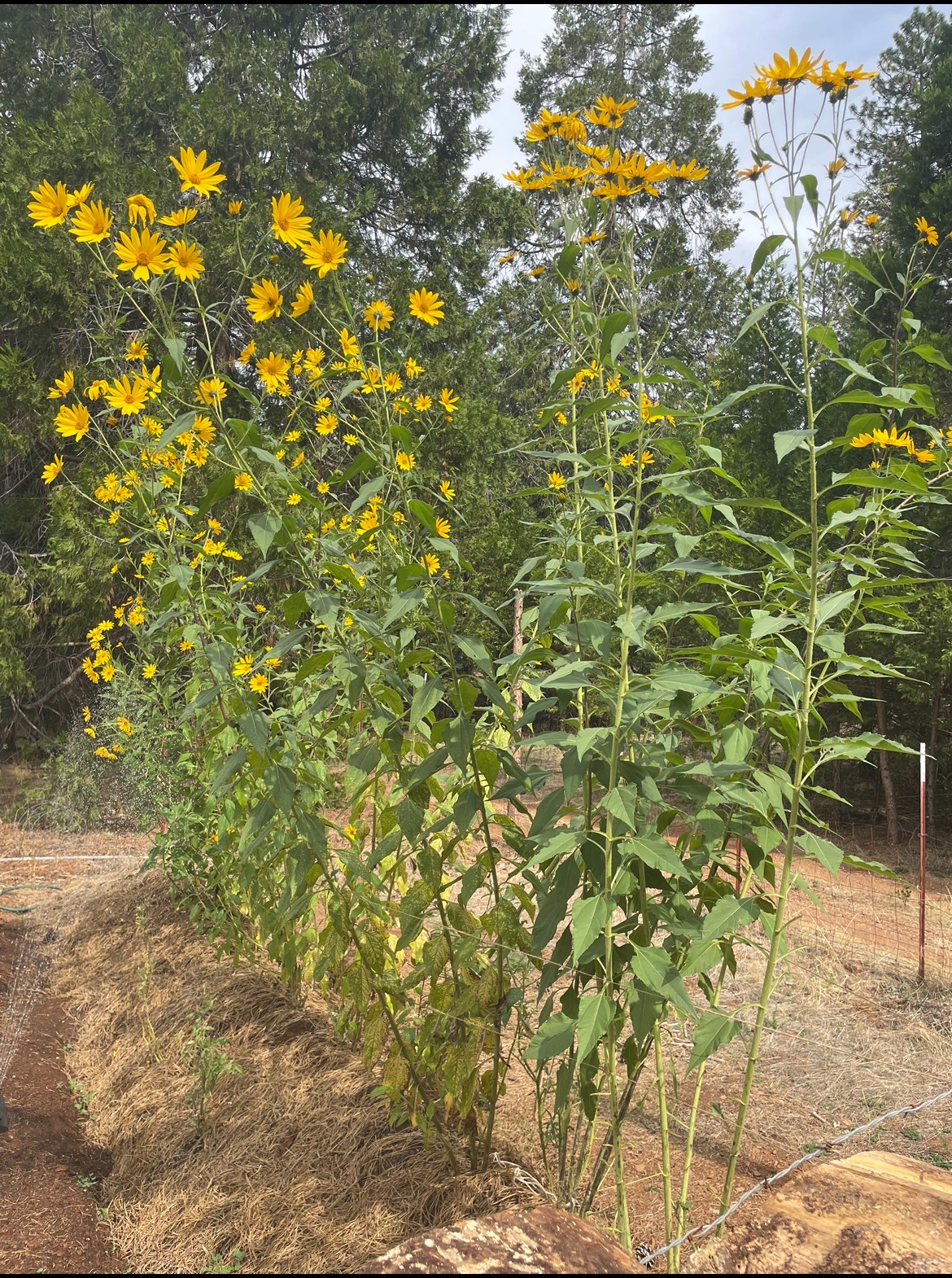
I am still experimenting as this is my first year growing them, but I grew them on top of a hugel mound with a six inch trench around it.  I dug the trench and put them on the hugel to keep the sunchokes from escaping, but the unexpected benefit is  I could see gopher holes in that garden area and see where they went right up to the trench and when they hit daylight in the trench, they turned around.  I'm also hopeful that if they made it across the trench that running into big logs would be a turn off also. Maybe this will work for voles also.

I am going to try to attach a picture but I don't know if it will work, but I think you get the idea from my description.  

my sunchoke picture on my google drive

chokescropped.jpg
[Thumbnail for chokescropped.jpg]
 
Posts: 129
Location: West-central Pennsylvania
69
  • Likes 11
  • Mark post as helpful
  • send pies
    Number of slices to send:
    Optional 'thank-you' note:
  • Quote
  • Report post to moderator
I got a cheap 1 1/2" electric shredder and put the tops through it. I spread the chips over the 'choke patches and they get turned under as I dig. I harvest them like potatoes. I wait until the tops are fully dead and dried so all the nutrients in the tops drain into the tubers making them larger and better tasting.
Use caution adding the tops to garden mulch. They are allelopathic, similar to Walnut trees but not as strong. Some plants aren't affected but some are. My Lambsquarters normally grow to 4' to 5' but in the 'choke patch they stunt to 18". Wild strawberries aren't bothered one bit. Also, beware of spreading seeds and bits of tubers. Mine don't seed, but other varieties do.
I have one patch started on an old shale driveway 20 years ago. Today, the shale is gone and the soil is great. Early on, they got nearly the size of baseballs, today they're the size of my fist and bigger.
I've also got two varieties. One is a white/tan skinned knobby, hard to scrub tuber. The other is a reddish skinned smooth tuber, picture a small red sweet potato. The knobby ones behave themselves. Their fart producing Inulin is broken down into fructose by freezing, fermenting, cooking with an acidic ingredient or cooking for about 1/2 hour. Those red ones though! They make it through our zone 5 winter freeze and an hour of cooking and still can blow your bloomers off! True Fartichokes!
My wife and I take a daily Inulin supplement for gut health, so we tolerate the 'chokes Inulin pretty well. The red ones taste even better than the white ones, we must make sure not to serve them to anyone else.
 
William Bronson
gardener
Posts: 5807
Location: Cincinnati, Ohio,Price Hill 45205
1431
forest garden trees urban
  • Likes 12
  • Mark post as helpful
  • send pies
    Number of slices to send:
    Optional 'thank-you' note:
  • Quote
  • Report post to moderator
I have a tall bed down by the street that was filled with sunchokes, but also has raspberries, an orange tree, and a Siberian pea tree.
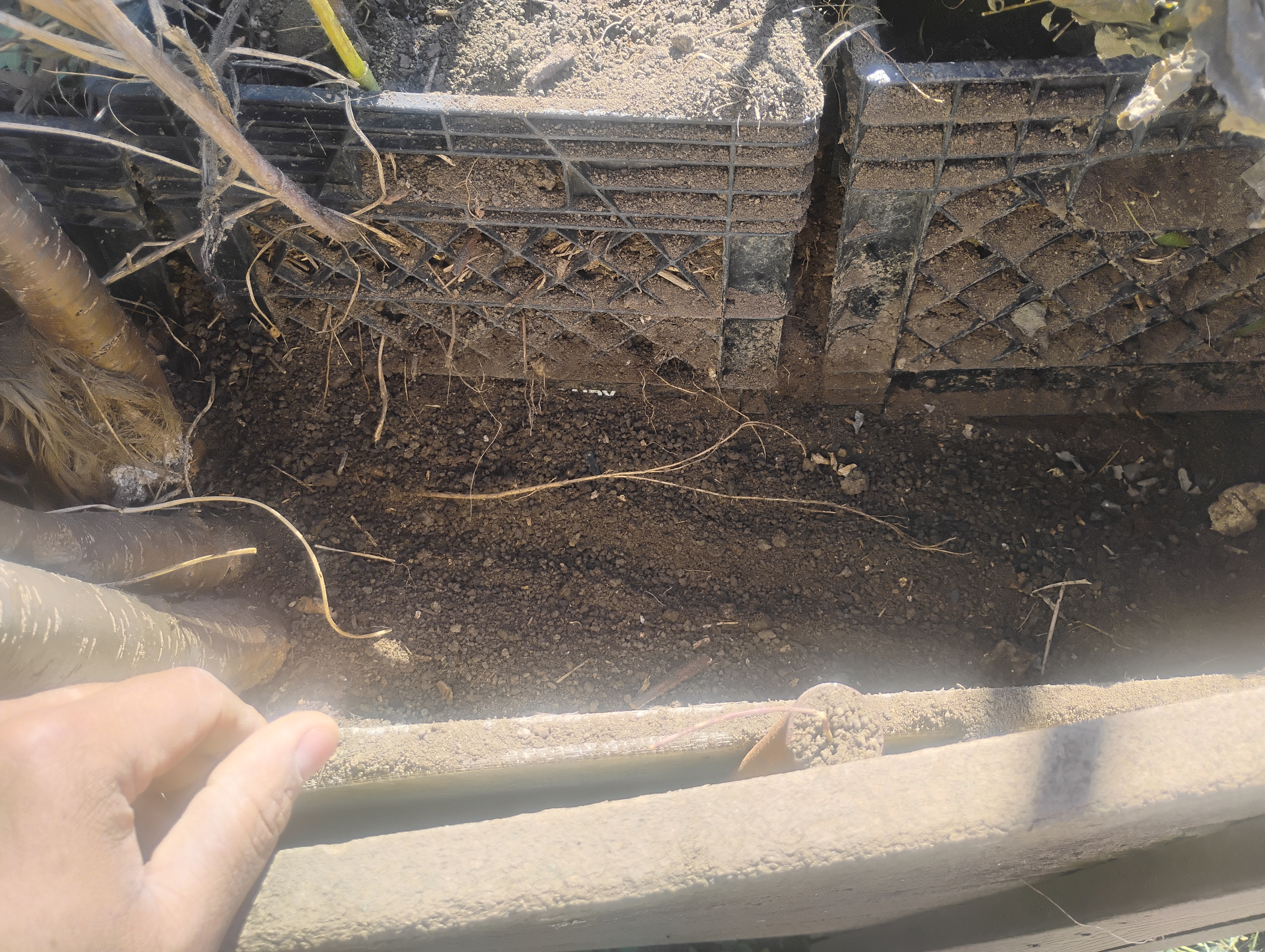
I want more raspberries and fewer sunchokes, so I have gone through the soil a few cubic feet at a time, sifting out the roots
.
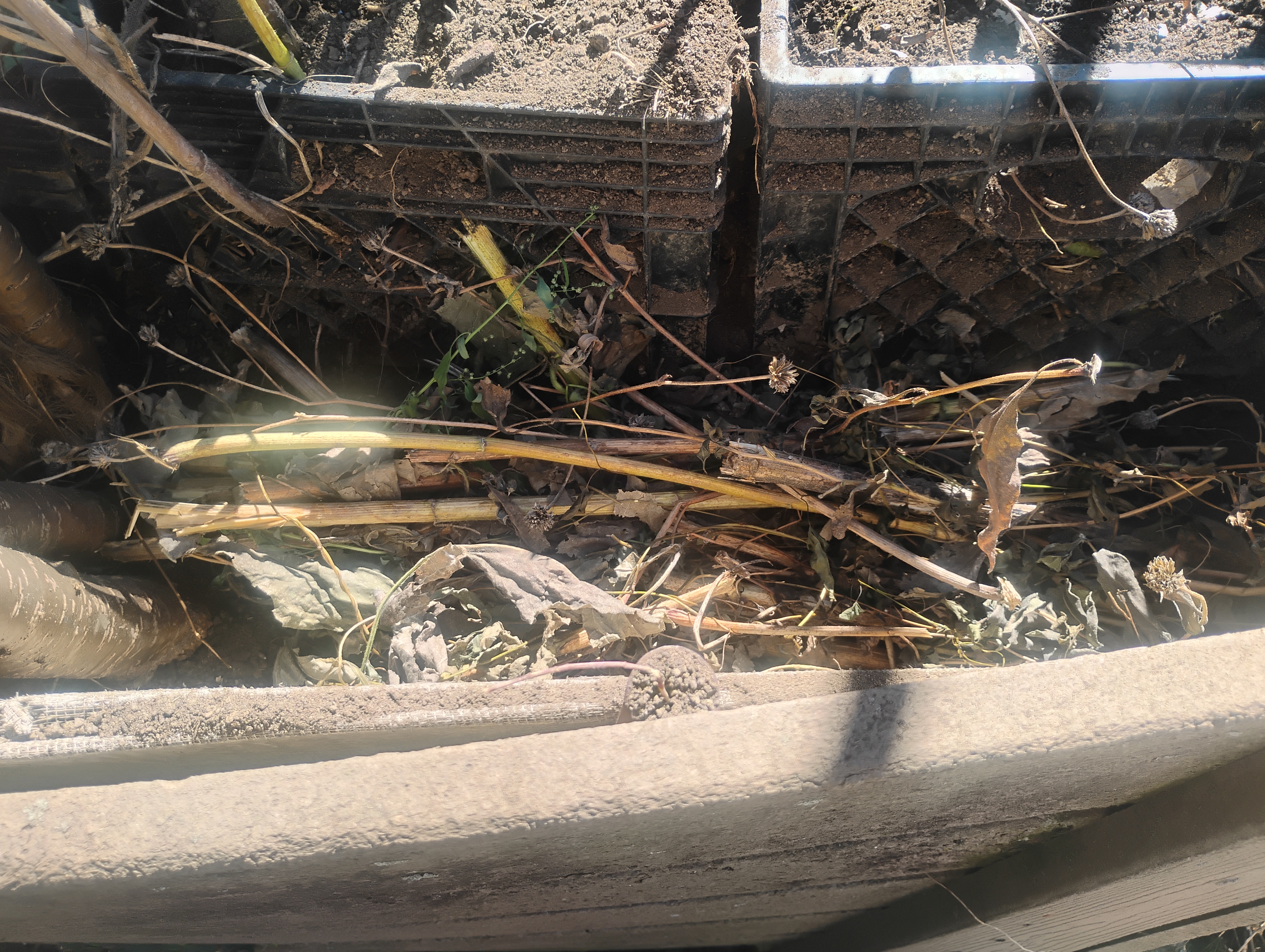
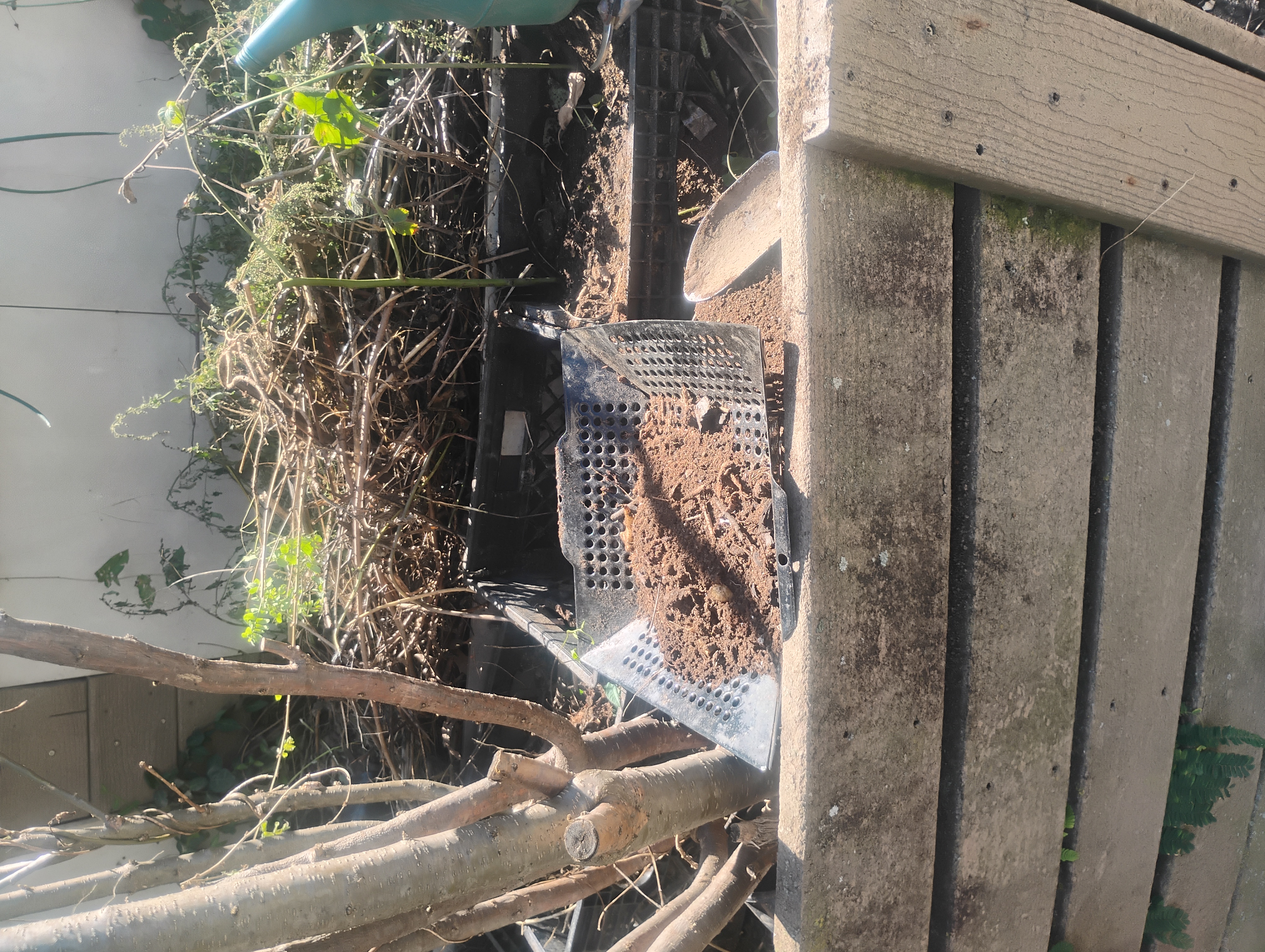
The resulting holes are filled with dead sunchoke stems and topped with the sifted soil.
The bare soil will be completely covered by tree and shrub starts in pots.
Mulch will be added under the pots.
I am trying to create spongy soil filled with organic matter.
Digging out the tubers gave me an opertunity to bury organic matter,  since the soil was distributed anyway.

Most of the pots have at least a  tiny bit of sunchoke root purposefully added to them, some have an entire stem and root system.
I am in part testing the theory that sunchokes produce better when faced with obstacles, like the side of a pot.
I'm also seeing how much root is needed to generate a new plant/tubers.
Raspberries seem not to mind sunchoke allopathy, and the other trees, well we shall see.
IMG_20261003_132113889_HDR.jpg
Where I dug out the tubers
IMG_20261003_132133623_HDR.jpg
Piling the stems in.
IMG_20261003_134627702_HDR.jpg
Covered in sifted soil
 
Posts: 48
Location: Wyoming Zone 3b
4
9
  • Likes 10
  • Mark post as helpful
  • send pies
    Number of slices to send:
    Optional 'thank-you' note:
  • Quote
  • Report post to moderator
All of my sunchoke tops go to the bunnies while still green - they absolutely love them! (Unless the deer get them first.) I grow them for the tops much more than the tubers because they are such good bunny food.
 
pollinator
Posts: 87
Location: Pierce County WA, Northwest and Sound
42
cattle forest garden fungi trees chicken cooking pig medical herbs bee sheep wood heat
  • Likes 10
  • Mark post as helpful
  • send pies
    Number of slices to send:
    Optional 'thank-you' note:
  • Quote
  • Report post to moderator

Cindy Cain wrote:I wish I had your troubles with biomass to dispose of. Our voles don't leave enough of the chokes for we himans to get a decent harvest. Any ideas? We live in a busy road so barn cats aren't an option


 Currently, I plant horseradish, daikons, and garlic around the tubers to protect them from voles, moles, and rabbits.  Herb green cover cropping over the top helps some potent cilantro, peppermints, seem to do the trick.  It’s only my second year with chokes, but I’m going to try Oscar’s Hugel mound, (maybe linearly) chokes idea as a perimeter for the greater garden.  Every time, amazing and truly creative folks all, thank you.  Cheers.
 
Blaine Clark
Posts: 129
Location: West-central Pennsylvania
69
  • Likes 8
  • Mark post as helpful
  • send pies
    Number of slices to send:
    Optional 'thank-you' note:
  • Quote
  • Report post to moderator

Kelly Ravner wrote:All of my sunchoke tops go to the bunnies while still green - they absolutely love them! (Unless the deer get them first.) I grow them for the tops much more than the tubers because they are such good bunny food.


Dry Matter Basis: Protein content ranges from 5% to 23%, with an average of 15.3% in fresh aerial biomass.
Quality: The protein contains essential amino acids and a high proportion of polyunsaturated fatty acids (PUFAs), making it comparable to alfalfa.

Dry Matter Basis: Crude fiber and neutral detergent fiber (NDF) vary by harvest time, with NDF ranging between 30% and 50%.
Variability: Fiber content increases significantly as the plant matures; crude fiber can rise from 48.4% to 67.7% from the early bud stage to complete flowering.

Protein content is highest during the vegetative stage and decreases by approximately 33% during the flowering stage, while fiber content increases. Consequently, earlier harvesting maximizes the protein-to-fiber ratio for nutritional or feed purposes.

 
Thekla McDaniels
gardener
Posts: 4009
Location: Western Slope Colorado.
1139
5
goat dog food preservation medical herbs solar greening the desert
  • Likes 14
  • Mark post as helpful
  • send pies
    Number of slices to send:
    Optional 'thank-you' note:
  • Quote
  • Report post to moderator
Wow!  With that nutritional analysis info, I am wondering if I should plant this year’s tubers in a region of the goat pasture.  I already try to have alfalfa, chicory, comfrey, maximillian sunflower, dock, bindweed etc etc etc. If I have the pasture growing more food than they can eat, favorite plants don’t seem to get over grazed.

I like them being able to choose their feed, “what they feel like eating right now.”
 
William Bronson
gardener
Posts: 5807
Location: Cincinnati, Ohio,Price Hill 45205
1431
forest garden trees urban
  • Likes 7
  • Mark post as helpful
  • send pies
    Number of slices to send:
    Optional 'thank-you' note:
  • Quote
  • Report post to moderator
Maybe plant them in a cage?
That way it can establish and grow out , but the goats can trim it back.


Kelly, how do the tuber fare, when the greens are harvested a lot?
Are they puny, or are their just fewer of them?
Do you ever feed the bunnies the tubers?
Have you fed them dried stalks or leaves?
I tried growing them in pots right in front of the porch, specifically as treats for the bunnies, but they struggled.
I haven't checked the yields yet but above ground, they were sad looking, I'm not sure why.


I gave a lot of my sifted out tubers to my friend, who was catering a farm to table event, but I have sooo many.
I'm going roast some, but I'm also trying  other things.

I put a bunch of the teeny ones and the white thready roots in a cat litter bucket with a black lid , layered with some sifted soil.
I watered it in and let it drain, and sometime this winter I'll bring it inside.
I'm hoping the sunchokes will sprout and grow blanched sprouts.
I've done this before with mixed success, too much medium in the bucket.
Now that I think of it, mold is real possibility, so any ideas to curtail that are welcome.
Garlic cloves maybe?
Would sand be better than soil?
I might dump this out and start over...

For the bigger , nicer bulbs , I plan on stashing them in containers filled with sawdust, soil, or sand, and leaving them outside until I'm ready to eat them.
I'm thinking of using smaller containers, for a dinner sized portion,maybe two 2 liter bottles, ends cut off and shoved together.

The other thing I was considering was fermenting them.
Not so much for me, but as a form of sillage for the chickens.
We shall see.

Back on the green biomass, it could also be silaged.
I've dried it before, but the leaves to not hold their shape for me, they powder in way the bunnies can't eat.
By stripping them and silaging them, you could store more fodder for the winter.
If you are drying a lot of leaves like this, you could pelletize them with a relatively simple machine , the Von Bachmayr drum.
It's a seed ballet, but it might work to make pellets.
Probably not worth the trouble.
 
Kelly Ravner
Posts: 48
Location: Wyoming Zone 3b
4
9
  • Likes 8
  • Mark post as helpful
  • send pies
    Number of slices to send:
    Optional 'thank-you' note:
  • Quote
  • Report post to moderator

William Bronson wrote:
Kelly, how do the tuber fare, when the greens are harvested a lot?
Are they puny, or are their just fewer of them?
Do you ever feed the bunnies the tubers?
Have you fed them dried stalks or leaves?
I tried growing them in pots right in front of the porch, specifically as treats for the bunnies, but they struggled.
I haven't checked the yields yet but above ground, they were sad looking, I'm not sure why.


I live in quite a cold climate, with frost possible any time of year. I have never, under any circumstances, gotten a sunchoke to blossom. I have gotten a few to grow about 6 feet high before they froze. I've tried them in every microclimate on my property and they definitely prefer very protected, south facing spots with very nutrient rich soil (bunny poop for the win!) But even the plants that grow the best produce very little in the way of tubers - I think it's just a little too cold here for them to thrive that way. The plants that I cut early seem to spread out sideways and produce even better greens, with multiple tiny tubers. The plants that grow tall all summer produce a single very thick, tough stalk that the bunnies still eat, but they definitely prefer the more tender leaves.

I have never fed the tubers to the buns, as sunchokes notoriously produce a lot of gas - at least in humans - and rabbits are rather famous for dying from gas, so it wasn't worth trying. I have never fed dried stalks or leaves - in the fall here they freeze, then wilt and rot. And if I'm cutting them, I'm just feeding them to the buns right away - I don't want to go to the trouble of drying and storing. The nutritional analysis posted above re: dried vs fresh was very interesting though.

 
pioneer
Posts: 556
158
cat trees urban
  • Likes 13
  • Mark post as helpful
  • send pies
    Number of slices to send:
    Optional 'thank-you' note:
  • Quote
  • Report post to moderator
Ooo. I can start planning on eating my sunchokes in the late winter again.  Last December, after strong antibiotics in August, I was diagnosed with IBS.  Turns out I am now sensitive to fructans. Inulin is a type of fructans.  But! The NHS Dietetic service have helped me make great strides in healing my gut, repopulating my microbiome, and learning a different diet balance to manage my IBS quite effectively.

Meanwhile, I left the sunchokes alone through the entire year, to do as they would with the hot drought.  They've put on a lot less growth than usual, barely half.

The only time my sunchokes, Fuseau type, have ever flowered for me was in two hotter summers with good rainfall.  They grew to well over 2 m / 8 ft tall too.

So reading what you've variously written:

I will get help to dig over the entire sunchoke patch in January.

I'll put some of the stems into the compost & leave the rest to mulch the patch until Spring.

I'll try fermenting some of the tubers, as I'm doing very well with my grain sourdough to "pre-digest" the grain fructans.

I'd already learned that I love acid parboiled roasted sunchokes pre-IBS, so fingers crossed!
 
Blaine Clark
Posts: 129
Location: West-central Pennsylvania
69
  • Likes 8
  • Mark post as helpful
  • send pies
    Number of slices to send:
    Optional 'thank-you' note:
  • Quote
  • Report post to moderator
Ac, take care with that IBS. Start back up really low and slow. One bite to start. Wait several hours then another if there isn't too much reaction.

Kelly, zone 3 is the max range for 'chokes. A guy I knew in upper Canada had to cover his every fall with over a foot of straw mulch for his zone 2 area and most tubers overwintered OK. One thing to consider is tracking down a short maturation term variety. The white/tan knobby ones I have are fairly short term, around 135 to 140 days if I remember. The reddish ones are about 155 days. My white ones are pretty nearly all dead and fully brown but the reddish ones are still blooming. We had hard frost the last two nights and the flowers are starting to wilt today. Some online suppliers show the maturation term of what they sell and I think there are varieties that mature in around 120 days. Might be what you're looking for.
I've heard several say that deadheading before the flowers open makes more and better tubers, well, I've trimmed the flowers as soon as they opened to make wine off of half of one patch. There was no difference in tuber growth or quality between the trimmed half and the untrimmed half. There could easily be a difference between varieties ... so ... Note; the flowers from the white/tan ones taste like squash after they're boiled, but the reddish one smell musty and taste musty. Years and years ago I gave a family in a nearby town a sample of the 12' tall with obnoxiously strong turnip/herbal tubers. They weren't interested in the tubers, they wanted the massive tops for their bunnies. Don't know about that cutting affecting tuber production, but the area has stalks as thick as bunny fur! It'd be difficult for a bunny to run through the patch! The stalks get well over 1", up to nearly 1 1/2".

William, I've thought about bagging them with lightly moistened sawdust overwinter but haven't tried it yet. Let us know how you make out.
 
Posts: 30
Location: Zone 4b Northwest Wisconsin
10
dog fungi foraging trees bike woodworking
  • Likes 10
  • Mark post as helpful
  • send pies
    Number of slices to send:
    Optional 'thank-you' note:
  • Quote
  • Report post to moderator
The ones in the ground I will let be wildlife habitat over winter. I will save any viable seedheads from the Joseph Lofthouse ones I received this year. They are spectacular!

The potted one in my urban driveway will be harvested, fridged and eaten over winter. The leftover biomass will be chopped and dropped around various things.

I think the right amount of farting is pretty good if it doesn't feel bad.

 
Thekla McDaniels
gardener
Posts: 4009
Location: Western Slope Colorado.
1139
5
goat dog food preservation medical herbs solar greening the desert
  • Likes 10
  • Mark post as helpful
  • send pies
    Number of slices to send:
    Optional 'thank-you' note:
  • Quote
  • Report post to moderator
About encouraging bigger tubers by removing the flowers, I think to truly test if that is true, a person would need to remove all buds at earliest recognition.  By the time a flower opens, the plant has invested a LOT of energy into it.

If the tubers were big enough and plentiful enough, no reason not to make wine too.

If the number and size are on the puny side, removing the buds before they form is like removing garlic scapes to get bigger bulbs.

 
William Bronson
gardener
Posts: 5807
Location: Cincinnati, Ohio,Price Hill 45205
1431
forest garden trees urban
  • Likes 10
  • Mark post as helpful
  • send pies
    Number of slices to send:
    Optional 'thank-you' note:
  • Quote
  • Report post to moderator
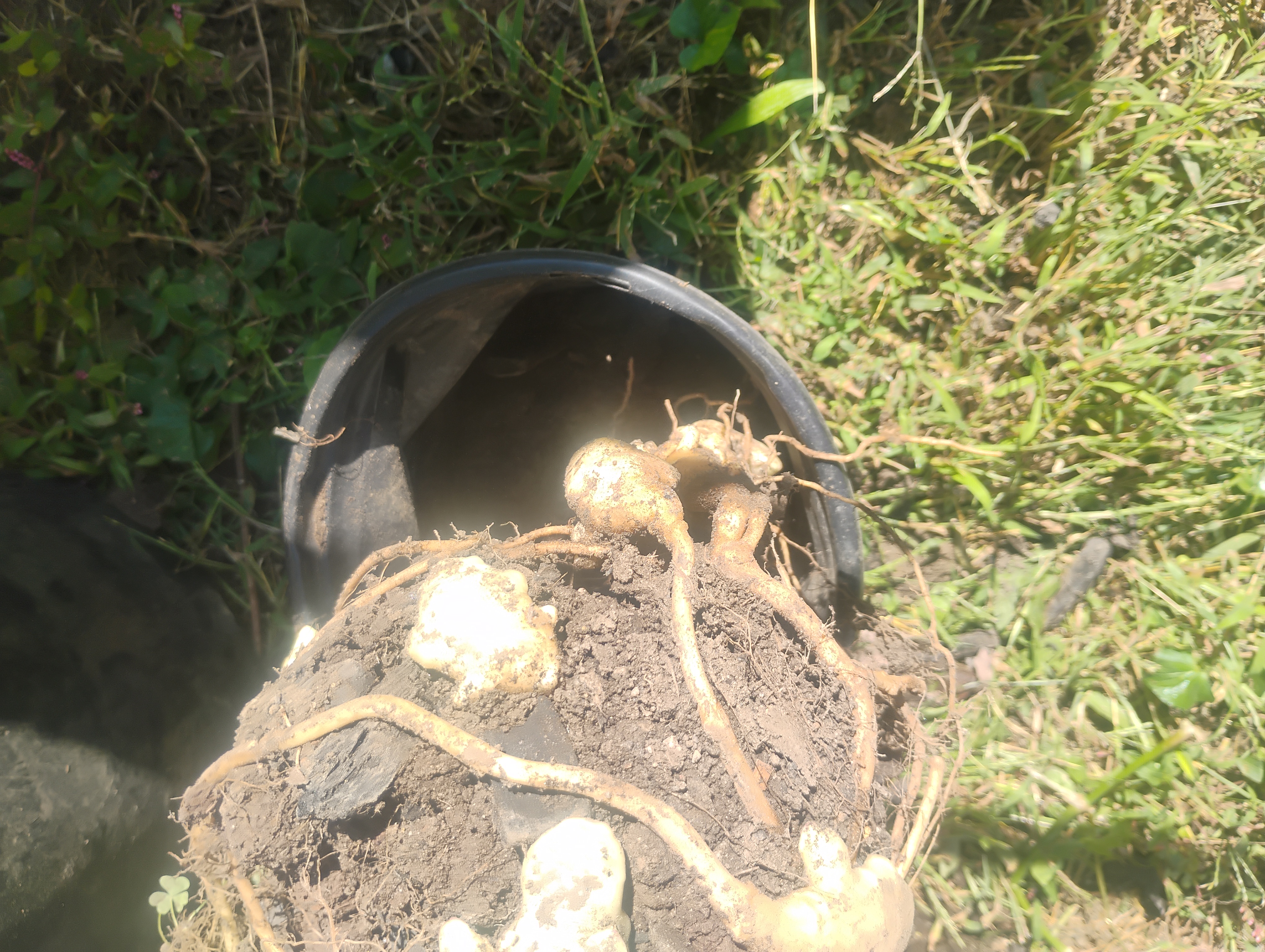
I was checking on things at another site and found a pot of sunchokes.
I had apparently chopped off the stalk a while ago, maybe it was looking dead?
Anyhow, it made a bunch of tubers in a small pot, even without going a full season, so I'm very hopeful for the ones I'm.strting in pots now.

I also checked on my raised bed of nothing but sunchokes, and harvested the green stalks, feeding the brown stalks, bare roots and any leaves back into the bed.
The above ground growth was tall, but sparse.
I have harvested from this bed already this year, but I expected it to send up more sprouts
Instead, the remaining ones just got thicker and taller.
IMG_20261007_142135645_HDR.jpg
Pot full of chokes
Pot full of chokes
IMG_20261007_154159391_HDR.jpg
Nothing but chokes
Nothing but chokes
 
One blast from the ray gun turned half a town into a guy named ray. Just like this tiny ad:
the next generation of humanure
https://www.richsoil.com/willow
reply
    Bookmark Topic Watch Topic
  • New Topic