

|

|
|
|
|

|

|

|

|

|
 10
10




 1
1
Proudly presenting RocketMassHeaters.com
A good starting point to all RMH research
How Permies.com works

 2
2
Leonardo Bevilacqua wrote: is it worth spending extra money for better quality firebricks, or would basic hard firebricks be equally good for the job?
How permies.com works
What is a Mother Tree ?


 3
6
3
6
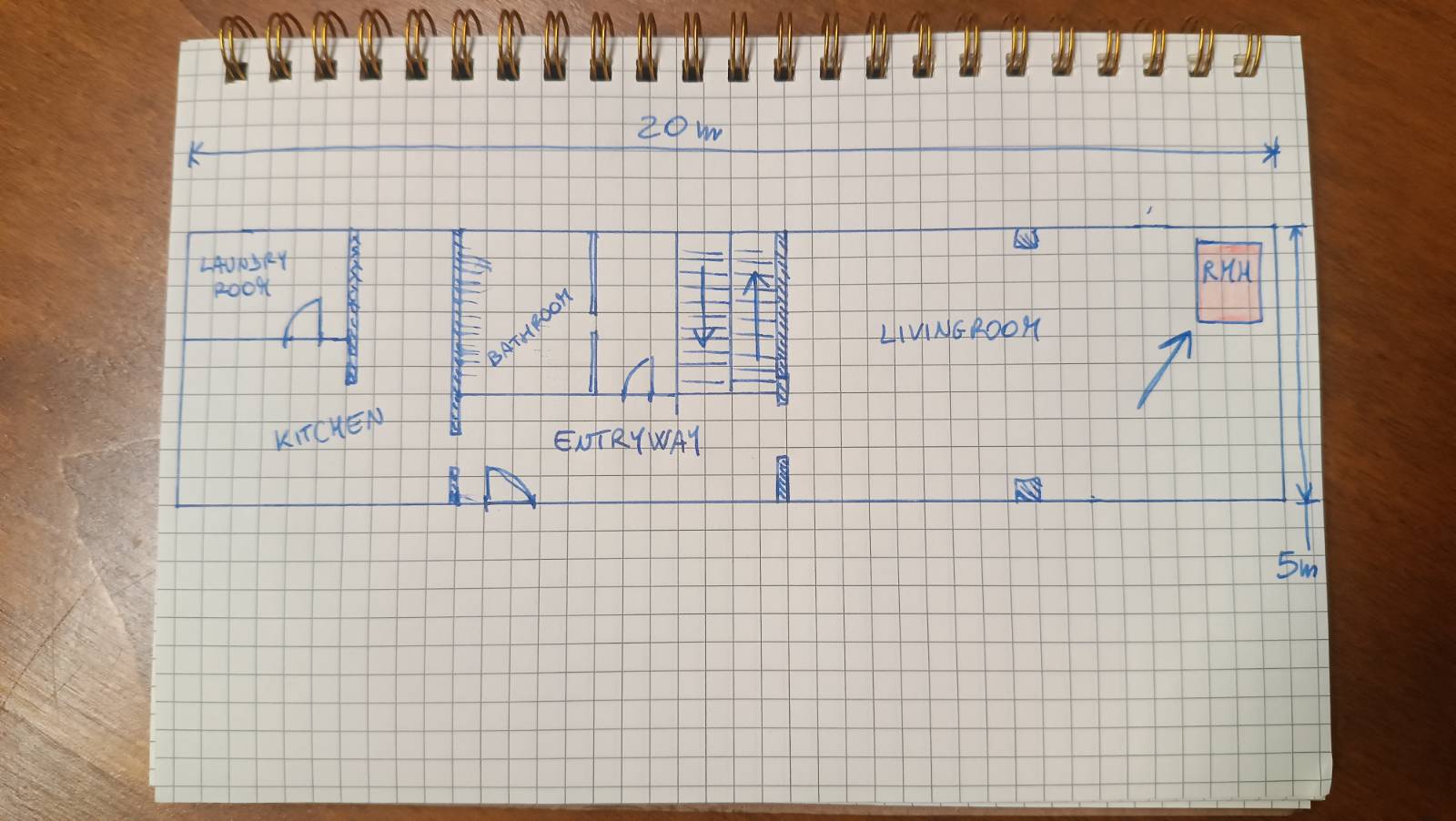
Leonardo Bevilacqua wrote: Hello everyone, this is Leonardo from North Italy.
Leonardo Bevilacqua wrote:
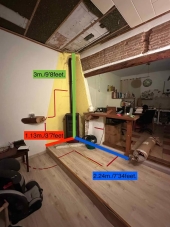
For the bell I thought about a stratification chamber made of concrete clinkers lined with firebricks in the upper part. I also thought of a double layered bell so that it would retain the heat longer.
Leonardo Bevilacqua wrote:
Does this project sound good to you all? Is there anything that I'm not considering, or considering wrong? Do you think I could go on calculating and drawing a detailed design? Would such a heater heat the two rooms? Would it somehow heat a bit also the second floor?
![[Thumbnail for Screenshot_20260109-195203-2.png]](/t/367080/a/281752/Screenshot_20260109-195203-2.png "Filename: Screenshot_20260109-195203-2.png
Description:") 8
8
regards, Peter
5
7
Leonardo Bevilacqua wrote:I get the point of not exceeding the ISA determined by the size of the core. But, are there any other proportions that need to be respected for the bell? What about the relation between the size/placement of the core and the size/shape of the bell?
Leonardo Bevilacqua wrote:Would it work if I make a bell which is long an tall but wide just enough to fit a core inside? Or should there be a minimum space between the core and the bell?
regards, Peter
6
Peter van den Berg wrote:
The bell could be deep and tall, no problem. Down to just wide enough to house the core, although in that case there should be at least a space at the back. Size of that space: at the bare minimum, 5 times the cross section area of the stove pipe, more being better. That space is there to lead the gases down to the bell exhaust.
![[Thumbnail for PXL_20260113_221507701-3.jpg]](/t/367080/a/281987/PXL_20260113_221507701-3.jpg "Filename: PXL_20260113_221507701-3.jpg
Description:")
![[Thumbnail for PXL_20260113_221419311-2.jpg]](/t/367080/a/281988/PXL_20260113_221419311-2.jpg "Filename: PXL_20260113_221419311-2.jpg
Description:") 8
6
12
8
6
12
Julian Adam wrote:
Peter, I have been thinking about your requirement to have the section around the core where the gases pass at least 5 times riser CSA. You gave me the advice last year not to count narrow slits. Since then, I've discovered the 'hydraulic diameter', which I believe, covers the load better, when we are talking about friction through a section. Are you aware of this? If so, what is the reason you chose not to use it?
regards, Peter
9
Peter van den Berg wrote:
Bar one example from an entirely other source, a chimney sweep, in fact. He used a simple formula to calculate what a rectangular chimney cross section would be when compared to a circular one. This goes as follows: twice the width multiplied by the depth of the rectangle, devided by width plus depth will give the comparable diameter. This would look like this: 2xWxD : (W+D) = comparable diameter.

Peter van den Berg wrote:
To keep it simple enough for the ordinary layman, I recommend at least 5 times cross section area of the chimney pipe. Without taking a lot of small slits into account, and the more space the better.
Peter van den Berg wrote:
My original take on this was derived from the work of Heikki Hyytiäinen. His Finnish contraflow worked with two 70 mm wide slits, each slightly larger than the chimney csa. One could say, roughly 2.25 times the masonry chimney csa in total. Later on, I realised this could lead to far too much friction or even a non-functional bell-type heater, so I switched to 5 times, just to be sure.
![[Thumbnail for Hydraulic-Diameter-non-circular-tubes.png]](/t/367080/a/282266/Hydraulic-Diameter-non-circular-tubes.png "Filename: Hydraulic-Diameter-non-circular-tubes.png
Description:") 7
7

 9
9
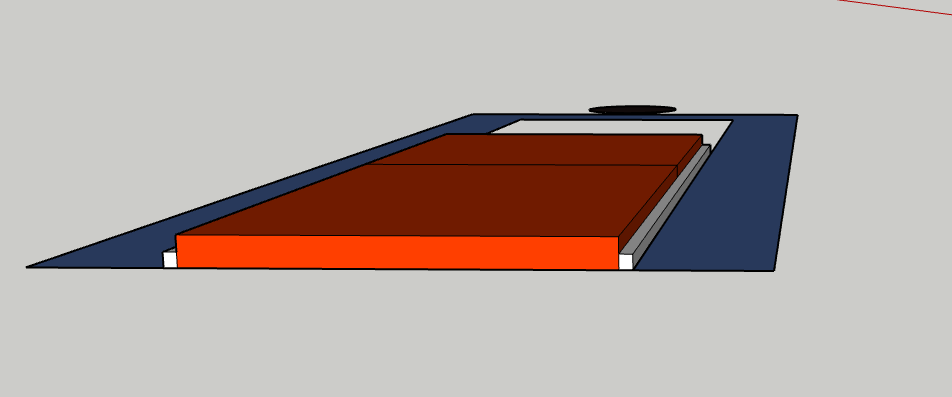
Leonardo Bevilacqua wrote:Thank you all for your thoughts. I finally had time to work on a first draft of the project.
I attach a few pictures of what I came up with.
I also attach a not very detailed sketchup project. The measurements are correct, but I didn't put in a lot of details.
I tried to make the bell as slim as possible, due to space costraints. Tell me if it could work like this.
Leonardo Bevilacqua wrote:To you, Peter, I calculated the area behind the core and, if I'm not mistaken, it is well above 5 times the CSA.
Leonardo Bevilacqua wrote:As I was drawing I came up with a couple of questions:
1) Is it ok if both the long sides of the core touch the bell? There would be 12mm superwool in between.
Leonardo Bevilacqua wrote:2) How can I design the exhaust port at the bottom of the bell? How do you determine shape and size?
Leonardo Bevilacqua wrote:3) How high should the bypass pipe be installed on the bell?
Leonardo Bevilacqua wrote:4) Any thoughts on cleanout ports location?
regards, Peter
6
Peter van den Berg wrote:
It would work, but I am not overly fond of this. To me, there might be a better solution.
[...]
Leonardo Bevilacqua wrote:1) Is it ok if both the long sides of the core touch the bell? There would be 12mm superwool in between.
Could be done, although there are compromises in there, flow-wise.
What you have drawn is in the right direction, starting low at floor level and quite wide. This construction makes it possible to sweep the chimney from the roof without dismantling anything. Is the roof accessible?
Leonardo Bevilacqua wrote:3) How high should the bypass pipe be installed on the bell?
You've drawn it very high, could be lower. Say, something like 30 cm from the top.
Now for something different. It seems to me that the front of the heater, where the door is, is facing the wrong direction. Built like this, you won't be able to sit by the fire with friends and family and see what is happening. With that in mind, please give the following a thought.
Instead of a straight core, you could build a right-handed sidewinder. The firebox door would be in the wide front of the heater then, facing directly into the rest of the room. Roughly calculated, that would mean the heater's front is protuding 14 cm more into the room. The bell will be obviously less wide, although not overly so. The whole of the thing will be more in proportion, no flow compromises.
8
Cristobal Cristo wrote:
I would get at least 40% Al2O3 bricks, the higher the better. Wood ash is fluxing the bricks lowering their melting temperature and high alumina is countering it. Because of that wood is a fuel that demands more from the material.
For the riser insulating firebricks IFB 26 (1400 C rating, but 1300 C will also do it).
10
Leonardo Bevilacqua wrote:
I made a little research to see what's available in Italy. there are plenty of choices for firebricks. And Alumina is only one of the specifics for firebricks. Which ones should I get?
And then, is there a difference between firebricks and IFB? Should I use firebricks for the main part of the core and IFB for the riser? I'm a little confused.
Leonardo Bevilacqua wrote:
The second question would be: how to I calculate how many brick I would need for the core (and the bell)? For firebricks the standard size here is 220x110x60mm. For clinkers I believe it is 240x120x60mm.
6
Peter van den Berg wrote:Could be done, although there are compromises in there, flow-wise.
Leonardo Bevilacqua wrote:Could you please expand more this point? Could you tell me what the compromises would be, or why you don't like my solution very much?
Leonardo Bevilacqua wrote:So, just to understand, do you think we would have problems with my design? If so, I would build a sidewinder, as you suggested.
Leonardo Bevilacqua wrote:I just calculated roughly the measurements of the opening, trying to come up with a rectangular opening that had the same hydraulic diameter as the exhaust pipe. Is that right?
Leonardo Bevilacqua wrote:You mean 30cm from the top of the bell to the center of the pipe, or to the top of the pipe?
Leonardo Bevilacqua wrote:When you talk about a "right-handed sidewinder" you mean one that has the riser on the right of the core?
regards, Peter
7
6
Leonardo Bevilacqua wrote:Where can I find the formulas to calculate the dimensions of the sidewinder core?
Leonardo Bevilacqua wrote:It would be very nice to have a place where anyone can find tables, and perhaps spreadsheets, with all the dimensions for the different types of core.
regards, Peter
8
Peter van den Berg wrote: But here are the numbers for the calculation, all mentioned numbers are internal. ....
At the moment, there isn't a central place where the figures of a Shorty core are summed up, yet.
7
Leonardo Bevilacqua wrote:Then, another set of questions. What about the door?
Leonardo Bevilacqua wrote:How do I calculate the square pipe section needed, and the cuts that need to be made, and their position?
Leonardo Bevilacqua wrote:Also, which kind of glass is needed?
regards, Peter
4
4
Peter van den Berg wrote:
Leonardo Bevilacqua wrote:Where can I find the formulas to calculate the dimensions of the sidewinder core?
At the moment, there isn't a central place where the figures of a Shorty core are summed up, yet. By the way, the numbers for the sidewinder version aren't any different. I don't know which sketchup file you used for upscaling, so I am unable to check whether it is correct.
But here are the numbers for the calculation, all mentioned numbers are internal.
Start with the base figure, written down as B. This is 72.34% of the diameter of the chimney pipe, equal to system size.
Width of the firebox: 2B.
Height of the firebox: 3B.
Depth of the firebox: 4B, upto 5B.
Height of the port: 2.1B.
Width of the port: 0.5B.
Position of the port in a sidewinder: centered in the port 1B from the rear wall, left or right.
Width and depth of the riser: 2B.
Heigth of the riser: 5B upto 5.5B.
Liner in the bottom half of the riser: left and right equal, seen from the port, double that thickness at the port side.
Height of the liner: 2.4B, also crossing over the port.
Resulting floor of the riser: square, each side equal to system size.
Exhaust opening of the riser: in the same wall as the port, width 2B, total square mm of the opening 100% of the chimney pipe's csa.
Heigth of the opening: follows from the calculation of the sentence above.
Piece of wall above the exhaust opening: same height as the opening.
See https://batchrocket.eu/ontwerpen#shorty
6
regards, Peter
7
Peter van den Berg wrote:
Leonardo Bevilacqua wrote:Then, another set of questions. What about the door?
The doors that I made myself in the past 40-odd years are all of the T-profile type.
Leonardo Bevilacqua wrote:How do I calculate the square pipe section needed, and the cuts that need to be made, and their position?
Use the link at the end my last post, all that you'll need is there. The text is in Dutch, admittedly, have it translated into English or Italian by Google Translate. I do that all the time with text that's in a language I don't understand. Links to the SketchUp drawings are there also, that's a standard 150 mm system. You have to start studying yourself, can't be helped.
Leonardo Bevilacqua wrote:Also, which kind of glass is needed?
Good quality heat-resistant glass. There are two brands in existence, Robax by Schott and Neoceram by Nippon Electric Glass. Both are suitable and pricey.
9
Leonardo Bevilacqua wrote:I have a question though. I was examining your sketchup model of the door. In your model you built the airframe with a 60x60x3 mm square pipe, which has an internal section of 54x54mm which is 2916 mm2. If I follow the instruction on the page you sent, this section should be 15% of the chimney pipe section. The chimney pipe section for a 150mm system is 17671,5 mm2, and it's 15% would be 2650mm2, not 2916 mm2. I don't understand why measurements don't match. What am I getting wrong? This is only one example, but also the main slot opening doesn't match the requirements. Am I calculating something wrong? Or, should I just use your model, scale it up 1.2 times to match my 180mm system, and copy your measurements?
regards, Peter
7
Peter van den Berg wrote:If you are aiming for 15% of the chimney's cross section area, that would mean there aren't any square or rectangular tubing that are exactly that size. So, what you should do is searching for a size that is close to what you want, preferably a little bit larger, not smaller.
As you may be aware of, the air supply is only just large enough, it isn't the limiting factor during the burn, the internal proportions of the core are. During development I had the air inlet on anything between 30% and 45%, it turns out the 30% figure is enough and not too skimpy.
The measurements are what to aim for, the model is the result of the aim.
4
3
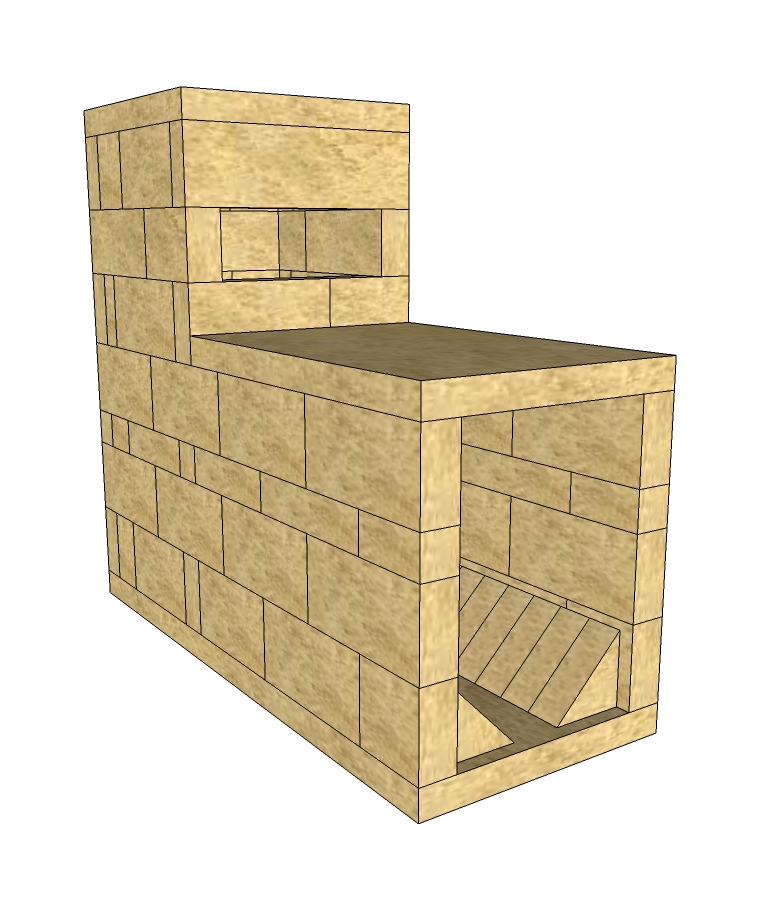
Leonardo Bevilacqua wrote:As I was "building" the stove in Sketchup I noticed something. My firebrick size is 220x110x60 mm, and it looks to me that it doesn't fit very well for the 180mm system measurements. I fear it would mean many cuts during the build. Am I right?
Leonardo Bevilacqua wrote:In the back of my mind I remember reading something about tweaking the measurements to fit better with the brick size one has at hand. I guess it would involve tweaking the base number B in Peter's formulas. Could you help me doing that? Or, is it better if I just stick to the standard measurements for a 180mm system?
Leonardo Bevilacqua wrote:Another question. I understand the strong recommendation to stick faithfully to Peter's proportions in order to have a good result. At the same time, though, I'm sure there's a tolerance within which no big difference can be noticed it the end result (performance wise) but may make the build easier. What tolerance would you say I have with the measurements? I guess it would be in the range of a couple millimeters.
regards, Peter
4
![[Thumbnail for shorty-core-180-Salone-prova-1.png]](/t/367080/a/295489/shorty-core-180-Salone-prova-1.png "Filename: shorty-core-180-Salone-prova-1.png
Description:") 4
4
regards, Peter

|
We can fix it! We just need some baling wire, some WD-40, a bit of duct tape and this tiny ad:
Come Visit Wheaton Labs!
https://permies.com/wiki/367505/Visit-Wheaton-Labs
|






![[Download RMH-Shorty-Salone-01.skp]](https://permies.com/templates/default/betaview/images/download-attachment.gif)